JohnTo
-
Posts
290 -
Joined
-
Last visited
-
Days Won
1
Content Type
Profiles
Forums
Events
Store
Downloads
Gallery
Everything posted by JohnTo
-
I have examples of tsuba from the Inagawa School in Edo which I hope will be of interest to MNB readers. The first is signed Yoshitoshi and the second, a daisho pair, are signed Yoshimitsu. The tsuba were purchased in two separate lots, a year apart, from the same auction house and the boxes contained similar descriptions in Japanese, so I assume that they were being sold by the same Japanese dealer/collector. Having no previous knowledge of the artists or the school, I make no claims as to the authenticity of the signatures (appraisals welcome), but as neither was a master of the Inagawa school I guess they are more likely to be genuine. The first tsuba I’m posting from the Inagawa School in Edo is signed Yoshitoshi (良寿, though Bonhams read this as the alternative Nagatoshi, which sent me on a long fruitless search for the artist). It is a marugata (7.2 cm x 6.8 cm, thickness [rim]: 0.4 cm. Weight: 142g) shakudo nanako tsuba with a copper/silver rope fukurin. The front of the tsuba depicts a Chinese sage beneath a thatched roof trying to read by moonlight and the back shows a few plants, rocks and five geese. The design is a mixture of carving and iroe takazogan. The only criticism I have of the workmanship is that the leaves of the bamboo just seem to be scattered around the stems rather than growing from them. The tsuba came in a kiri box with a Japanese inscription on a strip of paper, as follows; 良寿. 木村氏. 木邑とも銘を切る. 稲川良克の門人で, のちに寿良に学ぶ. 木邑良寿(花押),江城東紅菓川辺木村良寿年十五歳而作之と銘する. 獅子や人物図の高彫と片切彫の作がある. 江戸住. 江戸時代後期 My poor Japanese and Google translates this as: ‘Yoshitoshi. Kimura family (This misled me for months as I thought it read Mr Kimura, and was the addressee of the note!). Also signed Kimura with the kanji (木邑). A student of Inagawa Yoshikatsu, who later learnt from Toshiyoshi (can also be read as Juryo or Toshinaga). The Kimura Yoshitoshi (signature) was used for 15 years to mark his stay in Edo Higashi Kanagawa Ichigi village (?). There are works in high relief (katabori) and also those cut out in the round (katakiribori) such as lions. He was an Edo resident. He lived in the late Edo period.’ Corrections to my translation welcome. According to Markus Sesko (Genealogy Charts p 45) Yoshitoshi, a member of the Kimura family, worked in the Inagawa School in Edo and studied under Yoshikatsu, the third generation master and first member of the Kimura family to join the School. Yoshikatsu (1725-1779) was adopted by the second generation master, Naokatsu (1720-1763, who appears to have been only 5 years older than Yoshikatsu!). Seven other students of Yoshikatsu are listed, including the possible maker of my other Inagawa School tsuba: Yoshimitsu, posted separately below. No dates are given for any of the students but I deduce that they must have lived approximately 1750-1825. I have two possible candidates for the identity of the Chinese philosopher depicted on this tsuba, namely Che Yin (Sha’in) or Sun Kung, both from the Jin dynasty (265-420 CE). Che Yin used a bag of fireflies to provide light to study by, but as no fireflies are shown in this tsuba it’s probably not him. Sun Kung studied using moonlight reflected in the snow to provide light to read by. This tsuba shows only a thin new moon and no snow. Perhaps this is why the sage is looking despondent and is looking forward to the full moon in about 10 days’ time and perhaps some snow as well. I usually get the attributions to the mythology wrong, so I appreciate corrections from NMB scholars. Best regards (Just a guy making observations, asking questions, trying to learn)


-
First you can't trust signatures on tsuba and now you can't trust green papers. What is the world coming to? Thanks for the warning, John
-
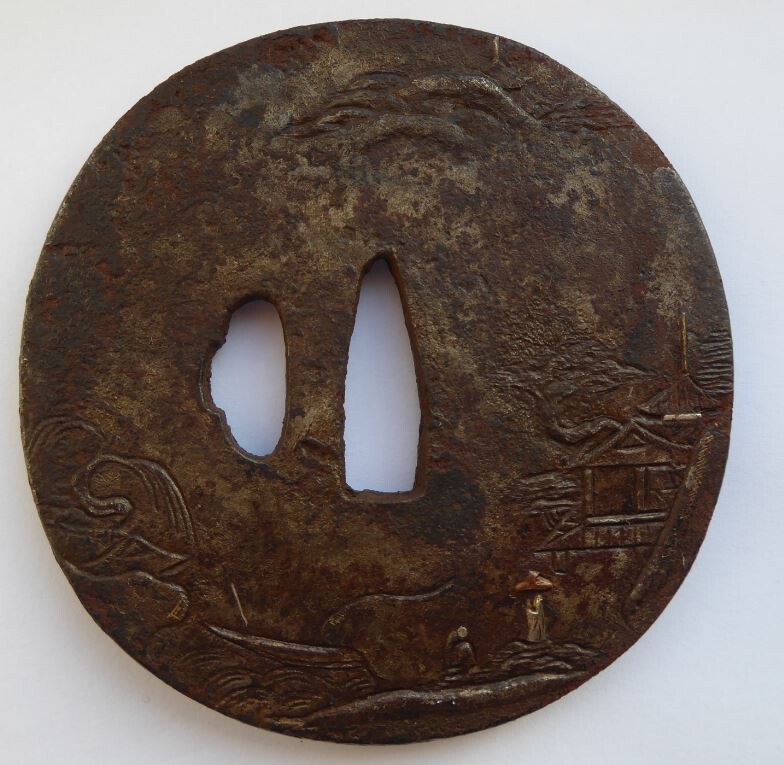
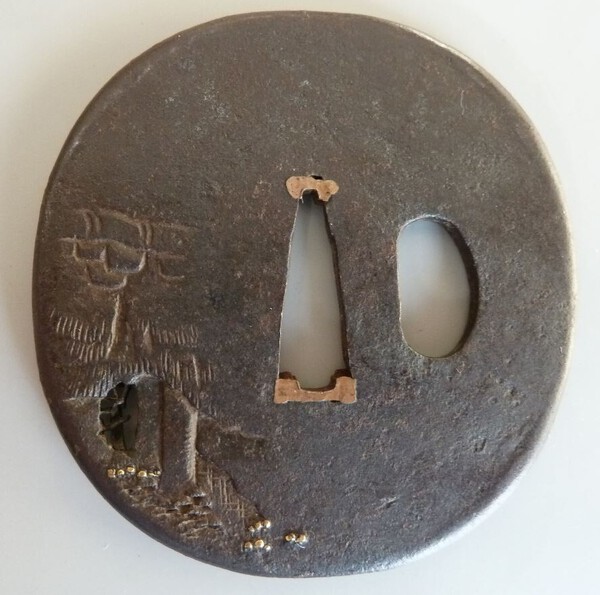
Thanks for story behind this Kanei style Chinese landscape. As you say many tsuba have this theme and I have a rusty one on my desk that I use as an experimental piece to test cleaning regimens (see attached). I can now add the story to my inventory description. Best regards, John

-
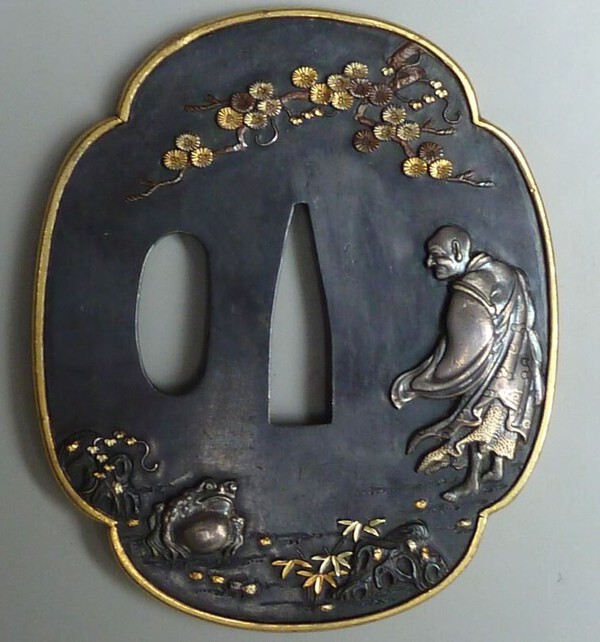
I picked up this attractive wakizashi size mokko form shakudo tsuba four years ago as part of a mixed lot. It has a single kodzuka hitsu ana and what appears to be a solid gold fukurin. It is mumei and decorated with takazogan inlay, with the main themes enhanced by iroe blossoms and plants scattered around. The ji of the tsuba is migaki (polished) rather than the nanako finish seen on many shakudo tsuba. The front of the tsuba is decorated with the figure of Gama Sennin (Chinese Liu Hai ), literally Toad Hermit, a Daoist immortal based upon the 10th century Chinese civil servant and alchemist Liu Hai. He is depicted with his large three legged toad, named Chan Chu (Three-legged Money Toad) from which he learnt the secret of immortality and the ability to change his skin and become young again. Gama Sennin and the toad are fashioned in what looks like a silver/copper alloy with the red of the copper showing through in parts (I’m not sure if this is deliberate choice of an alloy to add a colour range and also avoid the blackening of silver gilt copper as there is minimal staining around the seppa-dai indicating that it was not mounted on a sword for an extended period and so not subjected to wear and rubbing). On the reverse is a pair of quail in gold takazogan with Mount Fuji amongst clouds in the background. A pair of quail is used in Japanese art to signify a lifetime bond between lovers. Gama Sennin, Quail? It occurred to me the other day that long life and happiness together are the traditional blessings bestowed on the bride and groom at weddings. Add to this Mount Fuji to signify Japan and maybe this tsuba was given to/worn by a Japanese groom at his wedding to bestow a long and happy life together for the couple under the protection of Japan. Or maybe it’s just my imagination running wild. Apart from the obvious Goto School attribution I have no real clue to its maker as so many Schools seem to have made good shakudo tsuba in the late Edo period. I’ve seen similar styled clouds depicted on a Goto Ichijo School tsuba, but…. Ideas please. Dimensions: Height: 7.1 cm; Width: 6.0 cm; Thickness: 0.35 cm; Weight: 72 g Best regards, John (Just a guy making observations, asking questions, trying to learn)

-
- 1
-

-
Ooops, Sorry Chris, Getting names mixed up while rushing around. This is the first time that I have seen one of these tsuba actually mounted on a sword or tanto. It would be very interesting to see a picture of the tanto koshirae and blade. Best regards, John
-
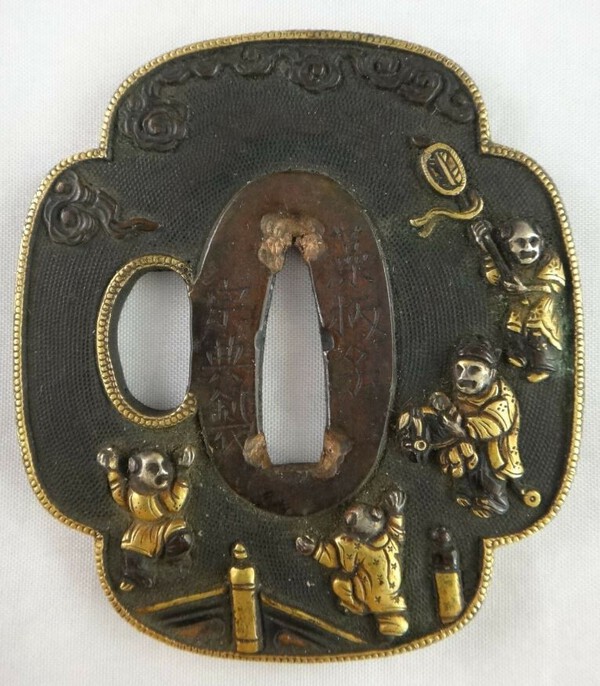
Hi Steven, The signature on your fuchi says Soheishi (Mogarishi) nyudo Soten sei. But I would not take much notice of it. Here is a tsuba with his 'signature', currently for sale at over £2000. But it looks like Mr Suzuki's 'signature' has been obliterated! Thanks for the additional example of Mr Suzuki's work. Best regards, John
-
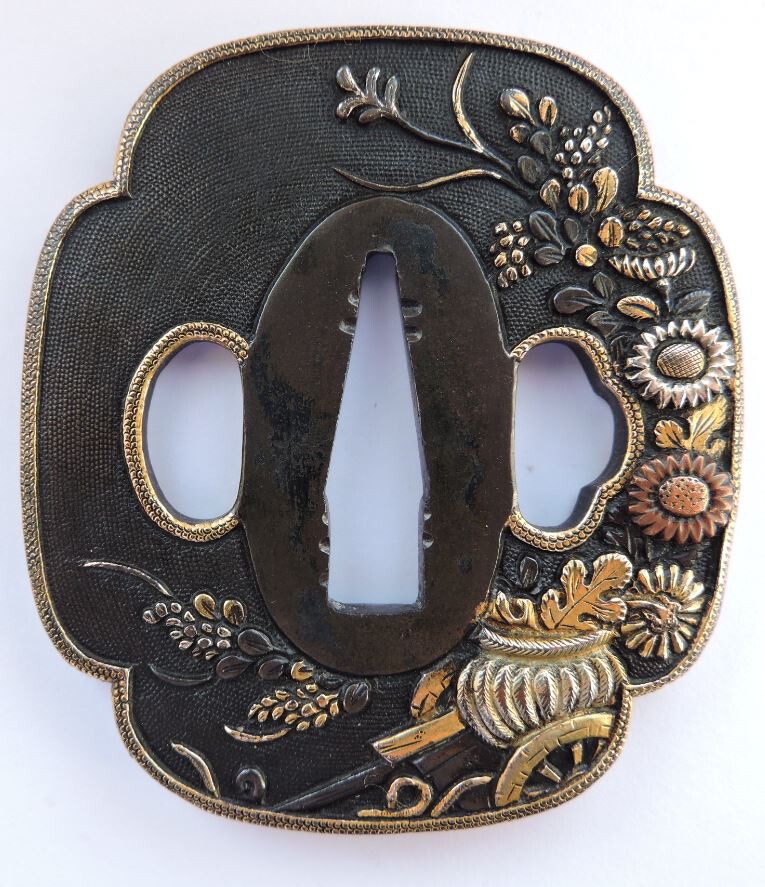
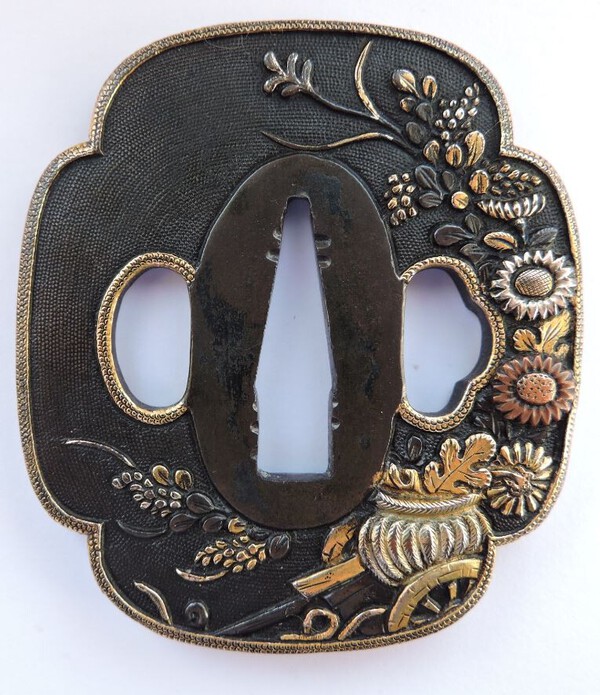
I am adding these two examples of Nagoya-mono style tsuba to my post separately as I don’t want them mixed up with examples from Mr Suzuki’s workshop. They are also from my collection. The first is a really awful example of a cast tsuba that appears to be identical to my example #9 in my original post. The casting is bad and the black patina looks like paint. In addition the punch marks are missing from the nakago ana, so maybe its one of Mr Suzuki’s rejects that someone else finished! The second example is similar to example number #3, flowers in a basket on a wheelbarrow, but there are significant differences in the design that show it not to be cast from the same mould. This represents one of the superior examples of Nagoya-mono. Unlike the typical examples from ‘Mr Suzuki’s workshop’, the punch marks around the nakago ana are different. In addition the patina of the metal looks a bit more like shakudo, so perhaps there is some gold in the mix. There were good examples Nagoya-mono tsuba in the Compton Collection. So, if they are good enough for him to have collected….. I hope that this shows that not all Nagoya-mono tsuba were cheap Goto knock offs, some were quite good but others were awful. Regards, John (just a guy making observations, asking questions, trying to learn)

- 68 replies
-
- 11
-
-

-
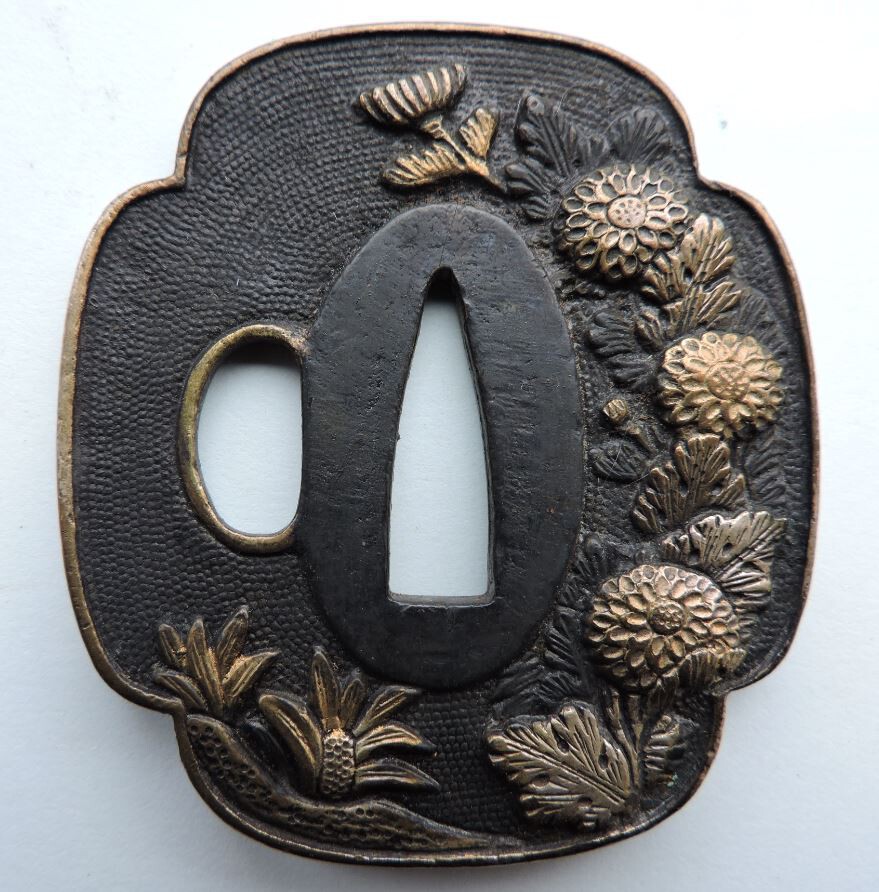
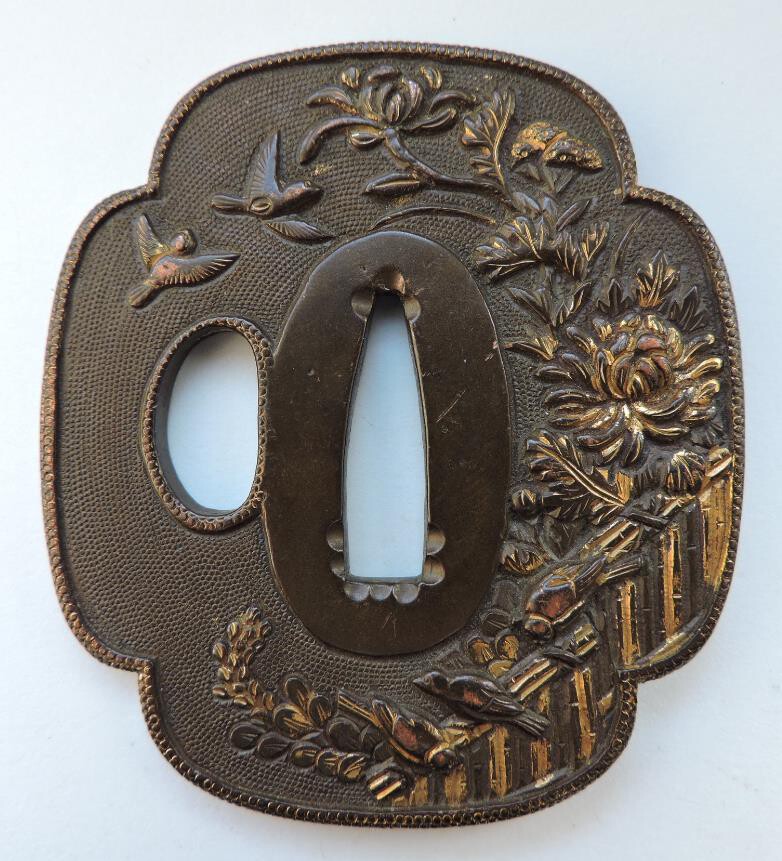
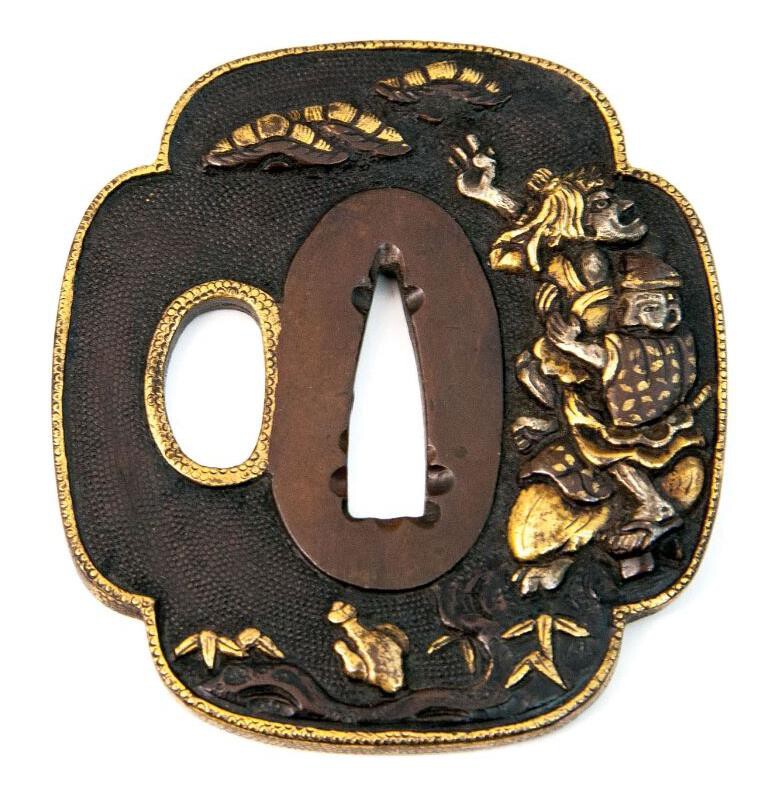
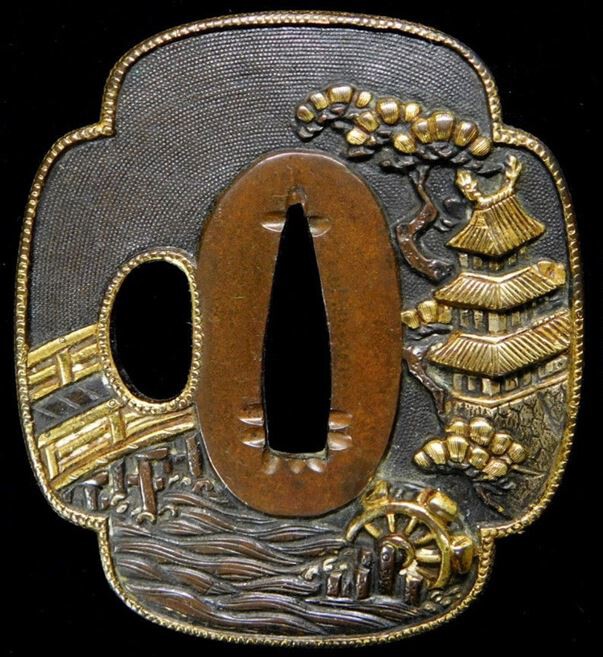
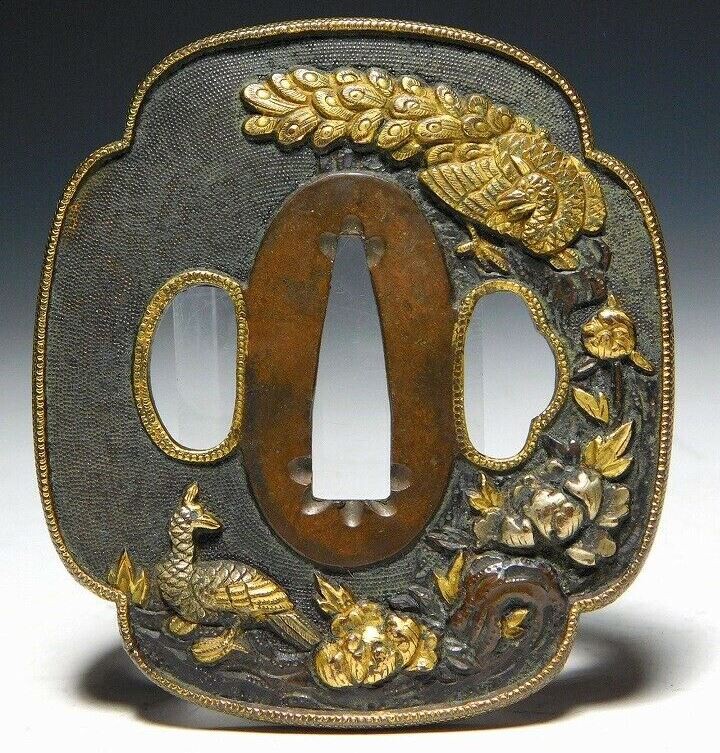
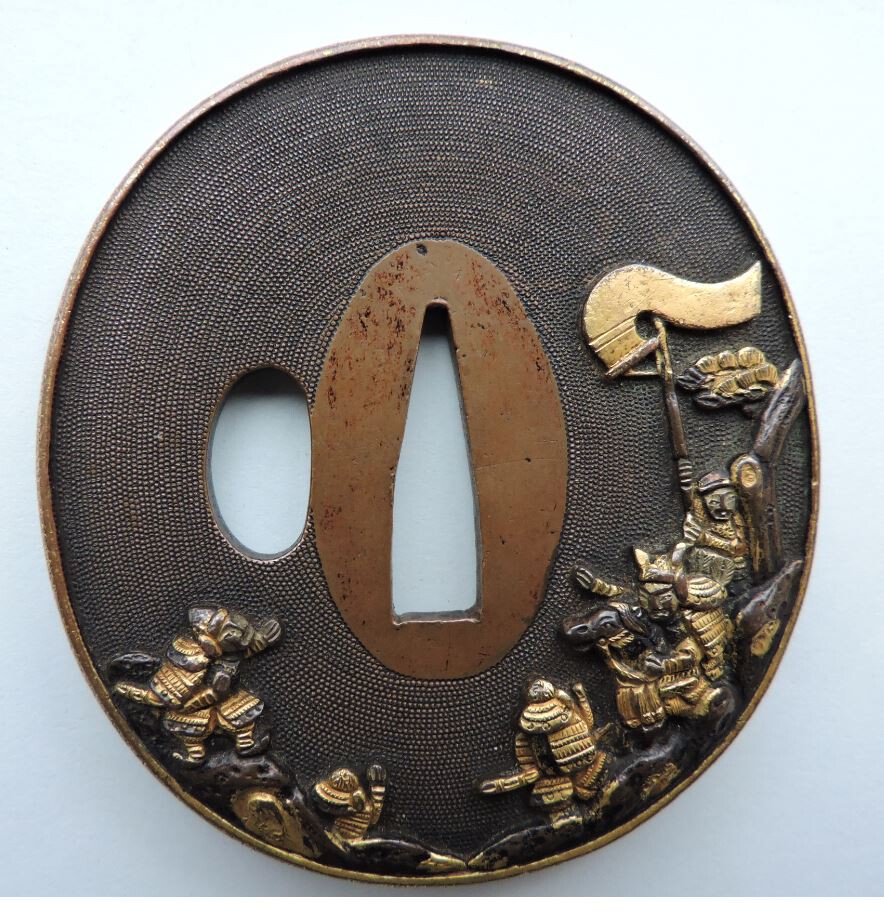
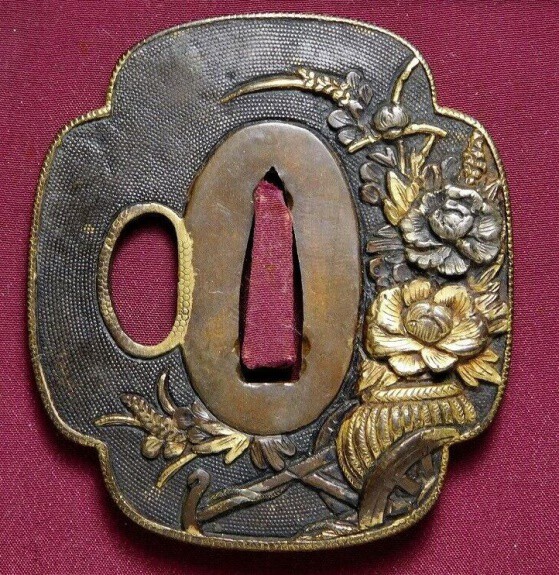
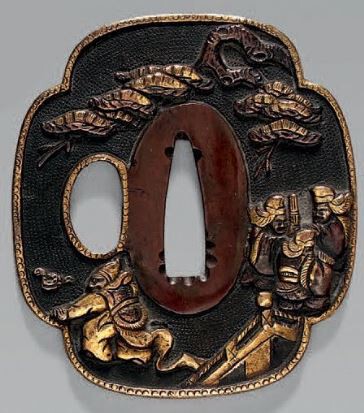
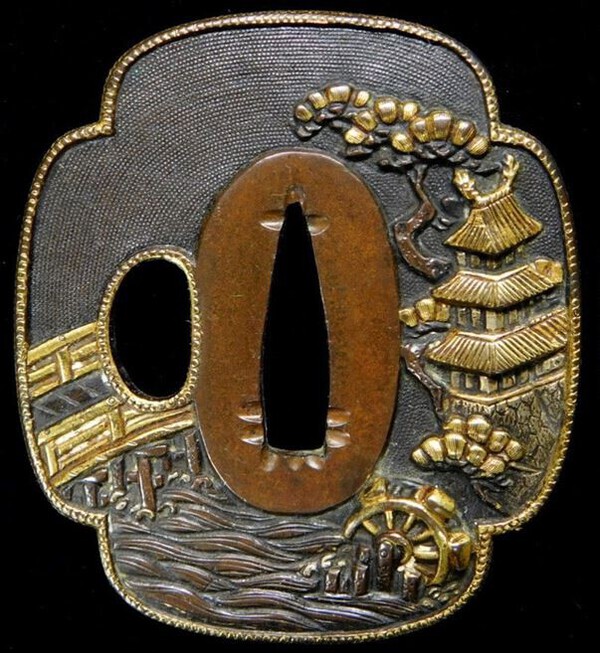
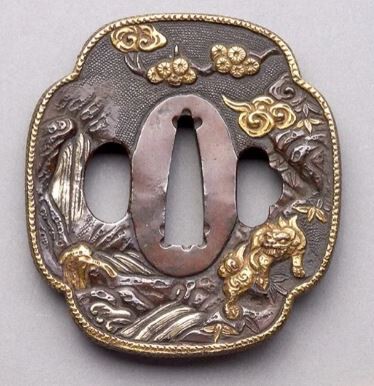
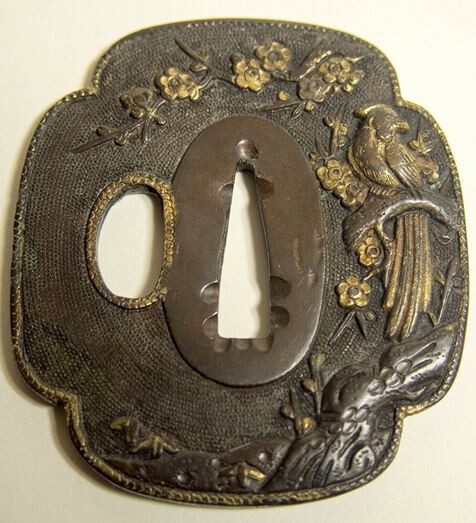
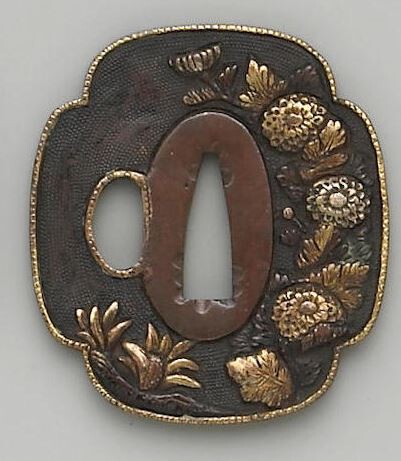
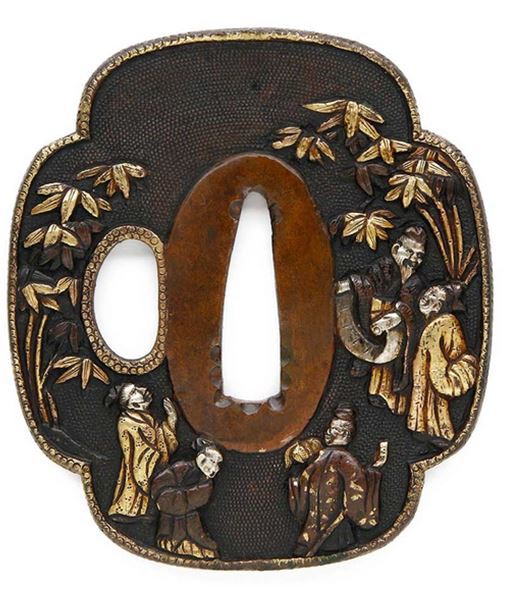
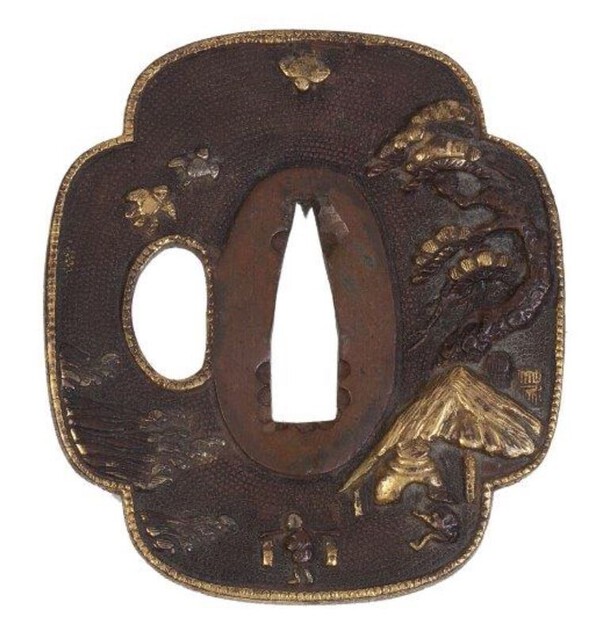
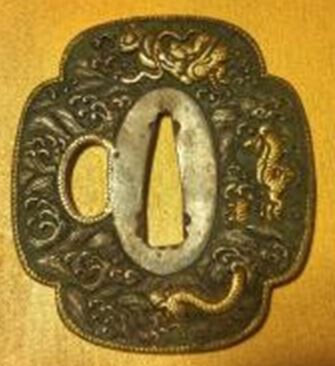
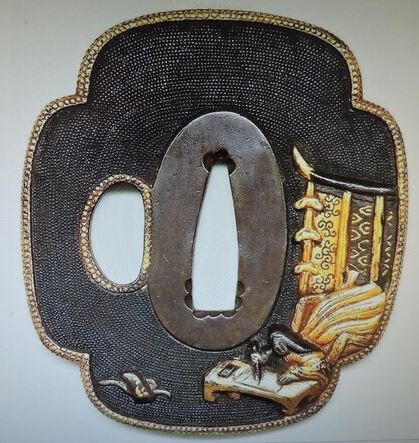
I have written this post as an aid to tsuba newbies, like myself, who may buy Nagoya-mono tsuba while mistaking them for Mino Goto shakudo tsuba. Examples of Nagoya-mono tsuba have been discussed many times on the NMB and I offer this post as a collation of examples from what I believe is a single workshop. Nagoya-mono (alternatives Nagoyamono or Nagaoya mono) literally means ‘Nagoya object or thing’, i.e. something from Nagoya. Sometimes they are called ‘shiiri-mono’; literally ‘thing off the self, or stock item’. There are various types of Nagoya-mono and this post is a collation of the wakizashi size, mokko shaped soft metal tsuba that superficially resemble Goto workmanship that I believe were produced in the same workshop. I must declare at the outset that I am not an expert on the subject and the notes below are based upon my observations and what little information I have been able to glean from the literature. So please feel free to correct and comment. I first came across these tsuba two years ago when two were offered for sale at a large London auction house and catalogued as ‘Mino Goto shakudo’. Fortunately, a slow internet failed to register my over the top winning bid. A couple of months later I purchased two (a lot cheaper) as part of a mixed lot and others keep popping up in online auctions both in the UK and abroad, including Japan. This prompted an interest (though not a love) in these tsuba and a concern that they were being (possibly inadvertently) advertised as more desirable Mino Goto tsuba. For example, there is a tsuba of this type to which has been added a ‘Soten’ signature on Ebay for over £2000! The general features of these particular Nagoya-mono are: 1 Mokko shape and wakizashi or small katana size size (my two are 6.8 x 6.1 cm). 2. Although looking like shakudo, the metal is probably nigurome, an alloy of katashirome (tin and lead) and copper, which only becomes shakudo after gold (3-7%) has been added (Christies Compton collection description). Whether this is true nigurome, i.e. the base alloy for shakudo, or a similar alloy better suited to casting and patination I cannot say. 3. The colour of the body (ji) of the tsuba resembles the blue black of shakudo but lacks the depth of colour and often has a brown tinge to it. The seppa-dai is always chocolate brown in the ones that I have seen. 4. The ji is not perfectly flat, as in Goto works, but often shows shallow undulations caused by uneven casting. 5. The nanako finish is not great. I thought that it was probably cast rather than made with a punch. However, comparing the nanako on one of my tsuba with that of a photo (on-line) of an identical tsuba showed differences. This may indicate the nanako was applied by hand (using a punch), or from using different moulds when casting the tsuba. 6. The mimi and hitsu ana are usually surrounded by a gold gilt finish that initially looks like regular nanako, but on closer examination looks like a lizard skin, i.e. shallow and with bigger oval spots (see pic). 7. Most have a single kodzuka hitsu ana, but some have both kogai and kodzuka hitsu ana. 8. Silver and gold gilding looks as if it has been applied by painting with a mercury amalgam and then heating to vaporise the mercury. I have not seen any evidence of gold foil peeling off the tsuba. I conclude that although cast, individual tsuba are finished and decorated by hand. I have not seen seams from the mould either, unlike cast iron tsuba. 9. Lastly, these Nagoya-mono tsuba have a characteristic pattern of ten punch marks around the nakago ana, viz: three at the top, two on each side at the bottom and three along the bottom. These differ slightly in position, so were evidently made individually and some have been altered. I think that these were quality control marks to indicate they were deemed good enough to sell. As soon as I see these I want to shout ‘Ah, another tsuba from Mr Suzuki’s workshop.’ Note: I don’t actually know the name of the workshop owner. So, who originally bought these tsuba? I don’t think it was tourists (Japanese or European) as has been suggested. There were few in the Edo period. Poverty and starvation were rife in the 17th and 18thC, so they may have been bought by poor samurai or by wealthier wannabe merchants, who were allowed to wear short swords. A bit of bling to wear on Saturday nights maybe. Many men throughout history and throughout the world have woken up after a night on the town only to find that they had ‘mislaid’ their money, valuables and sometimes their clothes. A wise man would leave his valuables at home. Although dismissed by many on the NMB, I see no reason why a collector should not specialise in Nagoya-mono, especially if they are not wealthy enough to buy genuine Goto works and have no interest in ‘bits of old iron’. However, some of the ones I have seen for sale have gone for over £300/$400, which I think is way too much! There are plenty to study in addition to those from Mr Suzuki’s workshop. So here is my collection of 16 designs (there are others) that I have come across in the last few months, all apparently from ‘Mr Suzuki’s workshop’. Two of them are mine (they were just included in job lots, honest!). I have also included a picture of the ‘lizard skin’ nanako on the mimi of one of mine for reference. 1. Takarabune (treasure ship) with the character Hoo (treasure) on the sail. This tsuba is mine 2. Chrysanthemum, birds and fence. This tsuba is also mine 3. Flowers in basket on wheelbarrow 4. Tadamori catching the oil thief 5. Man chasing snake 6. Pagoda and water wheel 7. Shishi 8. Ho-o bird on branch 9. Chrysanthemums 10. Meadow flowers 11. Five Chinese sages 12. Thatched hut scene 13. Two deer and flowers 14. Dragon 15. Lady Murasaki Shikibu writing 16. Peacock Regards, John (just a guy making observations, asking questions, trying to learn)







- 68 replies
-
- 13
-
-
-
Jesse, No one seems to have mentioned the obvious test. Put a magnet on it. Its an obvious fake and I doubt if its even iron. Hopefully you did not pay a lot of money for it a a major auction house. Best regards
-
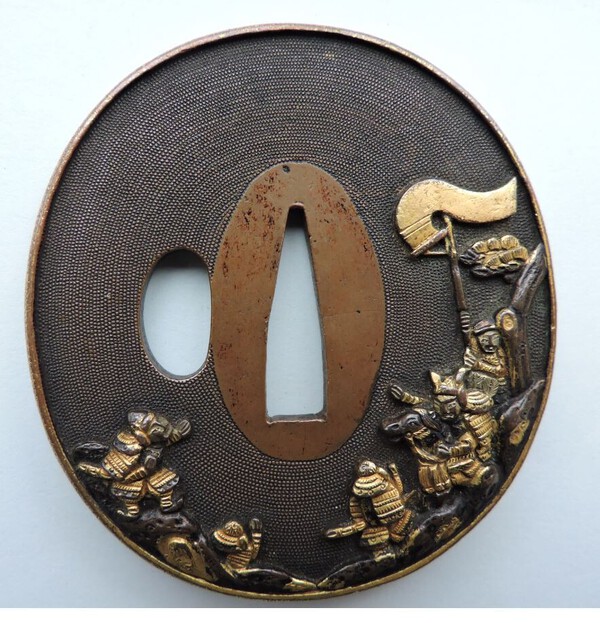
As said above, this tsuba is a Nagoyamono (lit. Nagoya thing or object) and made as an affordable copy of Goto work. They are often described as shakudo but are actually nigurome, the copper base alloy before gold is added to make shakudo. Hence the brown rather than blue/black patina. Quality varies, yours (and mine attached) are mid range. Although the plate (ji) is decorated with nanako I've always found that the rim (mimi) has a gilded lizard skin nanako finish (as do the rims of the hitsu ana). Although this quality tsuba was almost certainly cast, the gilding and nanako seems to have been done by hand. So, not the best quality, but not cheapo castings either. My tsuba has Soten style samurai on it and I have seen a very similar example on a Japanese website described as Soten. So I' don't know if the Soten school were involved in making Nagoyamono or whether the craftsmen just copied Soten designs. Best regards, John


-
Marcos, Steve, Thanks for the updated information. Sotherby's gave him the dates 1835-ca. 1909, but Steve's kanji look right, so I'll update my inventory. Thanks, John
-
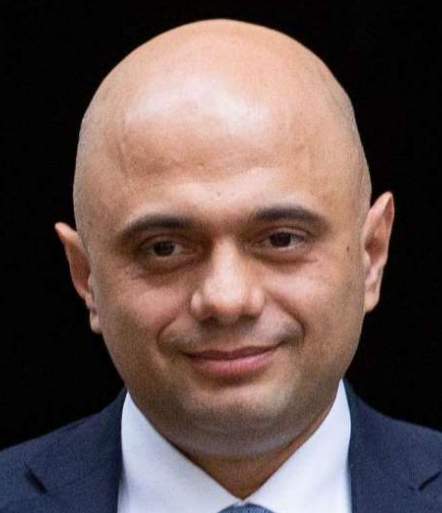
More information on the (possible) maker of this tsuba was supplied by Marcos on his recent New Year Ox Tsuba post (Jan 2021) as follows . Ikedo Minkoku was a great tsubakō, kinkō and ginkō formed in the Fine Arts University of Tōkyō where was taught by Unnō Shōmin, but after that he continued his formation with him at his atelier. The problem for Minkoku was the time where he lived, where tsuba orders were very few so, as many other artists, including Shōmin, he worked on incense pots, silver jars, tabakoire kagamibuta and so on. As Mr. Ōkawa told me, things were not easy as well for Minkoku student and Ōkawa san sensei, Ametani Yūmin, who mainly made rings, collars and obitori. Even Ōkawa san told me that, if you're not hired by a institution like Tōken Hakubutsukan or Bizen Hakubutsukan, is impossible to live as a tsubakō, so he also made jewellery till 50 years old. Congratulations about your tsuba. I think I saw time ago, in some auction a kagamibuta made by Minkoku and, regarding the piece, the price was so high, maybe because there is few works made and signed by him, so you're lucky. Marcos I have a couple of updates myself, so I thought that I would add them to my original post. The first concerns the design on the reverse of the tsuba, a pine tree. The relevance of this has puzzled me for over 10 years, but I think I found it last year amongst some haiku written by my favourite poet, Kobayashi Issa (literally one cup of tea, 1763-1827). The haiku is: ‘Hotoke mo narade uka-uka oi no matsu (Not yet Buddha, mindless old pine)’. I believe that the artist is effectively reversing the question, or Zen koan, asked on the front. The main design asks if a sacred carving of Buddha can be regarded as a piece of firewood. The reverse is asking whether a live pine tree has attained the Buddhist state of ‘no-mind’ and whether its fate, after being chopped down, is to become a sacred carving, or end up just pieces of firewood. If I’m right, I think that the design concept is brilliant, especially as the story of Tanka is my favourite Zen koan. The second update concerns whether it is genuine or a modern fake. It looks as if Sajid Javid (UK Home Secretary 2018, Chancellor of the Exchequer from 2019) may have posed as the artist’s model for Tanka!
-
Hi Marcos, Here is one of mine. Sorry, but the oxen is a little shy and is just being coaxed out of his barn with a bucket of food. Its just a wakizashi mumei piece but in the theme of oxen. What really made may day about your post was the reference to Ikedo Minkoku. I have a tsuba inscribed Funakoshi Shunmin, and alternative name used by Minkoku, according to Sotherby's. I've posted it before, it was one of the first that I bought. It shows the famous story of the zen monk Tanka chopping up a wooden Buddha for firewood to keep himself warm while staying at the Yerenji in China during the 9thC. I have never seen another tsuba by this artist, though museums (Boston, Brit) have tobacco pouch clasps and inro by him. I was beginnings to doubt that he ever made tsuba (I'm not saying mine is genuine, but the workmanship is great and I've never seen the design elsewhere). Thanks for the info. Best regards, and happy New Year. John


-
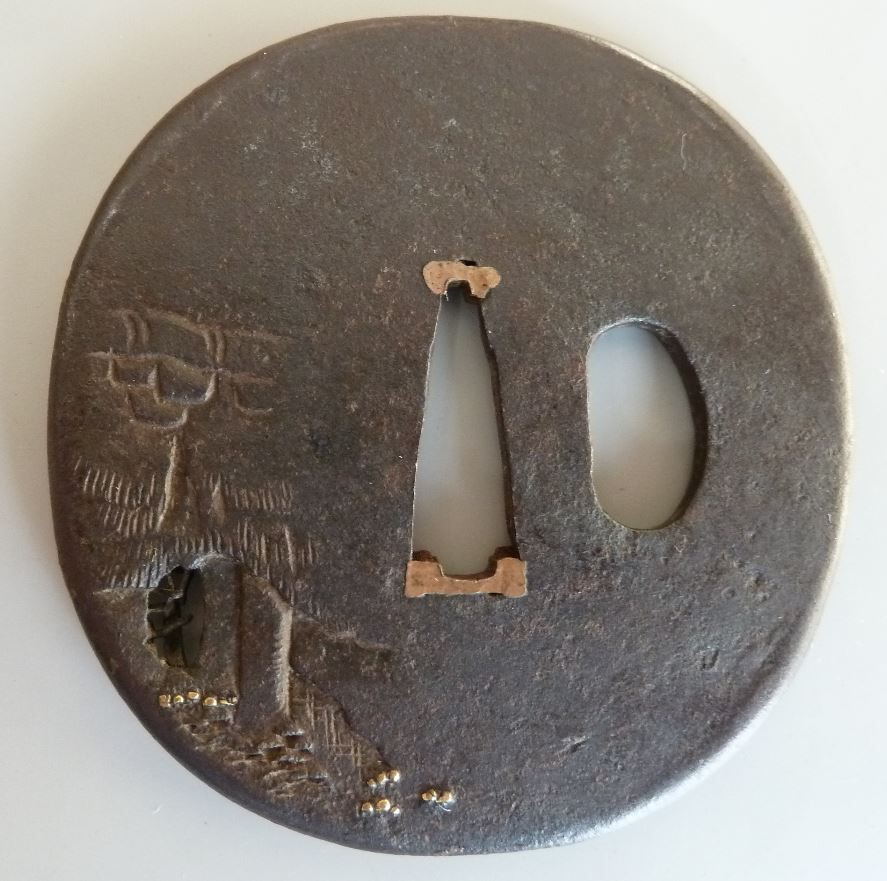
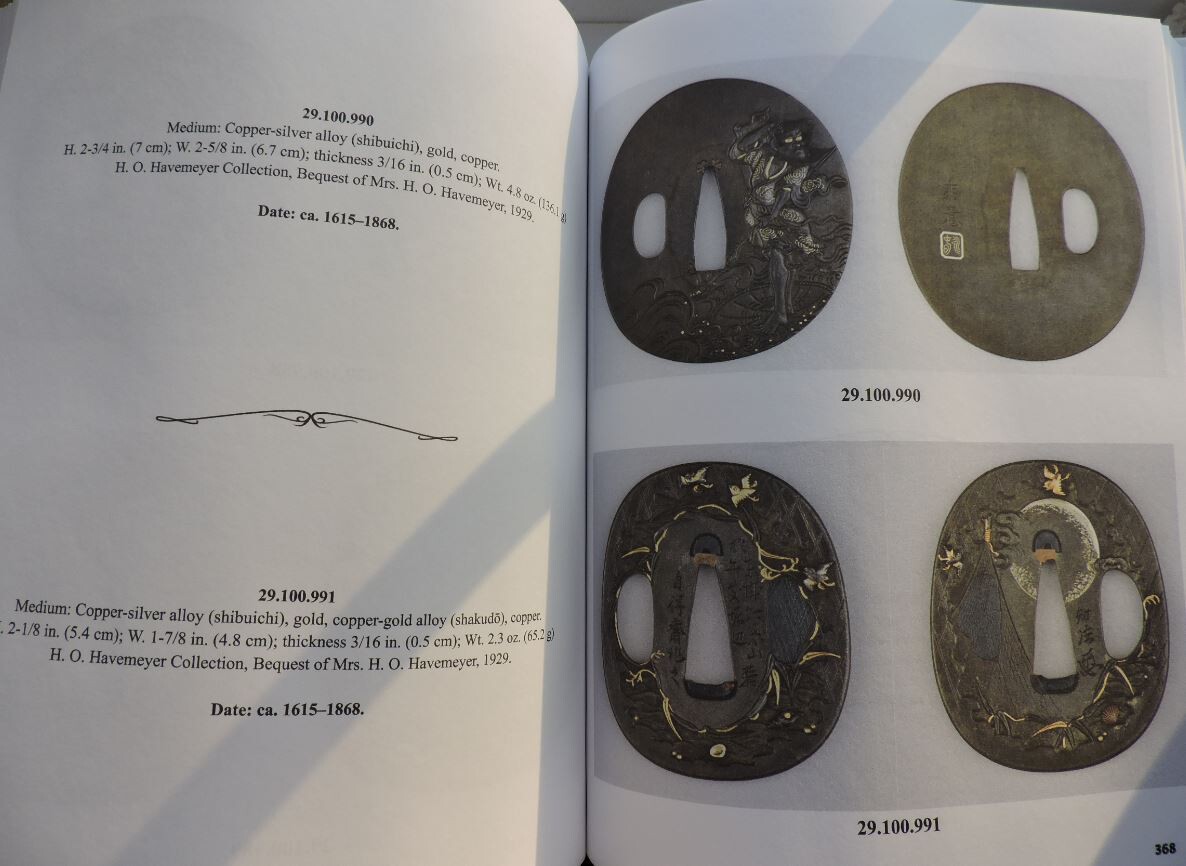
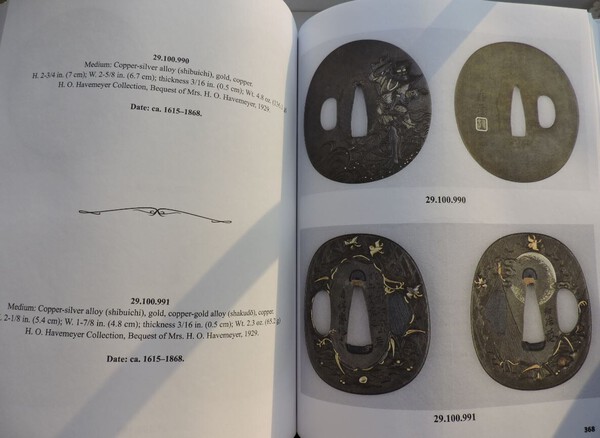
Following the link I saw that there were two volumes of the NY Met tsuba collection for sale at this site. I looked at the preview and it showed pics of tsuba with a full description, so I bought Volume 1. I am totally disappointed with it as the majority of entries are like the one attached, just a list of the metal and size of the tsuba plus who donated it. Like many of the tsuba, the ones pictured are signed, but no translation of the signature is given. The photos are of such poor quality that the signatures cannot be read. Without even a tentative identification of the school, artist and subject it is just a picture book as far as I am concerned and little use in furthering my knowledge. Sorry to be so hard, but at £50 I expected a more scholarly book. Best regards, John
-
I came across a version of this tsuba in a small auction in the UK a couple of years ago and wondered if it was genuine and decided it wasn't (Only saw pics on the internet). By coincidence I picked up an old Bonhams New York catalogue (16 Oct 2012) on the same day and there was a version of this tsuba (lot 1062, signed Umetada) that went for big money (over $1000). It also had provenance: ex St John's University Collection, so maybe it was the real deal. I will emphasize that I am not saying the Bonhams tsuba was a fake. I have also seen similar copies for sale on the internet for less than $50. My concern is that some NMB correspondents seem to be declaring with some certainty that various tsuba that sold for big money were in fact fakes. I wonder if the purchasers of these tsuba are NMB readers and might take them back to the auction house with a 'Hey, this tsuba I bought here is a fake. Joe Bloggs on the NMB says so.' Are we stirring up a hornets nest? best regards, John

-
Malcolm, Thanks for the link to Joly's book (Looks good and its free!). I've downloaded it and transferred it onto my Kindle. My mother bought me Joly's Sword and Same back in 1973. He must have been a great Japanese scholar. Pity he was before my time. best regards, John
-
Mark, You are right and I have been mistaken. What a quizmaster I would make. Its HOMMA MAGOSHIRO SHIGEUJI, a story I was totally unaware of, but the bird does have something it its claws (as does a couple of the other pics sent in). But thats what NMB is all about, learning and admitting when you are wrong. Hopefully the mistake does not merit seppuku. thanks again everyone for your input and information, I'll try to do better in 2021. John
-
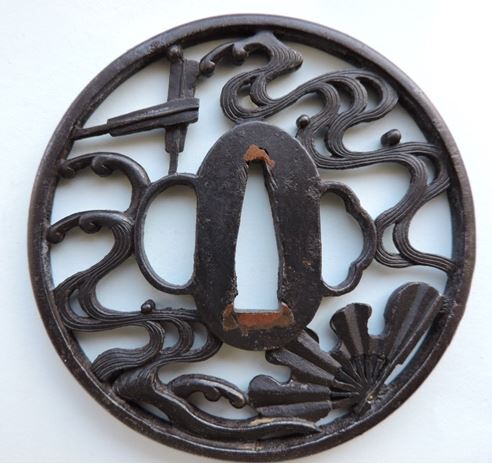
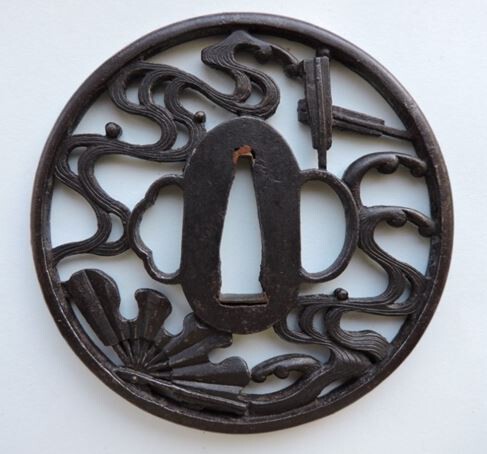
As expected it did not take you guys to solve the quiz, but we can’t have anything that taxes the mind too much at this time of year. A special thanks to those who knew the answer, but restrained themselves to give others a chance, and to those posting more pictures relating to the subject. When I have this tsuba on display and we have visitors I often offer them £10 if they can guess what the target was. I still have the £10. I believe that the tsuba depicts a scene from the Gempei War (1180-1185) at the battle of Yashima on 22 March 1185. On-line accounts differ, but the gist seems to be that the Taira (alternative name Heike) army, having been effectively defeated by the Minamoto (alternative name Genji) fled to the safety of their ships. According to the Heike Monogatari a very beautiful lady in one of the Taira ships placed an open fan (with a red sun’s disc design) atop of a pole and challenged the Minamoto to knock it off. The gesture may have been a bit of chivalrous rivalry between the two clans, or more likely a ploy to taunt the Minamoto samurai into wasting their precious arrows. A young (18 year old) Minamoto samurai, Nasu no Yoichi (Nasu Munetaka), accepted the challenge. He rode his horse into the sea and shot the fan cleanly through. Nasu won much fame and his descendants took a fan with sun’s disc as family mon. I believe that his descendants could walk into any bar in Japan, declare their lineage and expect that someone would buy them a drink. One account says that Nasu Munetaka used just one arrow to hit the arrow and that the arrow was fitted with a humming-bulb, and not the Y-shaped rope cutter shown on the tsuba. The Minamoto went on to destroy the Taira in the famous sea battle of Dan-no-Ura a month later (25th April). Broken fans became associated with the defeat of the Taira and are often depicted on tsuba. My wife bought me an iron sukashi one (see attached) which shows a broken fan in waves together with two arrows. As there are two arrows, I assume that the design relates to the battle of Dan-no Ura rather than Yashima. I have attributed this tsuba to the Kyo-Shoami School about 1700. My attribution is based upon the open nature and relatively thin mimi (Kyoto work), plus the 3-D, rather than 2-D (flat sukashi) carving of the design (Shoami) using Yagyu like waves. The tsuba also has just one tiny spot of gold nunome on each side for the rivet of the fan. The iron is very homogeneous, so I have put it as a mid-Edo piece. Comments and critiques on my attribution always welcome. That’s how I learn. With regard to the Shoki and Oni tsuba, it seems that tsuba workshops in the Edo period turned out lots of copies of popular tsuba. It don’t make them fakes, but losing their ‘uniqueness’ would undermine their value IMHO. All the best for the New Year John
-
Hi Luis I have seen tsuba similar to this for sale described as both Mino and Nagoya, and are probably offshoots of the main Goto family. However, it seems hard to get definitive information for us collectors in the west who's Japanese is not too good. By coincidence, I was about to post a Christmas quiz tsuba for a bit of light relief. This tsuba appears to have little in common with yours, except for the seppa-dai and nakago. The seppa-dai is chocolate brown, rather than the blue-black of shakudo. This effect is interesting me at the moment as it may mean that the metal is nigurome rather than shakudo. Secondly, the punch marks on my tsuba are virtually the same as yours, especially the open pair at the top. I believe that these are just a decorative pattern that was used by the workshop in Nagoya, Mino or wherever rather than a signature. I have also been looking at cast Nagoyamono tsuba and they also have a distinctive (but different) pattern of punch marks. More research needed, as they say (no doubt it is all written up in some Japanese book). Best regards, John
-
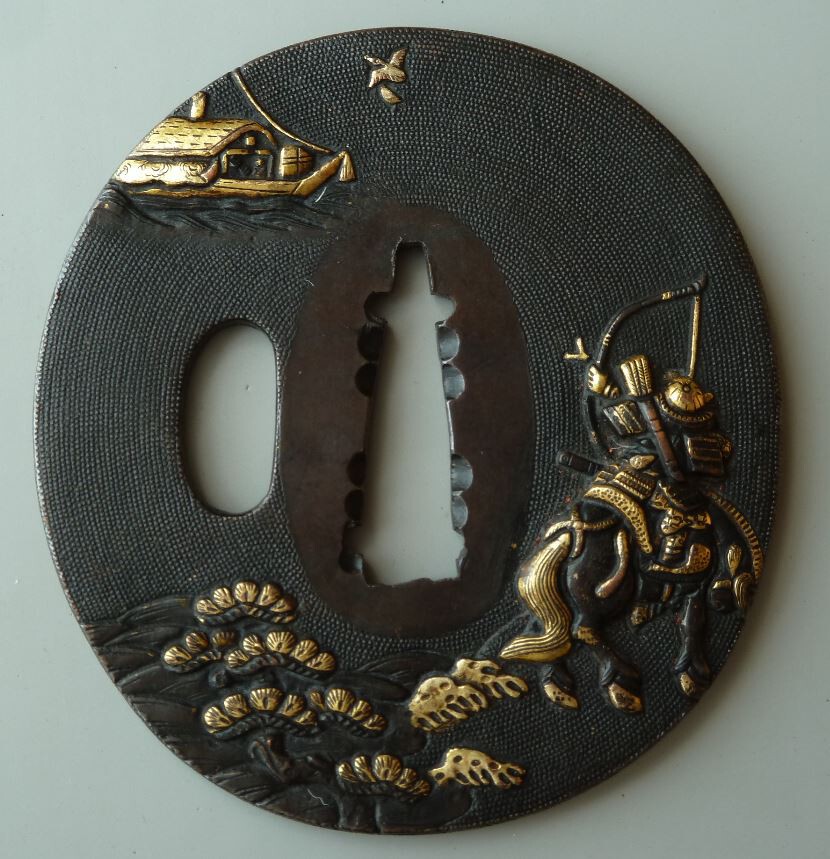
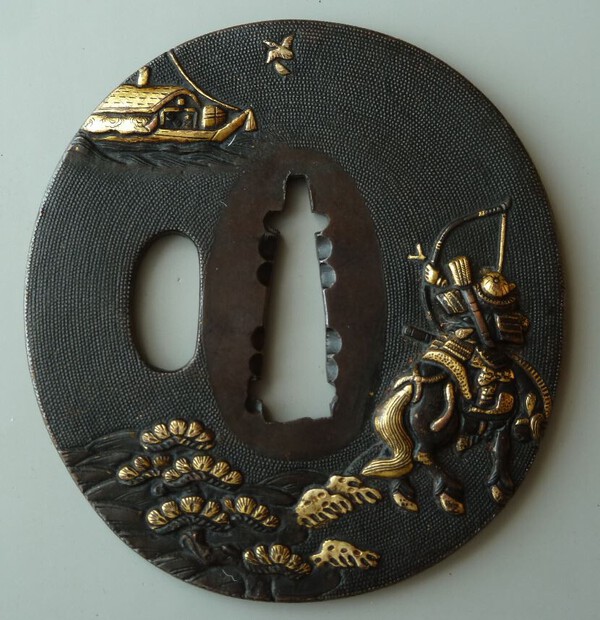
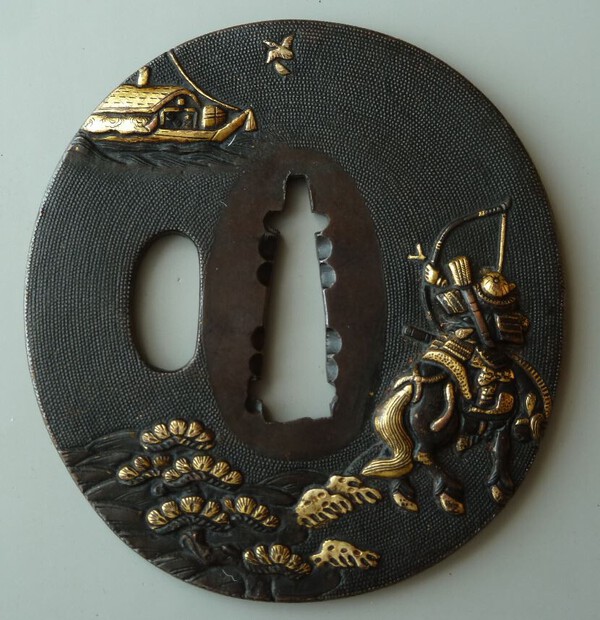
One of the aspects that I enjoy about collecting tsuba is discovering what the maker is depicting in the design. I expect that many Japanese living in the Edo period would have no trouble in identifying the themes, but to us westerners, lacking in a deep knowledge of Japanese history and mythology it takes some research. I have tsuba that took me years before I stumbled across something that enabled me to identify the subject material. So I thought that I would post this particular tsuba in the form of a Christmas Quiz (my answer, not necessarily correct, in the New Year). Nothing too taxing over Christmas. The tsuba is a ‘Mino Goto shakudo nanako’ type for a wakizashi (6.6 x 6.2 x.25 cm, weight 80 g) and depicts a samurai on a horse about to let loose an arrow towards a boat and bird in the opposite corner. The reverse shows two birds flying above pine branches. The samurai is depicted in gilded takazogan (a little worn in places) as are the boat, birds and pines and enhanced with some engraving. The nanako is also quite fine. Maybe not the highest quality, but not a cast Nagoyamono either. So here is my Holiday Quiz to exercise your minds during lockdown. 1. What is the archer shooting at? 2. What is the name of the archer? 3. What year did the incident occur? I also have a couple of features that are puzzling me. 1. These type of tsuba are usually offered for sale as Mino Goto, however I have recently read that the Goto family in the Edo period did not produce many tsuba, concentrating on fuchi/kashira, kodzuka, kogai and menuki. I’m thinking that this might be an up market piece from the Nagoya workshops (rather than mass produced cast examples) as the symmetrically placed round punch marks around the nakago ana (cosmetic rather than practical) seems to be one of their features (but some Goto workers also used decorative punch marks). Mino/Nagoya? More research needed! 2. The seppa-dai on this tsuba is a dark chocolate brown, rather than the blue black of shakudo. However the nanako ji is the usual shakudo colour. I have seen this two tone effect on some of my other tsuba and in photos of tsuba for sale, for example Compton II, lots 131-136 (a mixture of Goto and Nagoya). The Compton examples are described as both shakudo and nigurome (shakudo with little or no gold). Poor quality nigurome examples that I have seen seem to lack a good blue black shakudo colour in the ji and the seppa-dai is a lighter brown. It must have added another level of complexity to achieve a sharp change in patination between the ji and seppa-dai. Why bother when the seppa-dai is hidden? Comments please. Regards, John (just a guy making observations, asking questions, trying to learn)

-
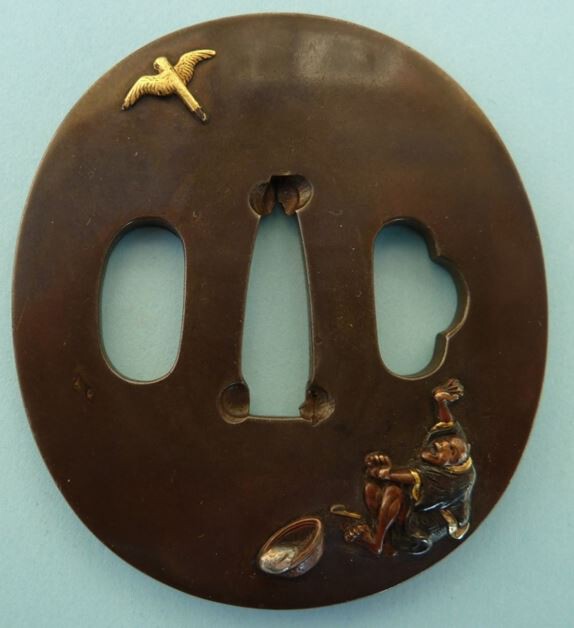
Hi Uwe, I was a bit rushed yesterday so here is a bit more info. Firstly, if you want to seriously study Edo period toso-kinko artists I must recommend Markus Sesko’s book, published by Lulu books (each one is printed to order). Bonhams have the Edward Wrangham Collection catalogues on-line under results. He had a lot of Ichinomiya tsuba ‘signed’ Nagatsune. The description for Lot 15 in Part I was: Ichinomiya School, early 19th century Of oval form, inlaid with three rats and a daikon in gold, silver and shakudo takazogan, signed Tsunenao with kao. 6.1cm (2 3/8in). Sold for £1080 The rat and two legged daikon are associated with Daikoku, one of the seven gods of good fortune. I bought three tsuba in one lot in Part IV and one of these was inscribed as a joint wotk by Nagatsune and a student, Sadanaka. I had not noticed before your post, but Sesko says Kyubei Tsunenao originally came from Takatsuki in Settsu province and ‘Haynes lists this kinko artist as the same person as Sadanaka’ Then cast doubt that they are the same person. I don't know which is right. Anyway, out of interest, I also post my tsuba and my inventory notes for this supposedly joint work (I never say any of my tsuba signatures are genuine as there are many forgeries out there and I’m no expert). An oval shibuichi tsuba inlaid in iroe takazokan with a peasant falling back, waving his arms, as a bird flies away, having scared the peasant or stolen some of his food. The reverse shows two shapeless lumps (potatoes?), one of which is on a vegetable grater. The tsuba is signed Echizen no Daijo Nagatsune [horu i ko?] Sadanaka kore o horu (Sadanaka carved this) with kao. Nagatsune (1721-1787) was the first generation successor to the two founders of the Ichinomiya School in Kyoto (Nagayoshi of the Ichinomiya family [school?] and Takanaga of the Yasui family). Nagatsune is recorded as the adopted son of the guilder Nagayoshi and a student of Takanaga. His personal names seem to have been Chuhachi and Ganshoshi and he signed his work as Echizen no Daijo Nagatsune (as this example) or Echizen no Kami Nagatsune. Sadanaka, personal name Banryuken of the Iwamoto family, was one of eight recorded students of Nagatsune. The phrase ‘Sadanaka kore o horu’ translates as ‘Sadanaka carved this’, indicating that this was a joint master and student piece, possibly when Nagastune was getting old, not as skilful, but still retaining the reputation as master. The end part of Nagatsune’s signature (not read by Bonhams) may read horu i-ko and translate as something like ‘carved again with’ indicating that Nagatsune and Sadanaka often worked as a team. Provenance:Edward Wrangham Collection. Lot 17 (with two other tsuba) from Part IV of the sale of this collection at Bonhams, Bond Street, on Wednesday 6 November 2013. Height: 6.8 cm, Width: 6.1 cm, Thickness: 0.3 cm, Weight: 91 g Best regards, John


-
Wrangham had a lot of Ichinomya school fittings in his 6 part Bonhams sale. A quick look turned up Lot 15, Part I, a shakudo nanako tsuba of daikon and rat sold for £1080. Markus Sesko (Japanese toso-kinko Schools, p107) devotes nearly half a page to him. Kyubei Tsunenao was a student of Nagatsune (died 1787) In a hurry, so had to be brief, best regards, John
-
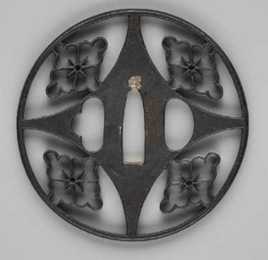
Grev, I have a tsuba identical to this one, except that the diamonds have been removed and its been reheated giving it a melted Kanayama look. I've posted it before and despite it's modification it is one of my favourite tsuba. I just love the iron. But subsequently I found this one with the diamonds intact. It was on a ko-Enju juyo blade (Gallerie Zacke) and the tsuba was described as 'The exquisite Kyo-sukashi tsuba complements the cloud theme of the saya'. So maybe yours is an abstract (cubist) cloud design. Sorry did not get a copy of the saya cloud design
-
Hi Tony, attached is a pic of the armillary sphere in the Nikko shrine from a Royal Armouries publication. regards, John

-
Curran: Lovely tsuba, how could you bare to part with it? I see your main monkey has a court cap and baton (gunbai?), whereas the other is holding a peach (missing on my tsuba). Jean: the kanji for senbikizaru are千疋猿; sen is 1000, biki is the counter for animals and zaru is monkey (saru changes to zaru when used in a combination word). Minogame 蓑亀 is a contraction of mino, meaning a straw raincoat and kame a turtle, i.e. a straw coated turtle, or one covered in trailing seaweed looking like a Japanese peasant’s raincoat. Although minogame may live to 1000 or 10,000 years (in mythology) the name has no specific reference to the age. Bob: Another lovely tsuba. Your monkeys have much more variety and life than mine. The three wise monkeys are distributed nicely around the top, adding to the interest, and you have the monkey holding a peach (and as it has a leaf attached I concede it is a peach and not a tama jewel). But no neck wrestlers or baton holder. I see yours is inscribed ‘sentoku kin wo mote kore wo tsukuru’, ‘made with sentoku’. Would you like to comment on the sentoku/brass issue? It looks like sentoku to me. Thanks for all your comments and additional information regarding monkey tsuba. Best wishes, John