GRC
-
Posts
761 -
Joined
-
Last visited
-
Days Won
14
Content Type
Profiles
Forums
Events
Store
Downloads
Gallery
Everything posted by GRC
-
Definitely you can see a clear "seem" running along the midline of the mimi. And it certainly appears to have enough age to be from sometime in the 1800's. Again though, Nanban-style tsuba are less reliable sources for this quest, because the country of origin can't always be certain: Japan, China, all over South-East Asia ("Monsoon-Asia"), and the Dutch East India Company was even having them produced as far West as Sri-Lanka.
-
Bob, I must apologize for the earlier post. I should have sent a PM. I don't want to mar this fantastic thread of "show and tell" you have been entertaining us with for such a long time.
-
Florian, are you thinking it was made sometime in the 1900s? I could maybe see a 60s psychedelic vibe. Thanks Curran I still don't know what to think of this tsuba lol but it sure is different!
-
"possible" is always a tricky word though... With regards to an unknown, just about anything is "possible" in the broad sense of the term, but the hard part is turning it into "plausible", with the ultimate goal being "certain". Without more definitive quotes or documentation to push the date back even earlier, it seems like the idea is still only in the "broadly possible" category. Some things to consider in pushing the date back even further: Who would be the target market for these? And, if you push the date back even further by many decades, then you'd expect to see a LOT more of these older looking cast examples. You'd also need to show where the necessary cast-iron came from and that it was readily available. I think that's where that "commercialization of the steel-producing process" statement by Lissenden needs more exploration and clarification. And, all of this "pushing the date back further" is based on the assumption, albeit a reasonable one, that "if they could do it, they would it". Just some thoughts to consider...
-
Well now that you mention it Florian, that could certainly be a possibility. Let me downgrade my "definitely" to a "could be". I have "Yatsuhashi" on the brain after researching it for the "beams motif" summary. The Japanese definitely played around with the motif a fair bit so I'm starting to see it everywhere.
-
It could be the inspiration for "Cousin It" from the Adam's family or maybe Van Gogh's Starry Night? Way ahead of its time for sure


-
Hi Bob, hate to say it, but that second one with the Vajra looks like it's cast. That might also explain the unlisted name.
-
Thanks jean, it would make more sense if he had said "decarburization" both times, rather than alternating with opposing terms. Probably a typo that both he and his thesis supervisors missed. But as written, it definitely confuses things.
-
Another one of the Chushu type shown earlier:

-
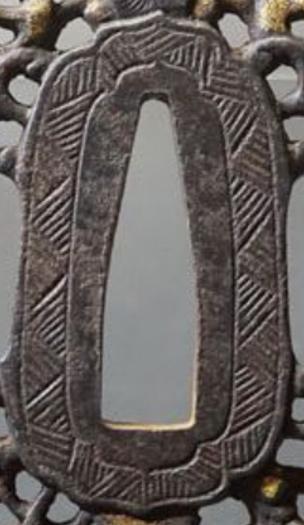
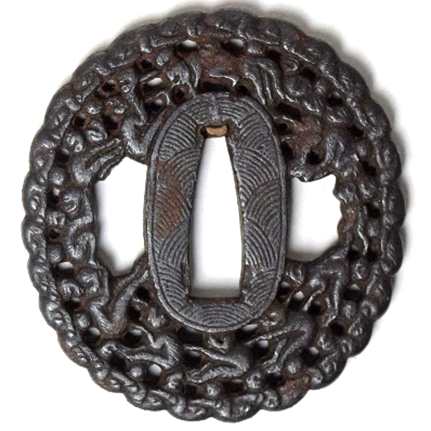
The anchor tsuba is definitely not Nanban, and it is definitely Japanese. The "diaper" here is just waves. I believe that what Lissenden was referring to is the "wave-like diaper pattern" found on many (but not all) of the decorated seppa-dai of the Nanban style tsuba. Here's a few examples: McElhinney is probably the person who has done the most research into the origins and classification of the different styles and types of Japanese Nanban and Asian Export guards. He describes Lissenden's Nanban classifications as a "good start" but has added so much more depth and clarification. I see that Mandarin Mansion, as well as Haynes & Long at shibuiswords have been posting quote and articles from him. Here's a cast Nanban tsuba that just recently sold for 32,600yen in Japan. I have other images that are exact copies of this tsuba pattern so there is no doubt that it is cast iron. These are copies of tsuba produced by the Yagami school that started in the late 18th century. This one looks like it has enough patina to be from sometime in the 1800s. But again, we just don't know exactly when, and with Nanban tsuba, we can't always be certain from where (within Japan or from outside Japan). This one is certainly made specifically for the Japanese market, and likely made in Japan. From Lissenden, "cast-iron" tsuba and iron tsuba that are "moulded" are interchangeable. Here's his main quote that pushes Japanese iron casting well back into the 1800s: "However, for many hundreds of years the carburisation of grey cast iron, enabling its conversion into malleable cast iron, (ref 230) had been well known and such a process was described in 1734 by Emanuel Swedenborg as being familiar to Chinese and Japanese metalworkers. (ref 231) While unsuited to the mass production of larger articles because of the amount of time the process demands, decarburisation would have been easily applied to the production of a limited number of smaller articles such as moulded tsuba." "The moulding of artefacts such as tsuba was thus a readily attainable process long before the popularity of the Namban group of tsuba became established. Conversely, the degree of commercialisation of the iron-producing process by this time leads one to presume that the tsuba makers would have obtained their iron from industrial manufacturers in ingot form. This would probably have already been decarburised commercially by a 'fining' process in order to convert the cast iron into its malleable cast iron form — a form well capable of being wrought into tsuba." It's this section on page 123 that originally lead me down the path of focusing on malleable cast iron, and trying to sort out the details of when and how this malleable cast iron would have been readily available to tsuba-makers. I wish he had elaborated on the "commecialisation" aspect of iron production in Japan or had provided some sources for that statement.



-
Hi Grev. Definitely Yatsuhashi theme They don't always put 8 bridges. The flowers aren't always irises. Both can vary. But as long as you have water, grasses and/or flowers and zig-zags, it's the Yatsuhashi theme. The tree trunk is unusual though. Couldn't hazard a guess as to the exact age, but maybe late Edo as the oldest? It looks kind of "pristine" though, almost like it was just made. Maybe a presentation piece or gifted tsuba?
-
Well, On the CAST side of things: -uniform colour everywhere (which is often some version of a uniform "grey" colour, but sometimes a "waxy-looking" black in some types of the more obvious cast tsuba). -the mimi and seppa-dai are definitely dimpled with little sand-grain-like craters. -there are some surface irregularities in the waves on the omote (front) side that has the majority of the anchor on it. And I mean the plate itself, underneath the fine wave lines. On the HAND-WORKED side of things: -the inlayed "water droplets". -there appears to be a few stray chisel marks (or maybe it's just damage?) on the ura (back) side's mimi at the 2 o'clock and 4 o'clock positions. On the "ambiguous" side of things (for me): -there appears to be some streaky "flow patterns" around the mimi on both faces of the tsuba, as well as all along the inner, sunken "step" the runs along the inside of the mimi. *could be indicators of "poured fluid" or indicators of the layers of a "folded plate", but it seems too streaky to be the folded layers. Especially so for the inner, sunken "step" along the mimi. If that was punched down with a punch, it would be a lot smoother than that, and a chisel would leave different looking marks as well. So, overall it looks more like it was poured fluid. Overall, I'm leaning towards initially CAST, then hand finished. I personally don't know if casting can produce such fine ridge lines. And, just throwing out a guess about the overall process here: Maybe the tsuba was cast, then inlayed with the water droplets, then the wave ridges were chiseled in by hand afterward? The timing of when the wave ridges were produced is an unknown for me. An interesting example Dan
-
Other than being differing opinions, could it also be possible that both attributions are correct? Motifs were often "shared" or "borrowed" between schools. (No "copyright laws" yet ) And sometimes a tsubako from one school would move to a new area and join a different school, bringing influences from the previous school with them. Just throwing those thoughts into the mix...
-
Great advice Grev Contact the seller (politely) and see how they respond. You might just lose out on the shipping costs. If they are reputable dealer with lots of stock turnover, maybe you could negotiate for an "in-store credit" to put towards something else in the future? They might be more amenable to that idea if they don't accept the return option. Sadly, I think just about everyone is going to pick up a cast tsuba or two along the path of the tsuba collecting arc. Myself included...
-
Bruno, that one's a beauty. I love the dark vs light Genji-mon on the front and back.
-
By pure accident, I stumbled across two more NBTHK papered examples with "cast-iron" in the title of some past auction listings on Lot-Art. One Echizen and one Shoami. Here's the screenshots of the titles, the only images available, and the descriptions: The first one has that "soft, rounded look" to it everywhere. It's also got "webbing" remnants near the 5 o'clock position, and a weird circular indent deformity at the 3 o'clock position of the mimi: some sort of bubble of gas that formed during casting maybe? For the second one, I might have initially passed it off as having "surface pitting from corrosion". But given the title, it would suggest that the "bubbly" indentations on the surface are the result of casting (trapped gases in the mold perhaps?). If the seller is calling it "cast-iron", then how can I argue with that? I'm sure many of people will recognize the emblem on the image. And just an added thought: if there's that much pitting on the surface, and it was caused by corrosion, then how are those very thin arcs still intact? They would have likely corroded enough to break clean through at some point. It is interesting to note however, that the accompanying descriptions in the listings just use the word "iron", when "cast-iron" was used in their titles. So I can't say with absolute certainty that these were cast, but if it looks like a duck and it's called a duck... then it just might be a duck?






-
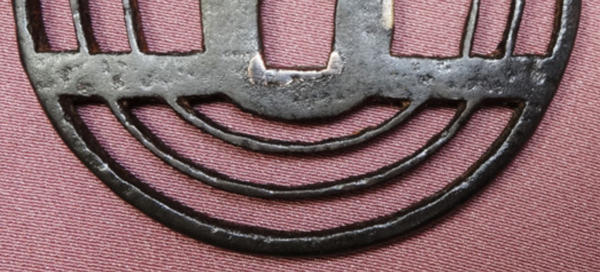
Roger, this is for you: WITH REGARDS TO CUTTING AND SAWING: Early sukashi, including works from Higo and Akasaka were cut with chisels. Here's a quick visual of an early sukashi (probably ko-shoami) where you can clearly see the stepped linear sections that make up the curved lines in this tsuba. These were definitely cut by chisel. More saw work was introduced during the Edo period to get some very fine sukashi lines. Anyway, here's a fantastic article from Markus Sesko, where he shows an example of an Akasaka or Higo sukashi tsuba that was incomplete, likely due to a chiseling error during its production, where you can see all the rough chisel marks: https://tsubakansho.com/2019/04/20/unfinished-business/ WITH REGARDS TO FORGE WELDING (not modern welding using electricity): In brief, you use high heat, then hammer layered steels together such that they "fuse together" to become a solid piece. This was done with varying degrees of: layering, forge welding, then folding it over itself, then forge welding again. The more times it was folded, the thinner and finer the original layers would become. Forge welding was very rarely used in "adding" things to a tsuba's design. The only example I have seen is where a particular forge-weld joint called a "lap joint" is seen in the super thick mimi ring that was added onto a ko-katchushi style tsuba like this one. You can see it at the 6 o'clock position. I've also seen a few openwork pieces where some tsubako took some "liberties" in modifying or repairing an older tsuba by cutting in slots into the existing one-piece tsuba, and added new pieces of thin metal bars to make the needed modification and still fit into the design. Basically like an "inlay" of a sort. Otherwise, SURFACE DECORATIONS are done using "inlays" and "overlays"... and there's lots of techniques for that, but I don't know too much about those. But, I recommend you watch some of Ford's videos to see that in action

-
Certainly this is getting a little off topic, but with regards to "cutting" sukashi: Early sukashi, including works from Higo and Akasaka were cut with chisels. Here's a quick visual of an early ji-sukashi where you can clearly see the stepped linear sections that make up the curved lines in this tsuba. These were definitely cut by chisel. More saw work was introduced in the Edo period to get some very fine sukashi lines. Anyway, here's a fantastic article from Sesko, where he shows an example of an Akasaka or Higo sukashi tsuba that was incomplete, likely due to a chiseling error during its production, where you can see all the rough chisel marks: https://tsubakansho.com/2019/04/20/unfinished-business/
-
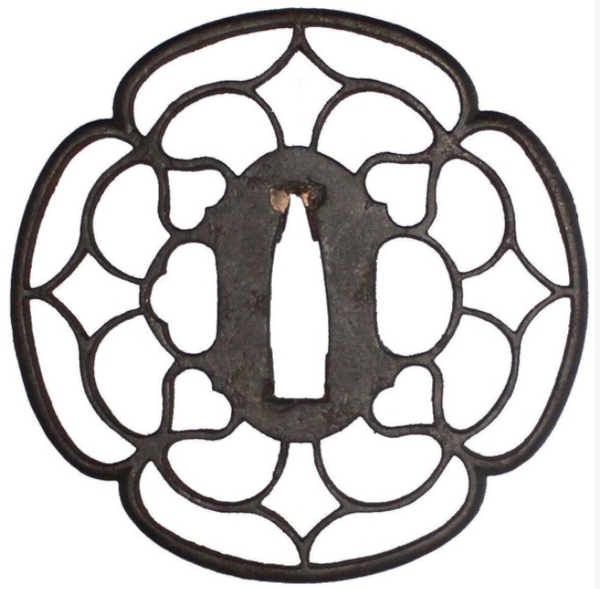
In hindsight, these three are looking like the "small, medium, large" of this flower motif


-
Oh, and yes Dale, the "rigning test" seems like a silly idea. Even a good quality "hardenable" steel is still relatively soft until it is properly heated, and quenched. Unhardened steel would sound "duller" than hardened steel. At best, you could use it to help identify a particular school's work in a particular window of time, but only if you knew that they always hardened their steel tsuba.
-
WOW! That's the best quote yet Dale! The proverbial "smoking gun" so to speak... 1840 is certainly Edo period, although it only hits the last 27 years of a 264 year period Still, you could sure crank out a lot of tsuba in 27 years... then throw in the production during the more industrialized Meiji period that started in 1867, with the first blast furnaces having been around for at least a decade already. Let's assume mass production of tsuba either stalled or stopped after 1876 when the samurai were banned from carrying their daisho, and that mass quantities of older tsuba became available for literally "a dime a dozen" and by the barrel full. And those low prices lasted for decades afterwards. Then add to that the production of more modern cast iron tsuba, let's say for the last 50 years. I'll stop at the 70s because we have seen multiple examples of very cheaply purchased, quality tsuba, from the 50s, 60s and 70s (like Jean's Ko-Katchushi tsuba for 500 yen). So 1840-1876 seems to be the 37 year "window of opportunity" for many of the older cast iron tsuba to have been made. Then there's the onslaught of modern made, higher precision "deception" tsuba in the last 50 years or so.
-
I second the Daigoro option. I've been trying to dig up more info on their work lately and this certainly has that "feel". It's definitely a little too "busy" for Akasaka, and the colour and plate don't look right. But then again, posted images can always have weird colour effects, so not always reliable. Just my 2 cents
-
Then there's all the chiseled woodgrain types like this one I've got: Are these just "Shoami" or more specifically "Aizu-shoami"? I like how they look like topographical maps

-
Thanks Grev That clears it up nicely. I didn't know what school to place your first tsuba pic in either lol. My gut feeling was maybe later Owari, but that didn't quite "feel right". Shoami seems perfectly reasonable. Florian, I like the pattern of yours, and the one plugged hitsu is a really nice feature. I like that it has the "circle/starburst" chisel designs you see in ko-kinko tsuba. The main things I saw that made my pine needle one a "possibility" for "ko", were the melted yakite surface, and the seppa-dai shape that is slightly flattened at the top and bottom, rather than a more gradual oval. I haven't ventured down the path of getting papers yet, but maybe one day... John, that's an interesting backstory on yours. It's always fun digging up info like that.