GRC
-
Posts
762 -
Joined
-
Last visited
-
Days Won
14
Content Type
Profiles
Forums
Events
Store
Downloads
Gallery
Everything posted by GRC
-
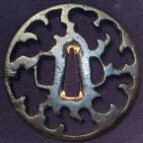
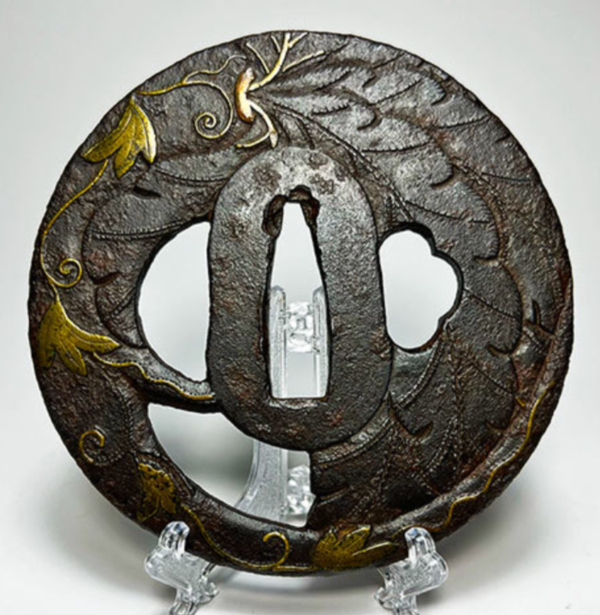
Here's a larger sized one (almost 8.3cm diameter) on YahooJ if you're looking to build up a set
-
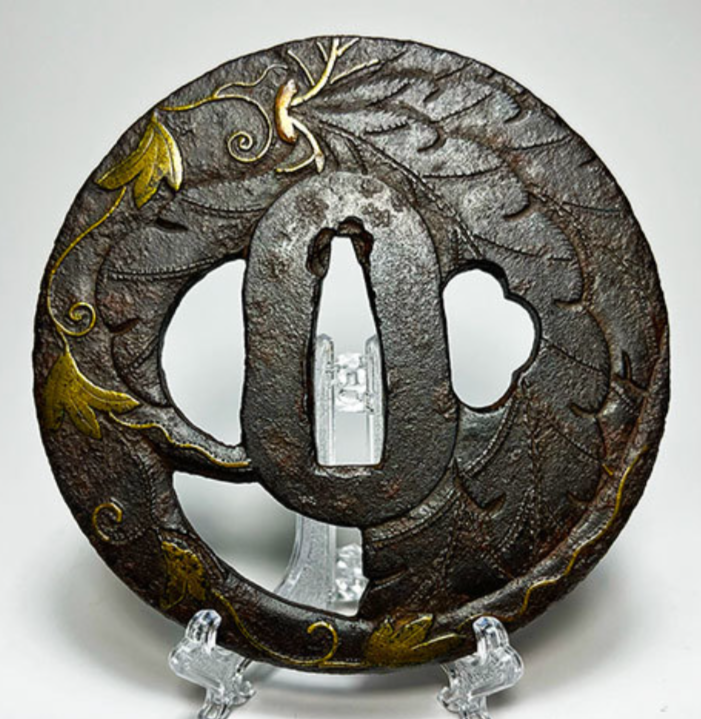
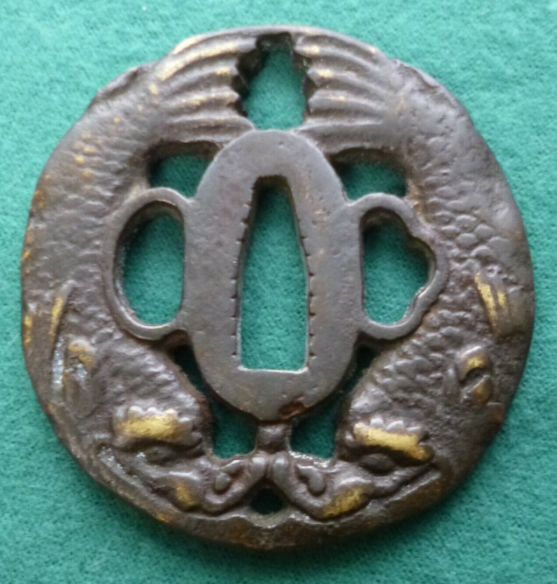
Looks like a proper Heianjo school tsuba. I can't say that I've seen many that size, so I think that's unusual. Congrats on the purchase I haven't seen anything cast that has proper inlays like yours. The cast ones have their surfaces gilded or painted to "look" like they have inlays. Yours looks legit to me. The opening in the center (nakago-ana) looks a bit wide, and the sides are more curved than the usual triangular "wedge" shape, so I'm not too sure what this tsuba was mounted on. There's usually little punch marks (tagane-ato) along that opening that help "pinch" it onto the blade it's being fitted to, and can often end up looking pretty "beat up" from a visual perspective. But, those are missing from yours. I wonder if at some point, a previous owner decided to file all that "roughness" out from the center, thinking it would be "more presentable" that way. Just a hunch though...
-
and then this one shows up on ebay for 10x the price! The eyebrows had a lot of work done... I guess it was sent to a pretty exclusive salon to get that done
-
Hi Gabe. Go to the downloads section and look for the "tsuba diving" article. It was written as a primer to introduce people to tsuba and tsuba collecting. I think the NMB member "GRC" wrote that one After that, the best place to gather some information on various tsuba schools is shibuiswords.com, which is written by Haynes and Long. Haynes has been studying, writing about, and collecting tsuba for many decades After that, have a look at various museum collections posted online: Metropolitan, Ashmolean, etc. Then once you've looked at a few thousand images and gotten a sense of what's out there , THEN start looking to buy the types of tsuba that interest you the most. If you want to build up a collection, then it really helps to have a tsuba "meikan" so you can identify the signatures of various smiths, which also helps to identify some of the many forgeries that exist. It also helps to familiarize yourself with mass produced cast tsuba and some of the really high quality fakes being produced today... so maybe search for "cast tsuba" here on the NMB, and have a look at the "oh for goodness sake" thread to get an idea of what to watch out for. Most importantly, ENJOY IT!!!! Oh, one last thing: bear in mind that the idea of "schools" is pretty fluid for a variety of reasons, including but not limited to: smiths moving to new schools, sharing of technique and style between schools, revival movements in the mid to late Edo periods that sought to bring back some of the styles form the past... not to mention the fact that some of the "schools" weren't actually schools at all and are simply a "construct of convenience" that allow us to classify some of these tsuba, etc etc Hope that helps ...
-
Fantastic Luca! Thanks for sharing that
-
Hi Jean, I’d like to respond to your recent post addressed to me. But first, I’d like to say thanks for engaging in the discussion. Without that back and forth, and inputs from everyone else, I might never have read all these different articles or gathered that information. I have learned a ton and am very grateful for it. I hope everyone else has enjoyed this thread as well. 20 hours ago, ROKUJURO said: “at the beginning of this thread, I have explained that cast iron was a part of the normal output of a TATARA process. So this material was always available, even in pre-EDO times.” That is true, but this is the brittle type of cast iron, so I think all of us would agree that this would not be suited for making tsuba. It’s the use of the softer, less brittle, decarburized cast-iron that would make more sense for the production of tsuba. And again, that was only produced in Japan, as of 1691. And to be fair Jean, you actually started off by presenting this view: On 1/27/2022 at 9:49 AM, ROKUJURO said: “it was not possible to produce cast iron in Japan. But it may have been possible elsewhere, perhaps in China.” The details about the Tatara producing some cast-iron were added in one of your later posts. With regards to this statement: 20 hours ago, ROKUJURO said: “I also explained how difficult and complex the iron casting process was, and how ineffective it would have been in the production of large item numbers.” This one still comes across as a matter of opinion: Lissenden had the opposite point of view and suggested it would be quite reasonable to make many wax forms from an original, carved wooden master. Lissenden also justified the use of this technique when trying to create tsuba with elaborate piercings or sukashi like many of the Nanban tsuba (which would be very similar to the NTHK papered "birds tsuba" posted earlier). The time saved in not having to chisel or drill repeatedly through a steel plate by hand, would outweigh the labour needed to make one wood mold, many wax forms and their surrounding matrixes (the hard casing that goes around the wax form). I could see your statement making sense for producing a tsuba with a solid plate because the solid plate would probably be faster to make using hand forging techniques. But for repeated production of something more elaborate, like Lissenden explained, casting would seem to make the most sense. With regards to this statement: 20 hours ago, ROKUJURO said: “…papered EDO period cast iron (papered as 'cast') TSUBA” Unfortunately, I suspect you might always be left wanting for that… but I’d love to see one too. Here’s a question to consider: What reason would any group that papers tsuba, need to use the words “cast-iron”, when “iron” would be perfectly sufficient to describe what the tsuba is made of? Between cast and forged iron, we’re really only talking about a few percentage points difference in the Carbon content mixed in with the iron, so both of them are simply varying mixes of roughly 95-99% Iron, with the remainder being mostly Carbon and a few other elements. A question for anyone reading this post: Is there a particular way that the NBTHK or NTHK distinguishes between different types of steel that may have been used in the making of swords (other than Nanban steel)? And do they even call it “steel”, or just simply “iron”? Hopefully some "sword people" might know that. In any case Jean, it seems perfectly reasonable for you to hold out for more examples, and I respect your choice. And lastly, to address the “mass-production” aspect: I suppose I look at it as: anything that is “reproducible” in quantity, whether that is 5 at a time or 100 at a time, doesn’t really matter at all I suppose, as long as you can repeat it. That's where Lissenden's "carved wood form" Jean, I suspect you’re probably right in thinking that one-off pieces (and probably small batch productions) may have been the norm, rather than cranking them out like an assembly line. I think there’s no doubt that the real “mass” production hit its stride in the Meiji period. In any case, the only real pursuit for me was whether or not the Japanese were making cast-iron tsuba during the Edo period. And now that seems to be likely. I’d like to end off by bringing back a quote from the first page of this thread. At the time, I found it to be an amazing quote from Markus Sesko, but I didn’t know enough to be able to put it in proper context. I really wasn’t ready to wrap my head around such an early date for cast-iron tsuba: On 1/26/2022 at 5:08 AM, JohnTo said: “Markus Sesko has a small reference to cast iron tsuba in his book the Japanese toso-kinko Schools (p 129) which states that the kinko artist Daininchi Fucho (active around Horeki, 1751-1764) learned his skills ‘from Ugai Gorozaemon who belonged to an Osaka-based family of kettle casters who produced cast-iron tsuba as a sideline.’ Now that mid-1700 timeframe makes so much more sense…
-
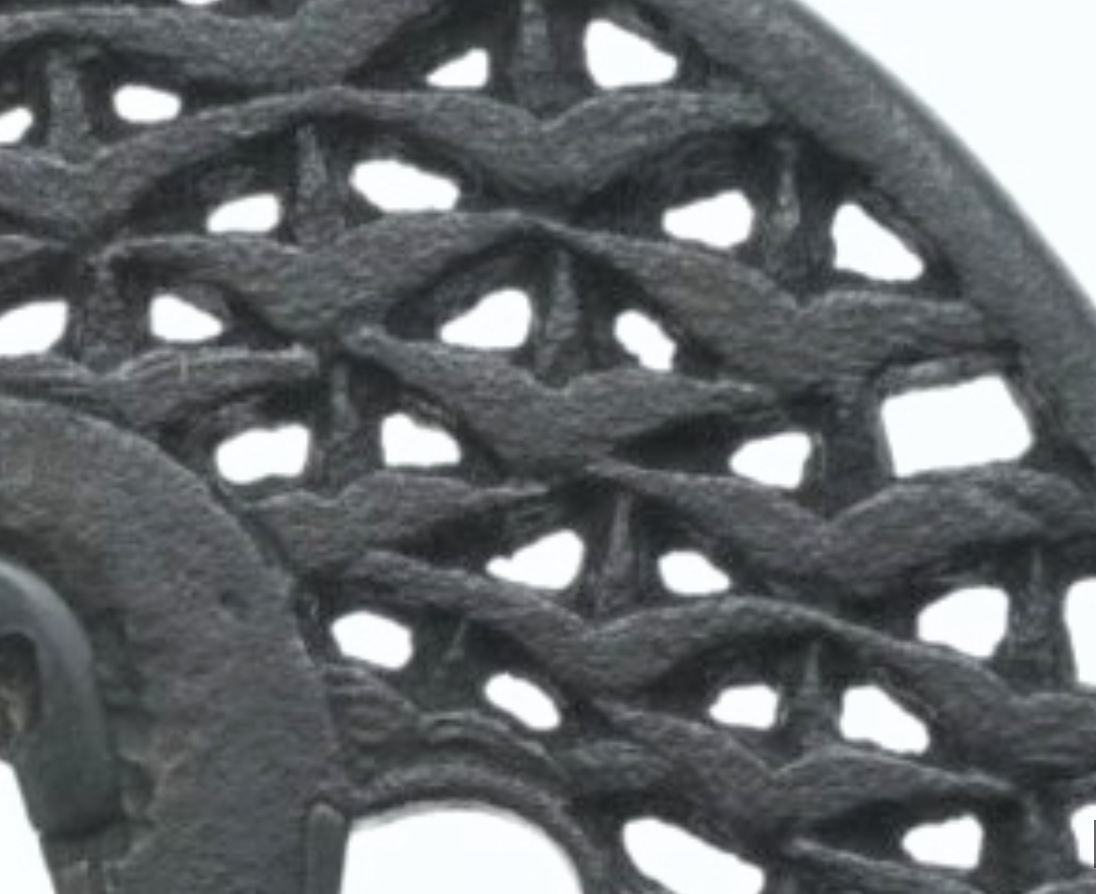
Roger, you're spot on. Hand working after casting makes it more difficult since you'll see evidence of both. By the way, this was something that was pointed out by Lissenden, in his analysis of casting in Nanban tsuba. He found that there was quite a varying degree of hand working of the cast tsuba he analyzed. Lissenden also made the assertion that if the tsuba has some hallmarks of being cast, then one must assume that it was initially cast. It would be extremely difficult to explain the presence of some of those features if it was exclusively hand forged. However some features, taken on their own could potentially be explained by other factors, which is why it really helps to have either: multiple signs of casting, or at least one casting feature that wouldn't make any sense being there if it was hand forged. An additional issue is relying on digital images alone. These will vary in picture quality, the angles presented, as well as light and colour saturation of the image. Playing around with these can really hide some of the cast-features. So on a side note... watch out for sellers with really dark images. Download/save the images, then change the brightness and contrast of the image so you can get a better look. It's always helpful to have angled views where you can see inside the hitsu and sukashi, as well as get a good look at the outer face of the mimi. Another issue is the degree of pitting and rusting on the tsuba... that can make things so muddy that you can't be certain of anything. In those cases, the only way I've been comfortable calling it cast, is when I have another example of an identically patterned tsuba that is less corroded.
-
Sorry Jean, but you have misinterpreted where my “zeal” has been directed… The whole way along, I have merely been entertaining the question: “Why not in the Edo period?” …and I have been looking for answers ever since, ready to accept whatever the outcome may be. If you look back, I was ready to “end the search” at the date of construction of the first Western style blast furnace in 1857, assuming that would be the only consistent source of the cast-iron. But, new quotes came up, that pointed to earlier dates of cast-iron tsuba production (1840s-1860s). So, I even raised some questions that I felt would have to be answered in order to help corroborate those dates: a) Where did that cast-iron come from, especially if it was malleable cast iron? This is what I equate to “OPPORTUNITY”… ie. COULD THEY HAVE DONE THAT, and HOW? b) What was the reason for their production, and who was the target market? This is what I equate to “MOTIVE” (Especially given that these dates were earlier than the Meiji period when Japan opened up to foreign buyers) After reading the sources listed in my last post, we now know FOR CERTAIN, that the Japanese had been producing and decarburizing their own cast-iron since 1691. Prior to that post, the belief presented here on the NMB was that it was not possible for Japan to produce cast-iron, let alone malleable cast-iron which requires further processing. This was used to advance the idea that cast-iron tsuba COULD NOT have been produced in Japan during the EDO period. These are clearly FALSE. As stated in one of my previous posts, part of my quest for finding answers, is to advance an idea from POSSIBLE to PLAUSIBLE, and ideally to CERTAIN. I can see now, a more realistic outcome may be: from broadly POSSIBLE (“don’t know, but maybe?”), to PLAUSIBLE (“ya, it could be”), to PROBABLE (“yes, probably”). So Jean, I’d also like to point out, that it was completely irrelevant for my last post to have the word TSUBA in the quotes provided, because I was merely advancing that new information to establish that: During the Edo-period (1691 onward), the Japanese had the OPPORTUNITY to make cast-iron tsuba that wouldn’t be so brittle as to be unusable. This information, just on its own, turns the dial from merely POSSIBLE, to PLAUSIBLE. My other summary statements were made because of the combination of · all the scholarly quotes provided throughout this NMB thread that support the idea (both directly and indirectly) · the papered cast tsuba examples · the accessibility to malleable cast iron from 1691 onward · two motives to justify why they may have been produced earlier than the Meiji period Taken as a whole, that seems to push the idea of cast-iron tsuba in the Edo period towards PROBABLE. Of course though, everyone is entitled to believe whatever they want. My goal is not to change your mind, but rather to ask questions, find answers, and follow the weight of the evidence.
-
RESEARCHING THE “COMMERCIALIZATION” OF THE Japanese STEEL-PRODUCING PROCESS USING TATARA DURING THE EDO PERIOD: sourced from: 1- History of Steel in Japan, by Eiho Nishida. 1973 2- An Iron Workers Community in Japan- A Study in the Sociology of Industrial Groups, by Kunio Odaka. 1950. The Japanese Tatara had gone through several stages of evolution to reach its “final stage” of development by the year 1691, that utilized a much improved, multi-person “see-saw” / “balance-type” bellows, with a hearth designed to retain heat. (1) These were staffed by a great number of both skilled workers, artisans, and less-skilled labour workers, who lived in dedicated communities of 50 to 200 people (including their families). (2) This final stage of development moved it from an outdoor small scale production output, to an indoor “industrial-scale” steel production with a complex of dedicated buildings that included: “The iron-cut, where iron sand was extracted; the charcoal yard; the smelter (see-saw Tatara); and the forge.” (2) “The forge consisted of a shop where the pig iron (cast-iron) was decarbonized and a finishing shop.” (2) “Commonly, work at the furnace continued for three or four nights at a time, during which workmen were not allowed to return to their homes.” (2) Using one of three different processes with this setup, three types of smelted metals could be produced (1): 1- “Kera” for swords 2- “Zuku” for casting (same as the “pig-iron” quoted above) 3- “Wrought iron” by decarburizing the Zuku or lower grade Kera These advanced indoor Tatara could produce steel blocks that weighed 4000-5000 pounds, which could then be broken up by a large hammer called a “DO” that was powered by a water wheel. (2) In 1853, the Japanese ban on building large ships was lifted, and in order to keep up with the increased demand for steel, the first Western style “blast-furnace” was built in 1857. So, in summary, the Japanese were able to make large scale quantities of cast-iron, as well as decarburize it to make it softer, since roughly the year 1700! (…rounded up from 1691) The introduction of the Western blast-furnace was only necessary to scale up production to even greater quantities, NOT in order to start the production. So, now we can add “OPPORTUNITY” on top of the already discussed “MOTIVE” for the production of cast-iron tsuba in the Edo period, as well as several EXAMPLES of cast tsuba that have been papered by NTHK or NBTHK. And just to add another MOTIVE for “mass-production” of tsuba, at least from the 1850s onwards (1):

-
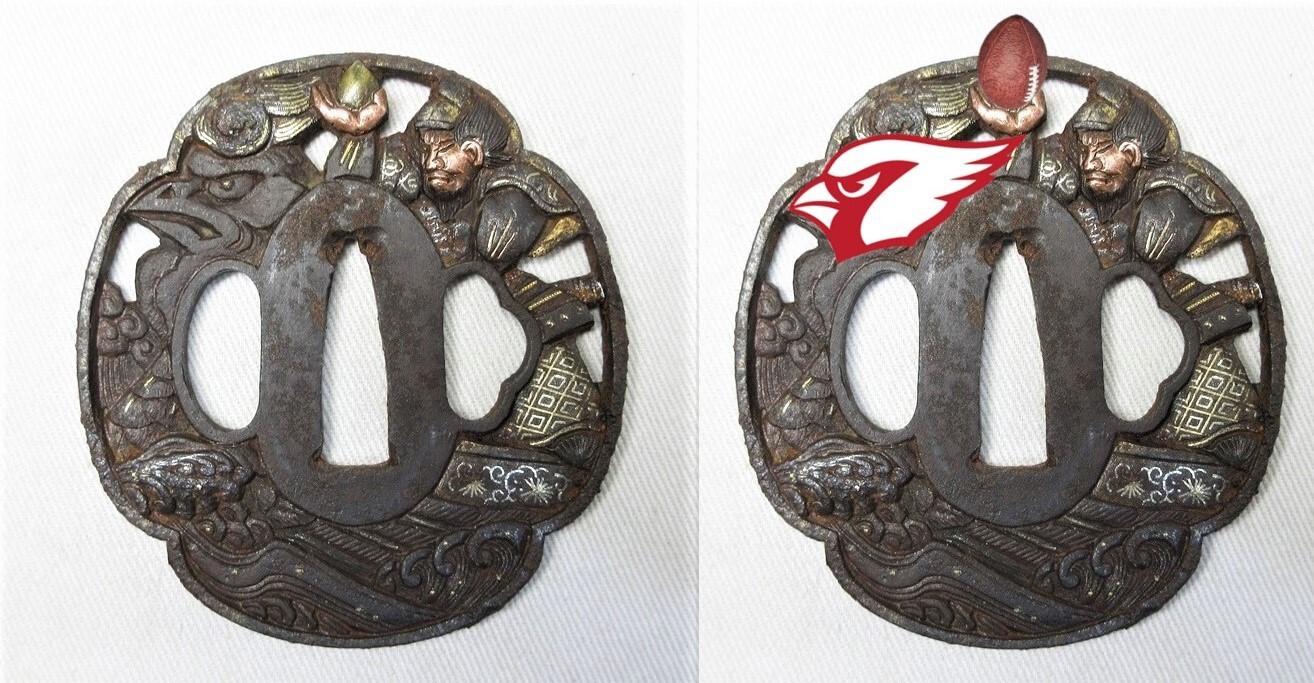
Sorry, couldn't resist... the resemblance is amazing though. Or maybe this tsubako was a fan of American football? (Not that it existed yet...)

-
BTW, I looked into some more analysis techniques, specifically the potential for using the CARBON DATING (which is invasive) and found a published journal article on it: Dating Iron by the Carbon-14 Method, by Van der Merwe and Stuiver Quick summary: One major limitation is getting a large enough sample to get enough Carbon to do the analysis. Cast iron is typically around 2% Carbon, and if it was softened afterwards through decarburization, then it would have even less. The ideal sample size for cast iron is about 100g, so that's pretty much the whole tsuba on most cases! The fuel that is burned is the only source of Carbon that gets mixed in with the iron to become cast-iron. So another major limitation is the source of the fuel that was used to produce the cast iron. If it was made with charcoal made from burnt fresh wood, then you can date it properly. But, If it was made from fossil-fuel coal, then it can't be Carbon-dated because it's too old. The upper limit of Carbon dating is around 50,000 years, and fossil fuels are millions of years old... simply a no-go. Fossil-fuel coal use began in the early 18th century in Europe and spread from there. From that time forward, both processes were used, sometimes even being mixed together to get specific products. This makes dating 18th and 19th century cast iron objects much more difficult because you won't know what the fuel source was for a particular object before you grind it all up and put it through the Carbon-14 testing. So if testing is done, it definitely has to be of the non-invasive type. Just thought I'd share that info if anyone was wondering about the possibility of using Carbon-dating techniques on tsuba
-
Relying on images alone, can make the identification of cast-iron very difficult. But I can see why you might single this one out. Even though this one is "Heianjo-style", there's a whole group of Heianjo plates that have purposefully rough-textured surfaces that were worked by hand (and possibly some sort of chemical treatment as well to create all the pitting and "flaked"-look... just a hypothesis). So this one should not be counted as "cast-iron". They are recognized as being proper forged plates. btw, the added ring on a mimi is a "fukurin" not a "hukurin"... could just be one of those pronunciation/translation issues of going from Japanese to English..
-
I hope the list of translated terms I put up aren't all euphemisms for some raunchy acts I think I figured out what the "diagram" and the outline around the nakago-ana on the first one are Definitely still qualifies as art Bazza. But certainly appealing to a very specific group of art admirers
-
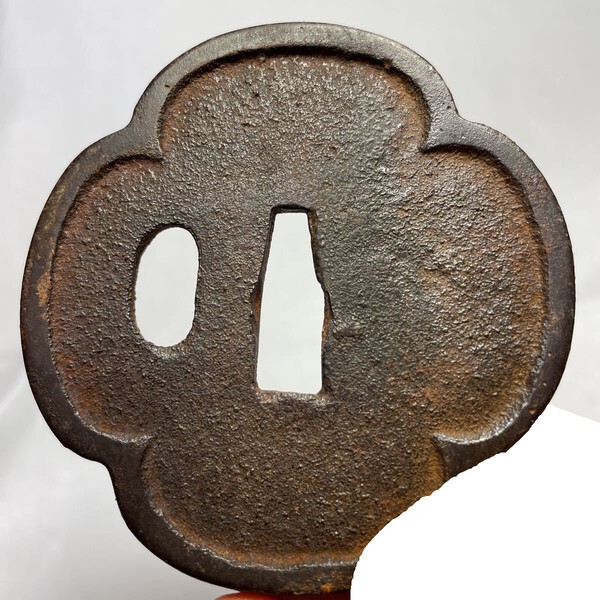
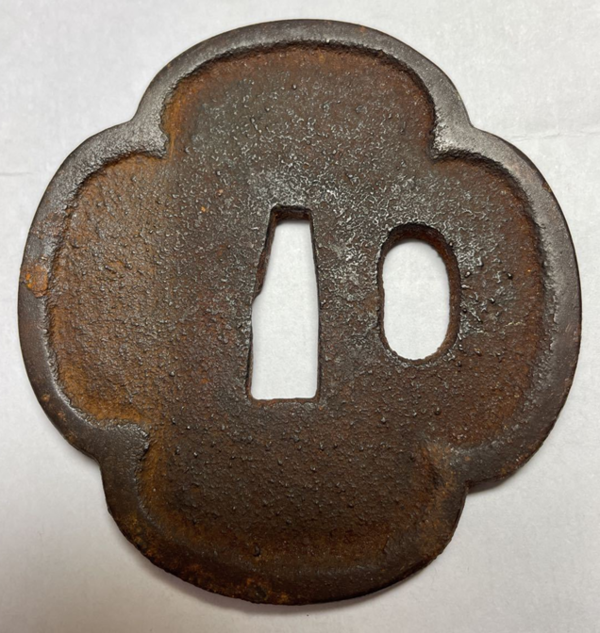
Well here's an interesting example that I haven't seen before: It's a completely utilitarian cast-iron tsuba, and not a copy of some fancy high end tsuba. So, one would have to assume this was not made to sell to foreigners, and was intended for domestic use. I erased the seller's fingers from the bottom right of the image.
-
oh lol, I didn't even see the theme on the second one!
-
That first one has script from a Japanese author whose works were published in the late 1920s and early 30s, but were banned/censored during a period of censorship leading up to WW II. I used a photo translation tool (which is far from perfect) to identify some of the text and the key references seem to be: -The battle of Chausuyama -Chief General Sane Asada Motokyou -Shimomunekari, who made a large spear tip wall -the place where Akari Handa sits In reading more about this period of censorship, I found out that they mostly banned writings with certain political ideologies, criticisms of certain foreign nationals, as well as references to assorted "debauchery" and red-light districts. The works also had to hit a certain threshold of "offending passages" in order to qualify. I think it's really interesting that someone would purposely etch these specific passages from a banned author, onto the tsuba of a sword, presumably in the 1930s... I have so many questions...
-
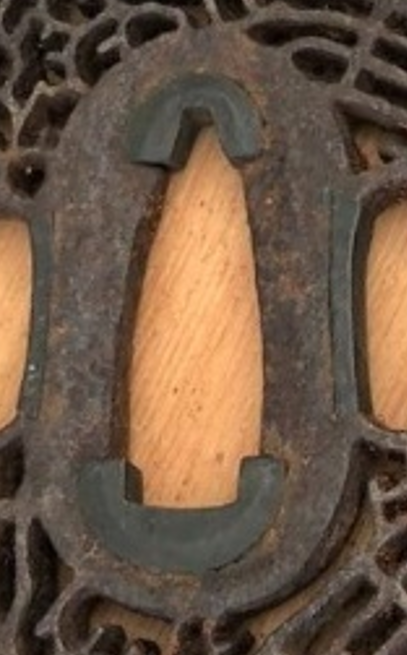
Coincidentally, I recently saw a Daigoro school "bundles of branches" tsuba that had very similar shakudo sekigane inserts at the top and bottom of the nakago-ana and sides of the seppa-dai. Interestingly, the seller even clearly described it as "junk", yet it still sold for around 32,000 yen!!! This Daigoro one had a lot more hand-work done to flatten out all the insides of the "sukashi". This kind of sekigane is not common at all so it's possible that both tsuba were made by the same producer and this could be one of their identifying characteristics. There's even some similarity in the hitsu shapes themselves. Again, not the type of tsuba a lower level samurai or merchant could afford an original of, so it seems to be another solid candidate for a late Edo period, cast-iron, shiiremono tsuba. And, it "fooled" today's collectors who have digital zoom capability, so back in the day, it would certainly look like an original when mounted on a sword and viewed from a distance.


-
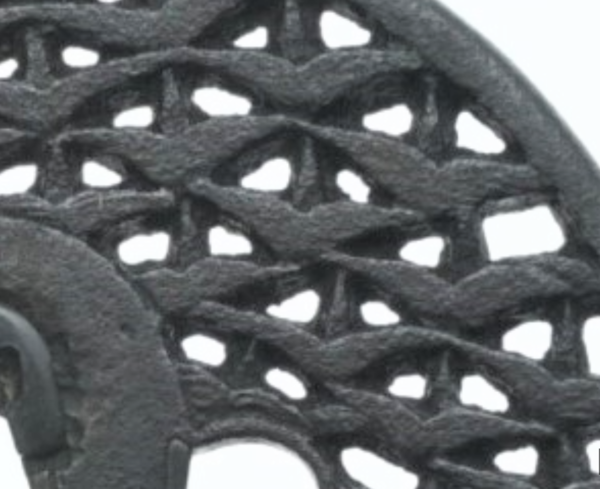
Dan, I think this one would certainly qualify as a shiiremono copy of an earlier Tadatoki piece form the Akasaka school (no idea which generation though). Regarding this tsuba: -It's definitely not up to the same standard as the typical papered Akasaka. -All of the surface edges of the birds are roughly textured and don't appear to be chiseled. -The mimi and seppa-dai all appear to have the same "porous" look to the them, pretty much everywhere. -There's even a bunch of "voids" in the vertical walls outlining the birds (once you increase the brightness of the image) so definitely cast-iron. As for hand-work: -The smooth insides of the hitsu, as well as the flat outer surface and rounded edges of the mimi must have been filed. -Also, I suspect there may have been thin "webs" that formed in the pockets where the sukashi should be. If you look closely, they appear to have been "drilled" out by hand afterward, because there's a series of little circular outlines to these "web" remnants. But it doesn't look like these were drilled through from one surface to the other... just through a thinner "web layer" in between the birds. So according to the NTHK and description, this is a late Edo cast-iron tsuba.


-
That game board also looks like it would serve well as a stepping stool... So maybe someone was poking fun at a rider who was short in stature and needed a stepping stool and ladder to get up on his horse? I'm just kidding of course...
-
the two objects at the bottom left are stirrups for riding a horse;
-
Geraint is spot on. I'd like to add some additional context: Collectors and dealers have been mixing and matching the components of koshirae from the get-go, to suit their own aesthetic ideals and market trends. It would be extremely rare to find a blade in all its original mounts. Add to that, the fact that the samurai themselves had several sets of fittings for each blade, and would swap them out to suit a particular mood or occasion. So who is to say for sure which set of fittings was the "original" for a specific blade? Unless of course it was a specially commissioned set of fittings and there's some kind of documentation to back it up. And btw, that particular tsuba you showed is available is such huge quantities that there is at least one or more available for sale at all times from a variety of sources. I've now seen so many that I'm starting to think that it could be the most produced cast-iron tsuba pattern in existence...
-
Completely agree with Florian's statement Here's the one I just missed out on, to someone with deeper pockets... It's also the example I still had "on the brain", where I thought the Yatsuhashi theme was cleverly and creatively depicted. I think the raised mimi represents the flower, the zig-zag is the reference to the Yatsuhashi (8 bridges), and the mokume is the water itself. Stunningly simply and elegant representational art. I'm already regretting losing out on this one... at least I got to see it and admire it


-
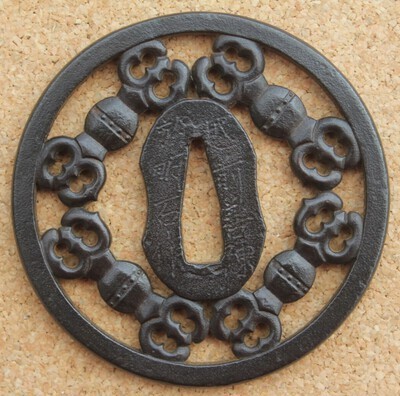
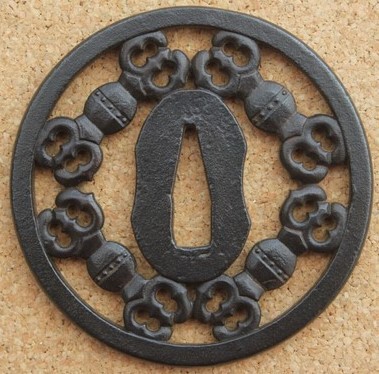
Here's a cast-iron tsuba with a design that your average samurai or merchant might not be able to afford an original of. But it sure would look nice on a sword (especially without the assistance of "digital zoom" to nitpick at the details). Back in the day, you'd probably never be close enough to notice it was cast... and if you were, you'd probably be more concerned about losing a limb (images reposted with permission )
-
Fantastic! Congrats on the purchase and making that awesome connection
-
I found some quotes that identify the "target market" for cast-iron tsuba prior to the Meiji period (ie. late Edo period) I was looking at some more Nanban info and noted that authors associated many of these (but not all) with "SHIIREMONO" (shi-ire-mono). Here's a previous thread about it on the NMB: https://www.militaria.co.za/nmb/topic/11499-shiiremono/ Quick summary: Shiiremono are essentially "mass produced" and generally regarded as lesser quality. However, there was also a full range of quality and prices of shiiremono of all types (not just Nanban-style tsuba). Lissenden pointed out that bulk production of cast-iron tsuba would certainly fit this type of production. He also noted that the labour intensive "undercutting" openwork of the karakusa-style Nanban tsuba would have benefited greatly from an initial rough casting of the tsuba, followed by hand finishing. I came across two quotes from reliable sources (Haynes and Gunsaulus) that push the date of shiiremono production back into the Edo period and even as far back as the 1700s. HAYNES quote from SOSHIN in the NMB thread above: "Here is a definition taken from the glossary of Tsuba An Anesthetic Study by Haynes and Torigoye. SHIIREMONO: "ready-made article." When applied to tsuba this term refers to ready-made or mass production work of the late Edo age, but may also be applied to mass production pieces of earlier ages. Much SHIIREMONO was made to be sold to foreigners." GUNSAULUS quote from Japanese Sword Mounts in the Field Museum of Natural History - Chicago "With the warring epochs definitely closed under the early Tokugawa shoguns, the end of the seventeenth and eighteenth centuries witnessed the culmination of the indulgent and luxurious life of the members of the military class. Tales are told of daimyo who, having lost much of their political power, sought satisfaction in the fields of art and poetry, and who, on account of their leisure worshipped richness and adornment to the extent of painting themselves after the fashion of women and matching their decorated swords with the magnificent costumes which were commonly worn in their court ceremonies. Merchants likewise became more prosperous, and many of them took to wearing swords along with their writing outfits (yatate) thrust through their belts. Due to these developments, the metal-workers outvied one another to produce sword-fittings of extreme beauty and elegance, and likewise, in order to satisfy the demands of the lower classes, artisans, copying the artists, turned out replicas and shiiremono in great number." So in times of escalating decadence, the lower classes of merchants (who were only allowed to wear one sword) and samurai (who were obligated to wear two swords) would be the target market for less costly copies of some of the finer works being produced for the more affluent. The quote points out the fact that tsubako were busy outdoing each other to make the next great tsuba, but someone still had to supply tsuba for the masses. So how does all this relate to cast-iron tsuba? Although there is no specific mention of "cast-iron" in either of these quotes, they both provide the "need" and the "market" for less expensive, mass produced tsuba in the late Edo period, prior to the Meiji period. And that fits with the late Edo time frame in Dale's most recent quote of cast-iron tsuba going back to at least the 1840s, as well as some of his other quotes stating that the mass copying of tsuba was well under way before the Meiji period.