GRC
-
Posts
757 -
Joined
-
Last visited
-
Days Won
14
Content Type
Profiles
Forums
Events
Store
Downloads
Gallery
Everything posted by GRC
-
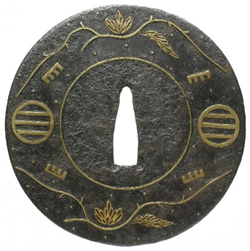
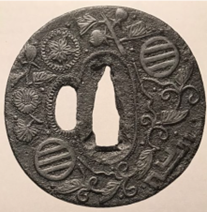
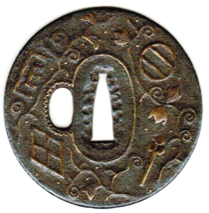
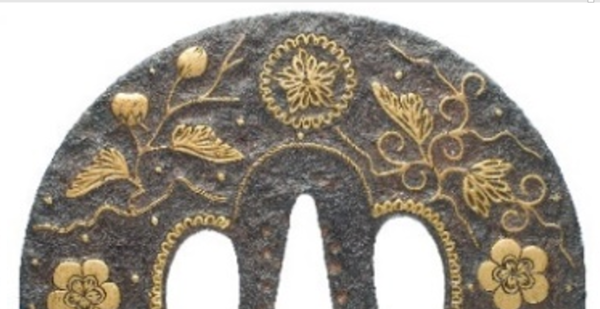
Stylistically, the arrangement of inlays looks more like Onin to me... Here are some known Momoyama period Onin examples for comparison: Note 1: the first four have a similar hitsu outline treatment as Luca's Note2: Onin often used a brass outline around the seppa-dai, whereas Heianjo did that a lot less frequently. Also note that most of the ones below have traces of "rope" patterning, rather than being perfectly smooth (closeup view in the last pic). Note3: same surface texture of the plate between Luca's and the ones below Note4: the flower treatments in Luca's tsuba look more like the Onin flowers below (the leftmost tsuba in the 1st and 2nd row))


-
The first one definitely looks like a rimbo/rinpo/rinpou 輪宝it, and it looks like the ends of the spokes are either jewels (which are often seen in these wheel motifs, like in the image below), or maybe even the tips of vajra (a handheld scepter with Buddhist symbolism). The rinpo is a Buddhist symbol shaped like a wheel with eight spokes (usually 8). The eight spokes represent the Buddhist "eighfold path" to reach enlightenment (don't ask me what the eight steps are though)

-
pac man eating a ghost maybe?

-
donkey kong is only available as a daisho


-
Pong anyone? The ball is moving so fast it's looking a little stretched out

-
I'm with Grev on that one, it's one of the fiercer looking, more naturalistic tsuba tigers
-
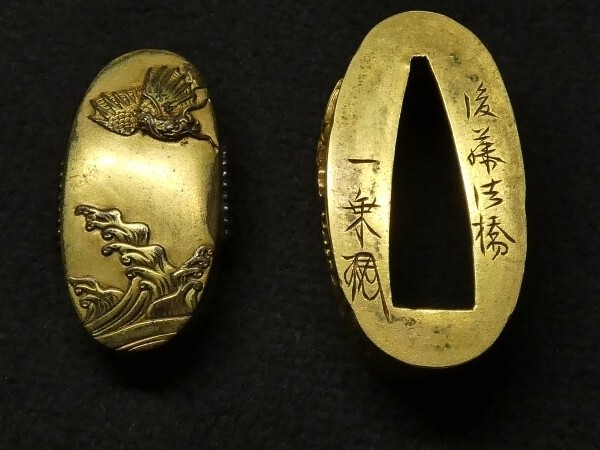
Shachi fuchi & kashira set, signed:

-
I picked up this tsuba a while back, partly because the construction seemed so bizarre. The sukashi flower motif is one solid piece with the seppa-dai, but it is wedged in and pressure-fitted inside a completely separate mimi. I've got a few questions: 1- How common was this, and does anyone else have any other examples? 2- Who made tsuba like this and WHY? I can't figure out the advantage (if any) of making a tsuba this way. The only thing that popped into my head was that maybe someone went to the trouble of replacing a previously damaged mimi that was original to the one-piece construction of the tsuba? There are images of a similarly built tsuba (#121) in the Nakamura tsuba book. It is shown whole, as well as disassembled: I suspect tsuba #120 is as well (shown below). The tips of the sukashi elements don't sit flush with the surface of the mimi and they all appear to be a little too "crisp" where they meet up with inner surface of the mimi. Also, I suspect the mimi was hit with a punch 3 times (roughly at the 10 o'clock position) in order to make a tighter compression fit to hold onto the tips of the iris flower... kind of like tagane-ato positioned along the mimi instead of around the nakago-ana. Could someone be so kind as to translate the captions for tsuba 120-121? Many thanks in advance


-
Richard, you peaked my curiosity... Love that tsuba too btw Interestingly, I found a scholarly article on the dendritic growth of silver, and it happens in the presence of sulfate ions (S04 with a 2- charge)... that's a sulfur atom combined with 4 oxygen atoms, which will interact with the silver ions in such a way as to allow for the silver to travel/grow in a dendritic pattern (similar to the branches of a tree, or branching neurons in the brain, or "fractal" patterns in general). So here is one possible explanation for what we're seeing on that tsuba: Some of the captured sulfur in the silver tarnish would have to have reacted with some source of oxygen to become sulfate ions. (not too sure how readily this occurs in the environment of a tsuba's surface during feudal Japan , but let's assume it happens) Then throw in the presence of some moisture for the silver and sulfate ions to interact in solution, then voila, you will get dendritic growth of silver. (remember that there are some silver and sulfur ions present in the tarnish, which will dissolve in water, even though the tarnish is mostly a covalently bonded network solid that will mostly not dissolve in water) The image below shows lumpy/clumpy growth of silver in the presence of nitrates (nitrogen with 3 oxygens), but dendritic growth in the presence of low concentrations of sulfates (sulfur and 4 oxygens). This growth occurred on a sheet of copper in this experiment, but I imagine it would be similar on some other metal (like an iron tsuba). Here's the link to the article if anyone else is interested: Fast Growth Synthesis of Silver Dendrite Crystals Assisted by Sulfate Ion and Its Application for Surface-Enhanced Raman Scattering | The Journal of Physical Chemistry C (acs.org) Video of the dendritic growth (looks like a whole coral reef is growing, but it's silver): https://doi.org/10.1021/jp201484r

-
Hi Mark. I assumed your use of "sulphate" was accidental Just wanted to clear it up for other members. As for solubility, I completely agree, and wasn't disputing that at all. As for weight vs mass, Once again, I completely agree that they are different terms with different meanings. "Mass", as you say, is certainly the correct term to use. I chose to use the word "weight" because that was the word most people were using in their posts, and what they would typically use when speaking to other people, so at the time, I didn't think it was necessary to add another layer of nuance to the scientific terminology being used. In hindsight, I probably should have included "mass" in my statements. Again, this illustrates the omnipresent issues with discussing scientific or technical concepts in a chat or forum-post type of format. Ultimately, my goal in posting was to try to bridge the gap between academic science and a "layman's" understanding, where perhaps the last bit of science training someone had was back when they were in high school Dirk, thanks for posting the closeup pic The spread and rise of the tarnished silver are both clear in that photo.
-
Geoffrey, "gimei" are tsuba that have had signatures put on them on them that basically make the claim that they were made by a particular smith or "school" of smiths. Gimei signatures could have been added at the time the tsuba was produced, or added later by someone who likely wasn't even a tsuba maker, both having the ultimate intent of inflating their value for sale purposes. These were/are very common practices in Japan (and elsewhere). I think what people might be suggesting by saying "late productions" is that these are all likely genuine Edo period tsuba, but are later direct "copies of", or simply "in the style of" earlier works. During the Edo period, there seems to have been a fair number of tsuba workshops that made large quantities of certain tsuba styles and motifs. Although most were made by relatively skilled craftsmen, there's still an element of "production for the masses". It's also possible that some of your tsuba were made by a particular tsuba "school", where apprentice smiths were making "copies" of a master-smith's work in order to scale up production. These wouldn't be considered "gimei" but would be considered "school work". In the end, these things are worth what people are willing to pay for them. But on that note, a well made copy or well made "in the style of" tsuba still has intrinsic value because someone will like it and will want to have it. The difference in the end will be a value $30-$50, a few $100 to a $1000, or many $1000s... From my observations, the closer the connection to the original master smith in both time and location of production, the higher price people are willing to pay for it. Something like this type of ranking: 1-original master work by a master artist 2-original work (but maybe not a "masterpiece") by a master artist 3-work in the style of the master, by one of their direct students (early school work) 4-work in the style of the "school", by a later generation smith working in the school (later school work) 5-some tsuba artist/craftsman somewhere, with no specific connection to the original master or school, who produces a piece in the style of a particular school ("gimei" if signed with some specific school or earlier smith's name) ... ... x-mass productions made by casting or machining. (* I didn't want to give this one a number so I called it "X". We've seen many examples where someone ended up paying way too much for one of these. The newly made ones are really deceptive!) I may have missed some in that list... so anyone can feel free to add to it, or muck around with the idea I suppose you could also make the case to re-rank #2-5 based on the specific talents of the respective smiths who made the tsuba Geoffrey, I'm guessing most of your collection would fall in the #4-5 categories, but I'm most familiar with only one of yours, so I leave the rest to the other NMB members to offer up their thoughts. I just wanted to help with the idea of "gimei", then I got caught up in values and rankings...
-
That's an interesting difference to point out Ford... The formation of a network would definitely "rearrange and reorganize" the existing silver atoms into this new network with the sulfur. So why does it stick better to silver than to iron? Here's my hypothesis: I could see the silver nunome sliding around more on an iron surface because it was merely "applied" to the iron surface to begin with, so it was never really "integrated" into the iron in any atomic sense. The atoms in the steel below would all be "metallically bonded" to each other so it might be harder for a newly forming network of silver sulfide to "push" its way down into the steel, so it would preferentially "skate" over surface as it grows. Take the "path of least resistance" so to speak. Conversely, the tarnish buildup on a chunk of silver would actually be "pulling" silver atoms that were actually "metallically bonded" with (and among) the other silver atoms of the block, so maybe the network forms in such a way that it is more "integrated" and woven into the silver block itself. Maybe even forming "peaks" and "troughs" going in and out of the silver block, kind of "locking it in" to a certain degree, rather than the "loose sheet" that seems to form on iron. This is just some deductive reasoning on my part... so I'm not sure if these statements are actually true But, it could help explain why the tarnished silver nunome on iron comes off so easily, but the silver tarnish is harder to remove from a silver base.
-
Congrats! I applaud your thrift store rescue, and then your seeking out of information
-
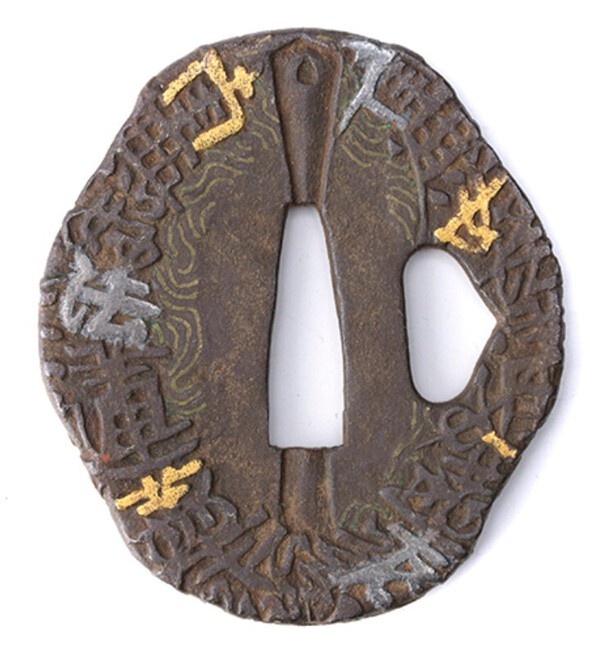
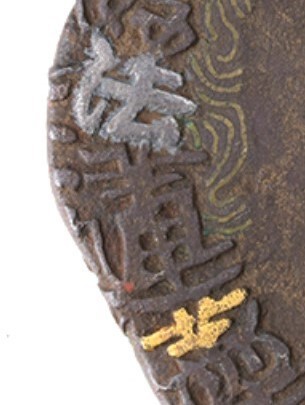
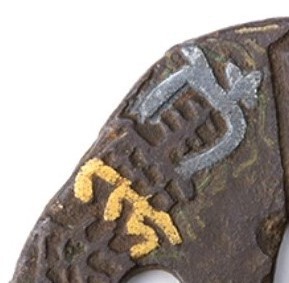
Just to give a visual to go along with the "fugitive" nature of silver vs gold nunome, the silver does have a tendency to "travel out" from where it started on the tsuba (not my tsuba btw):
-
like Barry, I'm also a science teacher (although not retired yet). I just wanted to comment on a few little statements to maybe help a bit, and avoid having some members (without science backgrounds) build up some accidental misconceptions Ford just corrected this one, perhaps inadvertently. silver sufide vs silver sulphate: The black silver "tarnish" that you see building up on old silver is Ag2S, is called silver sulfide, not "silver sulfate" Ag2(SO4) (silver sulphate for the UK spellers out their). These are two different substances with different physical and chemical properties. For example: silver sulfide is black, whereas silver sulfate is white. Silver sulfide forms a covalently bonded "network solid" with only slight ionic properties, and is considered to be insoluble in most solvents, including water. (https://en.wikipedia.org/wiki/Silver_sulfide) ie. It doesn't dissolve much at all, in just about any type of substance that would dissolve other things, so the loss in water would be pretty much imperceptible. Just some semantic wording on this one, but I believe the ideas are fundamentally sound when taken together as a whole: The main thing to clarify is the use of the word "element". The word "element" gets muddied by the fact that it can be used to refer to a single atom (like 1 atom of silver) or a grouping of atoms of 1 type (like a block of 100% pure silver). It might be more clear to rewrite it like this (although much wordier... so it's always a pain in the butt to explain science clearly in a chat or forum-post format): A metal object will gain weight when the surface atoms react with other elements/compounds in such a way to produce some type of "corrosion product", but only if that "corrosion product" stays on the surface of the metal object. The reason for this weight gain is that atoms from an external source in the environment are reacting with the surface atoms of the metal object in such a way as to combine with them to form "compounds". ie New atoms are being added to the metal object, therefore the object will gain the additional weight of the new atoms. That's the whole "conservation of mass" concept that was stated earlier by Mark H. Now on to the use of "element" in the context of weight changes: A block of "elemental" pure silver, will gain mass when it tarnishes, because sulfur atoms are being added to its surface as the black tarnish forms. But, technically an "element" as a "single atom" doesn't necessarily gain weight in a reaction... If an element ("single atom") does change weight in a chemical reaction, the atom itself will have only gained, lost or shared electrons, which are so small in size and mass that they are not measurable on a practical level. In the case of silver tarnish, a single atom of silver will be constantly gaining and losing the two electrons that are now being shared in the covalent bond between it and an the adjacent sulfur atom in the silver sulfide network. One silver and one sulfur are now sharing one electron each with each other, and these two electrons will be travelling (teleporting) back and forth between the adjacent silver and sulfur atoms. And again, this gain and loss of electrons would be imperceptible on any practical level of measurement. Now back to Colin's tsuba and iron corrosion products: In some cases the corrosion products (like the iron oxides in Colin's tsuba) have different physical properties that the original metal object, making them structurally more brittle, which can allow them to "break away" from the metal object over time. In the case of Colin's tsuba, the pitting we see is caused by the loss of this more flaky, brittle, iron oxide material ("rust"). So this tsuba has definitely lost some weight that could easily be measured (if we had the original mass). But if there is simply some reddish dusting on the surface of a steel tsuba, and none of it has flaked off yet, then the steel tsuba will have also gained weight, similar to the way the silver tarnish added weight to a block of silver. However, In this case, oxygen atoms will have been added to its surface as it "rusted" to form the iron oxides. Tying the idea of change in properties back to silver tarnish: The fact silver sulfide that it forms a "network solid" helps explain Ford's observations that it can actually flake off in chunks on really old silver. I've never seen that, but unlike Ford, I've never had a piece of silver that was so old that it had built up enough of this solid silver sulfide. Cool "fun facts" for the classroom, thanks Ford. Effects of rust or tarnish removal on weight: So given all of the above information, any time you polish away the rust from steel or tarnish from silver, you will be physically removing some of the original iron or silver atoms that had been incorporated into the rust or tarnish that you are removing. Ok i'm done now... sorry for being so long winded I hope it helps.
-
Thanks Geraint, it was actually Dale's post of exactly that set that got me thinking about all those questions That Nanban set was likely made in Japan, possibly by Chinese smiths working in Nagasaki.
-
One of Dale's posts in the "Unaltered Nanban" thread got me thinking... I've got some questions related to kozuka and kogai (not my area of focus, so I don't know too much about them): 1- Given that these are both Japanese implements, could one assume that "ALL" kozuka and kogai were made in Japan? 2- Does anyone have any examples of kogai or kozuka that were made in another country (other than cheapo modern knock-offs)? 3- Does anyone have any examples of kogai or kozuka that were fitted and used on non-Japanese swords? 4a- What do the earliest (pre-Edo to early Edo) kozuka and kogai look like? 4b- Were early kogai and kozuka entirely made of steel, or was the use of soft metals present from the beginning? 4c- Was the kozuka ever done with a one piece construction, or was the kozuka always made separately from the kogatana? Thanks in advance to anyone who can help fill in some of these details My apologies for the barrage of questions... but I would suggest placing the blame on Dale for making me wonder all this
-
Thanks for posting that Dale, Mandarinmansion is a fantastic resource for Nanban related content and information. I have never seen another set of Kozuka and Kogai like those before. Both are carved from a single piece of steel too, which seems to be genuinely "unique" (or at least extremely rare) for the kozuka, which typically "always" have a separate kogatana blade inserted into the kozuka handle. The tsuba on the left: Japanese features: Japanese style twin dragon motif; an ovoid Japanese seppa-dai; and purposeful hitsu-ana outlined by the dragon claw and cloud; also mokko shapes are not very common among the nanban tsuba and is generally a more common shape among Japanese tsuba. Chinese features: has only 2 directional cross hatching for the nunome; the piercings are mostly just drilled through holes with very little shaping and no undercutting to make a more 3D web. The combination of these seemingly contradictory features suggest a Chinese smith living and working in Japan, like in the "Chinatown" area of Nagasaki, producing tsuba for the Japanese market. I noticed the website's caption under the image also stated "Nagasaki" as the probably location The tsuba on the right: 100% Chinese: 2 way cross-hatching, Chinese style dragons; stylized Chinese Song-shan mountain motif below the seppa-dai; Chinese seppa-dai; no hitsu-ana; tsuba is bordered around the outside by a circle of lotus petals; the squared-round shape of the tsuba; the piercings are a bit rough and not meticulously undercut. Kogai & Kozuka set: It has more in keeping with the dragon style and production cues of the tsuba on the left, so Nagasaki area makes the most sense for these as well.
-
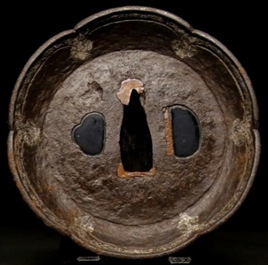
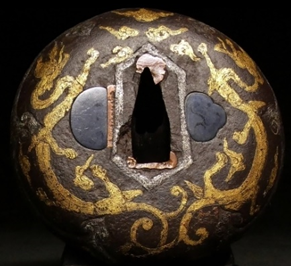
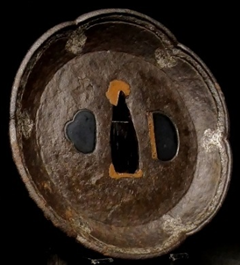
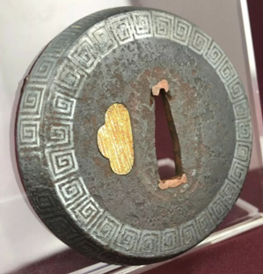
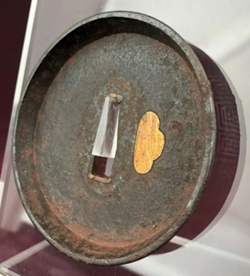
Roger, I think yours is a variation on the wan-gata form that was more common in continental Asia, but also produced in lower numbers by a variety of schools in Japan. But at the same time, like Dale suggested, it could looks like a variant of the Japanese Uchikaeshimimi form which not typically dished like a wan-gata... so yours looks like a blend of aesthetics. I have seen several examples of wan-gata shaped "Hizen", nunome decorated tsuba, where the dished inward side is much rougher than the outer surface. Although that's not always the case... Here's one (Possibly of Korean origin) that is finished smooth on both surfaces: Given that both rough and smooth inner surfaces exist on the dished wan-gata forms, you would have to conclude that it was a deliberate choice by the smith to leave one side rough. And Roger, yours has deliberate horizontal chisel marks that were done in clusters. I think they are meant to suggest some form of "mist" or "air" to go along with the dragon on the front.
-
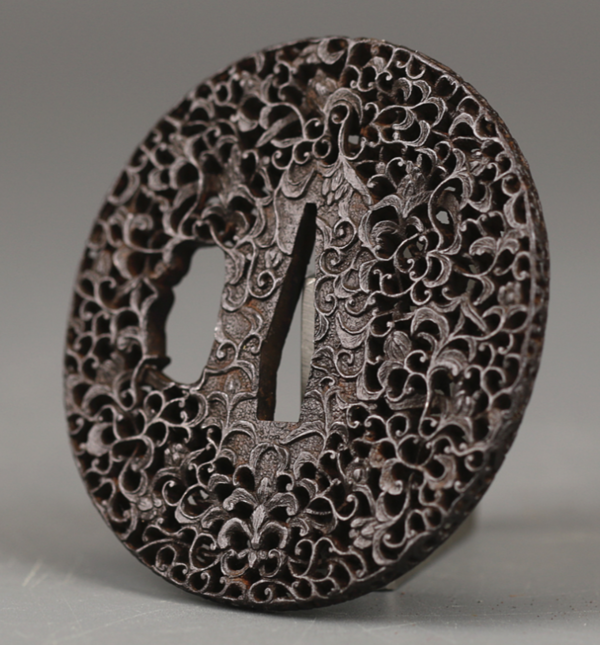
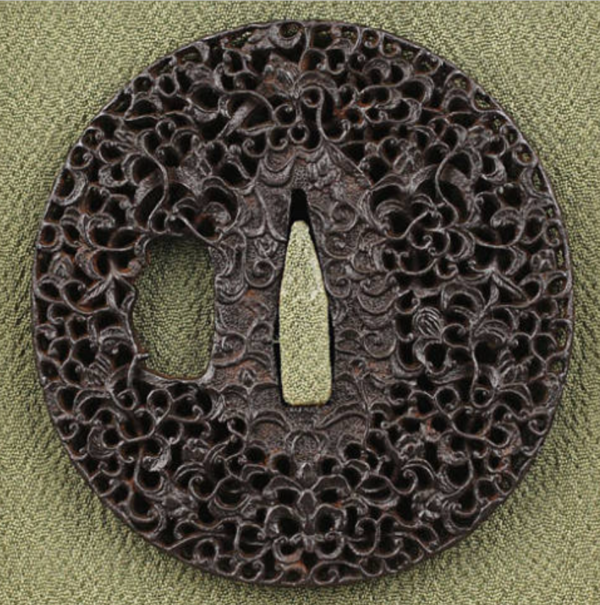
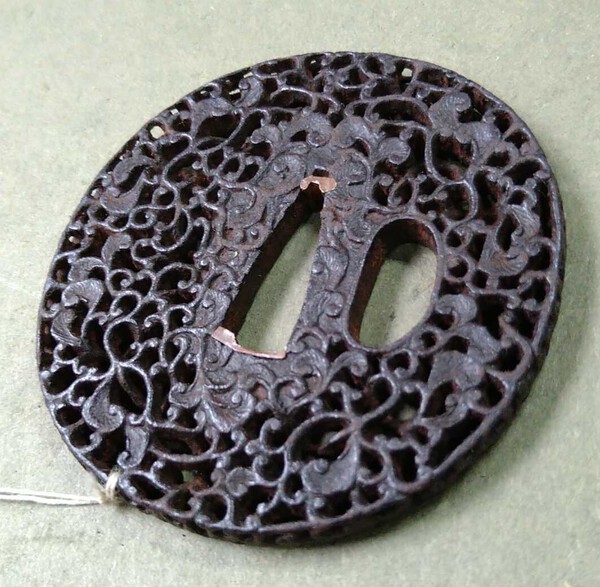
Does anyone have any other examples of this style of Nanban tsuba? I can say with certainty that these were made in Japan for the Japanese market, but I have no idea by whom or where specifically. Both appear to be unaltered (other than maybe the width of the nakago-ana, and the addition of sekigane on the second one) They must be from the same "school" and probably even the same smith, but that's all I have found so far of this type... I'm wondering if there even was a whole "school" of smiths producing this style, or if the smith was an "independent" Edo period smith. EXAMPLE 1: EXAMPLE 2:
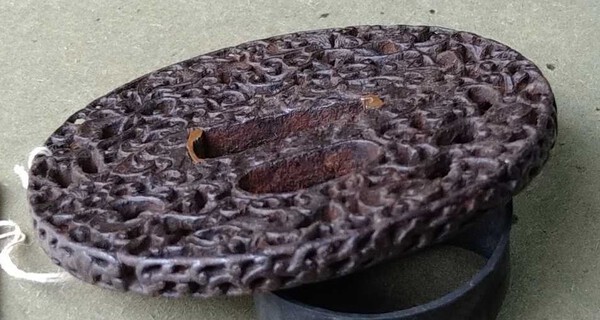
-
Another nice one Bruno, Looks more like an Edo period piece because of the tsuba's shape, the heavy thickness, and the pretty good condition of the nunome. However, the tsuba has been around long enough to have been mounted at least twice (there's a "double sekigane" at the top of the nakago-ana). It's definitely made for the Japanese market and likely made in Japan (I would assume somewhere in the Hizen area): The hitsu-ana appear to be original to the tsuba, or at least they were present before the application of the nunome. The nunome design also properly contours the hitsu-ana, rather than being cut through by a "later modified nakago-ana". I can't tell what the arcing design motifs are in the four corners on the ura side... Any idea what they might be Bruno?
-
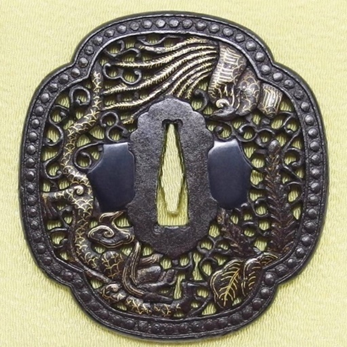
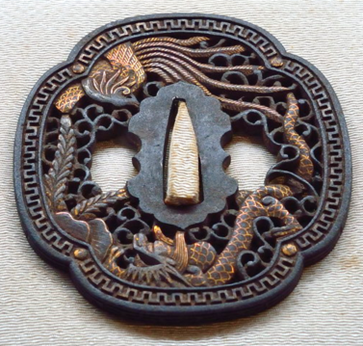
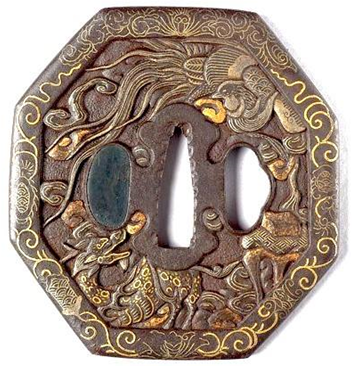
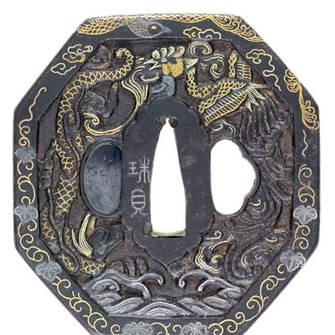
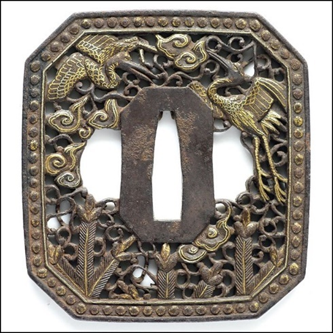
Bruno, that's a nice example of a Kiyou Toujin tsuba (is it yours?) Dale, definitely from the same school. They did a lot of "phoenix" and dragon combinations
-
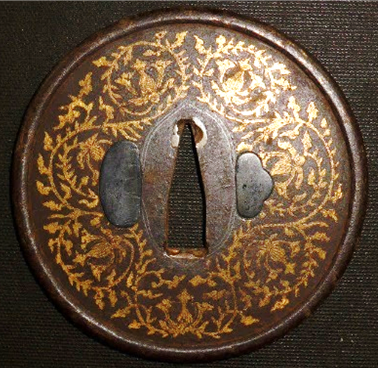
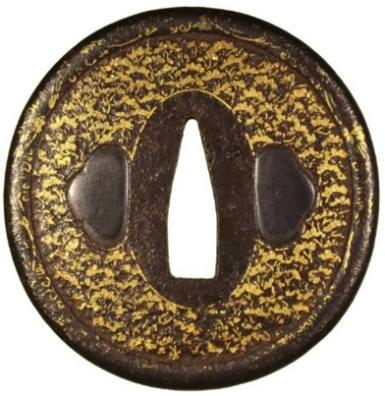
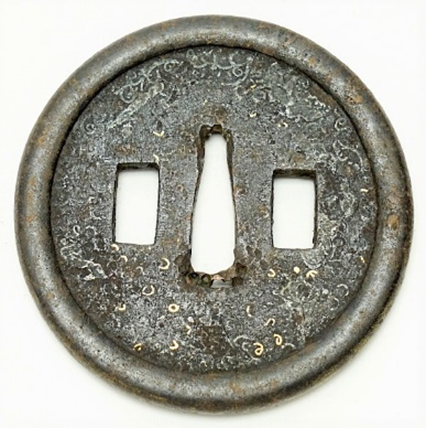
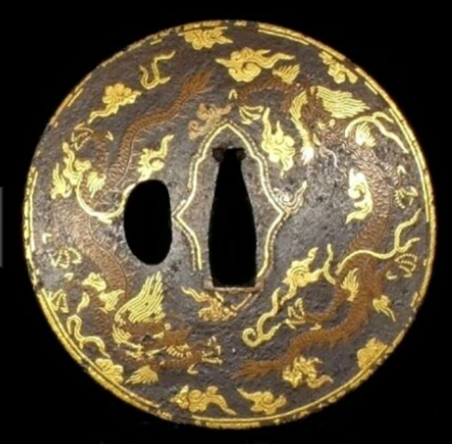
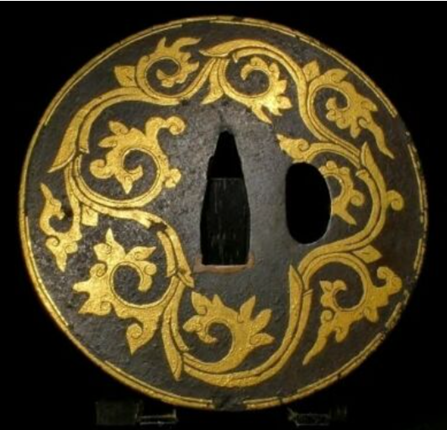
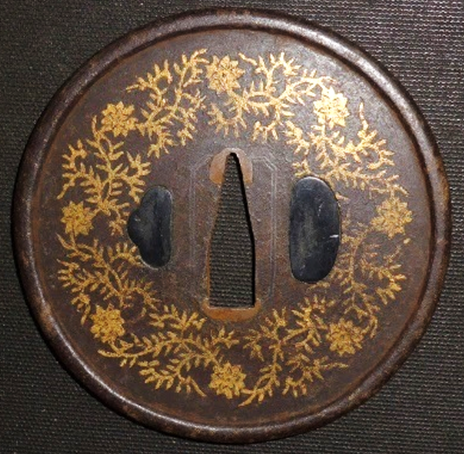
Here are some examples of what appear to be Japanese-made Katchushi and Tosho style tsuba which have added nanban nunome (overlay) patterns. I can think of three possible explanations: 1- These could have been Muromachi period Japanese exports, that were decorated in continental Asia for use there, then ended up back in Japan at some point. 2- They could have been made entirely in continental Asia, and they just copied the Japanese Katchushi and Tosho tsuba shapes. 3- They could have been "decorated" at one of the ports like Hizen (possibly even at a much later date than the production of the tsuba plate itself). There's no way to know for sure though... It's also possible that all three hypotheses are correct, resulting in multiple avenues for producing a similar outcome, and making it really difficult to pin down any one of these "histories" on any particular tsuba. The top and bottom pair of images show the omote and ura faces of one specific tsuba. It's interesting to note the difference in the treatment of the nunome outline of the seppa-dai on the opposing faces of the tsuba.
-
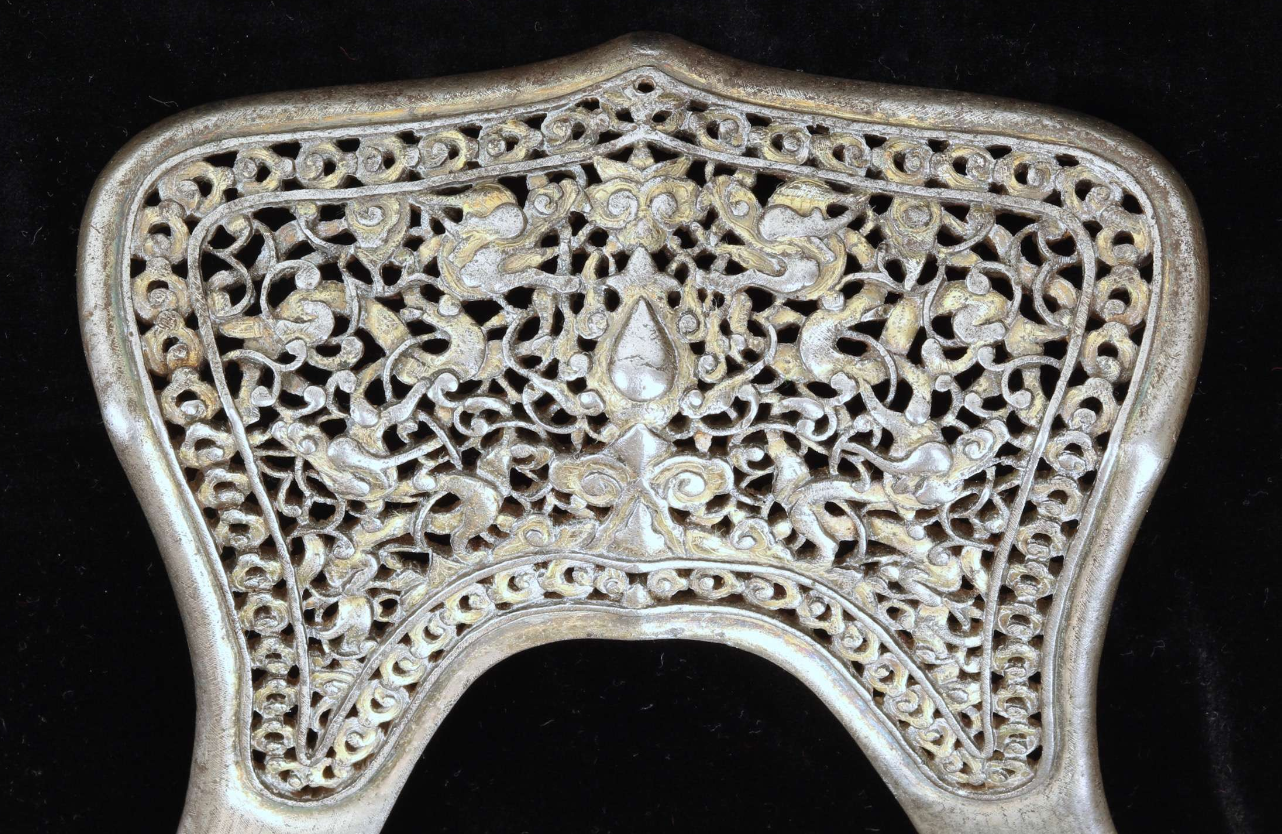
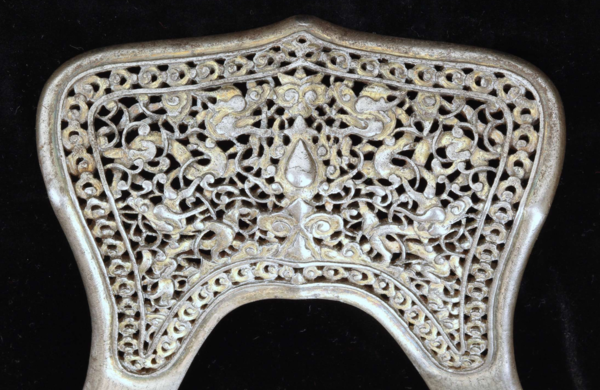
Oh and as Ian pointed out, there's definitely some influences from Tibet (and I'll add Vietnam as well) in some Nanban tsuba. "Nanban" is referencing a giant cross-cultural meeting point and sharing of ideas. There are a quite a few tsuba examples that get really difficult to pin down to a specific area of production because there are elements of multiple cultural motifs and techniques all wrapped up in the same tsuba. There's tons to sort through and lots to learn about. Here's a late Ming period (1500s-1600s), decorative horse saddle side plate: more info on it here: https://mandarinmansion.com/item/tibetan-style-pierced-saddle-plate
-
Ian here's a few examples of tsuba made by Chinese smiths living and working in Nagasaki (Edo period). I know of one "school" of these Chinese smiths, called "Kiyou-Toujin", and they had a very distinct style to them: