GRC
-
Posts
748 -
Joined
-
Last visited
-
Days Won
14
Content Type
Profiles
Forums
Events
Store
Downloads
Gallery
Everything posted by GRC
-
@FlorianB that all sounds like there's definitely some potential in those documents, especially with those specific date ranges too, which focus on some key points in time that we might gather information from. @ROKUJURO I think you may have misread my intentions, or maybe extrapolated them to an extreme point? My goal is not to discard, but rather to encourage a "ground up" evolution of the current system, rather than sticking to an institutionalized "top down" adherence to an outdated and antiquated system that has obvious flaws. Essentially, the idea is to slowly "force" change by gathering enough evidence to make specific cases for modification and refinement of the current system, because the evidence will speak for itself. Think of it like debugging a program after its initial launch... I think this program is in dire need of an update after 100 years of relative stagnation and maintaining "status quo", and I'm not the only one who sees it that way. And if "we" the dedicated collectors from around the world don't do it, then who will?
-
That's points precisely to the problem with the current system. It's set up as a sort of "dichotomous key" based on sets of relatively broad characteristics that were set up relatively early in the attempt to sort and classify tsuba. I think these criteria are too rigid and oversimplified, which directs us to put things in label boxes that are likely not correct. For example, It assumes that all "movement in design" is restricted to Shoami smiths (and some early Akasaka), which seems like a patently false assertion to me. It doesn't seem even remotely possible that they were the only smiths to use movement in their designs. So using "little to no movement in design / structured geometric designs" plus "visible evidence of folding in the plate" gets us an Owari label. This type of system does not allow for styles to evolve, unless you start throwing little qualifier words like "mostly" or "often"... which muddies the waters so much as to render the system "mostly" unusable, unless you are looking at "archetype" versions of tsuba from specific schools. To me, that's a crazy way of doing things, because it does not allow for any variation or evolution within multiple groups of smiths from large geographic areas like Owari, or take into account any aesthetic shifts in Japan's culture over time. I think I have gathered enough examples of Kanayama and Owari type tsuba that show a clear departure from the more structured geometric patterns we see in the majority of the Momoyama period, that show that a certain point in time, there was a general shift in aesthetic and artistic expression that was experienced in many regions of Japan. It was more of a general "zeitgeist" (spirit of the times) to borrow a German term that is such a good word in my opinion. With regard to Shoami specifically, most Shoami schools, where the smiths signed with "shoami", really only began in the mid to late 1600s. From various information sources, it's seems possible that the Iyo Shoami group may have started a little earlier, maybe by a decade or two. Certainly "movement" is present in many Shoami (and Akasaka) designs, but I would argue that the Shoami smiths were certainly not the originators of this type of design, but merely following in its footsteps. The designs of the tsuba I posted above don't fit with any specific style of Shoami work, and can be separated even more when you start looking at the plate characteristics, which fall entirely within an Owari type of categorization (following our supposed "dichotomous key" of classification based on broad descriptive characteristics. Also the hitsu-ana shapes do not fit with other examples of what most people view as Shoami tsuba or even ko-Shoami tsuba which tend to have more geometric shapes. Personally, I think the size differential of the hitsu-ana align better with the look of ko-Akasaka (who also had their origins from some type of Owari area lineage)... so I suspect it's possible that the ko-Akasaka and this "mystery smith" had similar Owari roots in that regard. So to make a long story more succinct, I feel that the tsuba above pre-date anything that we would consider Shoami works, and show a divergent shift within the smiths who came from an Owari area. In discussion with @Steve Waszak, we both feel this proposed period of time fits well with cultural shifts and influences that lasted a brief period of time at the very end of the Momoyama, and very beginning of the early Edo period, when there was even a rise in "distorted" modes of dress and mannerisms and went so far as to skew body posture (look up "kabukimono"). There was also a similar shift in "expressiveness" in other artisan crafts like painting and textiles.
-
That's so ironic actually, given how many "unknowns" are magically given the label of Shoami or ko-Shoami. I love that translation result, it makes me chuckle, thanks for pointing it out @MauroP
-
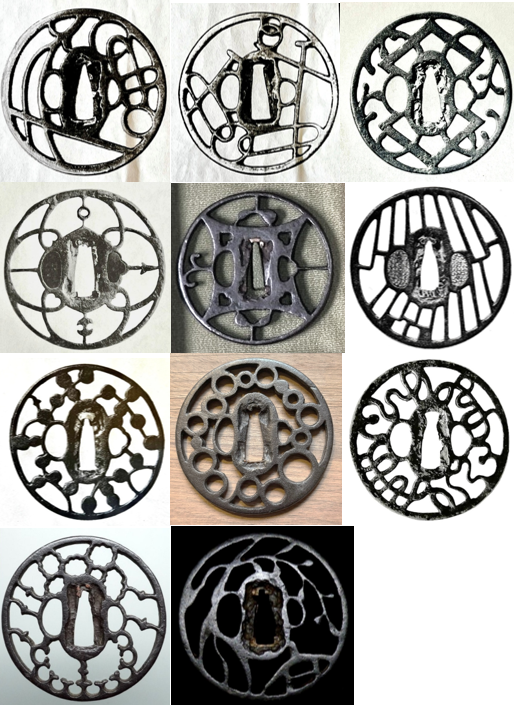
That now makes 11 examples from this one Owari "Mystery master"... These clearly represent a point in time when there was an aesthetic shift away from the typically more symmetrical geometric patterns of traditional Owari and Kyo-sukashi, exploring a much looser and expressive design theory.
-
interesting thought! Certainly. the annual koku (rice) stipend that various daimyo paid out to their retained craftsmen has been used in the past (when the records were available) to link certain smiths to certain times (and to presume their their relative "esteem" in the eyes of their daimyo). I wonder if tax records were kept at those times and even if a person's occupation was listed beside their name? The main problem is we don't have actual names for most Azuchi-Momoyama and early Edo period smiths...
-
OK, perhaps... I guess that is just my assumption about the the organization, from an outsider's perspective, with a little dash of frustration and maybe a little too much "curtness" and "brevity" in the way I express it I'll try to tone down my commentary about the organization and stay focused on trying to "improve the system" as a whole.
-
Thanks Florian I agree 100% that there are LOTS of "particulars" that people, including the "experts" at the NBTHK, are using to make their judgements. I'm not proposing to discard everything and start over... but proposing more of a gradual refinement of pre-existing categories that were mostly conceived of by Akiyama, which essentially became a sort of ratified dogma over the years. I suspect that Akiyama's intention was to build such a foundation and have it continue to grow and evolve (especially because most of his work developed through regular meetings and discussions with other dedicated tosogu collectors at the time). I think that original intention somehow got skewed along the way, and needs a more conscious and deliberate effort to reopen the door to critical thought and grow into something even better. And that can only start with an open discussion that revolves around evidence based analysis, but also requires the participants to be aware of what has come before and what the current system is built upon. i suppose I have been pushing these thoughts on NMB for a number of years, in the hopes of pulling in as many people as possible, and hoping to push more people into this type of discussion. Thanks to digital images (even with their shortcomings due to viewing angle and lighting issues), we have access to more tsuba today than Akiyama could have ever seen in his entire lifetime... so I think it's inevitable that some of us will start to see some groupings and patterns that Akiyama did not pick up on. It's way easier for us to send each other some images of specific tsuba we have, than it was for Akiyama and his group of enthusiasts to meet in person once in a while, or send each other some oshigata rubbings! So to be honest, we can and should do more than just stay settled in with what's comfortable, and keep hanging onto those papers, even when we know the judgement seems to be off at times.
-
I know I have seen it several times before (maybe even on NMB) but I don't seem to have a good image of it in my files. If you actually have the two set encyclopedia from Kanzan, that would be great, but It may have been published elsewhere as well. It's in his Owari section.

-
About “advancement of knowledge” in the field: People like Mitsuru Ito and Eckhard Kremers who have published books on specific collections of tsuba from particular smiths in a more analytical manner rather than just producing a picture book of accumulated tsuba from a particular school with no real analysis included. Markus Sesko of course needs to be mentioned because of his relentless efforts in translating Japanese texts, and the many years of him posting his blogs that frequently revolved around comparative analysis of small groups of similarly themed tsuba, sometimes by the same smith, and sometimes by different smiths. I always learned something whenever I read his posts. And then there's Steve Waszak with his years of dedication to Yamakichibei and Hoan tsuba... with a definitive book on the subject sure to come sometime in the future, which I hope to play some part in as I have also been diving deep into Yamakichibei, and separating out types of acid etched tsuba that often get mislabeled as Hoan. I have also been diving deep into all things “Owari-related”, trying to sort out the mess that is Kanayama, Ohno, Owari, and Ko-Akasaka (since they clearly had Owari roots), and trying to associate these with approximate time periods, trying to tie it all to cultural and artistic trends at various points in time. I apologize if I have left out any other publishers and bloggers from the list (like the “Zenzai blog” by Keisuke Nakamura, now that I think about it… he does this too, and I’m a big fan of what he puts together) Then there’s also some thoughtful insights and sharing of information on sites like this of course! At least this forum allows for the potential for some kind of proper, positive discussion. And just as an example, I realized I had two tsuba of clear Owari lineage, but that were also obviously divergent from the typical Owari tsuba. In comparing them, I realized they were made by the same smith who has yet to be described or named in some way. After posting the pair and pointing it out online, it tuned out that Eckhard Kremers had realized the same thing about this smith when looking at specific tsuba published by Sasano. Then he and I spurred each other on to do a deep dive into other publications and accumulated image banks, and we found a bunch more by the same smith. He has produced some extraordinary, unique designs that show a lot more "movement" compared to other Owari tsuba. His tsuba have gotten a variety of attributions from different sources, but as soon as you line them up, they are clearly all done by one smith. It's the "gut feeling" mislabeling under the current system that I think (hope?) can and should be course corrected over time, by doing comparative analysis in exactly this way…. I have also identified several other groupings of tsuba that I think point to the work of individuals smiths, rather than a broad label like "Owari" or one of the other Owari-linked groupings I mentioned above. Owari was after all, a significantly large geographic area with so many smiths with different styles over the course of the 1500s and 1600s. Anyway, It’s doable, but more people need to have these thoughts in mind when they are looking at examples and gathering up images of tsuba that allow for comparison (hopefully including some oblique and side views, and not just straight on black and white images!) Blah blah blah… when will this guy shut up… sheesh? I apologize for blathering, I will stop now Oh and no, I am not just presuming to throw my name in with all those that I mentioned above, out of some sort of inflated self-worth. But I'm putting in the effort to gather evidence, and trying to make sense of it all with an open mind and a critical view... which is what I share in common with all those I mentioned above. I hope to put together some kind of publication one day, but for now, I'm still gathering information and examples, and enjoying the obsession.
- 57 replies
-
- 11
-

-

-
About “mass production” and crossover between schools: I'm going to start most recent and head back in time... From my personal research over the years, true mass production of the generic rote kind, really seems to have kicked into gear around 1700, mid-Edo period. There were lots of sociological, economic and technological shifts around that time that facilitated that. More rampant crossover between schools and smiths seems to have kicked in around the mid-1600s (after the establishment of Edo as a new capital city and the "sankin-kotai" which was the forced pilgrimage and residency of daimyo and their entourage of 100s-1000s of attendants including craftsman, every other year. That all started in 1635 but was expanded to include more daimyo as of 1642. So that's when many craftsmen from different schools were all in the same place at the same time, for extended periods of time and sharing ideas and techniques with one another. From my personal comparative analysis of tsuba from the same maker (of known smiths, with a known mei), from the Momoyama to early Edo period, there seems to have been more of an "exploration of a theme" in the creation of multiple variations by one smith, but they did not seem to make rote copies of any specific design (maybe some did once in a while, but I don’t have any examples of that yet). Successors in a school lineage do revisit certain themes from their predecessor/s but they seem to put their own little twist on the design, perhaps to distinguish their work from others and put their personal "stamp" on it.
-
About these specific tsuba: I posted these three tsuba in particular in the hopes of gleaning some input from some other eyes besides mine and the papers and/ore attributions they have (which I generally do not trust, especially when “alarm bells” start going off in my head when I see what they are labeled as). I didn’t post these thinking I know the answer, not at all. This was “crowdsourcing” with the hopes of generating discussion. These are not common tsuba at all… sure there are plenty of cloud and geese tsuba out there, but this is a pretty specific variation on the overall theme. At first these tsuba all jumped out at me as being Higo tsuba because of the hitsu-ana shape, which is quite particular to them and is often a key point to identifying one of their tsuba. I was taken aback with the ko-Akasaka papers on the second one, but there is a distinct shift in the size of the hitsu-ana and the fineness of the chiseled karigane, and the relative proportions of the sukashi thicknesses… so I could see it as being something other than Higo. Until this point, I was unaware of Akasaka smiths doing Higo style hitsu-ana, I thought they typically stuck to their own shapes. Higo did have a strong influence on Akasaka afterall… something I sometimes see some people viewing the other way around… but I have always viewed it as Higo being the influence on Akasaka. I’d like to dig into the tegane-ato around the nakago-ana to see if I can dig up some similarities with other Akasaka smiths and Higo smiths… more evidence to gather to help build a more specific case for each or maybe keep the door open... time will tell.
-
Most attributions are based on a gut feeling... most papers are not judged by jury but by a single member, then the paper gets signed off at the end. Most of these judgements seem to be done in minutes, without any sort of diligence or consultation to databases of any kind (which is why the NBTHK frequently contradicts itself when the same tsuba gets re-submitted for shinsa) Proofs?! There are hardly any at all for anything that is unsigned from the pre-Edo and early Edo periods. Old books, and papers are just a loose guideline... and because of the author's own lack of certainty, they deliver plenty of opportunity to muddy the waters for current collectors who want to "know what they have". Some of these attributions have done more harm than good over time. It's exactly what @FlorianB proceeded to do, that we need more of... That's precisely the the type of thing we all need to be doing (and posting ) if "we" as a collective hope to get to something "better" than the vapid system we have now. ...or we can just keep flouting the papers people buy rather than the tsuba themselves. Not that I'm saying you are doing that Florian, but there are a ton of people who do... it is a money making machine after all, if you are lucky enough to get the "more valuable" school attribution in the lottery that is the current papering system).
-
Oh and back to schools issue...pertaining to these specific tsuba. There was a significant amount of overlap and cross-pollination, including direct contact between smiths among the Akasaka, Tosa Myochin and a strong stylistic pull for both of those groups toward the Higo Kanshiro, so it's no wonder all these tsuba have very similar characteristics, but are getting all these different labels. Even some late Edo period Tosa smiths were known to work in an earlier ko-Akasaka style (but usually with their own twist, rather than just doing rote utsushi copies). There's a really interesting and informative article that describes the detailed nature of this stylistic "entanglement": A Story of the Tosa - Myôchin 土佐 明珍 By Mark Ceskavich JSSUS Newsletter Volume 50, no.3, 2018
-
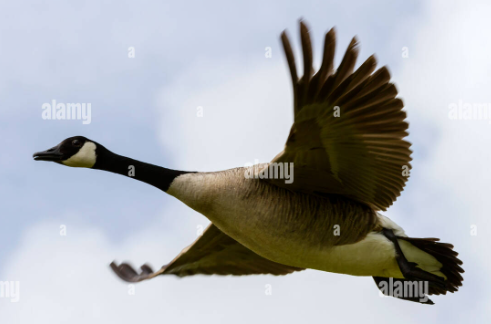
Back to direction of the wings... ughhh I give up LOL Sometimes they appear to have their wings arcing forward, especially when they seem to be taking a power stroke to get going: But then most of time they appear to have their wings arced backward, especially when they seem to be coasting/gliding: And there is also viewing angle and perspective to factor into it, which could alter the viewer's perception... so, um

-
Mauro, your sentiment basically captures one of the principal driving forces in posting this thread in the first place. It's a thought that can't be ignored the more you go down the rabbit hole of trying to sort out the mess of attributions and sometimes outlandish papers that exist (yes, even the new ones... not just the old green ones). Another point that really needs consideration is that the classification system itself is inadequate when it comes to assigning attributions. That's exactly why attributions seems to be subject to whims and fads and "cultism" of sorts. As the system stands at the moment, it's far far away from being a "science". It's only by gathering more evidence and really gathering up a strong database that we'll be able to do enough comparative analysis to really break things down into proper groupings and many more "sub-groupings" than currently exist. Some of these sub-groupings may never get a genuine name to hang on them, but I genuinely feel that could slowly tease out some more specific attributions that could even point to a specific smith's work (regardless of whether they fall under a larger category's umbrella or just shows an "influence" from one or more groups). But hopefully we can put together enough visual resources to point to see to say, "yup this is one of that guy's pieces". One day... but I sincerely hope we can all start slowly chipping away at it, one grouping at a time.
-
Well, now that you've brought the chidori/karigane issue into question, it's seems like an interesting question that I personally had never considered in this way before. I just always assumed the arc of the wings was the only factor that I ever considered in terms of "flight direction". But maybe your naturalistic goose tsuba might suggest the possibility of a forward facing arc for the wings of geese in flight? Also the head and body of some of these tsuba are relative short and stumpy while on others they are longer and more tapered. Is it just differences in craftmanship or actually supposed to be a different kind of bird? By the way, you weren't the only one to think "chidori" because some of the attributions I posted above did mention chidori rather than geese. I just outright discounted those statements as false and went with my gut that was telling me "geese".
-
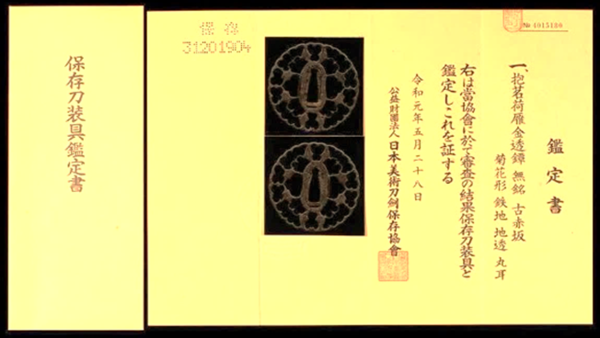
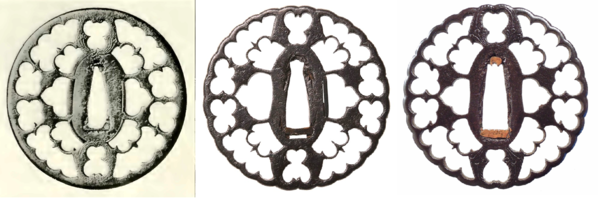
Ok, I suppose there aren't any more people willing to offer a hypothesis, or everyone else is somewhat in agreement with what has already been stated, or just don't know... #1 Apparently made by Higo's Hayashi Matashichi (It's published in the Gustav Jacoby Collection... and if I am reading this google translation correctly, it was once in the possession of the Hosokawa and Nishigaki lineages up until the late 19th century. #2 NBTHK papers to ko-Akasaka (lacking in any sort of useful detail, as usual...) Google translation: No. 4015180 Certificate of authenticity 1. Tsuba (sword guard) with openwork design of ginger and wild goose motifs, unsigned, Old Akasaka. Chrysanthemum-shaped iron base with openwork, rounded rim. The item on the right has been authenticated as a preserved sword fitting by our association as a result of our examination, and this is certified. May 28, 2019 Japanese Art Sword Preservation Association #3 Nishigaki Kanshiro (according to a hakogaki by Sasano. This one is posted on tsuba.info and is listed as 2nd generation Kanshiro in the section on Higo tsuba. I was given the info through messaging with the owner of the tsuba, but I don't have any images to post of the hakogaki. I was also informed that this one has some signs of slight layer separation, opening the door to a possible Akasaka connection And just to muddy the waters.. here's yet another, actually closest to # 2 in that it has the larger proportioned hitsu-ana. #4 It's in the Owari section of Tsuba Shusei (the elephant book), and it describes it as: 65. Myoga and Chidori – A tsuba with a nice texture in a central recess. In an older style. Seppa-dai 3mm, kakumiri 6mm. And just to blur things even more... here's one from illustrations of ancient tsuba on uchigatana, by Keichiro Yokota #5 attributed to Myochin it's back to the smaller sized hitsu-ana but it has some alternate motifs at the top and bottom of the seppa-dai (instead of myoga/ginger), and a few other small embellishments in the way the sukashi elements were chiseled. So to sum up... a mish mash of attributions due to some overlapping physical features between schools and smiths. So we have published attributions and hakogaki to Higo's Matashichi and Kanshiro, ko-Akasaka, as well as Owari and Myochin. Then I also got some suggestions elsewhere for Kariganeya Hikobe as well. So the answer is ... still to be determined I suppose



-
@MauroP I'm with you on the attribution... it is one family's recounting of an item that was apparently passed down through multiple generations, so who knows what kind of embellishments were added onto the lore surrounding this piece as the years went by... like grandpa's fishing story where both the fish and the waves keep getting bigger ever time he retells the story But the claim does line up with that smith's plate texture, so maybe a grain of truth? I also agree that the first one is likely the oldest, and everyone so far seems to be picking up on it as well. The third one does appear to have a much smoother surface, and looks to be more black compared to the first two.
-
Hard to really know if there is a verifiable "correct" on any of these anyway... so who knows Well one has a stronger "most likely correct" than the others... I'll explain later. Solid guesses though Jean (not that I'm saying they are "correct" or not...yet)
-
Ok I posted this somewhere else, but the membership in both locations is probably different even though there will be some obvious overlap. We'll see... it's my first time trying it. Up for a challenge? Does anyone want to hazard a guess as to the attributions for each of these three tsuba? They each got a specific attribution from different sources (and one of the members here is the source for one of them), but I'm curious to see what you might suggest for each. This isn't an attempt to pass judgement on anyone's "knowledge", it's an attempt to open a discussion and have some fun with it. Feel free to hazard a guess on any or all of them #1,2,3.
-
1000% ! I can't begin to tell you how much of an influence he was on me. I'm trying to piece back together some of the groupings of tsuba he had collected to showcase how each group of tsuba represents the body of work of a single unidentified smith. This is one of those missing pieces that really should get back together with the others, so that all of Bruce's insights and discoveries don't just fade into the mist and get cast about across the world, maybe never to come back together again... I'd also like to present those groupings on a forum such as this to showcase how the limited number of "schools" that tsuba get attributed to, are insufficient and need expansion.
-
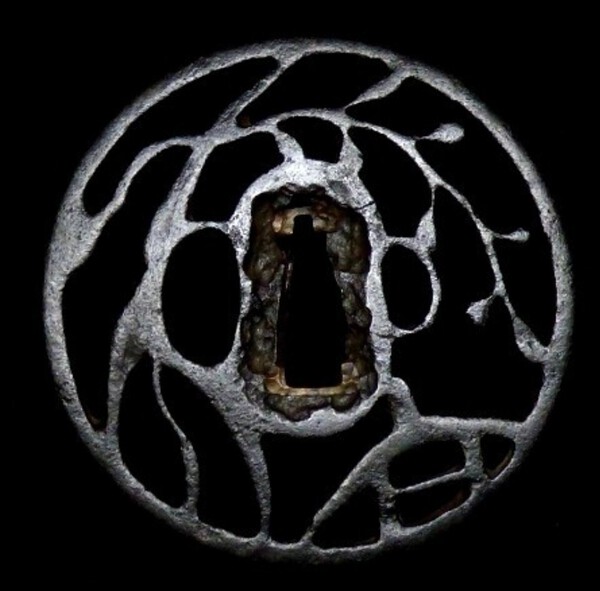
This is sort of a strange request... but I'm trying to solve a bit of a mystery. Bruce passed away almost a year ago now. He had acquired and sold off many tsuba over the decades he spent devoted to the study of tsuba and Japanese pottery. Anyway, he probably had this tsuba in his possession at some point, or it may even have been just an image from an online site that he saw it on, but I'd like to know if any of you have seen it or know who has it. Thanks in advance
-
Nice surface activity on that one, better than a lot of the other smaller pieces
-
Congratulations Markus, your contributions to the field are immeasurable really. @Markus would you be able to post the indexes for volumes 1-3 as well? I'm wondering which ones would be most suitable to my specific areas of interest Thanks.