Ray Singer
-
Posts
5,196 -
Joined
-
Last visited
-
Days Won
140
Content Type
Profiles
Forums
Events
Store
Downloads
Gallery
Everything posted by Ray Singer
-
Looks like Kanetsugu to me.
-

Hasebe Kunishige? Your Thoughts Please
Ray Singer replied to mareo1912's topic in General Nihonto Related Discussion
No, they are not all in excellent condition (if that is meant to say untouched). Some clearly do show wear from past polish and were not simply made this way. What are the answers to your quiz Jacques?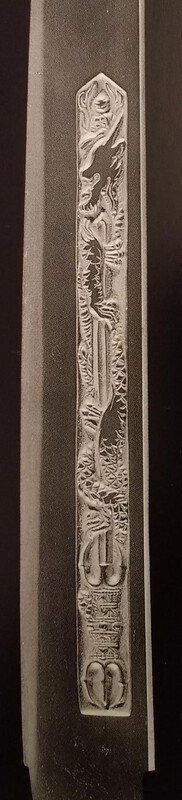
-
Got it, apologies if I misinterpreted your post Marco.
-
"going pretty well" implies that something is currently being done to the sword, rather that was done in the past. Is this sword in the process of being polished?
-
Marco, what has been done to this sword?
-
Hasebe Kunishige? Your Thoughts Please
Ray Singer replied to mareo1912's topic in General Nihonto Related Discussion
None strike me as being obviously a work of an Edo horimono-shi. Photos 1 and 5 appear in the style of horimono from the Bizen school like what you would see in a sword from Katsumitsu and Munemitsu. Photo 2 is the Soshu Yukimitsu tanto I shared before. Photo 3 is the Fudo Masamune. Photo 7 is Bizen Tomomitsu. The others may be koto as well. Photo 4 is a fragment and I'll hold off offering an opinion. I am not a horimono expert so if I am mistaken, so be it... -
Hasebe Kunishige? Your Thoughts Please
Ray Singer replied to mareo1912's topic in General Nihonto Related Discussion
I was trying not to be overly critical, but to my eyes this horimono is very poorly done and reeks of late work. Look at the execution of the face of the dragon. The perspective is inconsistent and distorted. The overall expression is comical. The face, upper jaw and teeth are all going in their own direction (buck-toothed comes to mind). Again, in post #27 I asked to see an original, Nambokucho period horimono which looks like this. I certainly have never seen one from the Soshu jo-ko which is similar.
-
Hasebe Kunishige? Your Thoughts Please
Ray Singer replied to mareo1912's topic in General Nihonto Related Discussion
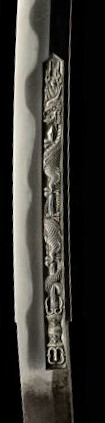
I am happy to give you my impression Jacques. Others may have a different perspective. It seems that later (Edo) horimono has a more ornate feeling, stylistically. The horimono-shi may be going to greater effort to represent the subject matter in a realistic way, with greater density of detail (smaller, more numerous scales, etc) and more effort to give the horimono dimensionality. The body of the dragon appears rounder, the head more turned towards the viewer. The horimono of Edo period artists such as Tadatsuna, Sadakazu, Nobuhide, Yoshitane, etc seem quite different to my eyes from Nambokucho / late Kamakura executions of the same subject matter. I have attached a few examples. Note that generally the earlier horimono shows the dragon's head more in profile. With the exception of Koryu Kagemitsu, these examples are from the early Soshu school. The last photo is of the horimono being discussed here.




-
Hasebe Kunishige? Your Thoughts Please
Ray Singer replied to mareo1912's topic in General Nihonto Related Discussion
I don't know that we will have this answer unless the sword was purchased by a member, resubmitted and the owner chooses to share the results. -
Kubur, Please see below for further discussion on Satsuma Rebellion koshirae. http://www.militaria.co.za/nmb/topic/4310-satsuma-rebellion-koshirae/ Best regards, Ray
-
Kubur, can you remove the handles to show us the nakago (tang). Remove the pin in the handle to reveal this. Separately, please note that placing the sword directly the ground can worsen its condition (potentially introducing additional deep scratches).
-
That does not appear to be a very significant chip and should be restorable. Please note though that handling the blade with your bare hands will promote further rusting. Grey has shared an excellent article above with recommendations for handling and care.
-
Please send a photo of the chip(s) in the edge. It appears to be a wide piece, and if the hamon is also wide it is possible that the shape can be restored by a professional polisher with no loss of value. Also (saying this with emphasis) only a licensed sword polisher should handle the restoration work if you decide to do this in the future...
-
Edited post. I see you provided the length in your opening post. It is a wakizashi. Best regards, Ray
-
Signature: 古山陸奥介弘元 (Furuyama Mutsu [no] Suke Hiromoto) Date: 天保 ニニ年八月日 (Tenpō yon nen hachi gatsu hi ) - A day in the 8th month of 1833 An example of his work on this page, 4th sword down. http://www.choshuya.co.jp/1/0712/thanks_sword.htm
-
Hasebe Kunishige? Your Thoughts Please
Ray Singer replied to mareo1912's topic in General Nihonto Related Discussion
My question was more about the stylistic treatment of the horimono itself. This seems quite different from, for example, the way that the subject matter is treated in such swords as Koryu Kagemitsu, Kanze Masamune, and others of the purported time period. This has a Edo feel to it, to my eyes. -
Hasebe Kunishige? Your Thoughts Please
Ray Singer replied to mareo1912's topic in General Nihonto Related Discussion
I would very much like to see an example of a Nambokucho-period horimono on this style. -
Your sword is signed Bishu Osafune ju Morimitsu saku and is dated to the eight month of Bunmei 12 (1480). I do have some doubts about the authenticity of the signature. https://en.m.wikipedia.org/wiki/Bunmei You can see some authentic examples from Bizen Morimitsu here. https://www.aoijapan.net/?s=Morimitsu&x=0&y=0
-
Tanobe-sensei generally prefers to give sayagaki for swords with existing NBTHK kanteisho and for blades of Tokubetsu Hozon class or higher (or blades which meet the requirement to pass Tokubetsu Hozon). While I believe he will make exceptions, that seems to be what is most typical. As far as not receiving detailed information in NBTHK kanteisho, you will get verification of the mei (when present), school and sometimes more detailed information pointing to a specific lineage (such as Kyo or Osaka Yoshimichi) and the generation. The length is also stated. NTHK kanteisho will give some more specifics about the jitetsu, hamon, boshi, etc however those details are largely self evident with a bit of study. Shotoku: https://en.m.wikipedia.org/wiki/Sh%C5%8Dtoku_(era)
-
Shotoku is simply the time period, not particularly rare in itself. Dates (nengo) typically begin with the time period. As Jean mentioned dates to the 2nd and 8th month are the most common. I've always found swords that were dated shogatsu, the first month, to be interesting because it is said that the smith tries to start off the year with his best work.
-
Kyoho 10 does appear to be the date. The sandai's working period is up 1716, but perhaps he worked beyond this? Is 1716 his date of death or simply the end of his representative working period (Shotoku). Best regards, Ray
-
Jim Kurrasch RIP.
-
能 makes sense. Was frequently used in the Ryokai group.
-
Jon, the first portion is Ryokai Fujiwara...
-
Seki Kanesada