


Ray Singer
-
Posts
5,196 -
Joined
-
Last visited
-
Days Won
140
Content Type
Profiles
Forums
Events
Store
Downloads
Gallery
Everything posted by Ray Singer
-

Considering Purchasing A Tanto...
Ray Singer replied to PhoenixDude's topic in General Nihonto Related Discussion
It was an item listed on his website. -
Considering Purchasing A Tanto...
Ray Singer replied to PhoenixDude's topic in General Nihonto Related Discussion
Yosozaemon Norimitsu gassaku. https://nihontoclub.com/view/smiths/meisearch?type=All&mei_op=contains&mei=yosozaemon -
Considering Purchasing A Tanto...
Ray Singer replied to PhoenixDude's topic in General Nihonto Related Discussion
FWIW, I would not be able to make a decision on the basis of those photos. It was not long ago that Benson sold a healthy Magouemon Kiyomitsu tanto (well preserved mei) with solid gold habaki for $6k. There may be other options in terms of Sue-Bizen tanto at a comparable price... -
Considering Purchasing A Tanto...
Ray Singer replied to PhoenixDude's topic in General Nihonto Related Discussion
It may be the photos (and the angle used) but there seems to be substantial 'bellying' in the ha where the width has been reduced. How tired is the tanto? -
Considering Purchasing A Tanto...
Ray Singer replied to PhoenixDude's topic in General Nihonto Related Discussion
Custom order Eisho Norimitsu with zokumei? Looks interesting. The nakago appears to me in very poor condition though, for Muromachi. Do you have more photos? -
Satsu-age (satsuma-age). I owned a Yoshioka Ichimonji which was saved in this way. Nice reference at the bottom of this page. http://www.ksky.ne.jp/~sumie99/suriage.html Not the one I mentioned above, but another Ichimonji which seems to have been put through this process. http://www.tsuruginoya.com/mn1_3/a00259.html
-
Shibata Ka's work is (in mine opinion) remarkable for the high quality of the jigane and naturalistic hamon with beautiful activity. Ka was in a unique position due to his financial resources of being able to view great masterworks at length in hand, from his own collection. His weak areas appear to be in sugata, which sometimes is quite stiff, and forging a fault-free jitetsu. This may be due to the fact that Ka was largely self-taught and produced few works. A discussion of a Ka tanto with a kitae-ware appears in one of the recent references on modern Japanese swordsmiths.
-
Looked like a nice sword, however it also has a fair sized hakobore mid-blade. Shibata Ka's work is very prone to exhibiting to exhibiting kitae-ware. I am not sure that I would have taken the risk on this one, even considering the extreme quality of his work. This one below was previously mine, was a special order sword, and took quite some time for the for the next owner to sell for $7,700 even though it was in a top-level work, mukansa polish, papers, etc... http://www.ricecracker.com/inventory/1112_katana_shibata_ka/1112_katana_shibata_ka.html
-
http://www.militaria.co.za/nmb/topic/5150-gendaito-mitsuokishibata-ka/
-
https://www.ebay.com/itm/323082102033?_trksid=p2471758.m4704
-
Gloves are not necessary or even recommended. See below for sword care guidelines: http://www.nbthk-ab.org/Etiquette.htm However, instead of uchiko this is a better option: https://www.adorama.com/cpcml.html
-
Muromachi Period Ko-Gassan Katana In Shirasaya
Ray Singer replied to Ray Singer's topic in For Sale or Trade
Bump. -
Mumei shinshinto will not be awarded higher than Hozon, regardless of the smith. The one which sold on Aoi-Art was only Hozon (but the associated koshirae had Tokubetsu Hozon). https://www.aoijapan.net/katana-mumei-yamaura-kiyomaro/ https://www.aoijapan.net/wakizashi-mumei-den-kiyomaro/
-
Both of those tanto were works by Saito Kiyondo. Kiyondo's work sells at a higher price to Saneo. He is held in great esteem by many collectors due to the story that he worked for 2 years producing swords to complete his orders his master received. There is an extremely high interest in Kiyomaro school work, but the second generation students do not command the same excitement as Nobuhide, Kiyondo, Saneo, Masao...
-
Chicago Shinsa - Process?
Ray Singer replied to Mark S.'s topic in Sword Shows, Events, Community News and Legislation Issues
There is a mail in service for $100 per item. Unsure how much it is costing to have someone carry the blade in for you, but there may be some savings using their mail in service. http://www.chicagoswordshow.com/shinsa-information/ -
越前國北庄住兼植 - Echizen (no) kuni Hokushō ju Kanetane
-
Appears to be signed ___住兼植 ____ ju kanetane. He was an Echizen smith, and the first part of the mei is likely Echizen.
-
If not, here is a link to a site with a number of options for matching sets of menuki. Many less than 30,000円. https://www.aoijapan.com/fittings/menuki
-
Do you have just this one menuki or are both present? There should be one on either side of the tsuka (handle).
-
The hamon appears to be exactly right for Aoe.
-
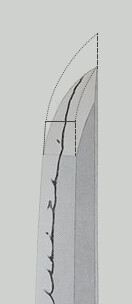
It is common for Nambokucho period swords to be made o-suriage (dramatically shortened). That process is done from the nakago end, not from the kissaki. The hamon running off before the end of the kissaki indicates that the tip was damaged and reshaped. You can see how the hamon begins to rise up toward the mune in the kissaki area, so this was a slight reduction in length from that end. I will attach a quick diagram showing how it may have looked. In addition to the reshaped kissaki, this wakizashi is also o-suriage (so it has been reduced in length from both ends). Looking at the kitae-ware (forging flaws) in the nakago it is possible that the sword was shortened to hide those kizu.
-
The fact that the sword has a significant flaw should have been disclosed by the seller. That said, if it is healthy the sword may still be a good study piece. Bitchu Aoe is a very well respected school who produced beautiful work. Even with the missing boshi, I personally would not feel bad about owning this one for $1,500 as long as sword is otherwise in good condition and would be inclined to replace the menuki and have the tsuka rewrapped. I may be in the minority with that position though.
-
The hamon does not continue through to the tip of the sword. It runs off the edge before reaching the end of the kissaki. Notice how it falls off about 1 cm short of the end.
-
If I am seeing correctly that this is the actual sword published in the book /catalog you show here, the attribution is only to Aoe, nambokucho jidai. The reference places the sword at 630 years old. Uncertain of the publication date. The sword has lost its boshi, which has a significant impact on value. More forgivable for a Heian /early Kamakura sword. For a Nambokucho period wakizashi it is a more significant issue. It is important for maintenance to remove the tsuka and clean & oil under the habaki. Best regards, Ray PS, it seems that a past owner robbed the koshirae of its menuki. Unfortunate if it was an ubu (unaltered) Edo period koshirae.
-
That is a very good attribution (if accurate). It appears that the sword may have stains / fingerprints. Unsure if you have supplies on hand, but please see below for a link on maintenance. http://www.nbthk-ab.org/Etiquette.htm

