Ray Singer
-
Posts
5,372 -
Joined
-
Last visited
-
Days Won
147
Content Type
Profiles
Forums
Events
Store
Downloads
Gallery
Everything posted by Ray Singer
-
http://www.sho-shin.com/yam13.htm Gordon Robson focuses in this school.
-

Identifying Old Sword, First Collection With No Knowledge
Ray Singer replied to guyktm's topic in Military Swords of Japan
One side has the appearance of a KAO followed by Kuniie Yasusada. There are three columns of kanji on the reverse, which may be in a different hand. -
If that last kanji were an abbreviated form of 歳 (sai) I would think this read 'go ju sai' (at the age of 50). I'm almost certainly misreading this, but just a thought...
-
Additional photos, including the kissaki, are here. http://www.militaria.co.za/nmb/topic/20876-island-made-gunto/?do=findComment&comment=253132
-
Unfortunately appear to my eyes to be a Chinese fake.
-
Shodai Nobutaka Value
Ray Singer replied to Eddie Tree's topic in Auctions and Online Sales or Sellers
Reference example (mumei in shirasaya only with several kitae-ware). https://www.aoijapan.net/katana-mumeinobutaka/ -
The reply from Aoi: "When we bought the Koshirae the owner said it's made in Kyushu island after Meiji period and usually Chinese productions are not on the market in Japan. so we accepted the owner's opinion without question. but as you pointed out it looks different. then we decided to retract the item from the auction."
-
What Generation Omi Daijo Fujiwara Tadayoshi ?
Ray Singer replied to rantoulpawn's topic in Translation Assistance
Strongly agree with Ed's recommendations. When I have a Hizen-to I am considering making a purchase of, I always consult with Roger first. -
What Generation Omi Daijo Fujiwara Tadayoshi ?
Ray Singer replied to rantoulpawn's topic in Translation Assistance
Roger Robertshaw describes a katana-mei yondai Tadayoshi on page 197 of his book. Not saying this piece is shoshin, however Roger has said several times that there were exceptions to the tachi-mei only rule. -
I think you all need to get off your high horses and rein in these comments. Someone should really pony up and buy this one.
-
Picked Up The Tanto Identified As Kane Sumi. Is This Correct. Any Info
Ray Singer replied to Scripps's topic in Nihonto
Appears to be Showa era (not Edo or Muromachi period). -
What Generation Omi Daijo Fujiwara Tadayoshi ?
Ray Singer replied to rantoulpawn's topic in Translation Assistance
I believe only the yondai (4th gen) signed using the mei Omi Daijo Tadayoshi. -
No problem Mark. I likewise looked but could not find a matching smith. Maybe meikan-more, but I thought it might be worthwhile to look into Iruka as a possibility for your sword. They are a school related to Yamato Tegai working in Kii and are not often seen. It appears that particular SANE kanji was used by a few smiths within that school. Refer to Markus' Geneologies and Schools of Japanese Swordsmiths page 69.
-
Does not appear to be sanskrit. Rather, this is kanji and hiragana in sosho style (cursive format).
-
Mark, I am attaching a reference for the SANE kanji. This is an Iruka Sanetsugu tanto. Best regards, Ray

-
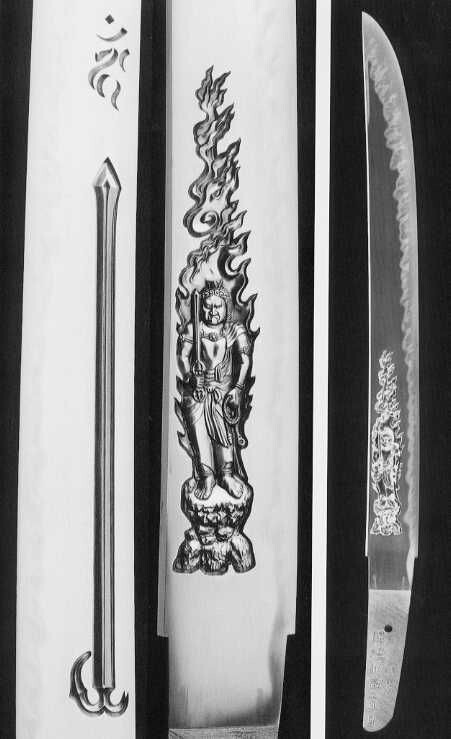
The bonji is Fudo Myoo (a Buddhist diety).
-
Shinano (no) kami Fujiwara Nobuyoshi. Information on this line can be seen below. https://www.aoijapan.net/?s=shinano+nobuyoshi&x=0&y=0 http://sanmei.com/contents/en-us/p1403.html https://nihontoantiques.com/project/katana-sword-fss-706/
-
For the second mei, perhaps Sanenobu (實信).
-
Help With Tanto Mei Translation ? - Mitsu?
Ray Singer replied to swordeval's topic in Translation Assistance
Norimitsu. These kanji were used by the so called 'Ho' Norimitsu. https://www.aoijapan.net/katana-bishu-osafune-norimitsu-tachi-mei/ Your tanto looks shinshinto though. -
FWIW, Ohno Yoshimitsu has made several high-end nata similarly shaped to this example, done with his trademark hitatsura choji hamon. I saw one Japanese collection which had two. Another was offered on a site in Japan for 700,000 JPY.
-
Sue Sa - Wonderful Example
Ray Singer replied to Vermithrax16's topic in Auctions and Online Sales or Sellers
A gakumei which was judged gimei and may (or may not) have since had its mei removed. http://www.legacyswords.com/fs_ant_daito45.htm -
Sue Sa - Wonderful Example
Ray Singer replied to Vermithrax16's topic in Auctions and Online Sales or Sellers
Gakumei may have been added using the mei of a completely different sword as an act of deception. Was judged gimei and the mei was removed. I have seen several Gakumei in which the mei was clearly removed later. -
Having two Rays replying to this thread will be confusing . But if the question was to me, I only shared the comment as an example of the quality level seen in earlier works of this school (a school normally only associated with utilitarian work). Some later Bungo (Takada) work can look like high quality Sue-Bizen and I have seen a couple that I would have thought were the work of the better (ie. Eisho) Sukesada. Aside from the kokoku example, the first sword shown on this page was a particularly excellent sword that was given its attribution by Dr. Homma. http://www.sho-shin.com/sai12.htm
-
Shodai Tomoyuki was an excellent smith and made one of the kokuho (a hirazukiri wakizashi dated 1364).
-
It looks like a nice package Lukas. There are areas of rust. How serious is it? With rust, it is not possible to selectively polish just that area. A full polish will be needed if you want to address that issue (you may alternately choose to accept and leave as-is if the rust is is not active). If your intention would be to have the sword polished after purchase, then factor in the additional restoration cost which would be more that the stated purchase price (factoring in shirasaya and tsunagi). Are there any major flaws in the sword? https://www.japaneseswordindex.com/kizu.htm http://www.ksky.ne.jp/~sumie99/flaws.html