Jussi Ekholm
-
Posts
2,233 -
Joined
-
Last visited
-
Days Won
43
Content Type
Profiles
Forums
Events
Store
Downloads
Gallery
Everything posted by Jussi Ekholm
-
Hello Alton, I do remember the discussion about Narishige. I had forgotten that highlighted page and that we probably discussed this sword a bit too. I wouldn't think gimei on this sword, just rather think it as (at least so far) unknown signature. I think the signature is legitimate on this sword. I think Michael has a point and it could certainly be pre-Ōei too, I see something from late Kamakura to early Muromachi as possibilities for this one. I believe the Bitchū Senoo Noritsune that Steve posted earlier is from Jūyō 53, unfortunately I don't have that book yet. That is the only (則常) Noritsune that has made Jūyō. The Noritsune (則恒) mei that Michael posted I believe it was judged as Ichimonji at Jūyō 18 but later revised towards Bitchū Senoo at Tokubetsu Jūyō 25. I think in general when Aoe smiths used 2 character mei, it was very rarely put so neatly near mune as on your sword. Later longer signatures were often on smaller characters and near mune. Have you tried taking an angled picture with a pointed light source, if it would be possible to see the actual hamon? This is an exciting sword. Do you have a picture of it with habaki on? Is this in shirasaya or in koshirae?
-
It seems like a very interesting tachi. As you said it seems to have signature Noritsune - 則常. However I think all recorded Noritsune smiths predate 1300, and I don't think this is as old. I do think Early Muromachi (c. beginning of 1400's) might be good viable age guess for this based on the pictures. I am liking the shape but unfortunately the condition might be bit lacking. Hard to estimate from the pictures but I am not sure if the hamon has changed a lot or if it was made in that way. I would think this tachi is in original length (possible slight machi okuri) and bottom hole being original and upper one added for katana style mounting. I think this is worthy of further research
-
I believe the sayagaki puts this towards Nōshū Seki jū Kanemichi - 濃州関住兼道 and dates this sword around Eiroku 永禄 (1558-1570). Thanks for posting this and it seems like a very nice sword. It is always very fun to participate in these and it gives a reason to tackle books.
-
Do you have a picture of the whole sword and tang & signature Alton?
-

Another attribution translation request - Thanks
Jussi Ekholm replied to FZ1's topic in Translation Assistance
They specify this as work of Nanbokuchō period - 時代南北朝 (Jidai 時代 - Nanbokuchō 南北朝) -
I think my guess would be late Muromachi Mino - Sue-Seki, smith would be 兼X (some smith starting with Kane).
-
Translation of attribution on papers requested
Jussi Ekholm replied to FZ1's topic in Translation Assistance
Same for me, looking at items is just so fun That particular wakizashi is far above my current budget but I find it interesting. NBTHK made the specification towards Naoe Shizu in brackets. Sometimes the differences between Shizu and Naoe Shizu attribution might be small sometimes big. -
You guys are putting up amazing show
-
I think this might be the most interesting item of these Georg, do you have measurements for this sword? Few years ago at Samurai Art Expo in the Netherlands a Japanese dealer had a tachi signed Yoshitsugu (NBTHK stated unknown province and early Muromachi for it). Although the signature on that seems bit different to this one in style. There were many different Yoshitsugu smiths working during Muromachi and most likely some unknown ones too. I feel this is definately worth researching as it is interesting.
-
Very interesting item Georg, I would think it might be late Muromachi Masatoshi 政俊 who has been listed as Odawara-Sōshū smith. I think the 2 generations worked roughly between 1550 and 1600. Here is one reference item: https://tokka.biz/sword/masatoshi2.html
-
Translation of attribution on papers requested
Jussi Ekholm replied to FZ1's topic in Translation Assistance
I am guessing I might know what item you are looking at if it is currently for sale with Japanese dealer. Very nice and wide profile but it could have lot of wear and condition might be iffy, the pictures are not the best but it is very interesting item. -
Can someone please help me with this date ?
Jussi Ekholm replied to Sunny's topic in Translation Assistance
I would guess it reads - 文政十一年仲春 - Bunsei 11th year (1828) mid spring (I am bit uncertain of my translation of this end) -
Ishido Yasuhiro - but what's up with the Ichi?
Jussi Ekholm replied to jt nesbitt's topic in Nihonto
This falls bit off my interest as I am into early swords, I don't have too much study material on these newer swords as they are not my focus. However I got intrested in this and took a look, and I am not exactly sure of the result. Someone more skilled in Japanese can make corrections. Here is history part of the Jūyō 42 katana entry - and my rough translation. 備中守康広は, 富田五郎左衛門といい, 紀州石堂派を代表する刀工で, のちに紀州から大坂に移り, 大坂石堂派の始祖となっている. 作風は, 御家芸ともいうべき備前伝で映りの立った鍛えに, 丁子乱れを得意としている. 銘文は, 初期には (於紀州康広), 或は (紀伊国康広) などときり, また (紀伊国當一康広) と當一を冠するものもある. 備中守を受領してからは, 表裏に銘をきり分けたり, この作に見られるように裏に菊紋を刻している Bitchū no Kami Yasuhiro was Tomita Gorōzaemon, swordsmith from Kishū Ishidō school. He later moved from Kishū to Ōsaka and founded Ōsaka Ishidō school. He is very skilled in Bizen style chōji midare and utsuri. Early signature styles were (於紀州康広) and (紀伊国康広) [This next part is relevant for the sword in question but I can't quite understand it], there is also style of signature (紀伊国當一康広). After receiving the title Bitchū no Kami, signature is now on both sides and Kikumon is engraved on to the back as seen in this work. -
It is remarkable sword. However a small correction to Aoi Arts English description, NBTHK states in Tokubetsu Jūyō entry that it is Middle Kamakura Period. Unfortunately there is no clear and large picture of sayagaki but Aoi's English page state that Tanobe wrote it to Middle Heian, however their Japanese page has in description that Tanobe wrote Middle Kamakura Period in sayagaki.
-
I think there are lot of good things going on this sword, that can be said even without seeing it in hand. I feel often on average swords passing Jūyō in early sessions have quite high overall quality on average. Bit of "bro science" but I think there is also bit of data to back it up. Also I just found out that it had good praise in sayagaki by Kanzan as there was a thread about it too, this is also interesting provenance, (translation provided by Moriyama-san) - 宇土藩細川家旧蔵之一 – One of the collection of Uto-han Hosokawa family. Unfortunately the text entries in the Jūyō books on earlier sessions are often lot shorter than in more modern sessions.
-
Dont you just love it that they don't post a picture of the certificate, guess that serves a marketing purpose?... It should be NBTHK Tokubetsu Kicho (I think it translates to that in English) Daishō koshirae attributed towards Omori Teruhide based on the information provided by the auction house. Seeing the certificate would be nice to see what specific info it provides.
-
I think there might be some miscommunication with Aoi due to the language barrier. I am not too well versed in later smiths but I think the following. I have always grouped all of them under Tegarayama, perhaps wrongly (but it makes it easier for me to understand). I know some sources like Fujishiro list the first generations as Yamato no Daijō (大和大掾) because they used that title. From the 1st generation Ujishige (氏重) the lineage lived in Himeji city in Harima province. Himeji castle is probably the most famous in Japan. Now when you look at Himeji map, there is Mt. Tegara (手柄山) [Tegarayama/Tegarasan] in the middle of the city. This group of swordsmiths worked in this area. I think Tegarayama is in some sources only used after the 3rd generation. When Aoi is replying to you they are indicating [3rd gen. Ujishige (氏重) / 1st gen. Ujishige (氏繁)] in their answer. So they are not mentioning 1st and 2nd generations that signed with Yamato no Daijō as a possibility in their opinion. That is why they are saying only the 1st generation used 氏重. There is lot of marketing buff for it in the ad but I feel it is a nice sword in overall. Unfortunately I lack sources on the later swords but you can try to google Tegarayama 手柄山, Masashige (4th. gen Ujishige 氏繁) 手柄山正繁 who is the most famous and well regarded smith of the group, Ujishige 手柄山氏繁. The smith in question that changed the character is ranked chū-saku by Fujishiro. For Jūyō swords by Tegarayama smiths I believe 1st gen. (Yamato no Daijō) has 1, and Masashige has 14 items (including 2 daishō & 1 attachment Naginata for koshirae).
-
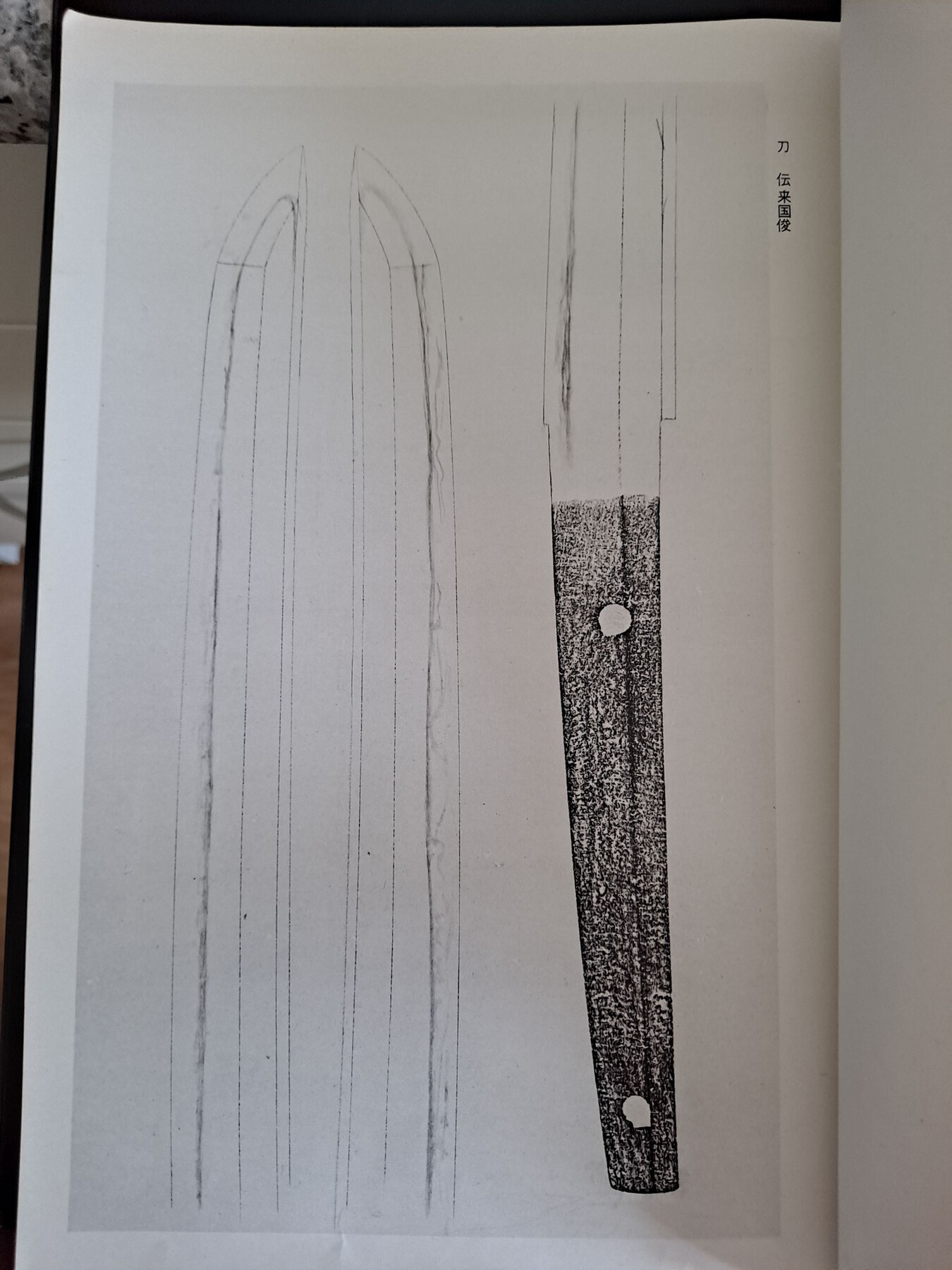
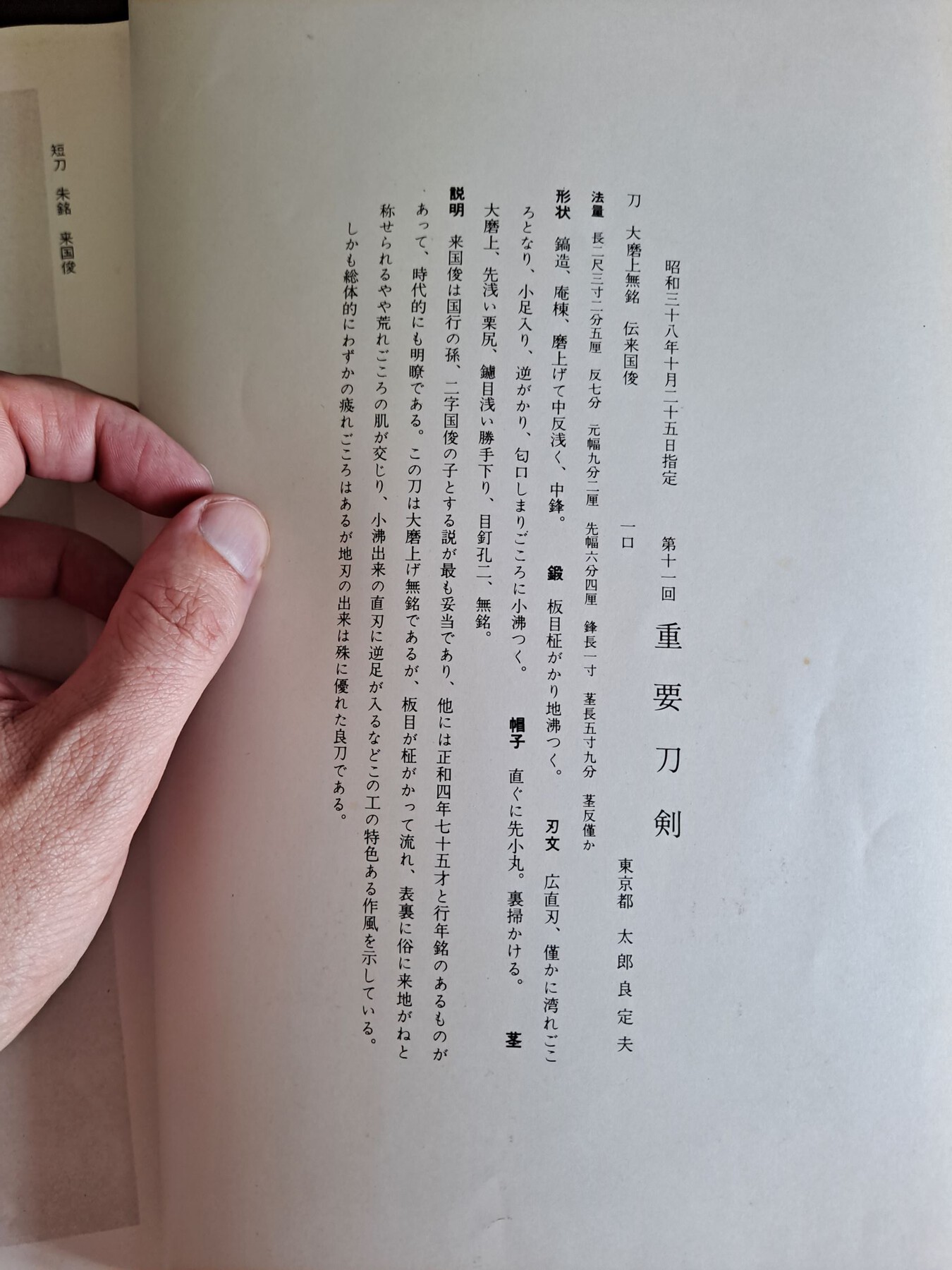
Here is the book entry for those interested of it. It passed long time ago in session 11. Congratulations of the item Jiri.

-
I was researching some other things while I made a curious find when looking at Jūyō 19 items. Due to this I might have to rethink my earlier Ōmiya listing I posted earlier in this thread. It also shows the importance of reading the entry in the Jūyō book instead of just going by one line that identifies the maker. At first I was going to make a post about that on totally different thing. The item in Jūyō 19 is the only mumei Jūyō item so far put towards Ōmiya Morishige, [伝大宮盛重]. Now I was wrongly thinking along the way of my earlier thinking posted above about mumei Morishige. However this item has this line at the end. この刀は鎌倉末期がら南北朝初期にかけての作である。So NBTHK clearly state that this ō-suriage (not mentioned in that phrase but item is ō-suriage katana) katana in their opinion dates from late Kamakura to early Nanbokuchō period. So they see this as work by Morishige who predates the 1st gen. Morishige. While not exactly related to the particular swords in this thread, I feel it kinda shows that there is much behind just the attribution. Therefore I feel something like Tanobe's sayagaki or NBTHK Jūyō explanation is very valuable for collectors.
-
Possible Bizen Yoshii school blade
Jussi Ekholm replied to Utopianarian's topic in General Nihonto Related Discussion
I think Yoshii could be a plausible call but of course confirmation by experts would be the best way to go. I am not sure what is putting me off about the polish, perhaps the hadori seems to be overpowering and creating too much contrast? Might just be the pictures of course too. -
Possible early Generation Osafune Tachi
Jussi Ekholm replied to Utopianarian's topic in General Nihonto Related Discussion
One thing to note that the signature is - 備前国長(船) - Bizen no Kuni Osa(fune). This particular signature style is extremely uncommon in Ōei-Bizen blades that I have so far recorded. I have around 100 Morimitsu swords and 0 with this signature, and bit over 100 Yasumitsu swords and 1 has this signing style (Tanto from Jūyō 31). This signature style was more common is swords of Kamakura and Nanbokuchō period and the potentially appearing again from Late Muromachi (although as I focus on early swords my data on later swords is bit limited). -
I think it is fun to have a friendly debate on minor things. There must be a reason why NBTHK made the call as Morishige out of the possibilities.
-
Possible early Generation Osafune Tachi
Jussi Ekholm replied to Utopianarian's topic in General Nihonto Related Discussion
Can you post measurements for the width, and measurement for the curvature? -
That is awesome display of Hasebe items Wish I could have been there.
-
Is this a good time to sell collections?
Jussi Ekholm replied to Peter Bleed's topic in General Nihonto Related Discussion
Many years ago I had the idea of tracking down items of my interest and trying to get info on pricing and "beat" the market... now years later I understand it doesn't really work out that easily as there are lots of other factors that play in than just the asking price for that item. The rarer the item is the harder the pricing will be. For some pretty common ones you can easily find for example mumei pieces is X price range, then you might get an exceptional item that is priced double that and it deserves that pricing. Also to be noted that market in Japan is quite different from international market. Of course in modern age it is getting more international but usually "basic - mid" items are much more expensive in Europe & US. However when it comes to very high end stuff then the rarity kicks in. It can be that an item goes from a dealer in the West to a dealer in Japan where a premium is added to it and it sells fast. Here is the link to the thread I made 2,5 years ago. Unfortunately many of the item links are dead since that. Still it might be of some interest or it might not. Personally I have kind of lost interest in price aspect of items and moved on to historical stuff. As I cannot afford to actively be eyeing out the market there is no need for me to really care about prices. Trying to understand differences between the items is to me more interesting than focusing on why for example one mumei Yamato Shizu is worth 6k, second 12k and third 20k. Of course they still often go hand in hand...