Bruce Pennington
-
Posts
14,277 -
Joined
-
Last visited
-
Days Won
170
Content Type
Profiles
Forums
Events
Store
Downloads
Gallery
Everything posted by Bruce Pennington
-
Thanks John. I guess I've heard of it, but never seen it or maybe never seen it so vivid. Is that the same as Matt's tassel in post #43?
-
Jareth, Do you know what the heck that is?
-

Emura? I need help identifying this sword please.
Bruce Pennington replied to NinjaBear's topic in Military Swords of Japan
Interesting example John! I should modify my statement to "I can't imagine an officer carrying a gunto without a tassel", as I actually don't know WWII regulations or practices about the matter. There were naval officers stationed on islands, and therefore "in the field", but I wonder how many of them were actually in front-line combat. I suspect most kaigunto spent their life sitting in the corner of their quarters on ship or in offices. But again I'm speculating about things I know nothing about. It is interesting to note that most gunto today are found on the market without tassels. I imagine some were removed before surrendering at war's end, some were removed and sold by dealers and collectors, but just how many were removed and not used by the original officers ..... good question! -
That's a cool way to match them up, John! And a good reminder for us when we see seemingly mismatched items here and there. Dawson's comment that "Japanese army officers were fiercely independent and felt no obligation to upgrade their equipment to be "uniform" in appearance." flies is the face of some who poo poo "mismatched" gunto because we (sometimes I find myself even in this camp) are so saturated with how items should look, we immediately assume the mismatch is due to post-war piece-together work. Of course, much or most of it IS piece-together, but this is still a good reminder to be a little more cautious before labeling something as such.
-
Sure about the date: July 1942 Smith: 兼直 (Kanenao) but I'm bad about smith names, so could be wrong. Small stamp is the Seki stamp, which means the blade was made non-tranditionally, in the Seki prefecture for the Army.
-
Emura? I need help identifying this sword please.
Bruce Pennington replied to NinjaBear's topic in Military Swords of Japan
An officer would never have carried their sword without a tassel. Navy all used the dark all-brown tassel. They can be found at sometimes at NMB (PNSSHOGAN just sold one), ebay, and dealers. -
Thanks Michael, the fittings are exactly what we would expect for a star-stamped RJT blade. The painted-canvas same' is often seen in the late-war Rinji. I don't know if it is due to lack of rayskin or if it was considered more hardy for combat befitting the purpose of the whole Rinji seishiki model design. Many, but not all, of the RJT blades had stamped numbers. Again, another mystery, as some match numbers on the metal fittings, where others don't. Your open heart stamp on the seppa is only the second one I've seen! It must be a koshirae shop logo, but as of yet, an Unknown. Thanks for the pictures!
-
Michael, Double release buttons - 1 on tsuka and 1 on saya? Also, does your nakago have stamped numbers at the end? If so, do they match any numbers on the other metal fittings? How about small stamps on the back edge of the nakago? Thanks!
-
Emura? I need help identifying this sword please.
Bruce Pennington replied to NinjaBear's topic in Military Swords of Japan
Anthony, A standard Takayama-to runs about $1,400 USD. If you use the retention cord and the upgraded saya covering (which shows wear), you could bump that up a tad. -
Rinji Seishiki Gunto blade length
Bruce Pennington replied to george trotter's topic in Military Swords of Japan
I got this from DaveR on one of the "Type 3" threads. If my math is right, isn't it saying that the nagasa is to be 2 saku 2 sun = 66.6 cm? That seems kind of long, doesn't it, and not lining up with real life blades (once we get some actual measurements!)? I must say, though, that often the mil specs didn't always pan out in real life for gunto. Nick Komiya posted a note from Tojo, himself, who stated the RS model should be made of tamahagane! I also find it interesting that the bottom sketch of the fittings seems to have a release button on the koiguchi.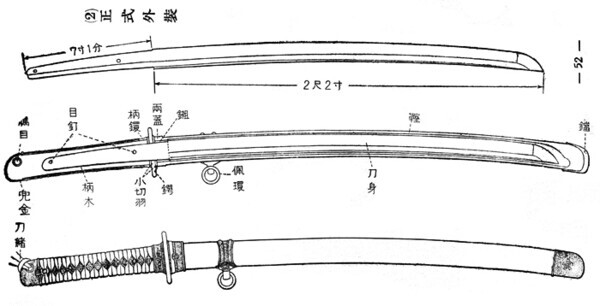
-
I think this was discussed on another thread that I can't find with my poor searching skills, but there are two late-war tsuka on this page with sarute ana not drilled through. I just found another. This star-stamped Munetoshi is in upgraded lacquered wooden saya, but you can see the sayajiri is low quality and the sarute ana isn't drilled through.
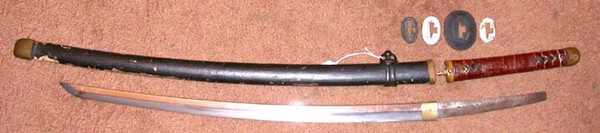


-
Rinji Seishiki Gunto blade length
Bruce Pennington replied to george trotter's topic in Military Swords of Japan
George, You may have answered your original question. It could be a simple as: blades made for Govt standard Rinji fittings (an prices) had to fit the Govt sized saya; whereas custom Rinji could literally be almost anything. -
Rinji Seishiki Gunto blade length
Bruce Pennington replied to george trotter's topic in Military Swords of Japan
Ah, Chris, I've been looking for that one! I have a photo of the stamped mune, but not the nakago with mei and date. Could you PM me with those possibly (simply just to keep from sidetracking George's topic). -
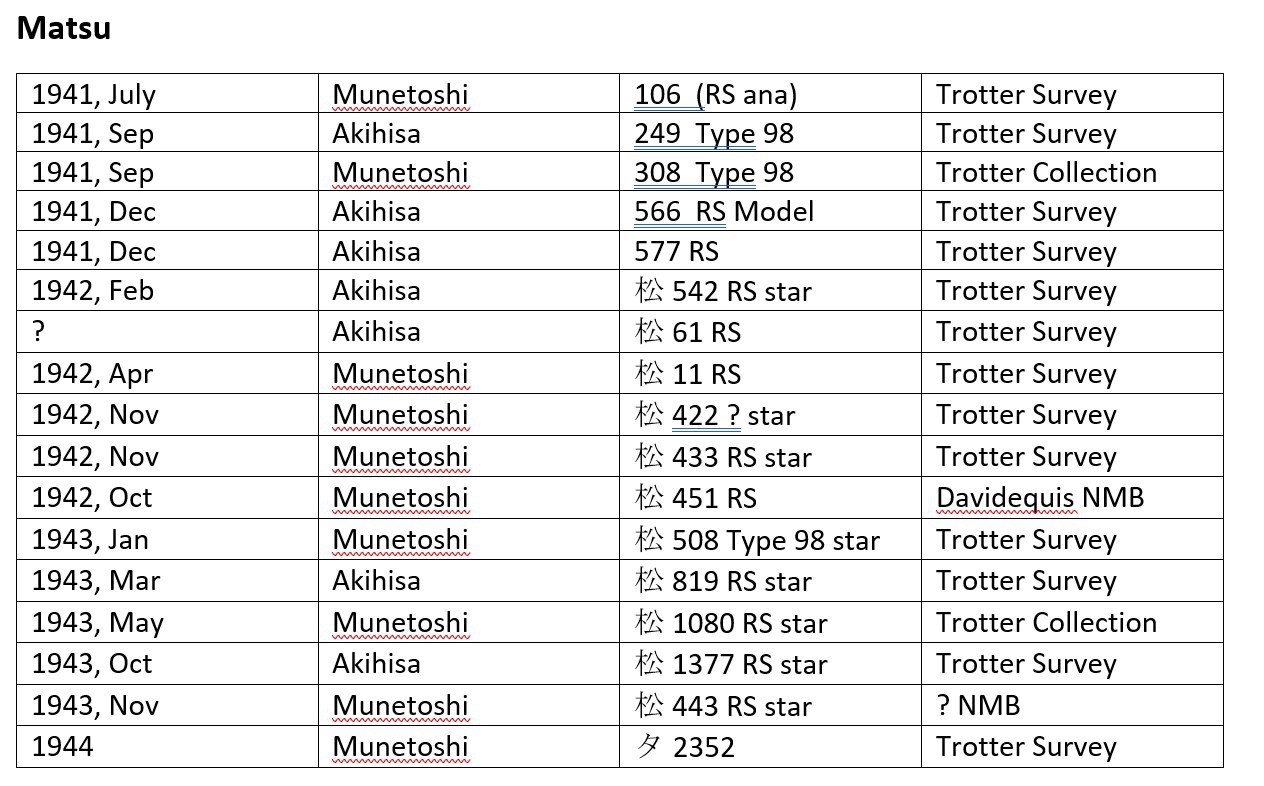
Thanks David! That 2353 is pretty cool! I doubt it is the 2352 of the Trotter survey, the numbers are easy to see. Also, number stamping on the war blades is quite varied, with numbers not aligned and differing sized numbers/letters commonplace. As I searched for your 443 reference I found a couple more that I didn't have! Here's the updated table: Matsu 1941, July Munetoshi 106 (RS ana) Trotter Survey 1941, Sep Akihisa 249 Type 98 Trotter Survey 1941, Sep Munetoshi 308 Type 98 Trotter Collection 1941, Dec Akihisa 566 RS Model Trotter Survey 1941, Dec Akihisa 577 RS Trotter Survey ? Akihisa 松 61 RS Trotter Survey ? Akihisa 松 97 NMB 1942, Feb Akihisa 松 542 RS star Trotter Survey 1942, Apr Munetoshi 松 11 RS Trotter Survey 1942, Nov Munetoshi 松 422 ? star Trotter Survey 1942, Nov Munetoshi 松 433 RS star Trotter Survey 1942, Oct Munetoshi 松 451 RS Davidequis NMB 1943, Jan Munetoshi 松 508 Type 98 star Trotter Survey 1943, Mar Akihisa 松 618 RS star Vajo NMB 1943, Mar Akihisa 松 819 RS star Trotter Survey 1943, May Munetoshi 松 1080 RS star Trotter Collection 1943, May Munetoshi 松 1082 RS star baldi1942 NMB 1943, Oct Akihisa 松 1377 RS star Trotter Survey 1943, Nov Munetoshi 松 443 RS star ? NMB 1944 Munetoshi タ2352 Trotter Survey 1944, Feb Munetoshi タ2353 Type 98 star For sale on web
-
Rinji Seishiki Gunto blade length
Bruce Pennington replied to george trotter's topic in Military Swords of Japan
I wish I had a measurement on my old standard Rinji, but it's gone and I don't. But my star-stamped Kunitoshi Rinji has a nagasa of 63.8cm, right at the bottom end of your range for custom Rinji blades. -
At least we got some gears turning! The more heads that we can get together on this, the more likely we'll come up with some useful information. Glad to see you working it David! On the sequencing - the numbers fall in line better if you look at the 2 smiths separately, and also assume the numbers started over each year - not perfect, but better. The 4-digit numbers are interesting in that they parallel the 4-digit numbers of the Mantetsu line. There is an odd-ball in 1940, but the 1XXX numbers show up in 1942 and 1943, with the 2XXX numbers appearing in 1944. I don't know if this explains it, but Nick Komiya, Warrelics, revealed an order from the Army to randomize serial numbers to obscure production capacities from Allied Intel. I'm not sure this was actually carried out by any factory, but it could explain the parallel jump to the higher numbers. Your thought about bunched/stored blades getting out of sequence has some merit. Army inspectors would travel around to the forges (and there were many!) monthly, bundling up blades and shipping them to Tokyo arsenal warehouses for distribution. The only glitch to this explanation would be that it would require that the date inscriptions would have to be applied by the Tokyo operation as the blades went to market for the numbers to be out of sequence, and I'm not sure it was done that way. Interesting stuff, eh!
-
Yes! I remember that one! Clearly a custom job! Very nice.
-
I saw that too, Dave, but I have seen legit kabu with squared edges. Strange paint job, but the quality or the metal-work is clearly legit on this one, as compared to the sloppy work on the item in question. Neil, Good point on the color of the cloth wrap!
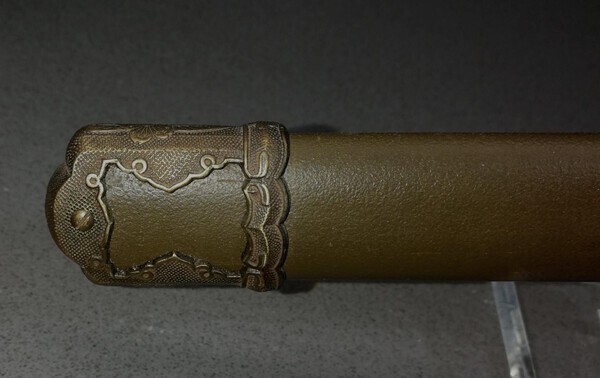
-
Thanks Chris! By the ana, I assume it's in Rinji fittings?
-
Matsu Stamp update Thanks to George Trotter, I've completed my survey of blades marked with the circled Matsu (none other form was found). After searching 4 sword forums (haven't done a web-wide search yet), the stamp, so far, is only found on blades made by the Yamagami brothers, Akihisa and Munetoshi. George said their forge was north of Tokyo - nowhere near Osaka - so it would appear the stamp was unique to the two smiths, and not associated with the Osaka Supervisory unit of the Kokura Arsenal. 松 matsu 小倉陸軍造兵廠大阪監督班 Ōsaka Supervisory Unit of Kokura Army Arsenal Considering that all observed inspector marks are the bare mark without circles or sukura (Showa stamp is the exception, but it wasn't tied to an arsenal, so it doesn't really apply to this issue), it supports the idea that the circled matsu is not an inspector mark at all, but something used by the Yamagami brothers in their serial numbering system (also supported by the fact that they moved to kana in 1944). Marks inside circles, stars, sakura, etc, tend to be shop logo or unique to sword shops. The only exception that I can think of is the Toyokawa anchor in sukura on seppa (which might actually indicate the seppa were made by a shop exclusive to the Toyokawa arsenal). I still can't shake off the coincidence of their stamp appearing in 1942, when the Army took control over nation-wide blade production, and the corresponding change in 1944 to stamps that reflected the locales/provinces where the blades were made. As RJT smiths, maybe their stamps were created to meet Army regulations. If anyone has further data that would add or change this issue, please let me know!


-
Bullet damaged sword captured at Guadalcanal
Bruce Pennington replied to Tonkotsu's topic in Military Swords of Japan
If he died in combat, I wounder how the gunto is tied to him? Maybe it was in his personal affects that were gathered after his death? -
Maybe someone with better search skills can find the thread where it was discussed about the Chinese military being authorized to produce their own version of the type 32 during the war. The handles were normally painted green, but I still wonder if this is what we are seeing.
-
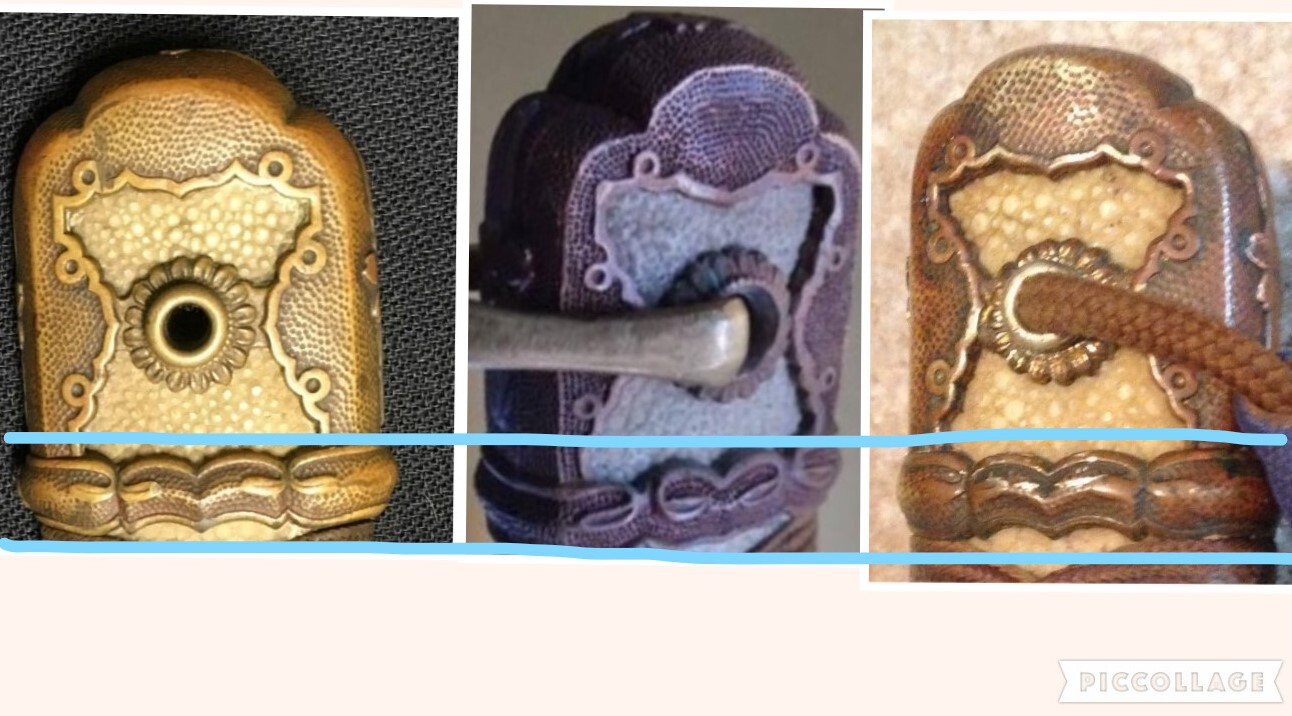
To John's points, the details of the kabutogane lean toward fakery. As we've seen in Trystan's posts about the latest Chinese moves in faking, they ARE getting better. With the nakago and all the small details, like I've highlighted in the attahced pic, if I had to bet, I'd put a small amount down on "faker." BUT, we have been learning more and more lately about things that had been called fake for years, and some of them have turned out to have an explanation. So, if it were mine, depending upon how much you paid, it might be worth preserving. If I were to re-sell, it would have to come with a caveat about the uncertainties. This comparison of 2 of mine with the one in question. The fakers really have a hard time getting this bottom edge detail right. They usually get the rest wrong too, but this one is darn good everywhere else.

-
Would these help?
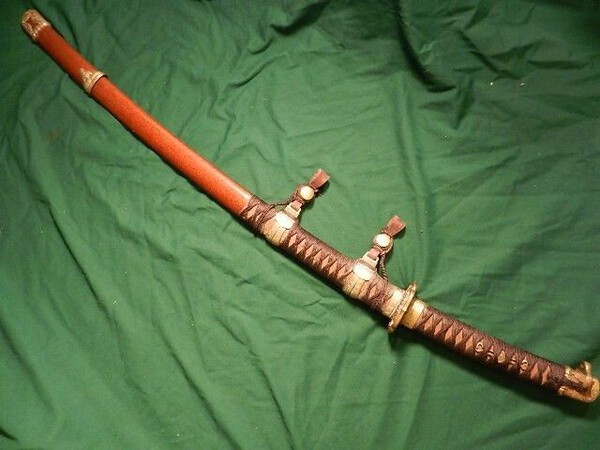

-
Translation on special order blade maybe- please?
Bruce Pennington replied to shakudo's topic in Translation Assistance
Forgive my ignorance, but this is just one side, right? What about the side with the Chrysanthemum? And does the presence of the chrysanthemum have particular significance? Thanks!