Bruce Pennington
-
Posts
14,318 -
Joined
-
Last visited
-
Days Won
171
Content Type
Profiles
Forums
Events
Store
Downloads
Gallery
Everything posted by Bruce Pennington
-
Ok, love you guys! But do me a favor and let's make any further posts about the topic please?
-
 WAIT A DARN MINUTE! Alison - Did you just sell this to someone? The saya seems to have been coated with something, but the blades are exactly the same! I think the saya was just oiled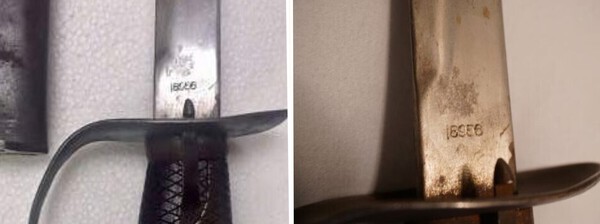

-
JP, I don't think they could have found enough old automobiles to scavenge enough springs to make 180,000 Type 95s. Are you saying, instead, that the factories that made 95s could have been using the same raw steel that auto manufacturers were using to make springs?
-
And without a reputable story along with a blade, we'll never now for sure. The article's author complimented the team member doing the smithing, so he likely did good work. I was simply intrigued by the confirmation that sword-stuff was being made in the field. Still tempers my thoughts when I see something a bit off on a guy's sword. I'm more likely to give something the benefit of the doubt, now, as to it's legitimacy. Yes, most of the fakery is pretty clear, but it's the odd-balls that make me wonder.
-
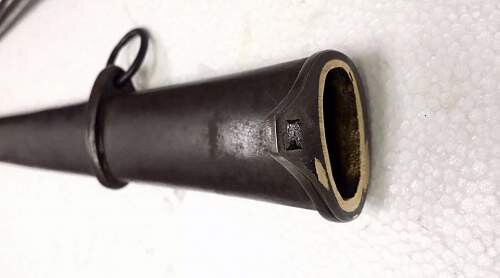
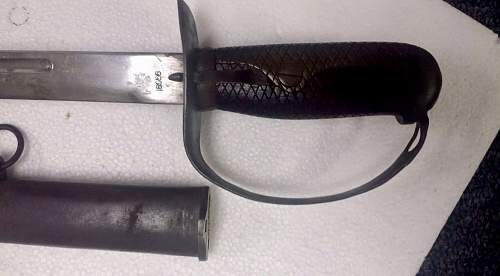
Well, the plot thickens. A guy over at Warrelics just bought a similar 32 ($195), and is waiting for it to arrive, but he's posted pics: https://www.warrelics.eu/forum/Japanese-militaria/type-32-sword-cosmoline-776160/#post2112925. It's not the first one, in cosmoline, but the second one at the bottom of the thread. I'm adding the pics here. Something I noticed on his is the saya throat. It's clearly made of brass, then coated/painted/blued with something to make it look like steel with a brass insert. Why would a legit sword-maker artificially make the throat to look like an insert? Seems more like something a faker would do. The handle work is really good and looks actually aged. The blade has the same problems with the ricasso and bo-hi. The numbers are a good distance apart. I mention that because on 95s the fakers seem to keep using the same numbers over and over. So, either these numbers are far apart because they really were on a real production line, or the faker was just smart enough to care about that. It has the same pointed latch tip, and squared latch receptacle on the throat



-
What NOT to do.... just a bit of fun
Bruce Pennington replied to Brian's topic in General Nihonto Related Discussion
Quite a beauty, Brian! The sarute is the standard cloth type. Just faded and worn. -
That’s exactly what I was thinking about when I read this Steve! Between this kind of blade and POW made blades, it makes me soften my approach to questionable Swords when they show up.
-
The one in the article I posted at the beginning. We don’t have one in hand, it was just mentioned in the repair team story.
-
Chris, you are right about the hamon, but you'll notice in the article that they were making them "for self protection," so they weren't concerned about the art. They were simply making weapons.
-
Two great threads posted by Guy at Warrelics on: Theater-made Gunto - The gunto repair team did not have their own swords, so they made blades from auto springs! and Naruse Kanji -- Shuriken, Swordsmanship .... and Sword Repair - a brief bio of one of the repair team members.
-
What NOT to do.... just a bit of fun
Bruce Pennington replied to Brian's topic in General Nihonto Related Discussion
I have heard that often, but don't know a source for it. -
Yes, a very nice Type 98 Japanese officer gunto!
-
NCOs with Private Swords
Bruce Pennington replied to Bruce Pennington's topic in Military Swords of Japan
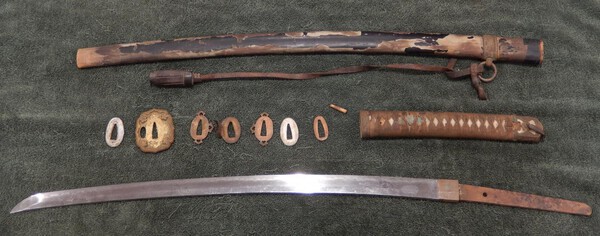
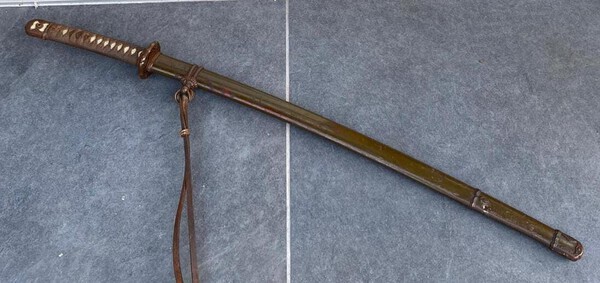
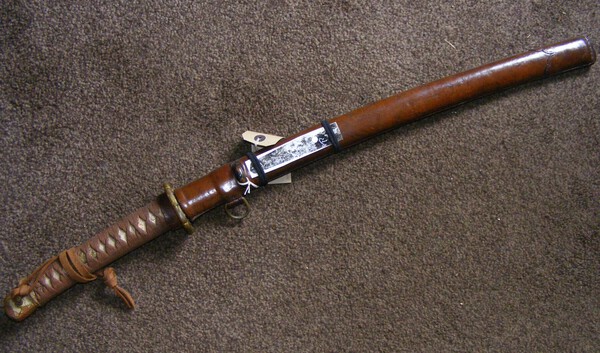
Rather than start a new thread, I'm going to tack this on this one. NCO tassels on Type 98 gunto and blades (both WWII and older) mounted in leather-covered saya and Type 98 tsuka/tsuba. I have found 4 on a quick NMB search. Adam's (Babu) recent one got me wondering. The majority of them have what appears to be used/abused NCO tassels, often the knot missing and the ends tied off. In some cases, the entire gunto looks equally beat up, like it saw plenty of time in the field. I want to propose the idea for discussion that these are NCO gunto, carried under the 1945 Army authorization for NCO carry of family swords. My idea is that when an NCO showed up at a shop with a family blade to be re-fitted, the shop used Type 98 tsuka/tsuba as they wouldn't have had access to aluminum tsuka. Another angle is the Warrant Officer. I found a 2015 post of a sword - Taken at Kabwet, Burma - where a museum had a fully fitted Type 98, company grade tassel, that was being carried by a captured Warrant Officer. Now, I find it more likely that a Warrant Officer would carry this, than a Type 98 with NCO tassel, but what if the guy came up through the enlisted ranks and became a warrant officer, upgrading his sword to an officer sword, but retaining his NCO tassel, like our "Mustang" officers today, wear their ribbons on their officer shirts (officers don't wear the ribbons on shirts. We're talking A.F.) I'll post this on the Warrelics forum too, to get blasted by the experts there, but I'm getting the feeling from some of these that the tassels are wartime, not G.I. add-ons or post-war add-ons. What say you?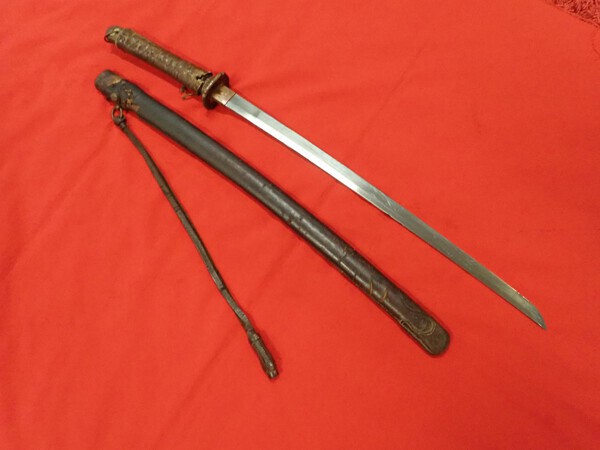
-
OLD POST! Interesting provenance. I'd say the answer is that the soldier was a Warrant Officer. I'm no expert in Japanese rank structure, but I would think he would be allowed to carry the officer gunto, company grade tassel. There was no tassel for Warrant Officers.
-
Another Navy Last one No6
Bruce Pennington replied to Guns Knives and Swords's topic in Military Swords of Japan
The lighter, top one is clearly a fake. The darker, bottom one is tough. The snaps look old, but the top end of the leather, especially inside the flap, look new, but the end looks artificially aged, with multiple cracks running all over. I have a fake that came with a batch of swords, and the saya leather has that all-over-cracking like it was treated with a chemical or something. I could be wrong on the bottom one, though. -
You've seen it before but any info would be good
Bruce Pennington replied to Babu's topic in Military Swords of Japan
Adam, After looking at the rest of the pics, one shows the blade in a very old tsuka. Which one came with the blade, the WWII army or the civil? -
You've seen it before but any info would be good
Bruce Pennington replied to Babu's topic in Military Swords of Japan
Adam You've got an old blade re-fitted for the war in army fittings. The tsuka/tsuba are Type 98 Army officer with the leather covering what is likely the original saya. Puzzling is the worse-for-wear NCO tassel. I've seen a number of these lately and don't know what to think. The easy answer is G.I. grabs any tassel he can find and puts it on his war trophy before going home; or post-war collector did it. But what post war collector would put just the leather strap missing the knot at the end. This looks war-era to me. Ignoring the tassel, that's what you've got. -
Is this a fatal flaw?
Bruce Pennington replied to PietroParis's topic in Auctions and Online Sales or Sellers
LIke Chris said, looks to me like it's one of those blades that was cut in half at the end of the war. There are a few around like this. Last one I saw was used to hold a koshirae set together. Ha Ha! I just realized the humor of the title!!! -
Ha! Should have known! Thanks Steve!
-
Another Navy Last one No6
Bruce Pennington replied to Guns Knives and Swords's topic in Military Swords of Japan
I didn't notice the leather till you just pointed that out. I think you summarized it well. This is my leaning too. Richard Fuller speculates that naval forces stationed on land working with Army may have adopted some of the army fittings. He mentioned durability, but I think the gold-gilding might have been undesirable if trying to blend in with the local flora. I believe there is also that element of being essentially abandoned on islands with no reinforcement, no resupply, and in the case of swords, no repair teams or access to the industry. Field repairs and replacements would, to me, be a natural thing to do. But at this point, we are WAY off the main road and deep into Speculation County. -
Uwe, I would have said Asano, too. Is this Samurai Mon site incorrect? Samurai Family Crests
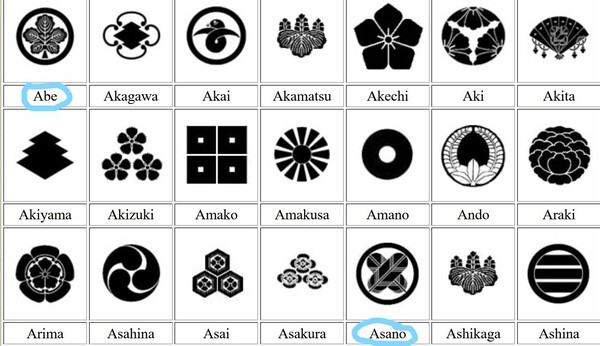
-
Rinji Seishiki Gunto blade length
Bruce Pennington replied to george trotter's topic in Military Swords of Japan
Ahem.... how do I keep getting YOUR projects!?!?! Ha! Well, it's a pretty small sampling, but so far it looks like they are all over the place. Chris and Neil both have a Yoshitada: Chris - 62.5 & Neil - 69.0 with the Mil spec at 66.6. Yours, George is short compared to the rest (Chris' is the only shorter), while the rest are longer than the spec. I didn't look the gendaito over, but I suspect the same from them. Interesting hypothesis, about the gendaito being longer, but I'm feeling like it was simply because of your sample-size of 2. I'll say, though, that even if wrong, you still broadened our understanding of gunto by your probing question and that's always a good thing! -
Another Navy Last one No6
Bruce Pennington replied to Guns Knives and Swords's topic in Military Swords of Japan
Michael, you have one heck of a collection there! That's a really cool blade! The fittings, though, are a real mess. I don't know what to think. The tsuka is mostly Army, but it has navy menugi. The blue ito looks like it has period wear, so it doesn't seem to be a post-war re-wrap. The Showa stamp is normally only seen on army blades. It has 2 mekugi ana, which means the blade was re-mounted at some point in it's life, which opens the possibility that this was re-fitted with the navy tsuba/seppa and menugi. The saya was originally covered in leather, which was seen in both army and navy combat saya. The only difference was the navy leather was died darker, sometimes black, whereas the army kept the leather brown. I guess you don't know the story behind this gunto? (Ha, I see John was typing the same time I was! Sorry for the duplication!) -
Type 98s in good shape sell in the range of $900-1,400 USD. Yours is weathered and used, which will or won't affect the pricing depending upon the collector buying. Some guys look for the pristine, and some love to see the battle-worn. So just depends on who's buying. I agree with Chris on the age - it could be 1930's or earlier. Not likely much earlier than 1800s - or it could be WWII era.
-
Kyle, Is the saya the standard 98 or is it leather-covered wood saya? Is the blade an older blade or WWII showato? I ask because I've seen quite a mix of parts on older blades that were re-fitted for the war. If it's showato and all standard fittings, I'd say that there is a small variety of chuso buttons. But like Chris was alluding to, if it is short, then either it's a replacement or seppa have been added since made.