


SteveM
-
Posts
4,391 -
Joined
-
Last visited
-
Days Won
98
Content Type
Profiles
Forums
Events
Store
Downloads
Gallery
Everything posted by SteveM
-
Jean is right 1. 濃州関住服部正廣作 Nōshū Seki-jū Hattori Masahiro Saku. 2. 濃州住三品義明 Nōshū-jū Mishina Yoshiaki. David beat me to it. (And David is right also).
-
I think this smith is Ittōsai Masakiyo (一刀斎正清) whose real name was Kobayashi Kiyoharu (小林清晴). In Shōwa 17 he entered the Nihontō Tōshin Seiren-jo (日本刀東神精錬所). My guess is that he used the name Masaharu during this time, but later changed to Masakiyo. https://tokka.biz/sword/masakiyo.html
-
Deja Vu
-
光山 Kōzan (light mountain, not to be confused with Kinkōzan, who is another, unrelated maker) Maybe Meiji? https://gotheborg.com/marks/satsuma.shtml
-
And yet, we have papered examples of the Masahide mei from Bunsei 3. Anyway, I'm just interesting in seeing more of the year, and not very keen on going down into the rabbit hole of authentication. Not yet, anyway.

-
It looks very much like a typical shinto wakizashi to me. I don't think that hamon is strong evidence of it being an older sword, particularly when the shape and curve are both very suggestive of a shinto wakizashi.
-
I would like to see a full shot of the year. I'm guessing Bunsei 2 (文政二年), but I can't quite see the whole thing. This would put the date of the sword's manufacture at 1819.
-
If you are talking about the other side, the inscription is 伊豫松山住靖献造之 祈栄高田本家 Iyo Matsuyama-jū Yasutate tsukuru kore Kiei Takada Honke The translation of that is Made by Yasutate of Matsuyama in Iyo Province / With prayers for the prosperity of the Takada family The front side is just 靖献作 (Made by Yasutate) You can find some more information about Yasutate in Markus Sesko's Index of Swordsmiths.
-
The kanji was right, the reading was wrong. 献, and almost every other kanji in the lexicon of several tens of thousands of kanji, has multiple readings. Ken is the most natural reading for 献, but not the only one. Actually, I think many Japanese people may misread this one. This well-known dealer has misread it https://www.nipponto.co.jp/swords4/NT328989.htm As has this one https://www.tsuruginoya.com/items/a00514.html
-
Yasutate real name: Gōda Toshiyuki
-
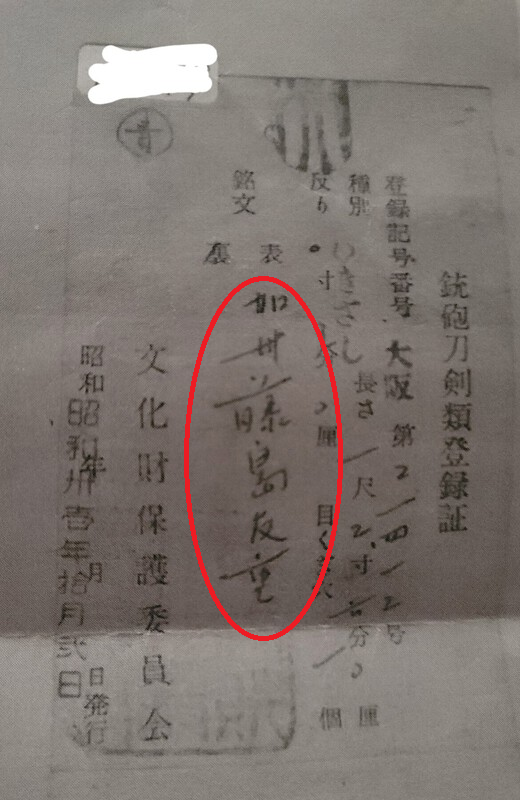
Yasuken? Can you show pictures? Or, maybe type out the kanji?
-
加州藤島友重 Kashū Fujishima Tomoshige
-
How many words? Figure a cost of approximately 25 - 30 yen per character for a specialized field such as antiques, and multiply by character count, and you will get an idea of how much it would cost to have it translated.
-
The surrender tag is an address and name of the person to whom the sword belonged. 西宮市下新田甲子園口一九四 安井重? maybe 重寅? Nishinomiya shi, Shimo Shinden Kōshien-guchi 194 Yasui Shige-something (possibly Shigetora?) Nishinomiya is a location in Kobe city. Kind of in-between Kobe and Osaka. If you flatten out the tag, the last character of the name might be a bit easier to read. The Senjuin Group from the fabulous Fred Weissberg https://www.nihonto.com/yamato-senjuin/
-
The mark is from China 道光年製 Daoguang Nianzhi, a porcelain maker's mark from maybe late 1800s to early 1900s? (I think. Not my speciality).
-
Its a very poorly written version of 団結している刃物 Sadly, the "United Cutlery" company did not pay for a translator to properly translate the name of their company, and they ended up with this odd-sounding Japanese phrase - probably the result of google translate. At any rate, it doesn't mean united strong steel. More like "blades that are uniting together", which sounds as awkward in Japanese as it does in the google-translated English.
-
WW2 katana by yoshikane tuskuru Kore
SteveM replied to Swords's topic in General Nihonto Related Discussion
Well, him and a bunch of other smiths took the the 5th Seat, so I don't think it is a powerful selling point. He seems like a reasonably obscure WW2 smith. Even in excellent condition you have to wonder how much the sword would be worth when you can already buy papered antique swords for a couple of thousand dollars. I mean, if the sword was recently bought/sold for around $2300, would a polish turn it into a $4000 or $5000 sword? I don't think there would be a market for this sword at that price, so I'd say sell it as is. -
WW2 katana by yoshikane tuskuru Kore
SteveM replied to Swords's topic in General Nihonto Related Discussion
濃洲住谷口義包鍛之 Nōshū-jū Taniguchi Yoshikane kitau kore It means Taniguchi Yoshikane of Noshu province made this. Noshu is a location that corresponds roughly to Gifu Prefecture in Japan today. -
Yes, you nailed the date.
-
Yes - you got most of it right, although you need to put them together in a way that makes grammatical sense. It's written in "kanbun" style, so it won't have syntax or grammar like standard Japanese. I'm not a kanbun expert, but I think it goes something like 地刃健全優作之一也 Jiba ga kenzen de, kore ha ichi yūsaku ni naru. This is a masterpiece with a healthy blade surface.
-
Hello Andrew, Date on one side, swordsmith's name and location on the other side. Unfortunately, the date is badly eroded, as is the location. The smith's name looks like 真貞 (Sanesada). There were several smiths who used this name, from as far back as the 1300s to the 1600s. If we could pick out the location or the date (obviously) we could pinpoint which smith made your sword. If we had a look at the entire sword, it would also be a help, as the shape of the sword indicates which era the sword is from.
-
Trying! "Toshiharu?" 1936 or 1945?
SteveM replied to Bruce Pennington's topic in Translation Assistance
I think its probably 十七 . The bottom bit of the 七 is only slightly curved, so in the picture it looks like a 十. -
義定 昭和十七年 Yoshisada Shōwa 17 Do a search on this site for Ishihara Yoshisada and you should be able to find some other swords with this name.
-
This thread might be useful:
-
If it is from the early 1800s (which I think it is), then it is certainly a traditionally-made Japanese sword, made in Japan's feudal past. Its impossible to tell the quality of the sword in its current state. I mean, it looks OK from pictures, but it needs to be polished by a trained Japanese-sword polisher so that the various features of the steel can be revealed. What we can say is that there is so little information on this swordsmith, he probably wasn't a particularly great artisan swordmaker. Having said that, he did train under one of the great masters of the art, so... if it were my sword I would be looking around for a trained polisher. There are just a few in North America. Watch out for "self-trained" polishers, as these guys invariably cause lasting damage to these irreplaceable objects. Whether or not it has a connection to WW2 is something probably only your grandfather could answer. It isn't unusual to find family swords being put into wartime fittings (scabbards and such) so that soldiers could bring a family sword to war - however your sword's fittings look like one would expect a late Edo-era (1800s) sword's fittings to look. In other words, its not in wartime fittings. I would say it probably stayed safely in someone's house throughout the war.


