SteveM
-
Posts
4,283 -
Joined
-
Last visited
-
Days Won
96
Content Type
Profiles
Forums
Events
Store
Downloads
Gallery
Everything posted by SteveM
-
Looks good. 興亜一心 満鐵作 Kōa Isshin Mantetsu Saku 昭和癸未春 Shōwa mizunoto-hitsuji haru Kōa Isshin Mantetsu sword (Japanese-made, in occupied Manchuria) 1943, Spring. There is a mountain of information on these types of swords here at this site. Very collectible, especially if they are in good condition, as yours is. Stay tuned...the Mantetsu guys will surely be interested in this.
-
The Admiral above has a different spelling 勝木源次郎 香月 could be read several different ways (Katsuki, Kagetsu, Kōzuki, etc.). First name looks like Kameo 香月亀男君 Katsuki Kameo, Kōzuki Kameo, Kagetsu Kameo, and others are possible. 城蘓岳 = Maybe refers to Suzhou, China? (城 can also mean city, in addition to castle).
-
I think this might better be called a sunnobi tantō rather than a wakizashi. It's right on the borderline of classification, but I think at this size and with this construction (hirazukuri) it's more appropriate to call it a tantō. Your mileage may vary.
-
It doesn't tell which generation, but it suggests a date of sometime during the Manji era (c.1658-1661).
-
Yes 1942. Actually this one says "Kigen 2602" (basically means the same thing as Kōki). 紀元二千六百二年
-
As in the other thread, the tantō is 義弘 Yoshihiro, using a variant of 弘.
-
Last one is Yoshihiro (義弘) using a variant of 弘. Consider it gimei for now.
-
Hello Josh, Browse the dealer section of this very site and you can find all the answers to your questions. I think all of the dealers here are respected and would be keen to answer any queries you have. https://www.militaria.co.za/nmb/forum/88-dealer-showcase/
-
The label on the side describes the kind of thread used: モール製 (made with gold thread). The label on the front would be a kind of identifying number/series/class of tassel (I think).
-
Hi @Ontario_Archaeology Matt, can you give us close-up of the tassel box label? I think its 准銀台(臺), but I'm not quite sure what it means. And, it might be い號 ?
-
Nailed it.
-
昭和十八年五月 勝正
-
The second one could be 貞 (also read as sada). Here is a grass-script style mei which contains the above sada. (from the site at http://kako.nipponto.co.jp/swords/KT120895.htm )

-
A question for Nobody in particular...
SteveM replied to Toryu2020's topic in Translation Assistance
Hi Ed - we have most of it, with some doubt on a few characters, but the gist of it is relatively clear. 1. It's from a swordsmith in Echizen. 2. On the opposite side is a phrase "Sutra Without Payment". It refers to a Kyōgen play - a comedy/farce. The story is; a priest goes to a family to perform a ritual buddhist sutra chant. At the end of the sermon, the priest lingers around so he can collect his payment, but the payment isn't forthcoming. The priest then starts hinting that he's waiting for his payment, jingling coins in his pocket, going out of his way to use the word "alms" in his sentences, etc. But the family is oblivious to his hints. Then he leaves, but can't stop thinking about the payment, so he hides his sash in his pocket, and goes back to the family telling him he's forgotten his sash, and starts to make even more broad hints about the payment. So it's a farce that alludes to several themes; the greed of priests, the lengths people will go to in order to get what is due to them, the ridiculousness of man in his quest for riches, how desperation makes people do crazy things, etc. It has given rise to the phrase Fusenai Kyō Ni Kesa wo Otosu ("when the payment isn't forthcoming, the sash gets dropped"). In everyday English we might change this to, "if you pay peanuts, expect monkeys". On this sword we might imagine it has more of a nuance of, "if you don't pay what I'm worth, don't complain how the work gets done", but this is just my own speculation. We can't step inside the mind of the person who had it written. Coming from this kyōgen play, we know the sword (or, at least the inscription) won't predate the play. I don't have an exact date for the play, but I would guess late Edo (1800s). I think we know a lot about the sword from what it has written on it. And an enigmatic inscription like this is always attractive to collectors, assuming the sword itself isn't a write-off. -
来兼房 Rai Kanefusa
-
Tang of Kai Gunto - need help with translation
SteveM replied to Kolekt-To's topic in Military Swords of Japan
Yes, I would say 濃州住栗木兼正勤作 Nōshū-jū Kuriki Kanemasa Kinsaku Kuriki Kanemasa from Nōshū (province) diligently/respectfully made this. -
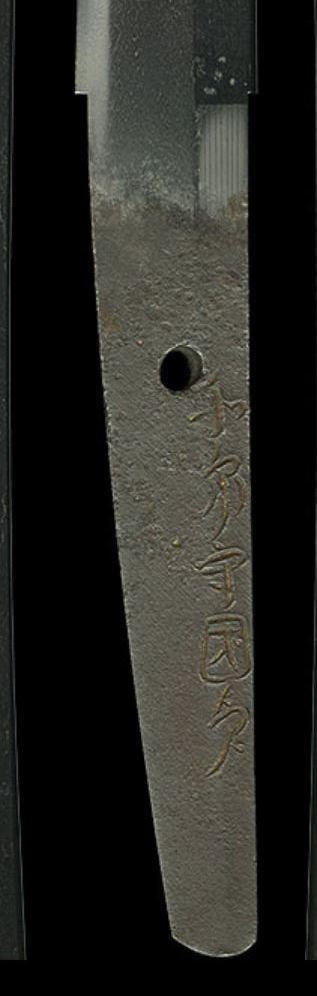
⻖ is actually a component, or a part of a kanji. It isn't used by itself. (You can see it at work in kanji like 阪 or 陸, etc...). The two kanji inscribed on the tang in this thread are more complicated and are written in calligraphic style (aka "grass script"). It's a highly simplified way of writing kanji, that, unfortunately, abreviates them so much that it's often hard to decipher them unless you are very experienced. I thought the second one might be 定 (sada) which is a very common kanji used by swordsmiths. Morisada (守定) is a possibility. I also considered 次 and 沢...but in the end I didn't have confidence in any of these, including 定.
-
タイ〱 (the third mark is a "repetition" mark, so the cutting test is たいたい or 太太 = taitai)
-
NBTHK's tatara makes three grades of tamahagane (Grades 1, 2, and 3). The site says Japanese swords are made from Grades 1 and 2. This also repeats the information about the carbon content of the steel, namely Grade 1 is between 1.0% - 1.5% carbon, while Grade 2 is between 0.5 - 1.2% carbon. It doesn't say what happens to Grade 3 tamahagane... maybe Grade 3 ends up in the souvenir shop of the sword museum. https://www.touken-world.jp/tips/19308/ 靖国たたらと日刀保たたらは、それぞれ異なる基準のもと分類されており、靖国たたらでは、「鶴」、「松」、「竹」、「梅」の4段階で品質を分けていました。日刀保たたらでは、「1級品」、「2級品」、「3級品」の3段階で品質が分けられており、作刀の際に用いられるのは1級品や2級品など、最高品質の玉鋼です。 As far as I know, there is no official translation of these grades, so when people like me translate into English, we'll use whatever English translation makes sense. So I have used "Grade 1" for 一級品, but another translator might decide to call this "1A". Note that the predecessor of the Nittōho Tatara was the Yasukuni Tatara, and Yasukuni had 4 grades of tamahagane: Crane, Pine, Bamboo, and Plum. Crane would be the highest grade of tamahagane, while Plum would be the lowest.
-
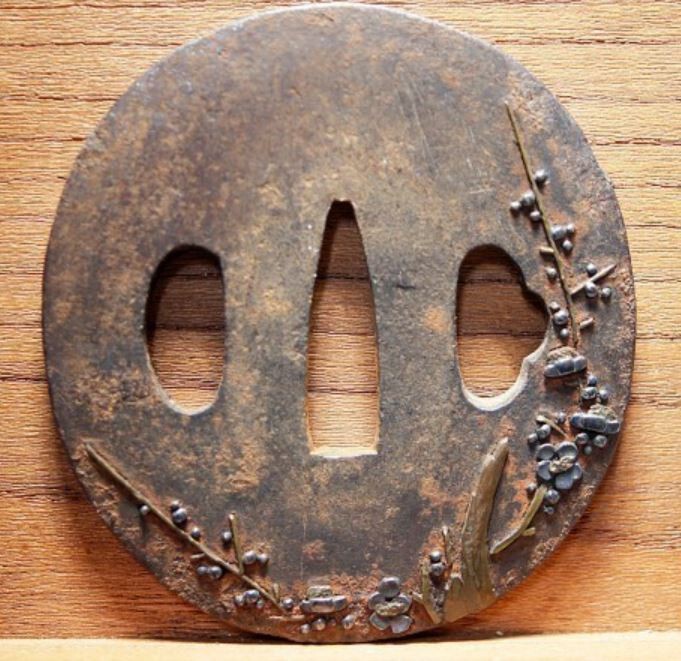
The fuchi/kashira are traditional symbols of good luck and longevity: pine, bamboo, crane, and turtle. Together with the plum on the tsuba, they would all be considered auspicious symbols. The menuki I am not so sure about; something related to the 7 lucky gods? Or, some kind of Daruma theme? Hopefully someone will pitch in with a proper answer.
-
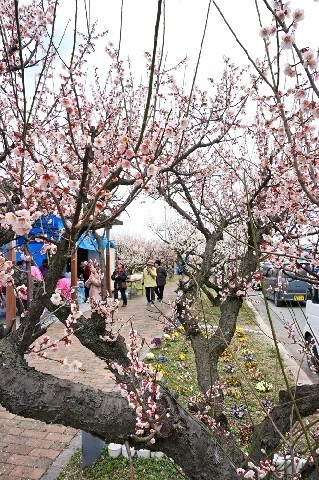
My guess is plum tree. Similar to the photo below (snipped from a Japanese auction site) The long "stalks" are tree branches. Plum blooms at the end of winter, when there are no leaves yet on the tree.

-
Also, the Japanese Embassy now helps repatriate war items. Check out the link below https://www.us.emb-Japan.go.jp/english/html/world-war-2-artifact-recovery.html
-
Looks like the first name is Yūsaku (祐作). Can't get the family name.
-
Need Assistance with Date and Part of Mei
SteveM replied to KuraiValo's topic in Translation Assistance
Yes, with a weird variant of 崎 that looks more like 嵜. And at the end is 造. So 三河国岡嵜住筒井橘清兼造 岡 is also written in a pretty stylized way. -
Oshigataa / Samples of Gotō Heisaku test cutter?
SteveM replied to TheGermanBastard's topic in Nihonto
Here is another sword with a cutting test by Gotō Heisaku. https://www.nipponto.co.jp/swords6/KY332229.htm Guido made an index of sword cutters (it should be available on this site somewhere), but this name doesn't appear in it.