


SteveM
-
Posts
4,384 -
Joined
-
Last visited
-
Days Won
98
Content Type
Profiles
Forums
Events
Store
Downloads
Gallery
Everything posted by SteveM
-
Haha - "amazing browsing skills" would be closer to the truth. Well, being able to read (usually) the hakogaki is also a big help. I've been looking at a ton of tsuba and hakogaki recently, and I recognized the horse coming out of the gourd and the name 張果老, but I still had to do a bit of browsing to sort them out.
-
Two Chinese sages Chō Ka Rō (張果老) who travels on a horse or mule that he essentially dissolves every night, and revives every morning by pouring water on it. Handaka Sonja (半托迦尊者) who I think conjures a dragon out of an incense bowl. Its a kind of mixing up of sages and beliefs, because Chō Ka Ro is a Taoist sage, and Handaka Sonja is a Buddhist disciple, originating in India. Anyway, despite the odd pairing, it authenticated (Tokubetsu Hozon) and the hakogaki is from Ogura Souemon, and looks to be in good condition, so the price is probably fair. Maybe a special order piece? Edit: Thinking more about this: the price seems very reasonable for a Shozui piece with TH certification. Especially with the exchange rate for JPY being so low.
-
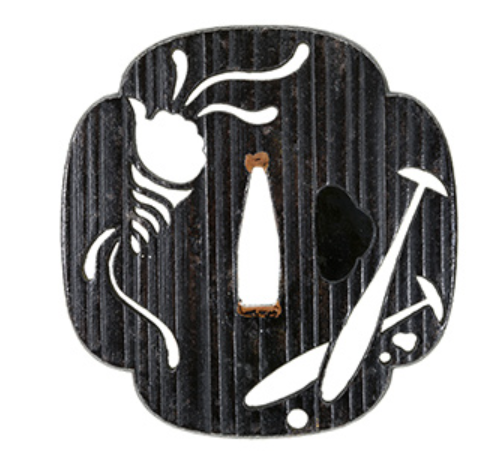
Similar striations in this tsuba that was attributed to Myōchin. I wonder if it was a stylistic trend, or if it has some particular meaning. https://www.seiyudo.com/tu-090116.htm
-
Box says 秋虫 (Autumn insects). I don't quite see the insects, but a lot of these tsuba with long, stem-like images in sukashi get attributed to autumn insects because the long filaments look like antennae. The box also says the fukurin is silver. I like it (even though I can't find any insects in it). Edit: Box also says 赤坂 - Akasaka.
-
New member beginning the journey.
SteveM replied to Avidmark's topic in General Nihonto Related Discussion
People mount gendaito in katana koshirae all the time. There is no taboo against having a koshirae made for a gendaito. But there is an economic headwind against making a bespoke koshirae. It is usually a labor of love, and whatever cost (including time and energy) you invest into having a koshirae made, will probably not be met with a corresponding rise in value of your ensemble. -
Here's one from March 1936 http://kajiyahiroshi.../token-ka311101.html October 1936 https://sword-auction.com/ja/product/16319/as22470-刀昭和十一年十月吉日-靖憲/ February 1937 https://x.com/GinzaM...200423282196480?s=20
-
My introduction/ help with an officer sword please!
SteveM replied to Gunner1171's topic in Military Swords of Japan
Hello Shawn, The guy that evaluated your sword was correct. It is a genuine WW2 sword. The writing says 関住兼松一則作 - Seki-jū Kanematsu Kazunori saku which means: Made by Kanematsu Kazunori, from Seki (city) Kazunori is the swordsmith's "professional" name. His real name was Kanematsu Kazuichi. Swordsmiths usually use a professional name that has some significance to their family or to the master craftsmen whom they apprenticed under. Anyway, the smith is Kanematsu Kazunori, who was what they call an RJT smith, which stands for Rikugun Jumei Tōshō (an "army-appointed swordsmith"). The small hot-stamp above the hole in the tang is actually an image of a cherry blossom with a kanji character "昭" inside the outline of the blossom. the kanji character is the first character of 昭和 (Shōwa) which is the era name of the era during which Hirohito (aka "the Showa Emperor") lived. This stamp was put on swords that were made in an arsenal, to differentiate them from completely, traditionally hand-made swords. So this means your sword is not 100% traditionally made, but instead was made using some modern methods and materials. Nonetheless, it is still an authentic piece of militaria. It looks like the tang was aggressively cleaned with some steel wool or something, which unfortunately stripped the tang of some of its patina. Cleaning with any abrasives or solvents will most likely ruin the blade - or at least damage it so that it will need to be restored by a traditional Japanese polisher. But set that aside for now, your blade is OK as is. There is some more information in the thread below (although the first link seems to be broken).- 9 replies
-
- 10
-

-

-

-
Works for me.
-
This is the swordsmith's signature 濃州関住村山国次 written in a highly stylized way. Nōshū Seki-jū Murayama Kunitsugu. It means "MURAYAMA Kunitsugu of Seki city in Nōshū province made this". Nōshū province is present-day Gifu prefecture. It was made circa 1938-1945. The writing is quite difficult to decipher. Take a look at the attached thread which shows a sword with the same signature.
-
Just booked my room. Count me in for Friday dinner if there is still room.
-
Looks nice. The online seller misspelled the artist's professional name, and in the text inside the pictures, the seller misspelled both the artist's real name and the artist's professional name. It a really sloppy, lazy listing from this seller. I see another tsuba by the same artist from this same seller with a similar misspelling (link at the bottom of this post). It's a level of sloppiness or laziness that makes me slightly suspicious. Anyway, the theme on this tsuba is (obviously) bamboo and plum blossoms. It is a winter theme, and on the box they refer to these two symbols as the "two elegants" (ニ雅) which is a poetic allusion to plum and bamboo. No idea if the mei is authentic or not. https://page.auction.../auction/m1120190916
-
Professional name of Isshu (一舟).
-
The box says 集雅堂 (Shūgadō). It's the name of an antique shop in Tokyo Osaka. It might also be the name of an artist, but the antique shop tends to clog the search engine results.
-
Wow - Tony what's on the other side of that tsuba?
-
Surrender tag and mei on a possible nagamaki
SteveM replied to Shuriken's topic in Translation Assistance
潮見町一組 Shiomi-chō, ichi-kumi It's the name of a location (Shiomi-chō, possibly in Saitama Chiba prefecture) and "ichi-kumi" means "group #1". Maybe a neighborhood association, or the name of an organization that might have been in charge of collecting swords. -
Tough to figure out Right side looks like 厳藩 ? Place name? Left side looks like 囗行 ? At first glance it looked like 正行, but when I expand the picture it doesn't seem to be 正.
-
Hmm. Now I'm doubting myself. But has the "nobu" been completely (expertly) erased? Why erase the nobu and leave the star stamp?
-
Kikumitsu, but it's very confusingly inscribed into the tang.
-
Hello Ben, your reading/translation is correct. I think there are probably many more smiths than the two you found, who signed with Bishū Osafune-jū Sukesada. Given the shape and the signature style, I wouldn't be looking any farther than the late 1500s for this sword's origins. It doesn't show any signs of being drastically shortened, so we can assume it was made as a wakizashi (as opposed to a tachi or katana, which was later shortened). The extra hole in the nakago looks like it might have been made to accommodate a new tsuka, which is pretty common. The signature looks fairly crisp and clear. There isn't too much patina/rust build-up on the tang. So maybe 1600s to 1700s. The kogai is signed 後藤光信 (Gotō Mitsunobu), with monogram. It's kind of a blurry image, so I can't really see the design on the kogai, but it's probably best to think of this signature as a forgery. Gotō Mitsunobu was a famous metalsmith, working in the early Edo era. Looks like the utility knife (kogatana) has a signature that starts off with maybe 千代 or 十代 (Sendai- or Jūdai-). Can you take the knife out of the kozuka? They are made so that the knife can be readily replaced, and usually they will come out without exerting much force, but if it won't budge then leave it as is. Names on kogatana are often an "homage" to a famous smith, rather than the name of the smith who made the kogatana.
-
The tag has the name and address of the former owner. It is from a small town on an island off the coast of Okinawa. 勝連村字津堅 與那下武不囗 Katsuren-mura (name of village), Tsuken (name of island/neighborhood)) The owner's family name is Yonashita. (Can't read the given name) It's a very rare name. There are still descendants of this person living on that island. https://maps.app.goo.gl/TX4HfuL4vyvjPxp19
-
Note that holly is hiiragi (ひいらぎ - two "i" sounds together creating an elongated "i"). Unlikely to be any wordplay here, I think. Maybe they are symbolic of bits of family crests. Just a wild guess.
-
That's it, Piers! Thanks much for that.
-
Looks like a Brian Tschernaga two-tone double-piece habaki. Inner piece is shakudō and outer piece is gold foil? (possibly solid gold, but quite expensive to make a solid gold outer piece nowadays. I know he makes such pieces.
-
地刃㞮耒宜敷 Jiba deki yoroshiku well made Jiba ("well-executed" works for me also) I don't know what that final squiggle at the end of that line is. Some mark indicating the end of the sentence? Tanobe-sensei does like to throw in obscure things into his inscriptions.