


Ken-Hawaii
-
Posts
7,353 -
Joined
-
Last visited
-
Days Won
96
Content Type
Profiles
Forums
Events
Store
Downloads
Gallery
Everything posted by Ken-Hawaii
-
Why is that, Piers? Seems a bit odd for all the magnolia trees to be suddenly used up...? Ken
-
opinions on Saneo mei please
Ken-Hawaii replied to Mark's topic in General Nihonto Related Discussion
Mark, how about a few good photos of the rest of the sword? A number of us are interested in the Kiyomaro school, & I would rather depend on the attributes of the blade than on just the mei for identification. Ken -
Stu, do yourself a big favor & do NOT plan to spend only one or two days in Japan! There's no way you can do justice to any decent sword shop, let alone a museum with Nihonto in that short a time. Welcome to the forum. Ken
-
I keep my daughter a few thousand miles away, Hoanh, but the grandkids can come visit any time. In fact, one granddaughter lives with us while she's attending university. Congrats to you, Ray, but I'm really glad I don't have to start over again!! Ken
-
Ray, you're a lucky man to have a wife who supports your Nihonto addiction! Nice blade! Ken P.S. I'm also one of the lucky ones.
-
That's really strange. Our sword club made 25 kake for last year's exhibition, all of which were lined with felt where the blades contacted. None of our 50 blades had any problem whatsoever after 2 days of being displayed. Ken
-
Ben, just for your info, a blade in full koshirae is considered as "protected." Just store it edge up & all will be fine. A katanakake is intended to both "show off" the blade & to allow quick access if you need to use it in a hurry. Otherwise, the blade would be stored long-term in a katanadansu. Ken
-
Keith, please do post good photos. Otherwise, none of us can give an opinion. Ken
-
Yup, if you use quality equipment, you get quality results! Great shots! I'm going to use your photos to show our sword club newbies what nie really looks like. Ken
-
Justin, I'm really impressed with the top two closeup photos you posted. They are excellent examples of nie, to say the least. What was your camera/lens/lighting rig? Ken
-
Please sign your name to all posts per Brian's rules. The width of a katanakake is generally listed as the entire/overall width, rather than the distance between the two vertical pieces where you would mount a katana or wakizashi. But not knowing the exact dimensions of either it or your specific wakizashi, it's not possible to give you an accurate response. Welcome to the forum. Ken
-
Great job, Dan! Looks an awful lot like the forge at the Bizen-Osafune Sword Village: Ken
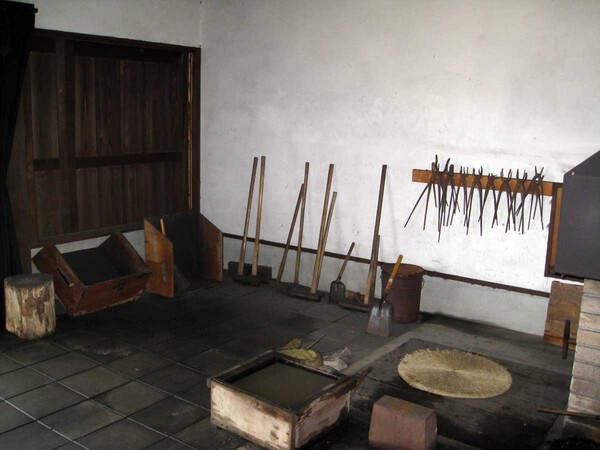
-
Edo Period Corner Part II
Ken-Hawaii replied to estcrh's topic in General Nihonto Related Discussion
It's too bad that the e-Budo.com Web-site is down right now because we had a year-long discussion on blocking with blades & its effects on the katana. In short, blades were seldom broken by a blocking technique per se, but when the ha struck the mune, all kinds of bad things could happen. And there were lots of chips from ha-to-ha strikes, too. My wife has trained in both kendo & MJER for many years, while I skipped the kendo. It's fairly obvious that we swing swords completely differently - she often has what we call "kendo arms" where, for example, she will perform jodan straight down onto men, while I keep the blade edge & hasuji aligned with whatever I'm swinging at. But we both have been trained to perform large swings, rather than the abbreviated swings that are usually seen in competitive kendo, so I don't think that would be much of a factor in actual combat. Ken -
No problem, Hoanh. Kill two birds with one stone this way! Ken
-
http://www.ebay.com/itm/Japanese-Sword-Kaifu-school-Koto-period-NBTHK-paper-/321076768532?pt=Asian_Antiques&hash=item4ac1aaaf14 I'm trying to figure out just what the shape of the shinogi-ji is - it almost looks like it has been sharpened along the mune. Any ideas? Ken
-
That's actually a good point, Martin. We've all been bemoaning the problem of not seeing many new collectors & being afraid that our interests will die out. I've seen at least a baker's dozen of newbies who have paid bottom dollar for a piece of junk, but who are now members of our sword society & studying & collecting very serious Nihonto. So I'm no longer sure that "feeding on the bottom of the bin" is necessarily a bad thing for keeping our love of Nihonto alive. Sure, it makes a lot more sense for them to do some studying & not waste their money, but if their initial mistake gets them signed up with NMB & interested enough to continue their studies, I'm all for their experiencing "Santie!" Ken
-
Articles for the JSS/US
Ken-Hawaii replied to roninjje's topic in General Nihonto Related Discussion
E-mail sent, John. Ken -
Thanks, Markus. Looks like it will be an interesting blog. Aloha! Ken
-
Propper Kantei
Ken-Hawaii replied to christianmalterre's topic in General Nihonto Related Discussion
Squirrels & nuts!! -
I also dealt with Kelly for quite some time, but recently stopped doing business with him when he didn't follow through on an auction item that I really wanted. I told him that if he couldn't be depended upon, I didn't need his services. Ken
-
Read your info a tad more closely, Jean. Vienna Chalk says very clearly that it is used AFTER the metal is polished. I assume that means it's used to remove any surface "stuff" without actually affecting the metal's surface. Ken
-
I have a friend in Fiji who just inherited a fairly decent Nihonto, probably a Kanesada. He wants to send it to me to first get it evaluated by our sword society experts, & to then bring it to Bob Benson for polish & full restoration. The problem is that I have absolutely no idea what the regulations are for shipping a blade from Fiji to the U.S., & then eventually returning it to him. Do any of you have that information, or can you suggest someplace else I can check? Mahalo! Ken
-
Jean, I think you may have a misunderstanding about uchiko. There are some very cheap uchiko offerings that do contain talc, marble, etc., but real uchiko is the finely-ground uchigumori polishing stone. To grind/polish steel, the material must be harder than the steel, but no form of calcium carbonate is that hard (http://www.reade.com/Particle_Briefings/mohs_hardness_abrasive_grit.html). Also, choji oil is simply mineral oil with 1-2% clove fragrance (http://oil.solution-network.com/mineral-oil-msds/?pg=2 lower frame). Ken
-
I frankly think that Jean had the most appropriate question: I happen to live in a rather humid climate here in Hawaii, a literal stone's-throw away from the Pacific Ocean, so oiling my blades every quarter is less an option than a necessity, although I keep my blades in shirasaya inside a traditional katanadansu. Speaking as a Petroleum Engineer, unless you choose to use a denatured alcohol (usually isopropanol) or a ketone (acetone), you're simply not going to remove all of the old oil previously applied to your blade. And there is really no reason to remove it all; what you're trying to do is to keep the "old" oil from polymerizing (getting gummy) due to heat, or maybe some residue inside the saya. The thin new coat of oil is intended to provide a passivation (oxygen-resistant) layer to preclude rust. Done correctly, there won't be a build-up of oily residue in the saya. There may also be times when uchiko is warranted, but I'm not addressing that; however, using uchiko just to remove previous applications of oil is really tremendous overkill, & that alone won't work, anyway. Ken
-
I think the use of the tip of an antler might work well in your excavating. Ken
