Ken-Hawaii
-
Posts
7,353 -
Joined
-
Last visited
-
Days Won
96
Content Type
Profiles
Forums
Events
Store
Downloads
Gallery
Everything posted by Ken-Hawaii
-
Limited access for a while
Ken-Hawaii replied to Brian's topic in General Nihonto Related Discussion
Take a couple of melatonin (available in any drugstore, 3 mg) 2-3 hours before you want to sleep, Brian. A real wonder (non-)drug! I've used it for decades on my many flights around the world, starting when I was flying to Vietnam on a far-too-regular basis. Ken -
Dave, newer blades (Shinshinto are several hundred years newer than Koto) are unlikely to have been "polished many times." None of my Shinshinto blades have noticeably less niku than my Koto blades, so if yours do have less, my only thought is that they are specific to that smith, or you have bought blades which have been heavily repolished for some other reason. Ken
-
I hadn't thought about that approach, Barry, & I easily found a Web-site (http://www.collectinsure.com/) that appears to provide coverage for swords. Not at all inexpensive, but better than nothing if you can't find other insurance coverage. Thanks for the idea. Ken
-
Jim, I took a slightly different approach, but with no better results. As a former insurance broker with several licenses, I went back to all of my old companies & asked the same thing. In short, unless you can find an agent who is willing to sell you a rider based on your own guesstimate of a blade's value, I don't know of a way to get an appraisal for coverage. From the insurance industry's viewpoint, there aren't any "approved & certified" Nihonto appraisers. If you have a notarized receipt for what you paid for a blade, that can be used for a basis for coverage, but at least three major insurance companies (Aetna, TransAmerica, & Lincoln) completely refused to provide coverage to me, even though I used to be their sales rep. I ended up buying a very secure vault - which is bolted to concrete - & storing my most valuable blades in that, along with a Dry-Rod to prevent humidity from rusting them. I have a katanadansu for the rest of my collection with a sophisticated alarm system for the house, & a few rather unpleasant surprises for anyone who happens to break in while I'm at home.... Ken
-
I came across a very similarly-shaped blade at the Bizen-Osafune Sword Village: http://img132.imageshack.us/img132/9966/img2025f.jpg. It was by far my favorite item, was in excellent shape, & was made in the 1500s, according to the display sign. Ken
-
I bought a wakizashi from a fellow sword club member who needed some extra cash & who said that the mei reads "Echizen no Kami Fujiwara Kunisada." But looking a bit more closely, the mei appears to read "Echizen no daijou Minamoto Kunisada." Can one of you experts please clarify the Kanji? http://img607.imageshack.us/img607/5325 ... izashi.jpg Mahalo! (Thanks!) Ken
-
Hard to take a weekend off from this board without needing to catch up on some very interesting info. If the collecting of Nihonto is for the "rich," then my lovely wife must be hiding something from me! Linda & I have what I think is a fine & reasonable collection of blades that we've slowly accumulated over the past dozen years, with a couple of real gems. We certainly aren't in the "business" of collecting, but rather enjoy the study of our blades for the history, suitability of each for its intended use, & just plain beauty. Our sword society members are, in large part, collecting for the same reasons, assuming they aren't lying to the rest of us. We have four former shinsa who are happy to share their knowledge, & often bring in a blade or two to sell to us members. In fact, at our November meeting, one of them brought in four of his own Nihonto & eight of another senior member's who is probably in terminal health. The most expensive of those blades was around US$2,000, & ranged in age from mid-Koto to early Shinto, in both shirasaya & koshirae. Yes, I did buy one: a nice papered wakizashi for $700. As far as the "doom of collecting," just take a look in the Izakaya on what else we members collect (http://www.militaria.co.za/nmb/viewtopic.php?f=56&t=10138!! Everything from jet pilot helmets to Roman coins to cannon to the tortoises we collect. Why would anyone think that Japanese blades would fall completely out of "fashion" for collectors? At our sword exhibition the end of September, we had nearly 1,000 attendees who were interested enough to spend several hours examining our Nihonto & asking good questions, & we've added a dozen new club members as a direct result. Now that may be because we happen to live in the "melting pot" of Hawaii where nearly a quarter of our population is of Japanese extraction, but I sure don't see a lack of present or future interest in the Japanese sword. Now Piers & I are having a quiet discussion about the state & future of sword smiths in Japan. On our Osafune trip earlier this year, he & Linda & I spoke to several smiths who said they are very worried that there won't be future generations of smiths because of the lack of buying interest in Japan. Piers & I are trying to come up with a way to open new markets in the U.S. & elsewhere for these shinsakuto. There must be other ways that NMB members can help in areas like this. Ken
-
Samurai rank by tsuba
Ken-Hawaii replied to Ken-Hawaii's topic in General Nihonto Related Discussion
Curran, I was off-island yesterday & so didn't see your post until this morning. I have no idea what private correspondence was going on, but my posting of this question was based solely on Skip's article in the "To-Ron" newsletter I received late last week. BTW, I used the word "rank" because that is what Skip used in his commentary. He showed five beautiful Higo tsuba, probably from the Nishigaki forge, which he says "show stages of development from entry level to mid-range Samurai rank." My uneducated eyeballs can't really see a lot of difference among them.... Obviously, Samurai did indeed have different ranks, & my original intent was to ask if the tsuba was the way one Samurai could tell whether his status was higher or lower than someone else he met, but I can't tell from this thread if there was some other way, too. Ken -
Samurai rank by tsuba
Ken-Hawaii replied to Ken-Hawaii's topic in General Nihonto Related Discussion
Let me quote the first two paragraphs of Skip Holbrook's article directly: Now I'm certainly not as well-versed in tsuba details as is Skip by any stretch of the imagination, but I can't see him making these statements in a newsletter read by hundreds or thousands of those of us who collect, study, & admire Nihonto & their accoutrements unless he has a firm grasp of the topic. If anyone has a contact for Skip, I would appreciate having him comment on this thread, but in the meantime, it sure sounds like this would be an excellent chance for the rest of us to learn something we simply hadn't thought about. Ken -
Samurai rank by tsuba
Ken-Hawaii replied to Ken-Hawaii's topic in General Nihonto Related Discussion
I've read about half of your references, HJ, but this wasn't my original idea at all. I'm fairly certain that Skip Holbrook wouldn't have published his article without a lot of supporting information & studies - he's rather well-known for his knowledge of tsuba.... Ken -
Skip Holbrook posted a most interesting article in the NCJSC To-Ron newsletter, entitled "Not All Samurai Were Generals." In it, he stated that "...the guard on a person's sword was probably an important indicator of the wearer's rank." And "The Samurai system was more subtle [than the ranks we see on our own military officers] but just as precise." Not only had I never heard of this, but I was also unable to find any on-line references. I would appreciate any information on this topic because it sure makes me view my own tsuba in a different light!! Thanks! Ken
-
Do you use your nihonto for tameshigiri?
Ken-Hawaii replied to Hans Kondor's topic in General Nihonto Related Discussion
Thank you for sharing that tameshigiri video, Kunitaro-san. An incredible display of hasuji & blade control!! Ken -
Umm, I don't think any of us were making economic assessments as such, Andrea. Rather, we were indicating that unless you spend some quality time learning about why you would like a specific blade, you're unlikely to get as good a deal as if you understand a bit more. Ken
-
I'm not familiar with that particular book, Andrea, & my Italian probably isn't up to getting much out of it, anyway. If you will check on this NMB thread, http://www.militaria.co.za/nmb/viewtopic.php?f=16&t=12325, you will find the three books I mentioned. I'm assuming that your English is a darn sight better than my Italian, BTW! I think these books should form the basic library of anyone seriously interested in Nihonto, & I also think you should study them in some detail before choosing your first blade. You will certainly buy a better blade & probably at a less expensive price with the knowledge you gain from them. Good luck! Ken
-
My company used to sell cameras for Phase One, Jean, & so I got to use them for awhile to demonstrate to prospects, but couldn't pony up the then-$35,000 to keep one. I've got a Canon T2i with a few lenses, & that suits me fine for 95% of what I need. Ken
-
Only in general, Jean. They had two camera systems set up in one room. I'm guessing one was either a Hasselblad or Bronica with a digital back, & the second was a Phase One back on a Mamiya camera, which means they are likely shooting at 25-60 megapixel resolution. One camera looked like it was set up for closeup work at about a 45-degree angle to the table, with about six lights around it; the lights weren't set up, & were all in a line, so I don't know how they would be angled in production. The second camera was set up to shoot straight down on a heavy-duty commercial rig whose name I can't quite remember. Again, its lights were just pushed up against the wall, but I also saw a ring-light that probably fit over the camera lens. Both digital backs were hardwired to laptop computers. There were several rolls of different-colored fabrics on a cart. That's about all I can remember from 2+ years ago, but I'd sure like to have the same setup! Ken
-
Yes, I've seen Aoi Art's photo setup, & they definitely use high-resolution digital cameras. The Elmo-type scanners are primarily used for flat artwork (i.e., paintings & the like) rather than for anything like a sword blade. In a school setting where there are kids running around, setting up a simple overhead scanner makes things easy for the teacher, & that's really the target market. And although you can capture an image from the Elmo, most of the time you're just projecting a video image onto either a TV or a video projector. There are other 3D overhead scanners, but they're intended for reverse engineering, rather than photography, & are quite expensive. It would be a lot less expensive to set up a full image-capture system with digital camera, lights, etc. Ken
-
I've sold several hundred of these, mostly to schools. The field isn't what I would call "flat," so I'm not sure how easy it would be to stitch together the scanned images. You don't really need an A2 size, Barry, as in most models you can just raise the scan head a bit further to get a wider field of view. Check out http://elmousa.com for some info. There are a number of other vendors, but Elmo is usually the least expensive. Ken
-
Andrea, in your browsing of the forum, please look for suggestions that have been made on study materials. For less than US$100, you can buy three books that will make your understanding 1000% better! Welcome to the forum. Aloha! Ken
-
Do you use your nihonto for tameshigiri?
Ken-Hawaii replied to Hans Kondor's topic in General Nihonto Related Discussion
Obviously few of you have a Japanese sensei if you're making comments like this. Although I'm advanced yudansha in MJER & kodansha in several other martial arts, I have yet to find a Japanese sensei who doesn't expect me to address him/her as "Sensei," & I have no problem with that at all. It's as much a matter of culture as anything else. I've taught judo for over 45 years - master classes these days - & honestly have not found anyone who doesn't address me as "sensei," but I also wouldn't take offense if a student didn't choose to do so, as long as he/she was polite about it. Ken -
Piers, why does this reminds me of the conversation you & I had earlier this year with Ando-san on his lack of business? There are certainly many opportunities for Osafune & other craftsmen to sell their goods & services here in the U.S., but they have to be willing to do so. The suggestions on this thread are precisely how they need to get started. Is there someone in your university who could set up a small business to help walk them through this process? (I know better than to suggest you do it!) Ken
-
Did anyone visit "Evangelion and Nihonto" at Osafune Museum?
Ken-Hawaii replied to Drago's topic in Nihonto
Groan!! You are not making it any easier for me to decide on whether my wife & I will put on a presentation & iaido demonstration for the Kawaii Kon anime exhibition next March. We've been asked to do this so that the younger generations will become more interested in Nihonto. My Board & I decided that we would not participate as the Japanese Sword Society of Hawaii for many of the same reasons Paul addresses, & that leaves Linda & me to make our own decision. I'm frankly not sure which approach we would take. Just talking about the katana as a weapon won't mean much to a bunch of fans who are interested in magical weapons, & showing an iaido demo will only illustrate how the real world limits what we can do.... Any ideas from current anime/manga fans on the forum? Aloha! Ken -
Has anyone viewed the DVD "Murakumokai - World of Best Nihon Token Swordsmiths Masters, Katana, Gendaito"? A brief summary is shown here: http://www.tozandoshop.com/product_p/019-spd8801.htm. On our recent trip to the Bizen-Osafune Sword Village, we met the son of one of the master togishi shown on this DVD, & I was wondering if it would be worth buying at around US$60. Thanks! Ken
-
Cleaning with methylated spirits?
Ken-Hawaii replied to george trotter's topic in General Nihonto Related Discussion
George, feel free to use methanol, ethanol, or isopropanol (isopropyl) - they are all alcohols that are suitable for cleaning blades. Please note that unless they say "denatured," that they contain up to 30% water, especially isopropyl alcohol, so be sure to oil them immediately after they are wiped dry. Ken (Chemical & Petroleum Engineer) -
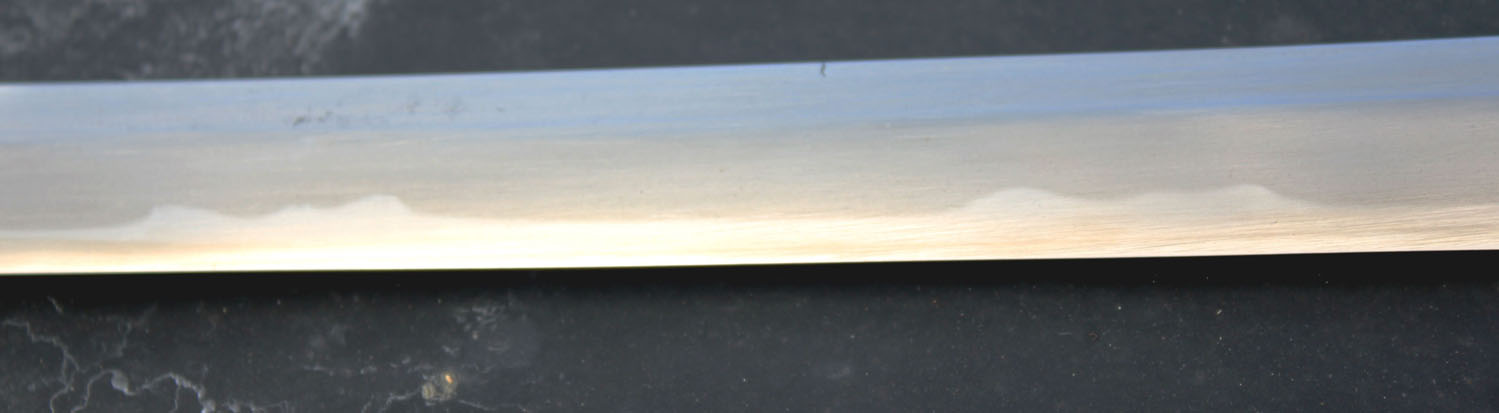
I hope not, Chris! It has a nice sanbonsugi hamon & decent hada (please excuse my quick photo): Why would anyone "scribble" a mei? Ken