Ken-Hawaii
-
Posts
7,353 -
Joined
-
Last visited
-
Days Won
96
Content Type
Profiles
Forums
Events
Store
Downloads
Gallery
Everything posted by Ken-Hawaii
-
Shinto into Shinshinto - why?
Ken-Hawaii replied to Ken-Hawaii's topic in General Nihonto Related Discussion
Eric, are you sure that Masahide wrote Token Jitsuyo Ron? I thought that Naotane wrote that study. I'm not familiar with Kenko Hiden Shi, so thanks for that info. I'd love to get my hands on an English translation of that book! I know Masahide's school had a ton of students, but had no idea that his techniques would/could spread so quickly. Word-of-mouth messages I can understand, but passing along forging & yaki-ire details are a little more than that. And the new availability of modern steels would have to come along at the same time, wouldn't it? Ken -
Shinto into Shinshinto - why?
Ken-Hawaii replied to Ken-Hawaii's topic in General Nihonto Related Discussion
Okay, as the OP, I'll admit we've gone a tad off-topic now. Interesting for sure, but getting back to my question, Markus has come closest to getting the info I want: Taking that as a given, how did Masahide's efforts to revitalize the craft with a return to the Koto methods get spread around Japan? It's not as if they had instant messaging, & I would think that most smiths wouldn't be all that willing to share forging & yaki-ire information. Chris mentioned that he wrote at least one book - do we know anything about his writings? - but even with lots of students & a book, how did his ideas spread from Musashi Province to far-flung places like Osaka? From the blades I've seen, the old Koto techniques migrated a lot faster than I would think possible in that era. Do we have any info on the diaspora? Ken -
Shinto into Shinshinto - why?
Ken-Hawaii replied to Ken-Hawaii's topic in General Nihonto Related Discussion
Good point, George. I don't have any information on who commissioned these two volumes, or when, but I do have to think that there was a considerable cost to put them together. How likely is it that someone was willing to pay out however many ryo to create these 100+ diagrams & even more oshigata just for money/reputation/social connection? I'm sure there are other members who can comment on this far better than I, though. Oh, & don't forget that I can't read the Kanji, either. :D I just found some info that might shed some light: Ken -
Shinto into Shinshinto - why?
Ken-Hawaii replied to Ken-Hawaii's topic in General Nihonto Related Discussion
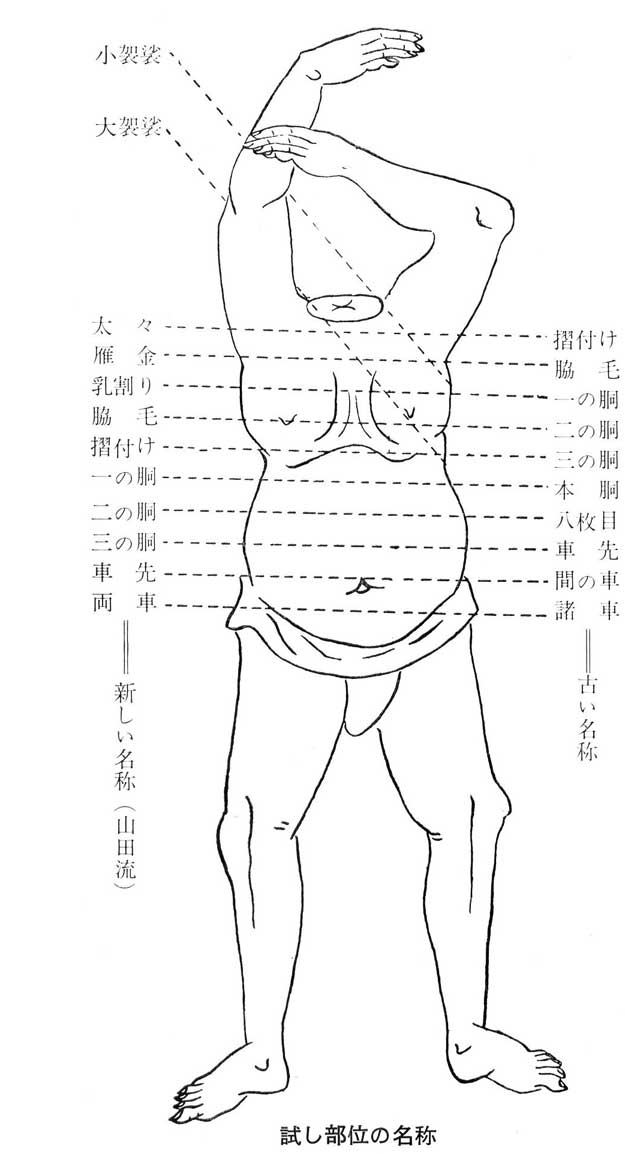
I have the two-volume set of Kubikiri Asaemon Token Oshigata in which are shown many ways to test swords on criminals. I'm not sure when these were originally printed, but just from the photos I can tell that there was a specific testing regimen, depending on how much resistance was wanted in the tameshigiri target. If someone knows more about the era, we could probably figure out what was tested. Here is one diagram: Ken
-
Sounds like that to me, too. Ken
-
Weekend reading.
Ken-Hawaii replied to Henry Wilson's topic in Sword Shows, Events, Community News and Legislation Issues
John, they did mention it: Ken -
Kinda' funny, John - I just did a Google search for "Toraedento," & found . . . one hit, yours. So the term is obviously not in common use. Ken
-
Weekend reading.
Ken-Hawaii replied to Henry Wilson's topic in Sword Shows, Events, Community News and Legislation Issues
All the more reason to support his video magazine project: http://www.militaria.co.za/nmb/viewtopic.php?f=6&t=16755 Ken -
Oh, great! Still another term I've never heard of! On-line reference, John? Thanks. Ken
-
New member need help with books
Ken-Hawaii replied to Marc's topic in General Nihonto Related Discussion
Yup, I use my Fujishiro all the time, & that's no sham! Ken -
Hi, Piers - glad to see you back on the site. Trying to find anything on "yasu" gets me tons of the expected Yasu Kizu, but nothing on the blade type. Same for "mori." As I'm not familiar with either term, can you point me in the right direction to an English-language link? Thanks! Ken
-
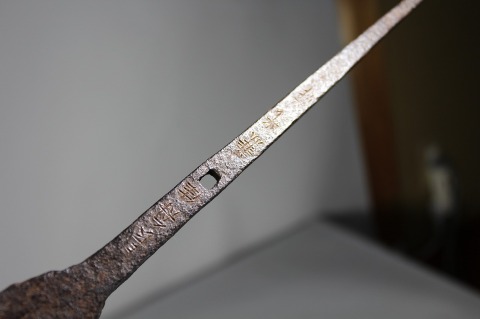
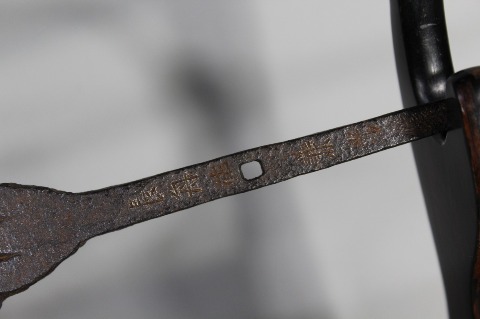
More a similar act of Myer's rum, but I do think that even with my reading glasses, things are getting a tad harder to read.... BTW, that mei is from a trident yari that I just bought. Totally different than any I've seen before: I'm looking forward to studying it. Ken

-
Many thanks, Gabriel. I'm sure my somewhat older eyeballs had something to do with the fact that I can't pick out "ju." Aloha! Ken
-
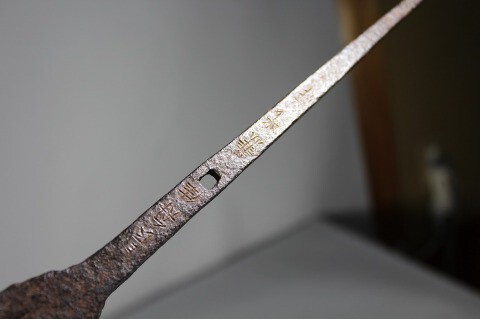
My apologies for the lousy resolution, but I could really use some help with this mei translation. It looks like Osafune ??? Kanesugu. Thanks! Ken

-
New member need help with books
Ken-Hawaii replied to Marc's topic in General Nihonto Related Discussion
Sounds like a good idea, Kirill. When do you plan to publish? Actually, if you do some detailed browsing on the Web, you can find tons of good info & photos on hada, boshi, hamon, etc. I've been accumulating data & shots like that into what has become a very large Excel spreadsheet (right now at 30.3 MB) so I can take a quick look if I have a question about something. Comes in very handy at times. But can't turn it into a book because nearly everything belongs to the people who published it in the first place. Ken -
Shinto into Shinshinto - why?
Ken-Hawaii replied to Ken-Hawaii's topic in General Nihonto Related Discussion
Suishinshi Masahide and the Functionality of Nihonto (http://www.nihontocraft.com/Suishinshi_Masahide.html Translated material provided by nihontocraft.com Suishinshi Masahide is known as the founding father of the Shinshinto era. Early in his career, he aimed to recreate Sukehiro's beautiful toranba style hamon. Masahide devoted all his effort to mastering it. However, around the middle of his career, he changed his approach totally. The reason for the change is known from Masahide's published research. He observed that swords with a "Hade" (wide and gaudy) style hamon tend to break. Masahide wanted to abandon the artistic mentality that focused on the cosmetic beauty of the blade and return to the original function of Nihonto. His new approach was called "Fukko-to". The aim of it was to recapture the practical excellence of Kamakura period works. He wanted to make blades that cut well and were durable. In his book, Token Buyurai, the following statement is made. "Needless to mention rather we are discussing the o-midare hamon of Tsuda (Sukehiro), Sakakura (Terukane), choji or kikusui, if a blade has a wide hamon pattern it tends to break when in use". Masahide gained this knowledge empirically through repeated eye-witness accounts and reliable sources concerning swords in actual use. The following are 25 incidents that Masahide mentioned, in which blades with a "Hade" style hamon were broken. It is a direct translation. 1. Suishinshi was at the house of an Akimoto retainer. There was a thief that night. The retainer used the mune of a blade to strike the thief. The blade broke in the middle and the kissaki was knocked off. As a result, it landed on the rooftop of a neighbor�s house. This was a katana by Mizuta Kunishige with an o-midare ba hamon. 2. A younger friend of the Akimoto retainer used the mune of a wakizashi to hit a dog. The blade broke in the middle and the dog escaped. It was a mumei wakizashi by Etchigo no Kami Kanesada with an o-midare ba hamon. 3. In the Shitatani area, a retainer was fighting a merchant. The retainer's blade broke and his arm was cut. The retainer used a Shinto katana by Omi no Kami Tsuguhira with a wide hamon. The merchant used a Bizen Sukesada katana. Masahide witnessed this himself. 4. A Shitatani fencing teacher named Fujigawa was testing a blade by cutting a kabuto. The katana broke about 24 cm from the kissaki. It was a Satsuma blade. 5. In the Shiba area, a martial artist named Akamatsu tested a katana on a kabuto and the sword broke. This was a blade by Ishido Korekazu. 6. In Inaba, a retainer was arguing with a Shinto priest, a katana was involved and broken. It was a Inaba Shinto sword. 7. Satsuma area smiths tested their katana on thin metal plates and the blades were broken. 8. Kobayashi Masaoki, a student of Suishinshi, made a katana with big hamon pattern for a retainer of Etchigo. The blade broke when hitting stone statures in the garden on the mune side. It shattered like an icicle. 9. An Awa retainer was testing blades by the order of the lord of the Hachisuga family. He tested blades made by Shinkai, Etchigo Kanesada, Osafune Sukesada, and Suishinshi Masahide. During the mune testing, the blades that had big hamon patterns were all broken. The ones with small hamon pattern developed ha-giri (On the battlefield, this id highly preferable to breaking in half). However, some of these were broken too. 10. A family in Shinano had collected more than 150 pieces of broken katana, yari, and naginata of from battlefields in the koto period. 11. An Okayama retainer named Watanabe was doing a cutting test on the lower part of a corpse. The katana broke at the monouchi area. It was a Seki blade. 12. A bandit attacked the leader of Okayama retainers. The leader used the mune side of a katana to fight the bandit but it broke. He then picked up a bamboo stick and continued to fight. Eventually, he was able to defeat the attacker and used a rope to tie him up. When the retainer checked the bandit he found wounds caused by the bamboo stick but none by the katana. He couldn't help but to laugh at the situation. 13. An Okayama retainer got into an argument with a person on a ferry. He drew his katana and made a cut. The blade caught the wooden pole of the boat and broke at the monouchi. 14. A Bushi from Mito was doing a cutting test on a skull. The katana broke. A Mito swordsman was fighting with a Bushi. His katana broke about 27cm from the kissaki. It was a Hizen mono with hiro (wide) suguha. Suishinshi Masahide documented the above examples. Takehiro Yasuhide, an Oshu retainer and a student of Suishinshi Masahide recorded the following examples. He worked with Suishinshi on developing the theory of Nihonto Functionality and the publishing of Masahide's research. 15. Five newly made Yari by Edo smiths were broken during a wild hog hunt. 16. During a fight in Gunma, one combatant used a Mizuta Kunishige katana and his opponent used a well-made naginata by Satsuma Mondonosho Masakiyo, as a result, both were broken. 17. In the Fujioka area, a Mito family ken was tested with a katana and the katana broke. It was a Tsuda Sukehiro. 18. A Bushi named Nagai used the mune of his katana to hit the shikii of a house entrance. The blade broke into three pieces. It was a katana with big hamon pattern by Kawachi no Kami Kunisuke. 19. An Etchigo Takeda retainer hit his katana on a stone lantern in the garden of a Shinto shrine. The kissaki broke off. 20. A Bushi Saito in Oshu was in a fight. His katana hit the door pillar and broke into three pieces. 21. A Higo retainer practiced fencing with his son who used a ken. The retainer's katana broke. It was an Ishido Korekazu. 22. A Higo retainer used the backside of the kissaki to hit the hand of one of his servants. The monouchi part of the katana broke off. It was a Mizuta Kunishige. 23. A Higo retainer fell from a horse and his blade broke in two. It was by Setsu no Kami Tadayuki. 24. An Oshu retainer was paying respect in a temple and for some reason his blade bumped the Ishidon (stone/rock steps) and the blade broke in two. This sword was from the Nao Yamashiro no Kami family. It was a koto Bizen with choji midare hamon. The retainer had the remaining part of the blade made into a wakizashi about 40cm long. --- It is interesting to note that among these 25 accounts there is a disproportionate number of broken shinto blades from Osaka and Mizuta followed by Ishido and Satsuma. The text does not mention the exact ji-ha of these blades and the extent to which they were typical for the given school/smith. However, perhaps it is important to understand that blades do break and we can take steps toward judging functional excellence from Masahide's research. --- It is true that there are many Saijo Wazamono smiths that made a hade style hamon. Kiyomaru, Kotetsu, Tatara Nagayuki etc..... Koyama Munetsugu should be mentioned as a maker of a very functional choji hamon in Shin-shinto times. (A nioi deki hamon is not as brittle as nie deki) Also, with koto there are a great many famous cutters with a wide hamon. The core steel of the blade has much to do with its ductile properties, thus its durability. A very skilled smith could overcome the brittle nature of a widely tempered nie deki blade by introducing other durability promoting elements into the construction of the blade. Masahide's observations are hard to put into context but none the less, they are enlightening. --- Another thought is that some of the above examples may lead the occidental to uneasy preponderance. Especially the striking of stone with a blade or the use of the mune offensively. This is not something we hear much about in Western texts. Perhaps cultural differences are at work here? Lore of blades cutting unsurpassable objects is not uncommon in the east. This leads me to believe that it is not at all unthinkable that some Samurai, especially one of lower rank without formal education, may attempt to cut stone to display the quality of his sword. As for the use of the mune side of the blade in combat, this was a common tactic that was very effective in delivering a non lethal blow. Much like a "warning shot" in our frontier days or simply a mild punitive action. In many documented sword tests the mune as well as the sides of the blade were given specific and deliberate attention to make certain it could withstand the abuse of being used this way. Thus the sword is to be a complete weapon able to used in a variety of ways depending on the situation at hand. -
Although it's fairly clear when & why the Shinto period started, it's not at all clear to me why the Shinshinto period started in 1781. I've heard that the availability of modern steels may have been why, & also that Suishinshi Masahide was the founding father. But in either case, why was 1781 chosen specifically as the start of Shinshinto? Modern steels didn't just magically show up one year, & Masahide was only one smith in one area who made blades for less than 10 years. So why is there such a firm time delineated for the start of Shinshinto? Ken
-
They are at it again!!!
Ken-Hawaii replied to Jiro49's topic in Auctions and Online Sales or Sellers
Not to mention China.... Ken -
When it comes to doing stitching of photos, I've found that Microsoft ICE (http://research.microsoft.com/en-us/um/redmond/groups/ivm/ice/) does a really good job, & the price is certainly right. The trick is to NOT use a featureless background, but rather one that the software can sense so that it can correctly overlap the images. Once the entire blade looks correct, then you can use Photoshop to remove the now-extraneous background, & then add in whatever you would like. Do work in TIFF format, as it is lossless; JPGs will cause you grief, except as the very last saved image. Ken
-
Help identifying this sword
Ken-Hawaii replied to Ihammer's topic in General Nihonto Related Discussion
Then perhaps you may get some use out of it when you're cutting down trees or bushes.... Ken -
Tobias, just to make sure you understand, you would never store JUST the katana in a bag, right? If it's in shirasaya or full koshirae, you could leave it in there for awhile, but unless you're in a perpetually arid climate, you may be looking at some eventual rust. My blades reside in a katanadansu, & I only use the bags to transport them. As far as making one yourself, there are some instructions at http://www.ehow.com/how_7727597_make-ja ... d-bag.html, but I'm a long way from being a seamstress (seamster? ), so hopefully someone else with much more sewing experience can answer this for you. Ken
-
Paul, how can we get things to you? Tokyo? London? U.S. somewhere? The tripod isn't light, so the closer the better unless you want to pay for shipping. I also have a 0.5X wide-angle Kenko lens that will work on your Canon if it has a 52mm adapter. From my experience, if you're shooting full HD (1920 X 1080 interlaced) with the 60D, you want to be careful of heat buildup, both in the camera circuitry & the battery. I've seen DSLR cameras literally go up in smoke, so please be cautious. The 60D's optical stabilization is a bit jittery in HD video recording, & it's darn near impossible to auto-focus while you're recording, but you can focus manually with some practice. I eventually went for an inexpensive 3-CCD video camera for video, leaving my DSLR for still images most of the time. You're also stuck with a maximum 29 min 59 sec of recording time at about 330 MB/min, or around 10 GB per file. So I suggest that you save your money & get 16 GB SD cards instead of 64 GB. If you're anything like me, you'll swap out your SD card after each shoot, anyway, to minimize glitches like overwriting. Canon DSLRs do produce pretty decent HD video using H.264 .MOV files, which should work great with your Mac workstation, Paul. I've never had any trouble integrating the output with that of my video cameras, but be sure to do a white-point balance on both cameras before each shoot. You're right that audio capture isn't all that great with a DSLR, but rather than buying a camera-top stereo mic (which truly screws up the handling!), I suggest that you check out the Zoom H4n audio recorder (http://www.zoom.co.jp/products/h4n). It can be tripod-mounted, & does a superlative job of audio recording, much better than anything camera-mounted (& cheaper, too). Okay, enough words of wisdom today.... Ken
-
It took me awhile to figure out where this post was relocated, but many thanks for that info, John. Makes a lot of sense. If you run across any sources for raden on saya, though, please let me know. Ken
-
Paul, crowdfunding like this has a tendency to be fast at the onset, slowing down considerably after the first week or so. So at only 16% of your goal, I suggest a slightly modified approach. Please provide us with a detailed list of what you're looking for in video & still camera(s), lenses, memory cards, accessories, etc. It may be that one or more of us would be willing to contribute or purchase all or part of one item, rather than just sending money, which may be in short supply. For example, as a long-time video shooter/director/producer, I have 3 or 4 professional-level Bogen tripods that I haven't used in the past year, one of which would save you about $500. Ken
-
I own two yari, both in raden koshirae. But I'm trying to find out more about what exactly "raden" means, the process of making it, & how it got started. Using mother-of-pearl & shells for decoration seems to go back at least to Kamakura times, but I can't find any sources. Any info out there? Ken