

ROKUJURO
-
Posts
7,012 -
Joined
-
Last visited
-
Days Won
39
Content Type
Profiles
Forums
Events
Store
Downloads
Gallery
Everything posted by ROKUJURO
-
In my opinion, this is a forging flaw. As it is in a critical position, you should not take the sword to war. Otherwise for collecting it is certainly o.k. If it disturbs you a lot, you can have that fixed by a TOGISHI so you don't see it any longer.
-
Congratulations! Altogether a very decorative piece!
-
John, this might have to do with the fact that forgeries or copies are looked upon differently in East Asia. You may remember the problems with Chinese fakes of Western brand items (not only clothes), and in the 1960's, the same problem was seen in Japan. I remember an important industrial fair in Japan of that time where a true copy of a BMW motorcycle was shown - even with the blue-white brand badge! The Japanese were proud of it, and the West was shocked and protested against industrial theft. When the first few TEPPO guns were purchased from the Portuguese on TANEGASHIMA island, nobody expected the Japanese to be able to copy these, but in fact, they were fast (and successful) in doing so! There were several accepted reasons for making copies, and most people did not care too much. In the late 1970's (if I remember correctly), there was an auction of Asian Arts in Cologne, Germany (Lempertz). They displayed a beautiful blade with a gorgeous HAMON and O-GISSAKI, but with obviously GI-MEI (I think it was KIYOMARO). The blade was eventually bought for an enormous sum (about DM 8.000.-- if I remember correctly) by a Japanese dealer, and many of us guys watching this were astonished and asked themselves if the buyer was perhaps not knowing this. But I learned from Michael Hagenbusch, that the blade was certainly bought knowingly and probably sold at a very high price to a Japanese collector who would never ask if the MEI was genuine or not. He said: 'The new owner will put it in his KATANA-DANSU and be happy to own a KIYOMARO and never show it to anybody.' So forgeries are - at least in my understanding - mainly a question of the social acceptance of non-authentic items, and are not always seen as critical as we do in the West.
-
Jean, yours is cast!
-
It is all about ergonomy, still today. Your physical data, what you do with a tool/sword and how you do it is important, the more, if your life depends on it.
-
Ray, Congratulations! A good camera and working light are everything in photographing NIHONTO!
-
If you look for JAKUSHI, you will find similar items.
-
Neil, the blade is signed TAMBA no KAMI YOSHIMICHI - just in case you didn't know. There are several generations, and the MEI is one of the most faked, unfortunately, And all the best for your other precious items....
-
Taylor, this looks like a perfectly genuine KATANA, signed (and probably made) by KIYOMITSU. The mounting parts are not in good shape and the TSUBA is missing, but in case it is not expensive you could try to get it. But please consider that a restoration can not be made at home in your kitchen! If you are prepared to invest some money and you are really interested in NIHONTO, it may be a good start for a collection. The NAKAGO does not look like KAGA province, so it might be a later KIYOMITSU, but if it is not a WWII blade (which I cannot judge) it may still be a few hundred years old.
-
I know NAMIKAWA HEIBEI for almost 40 years now, and when I made my first purchase in the late seventies, they sent me the goods with the invoice in the parcel! I paid after the receipt! That has obvoiusly changed for good reasons, but they remain a reliable and competent supplier.
-
Omar, it is indeed MIGAKI NAGASHI, but the effect changes as soon as the MIGAKI-BO is working on the hardened steel of the BOSHI turn-back. This is why the lines are no longer visible near the tip of the blade. This special TOGI process starts with roughening the surface of the MUNE with the same stone that is used for the KESHO (HADORI). The MIGAKI steel then leaves mirror-like traces on the matted surface.
-
George, as far as the photos allow an assessment, it looks like a civilian sword wilth a military cloth protection cover for the SAYA. It is obviously quite neglected, but here on NMB you will find lots of information about how to handle these items and how to prevent further damage. Besides its value as a war trophy, it may have some market value, and it would be a pity to see that being lost.
-
Grev, judging only with photos, I would keep 1a & 1b, 3, and 13, whether they are SHOAMI or not.
-
 Barry, the MEI on your blade should read NAGASONE KOTETSU NYUDO OKISATO, but when comparing with items in the internet I have seen several different ways of writing, like NAGASONE OKISATO NYUDO KOTETSU, or even NAGASONE OKISATO KOTETSU NYUDO.
 -
Hi Virginian, please sign all posts with your first name and an initial as is requested here. 1. Japanese swords can be restored in Japan. This board can supply recommendations for agents and polishers (not for the military blade). 2. Sword appraisals (SHINSA) are of course made in Japan, but also in the U.S. (not for the military blade) 3. There are several ways. A good place could be one where you get the highest price which could be a specialized auction house. But my personal opinion is that the sword should go to someone who takes good care of it and preserves it for future generations. You might find someone like that here in the 'FOR SALE' section. E-Bay should not be considered unless you are a specialist. All the best!
-
Yes, Hamfish, we all like the rare Alaska TSUBA!
-
Gentlemen, MATSU-KAZE in Japan is offering papers (without the items) on E-Bay: NBTHK Certificate Papers 10 Tsuba & Tanto. Akasaka, Nishigaki, Higo, Kyo-Sukashi $30.00 4 bids NBTHK Certificate Papers 10 Tsuba & Tanto. Akasaka, Nishigaki, Higo, Kyo-Sukashi. 10 certificates for TSUBA (envelope is nine pieces). We don't declare the low value or mark as "gifts". from Japan. Amazing or frightening? Kind regards, Jean C..
-
Andrey, the thickness of the plate, the state of corrosion (or the lack of it), and the shape of the rim (almost KAKU MIMI in places) could be indicators for a later manufacture in my eyes, so probably not KO-TOSHO, but early EDO JIDAI.
-
I remember having seen a similar one in the collection of Janos Horvath in Winterthur, Switzerland. That may have been around 1980. As Ford pointed out, the manufacture of these pieces has probably always to start from a cast base plate as brass is difficult to forge.
-
Grev, that was certainly a lot of work! Nevertheless, I would like to second Steven as I like to see only a few TSUBA nicely presented. Imagine how long it takes to see and admire a TSUBA really close in hand. I don't think I would be able to enjoy many TSUBA at a time.
-
Where To See Nihonto Around The World?
ROKUJURO replied to a topic in General Nihonto Related Discussion
Musée des Arts Asiatiques in NICE, France Sometimes good exhibitions on Japanes subjects. Website does not work. https://www.departement06.fr/musees/musee-des-arts-asiatiques-2508.html or http://www.nicetourisme.com/nice/184-musee-departemental-des-arts-asiatiques -
Bob, this seems to be a short WAKIZASHI in UNOKUBI-ZUKURI shape. It has only one cutting edge, so no dagger. Do not attempt to restore or fix anything until you know for sure what it is that you have. Keep the blade away from children and moisture and don't touch it with your bare hands. Please read a lot about Japanese swords, we have a wealth of good information here on the board. It is probably not a national treasure, but it is a solid and authentic Japanese sword of the very late EDO period (my personal guess) in fair condition, and as such a good start for a collection.
-
Greg, with the KANJI pages provided by the board, it seems that the second KANJI is KAZU (or ICHI) and the third might be FUMI. The experts might know better.
-
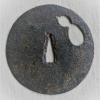
Ben, the TSUBA seems to be quite thin, so I have an impression of KACHUSHI style with some ONIN flavour.
-
Thank you, Peter! The author is a generally well informed professor, but many of his conclusions are based on guesses. He mixes up some important terms like 'polishing' and 'grinding' which are necessary to deal with the Japanese subject of TOGI. Folding and fire-welding of iron or steel were standard techniques in the iron-age and are still relevant for those who run bloomery furnaces or TATARA today. His use of the term 'faggoting' is probably not correct for the iron-age, but came into use in medieval times. It is a complex subject though.
