Ford Hallam
-
Posts
3,091 -
Joined
-
Days Won
78
Content Type
Profiles
Forums
Events
Store
Downloads
Gallery
Everything posted by Ford Hallam
-
I was showing this beautiful kozuka to my partner, also a goldsmith, this morning. She commented similarly to others here that the silver could do with a bit of cleaning. This then prompted me to ramble off on an impromptu 'lecture' on some specifics of Japanese aesthetics. For what it's worth I'll try and condense what I was saying to add a little food for thought. The first point I'd make is that unlike the situation in Europe from the 16th century ( ish) and the rise of the notion of artists as independent creative individuals the distinction between what we understand as craft and fine art was only something that started to take hold in the very late 19th century in Japan. What this means is that almost all items we'd regard as art were conceived, in Edo Japan, as being firstly artefacts. That is to say cultural objects. As such what happens to these objects over the course of their existence becomes an integral part of the object itself. Any obvious decorative aspects or artistic expression remains, is altered in appearance and is added to by time. We might even say the work matures. So what we then have is a multilayered object to experience. And at this point it will be obvious that the teachings of wabi and sabi are at play. But wabi and sabi are too often reduced to simplistic adjectives that give the impression that the matter has been adequately described whereas in truth the words themselves put a stop to a deeper understanding. Incidentally, this is why I almost wince whenever I read those trite terms. To more adequately delve into this aesthetic it's necessary to go to the actual source of these impulses as they are expressed in Japanese art. This is in poetry, literature and Buddhist philosophy. Yoshida Kenko ( b.1283 ) writing in his 'Essays in Idleness' advises on the most suitable decoration for a tokonoma in a tea room. He makes it very clear that a freshly created and 'perfect' hanging scroll, lavishly mounted, would miss the whole point. For Kenko the scroll becomes 'right' only once it has aged some, the paper or silk a little faded and worn, the tassels perhaps showing signs of becoming threadbare, a worn hem a tiny tear etc. Kenko seems to be telling us that the fresh, clean and new is almost an affront to nature. Even the most fresh things born in nature, flowers or blossoms for example, are only in that instant of unsullied perfection for a very brief moment. Any intellectual attempt to freeze that moment is utterly artificial and at odds with the very essential cycle of existence. This is why the underlying and vital scent of Japanese aesthetics is inevitably one of yearning, a melancholy longing. A big bold 'new moon' in the night sky is impressive, it might evoke a feeling of awe, 'aware' even, but in its impressive boldness it can also silence our own, more subtle. emotions. It might run the risk of being seen as art to impress, and not art to commune with. But when a cloud drifts in front of the moon and partially obscures it we are offered a multitude of possibilities in terms of how we might experience the scene before us. By introducing the elements of uncertainty and ambiguity our minds are freed to drift to their own inclinations rather than being directed by more overt 'statements' in the art. Kano Natsuo is known to have been a very cultured man, and especially so as he got older. He was evidently very much influenced by Heian period culture so he almost certainly knew the writings of Kenko intimately. As such I think it's safe to say he was well aware of what time would add to his work and I imagine he knew that it would only 'mature' to being 'correct' long after he was gone. We can easily imagine the kozuka newly made, the silver reflections gleaming stark and bright in the misty shibuichi water. But the reality now is that that memory is now overlaid by the effects of time. We could step in and reverse that subtle process and restore the silver to its pristine original appearance, and lose the traces of its life....OR we can hold that memory present and at the same time allow what is to offer its own beauty to us. It's hard to properly see the present beauty though, if we are hankering for the original 'perfect' shiny silver effect. There are countless poems that tell of parted lovers, separated by distance or time, whose power rest precisely in the expression of loss and longing, that melancholy desire....but if somehow those feelings of longing for what is no more were suddenly resolved, the missed partner magically returned, the poem would become mundane and lose all of its content, and power to move us. Natsuo knew how his moon would change, and become something else. I think he'd be well satisfied with what we now can contemplate. Time had added additional layers of meaning, and through that process perhaps offers hints toward more profound contemplations of our own existence.
- 35 replies
-
- 24
-

-
Lovely piece, certainly one of my favourites. There's a very similar, or the same one, illustrated in the Natsuo Taikan. I believe that the moon's reflection is silver but that it has tarnished to an almost back patina over time. The graininess of the sulphide layer can be seen in the enlarged image.
-
you're welcome, Marco. As for restoration, I tend to err on the side of doing nothing too less in most cases. I wouldn't have though your kozuka really needs any serious work. Perhaps just a gentle wash with warm water and a mild soap, and using a worn toothbrush. That will take care of any dirt and the ink.
-
Hi Marco if you mean the slightly silvery grey areas in the flower then I would suggest this is mercury. The decorative panel is possibly well gilded copper which was gilded by the kinkeshi or fire gilding method. This uses mercury as a base by which to get the dissolved gold to evenly cover the base metal. The mercury is then burned off using heat, but inevitably some mercury will always remain in the surface. Over time it appears to 'sweat' together and concentrate in protected recesses. There are also traces of sumi ink on the decoration, this is sometimes wiped on and off, by dealers, give the appearance of age
-
Dont use pipe, it's far too thin and you have no mune as a consequence. Also, because it's so thin there's no possibility of a taper from the seppa side to the leading edge, which is crucial to the actual function of a habaki acting as a wedge into the saya. I'd suggest getting a copy of The Craft of the Japanese Sword by Yoshihara and Kapp. There's a detailed chapter on the making of habaki which will provide everything you need to know to do a proper job.
-
I reckon a contemporary version featuring an 'adult' game of twister would be brilliant.
-
Hi Ken, I've got some very useful teaching material that was used by Ikeda Suematsu Sensei, the noted scholar and father of the polisher Ikeda Nagamasa. One of the sheets of photos is exactly the classic pine tree motif. I'm planning a series of film lectures on these plates I have but will photograph this one and post it here this week-end with a commentary.
-
Looks very much like modern hobby work to my eyes. The essentially unworked flat ares of the plate in the thicker parts of the tree trunk are a big give-away for starters. The nakago-ana is unconvincing also, as it the mimi. No idea what is going on with that cloud plonked right at the top in the middle and the carving there is pretty amateurish, I think. Overall the design seems to be ignorant of many basics of Japanese design, probably revealing a poor attempt at copying a couple of tsuba in an attempt to create a mash up/new design.
-
Hey Richard, i will happily put money on the outcome of any analysis of these bits, they're shakudo.
-
Hi Richard well maybe this will please you then... Shakudo can sort of self patinate as is often seen but it needs a bit of help by way of handling. What is actually happening there is that oils and fatty acids from our skin is continually polishing off copper oxide and helping the correct, more durable, oxides develop. Where this doesn't happen, like in a scratch or protected crevice, a layer of pinkish copper oxide develops very very quickly, (in fact immediately) which then further resists the development of the more complex copper/gold matrix patina layer. This is also why the inside of shakudo kashira and fuchi are often pink while the outer parts are properly patinated. In working, heating to solder etc., the surface oxidises very heavily and must be cleaned in a mild acid (pickle), this then leaves a copper rich layer on the surface that unless properly polished off will never patinate black. Also, It's extremely difficult to achieve a convincing black patina on copper, and I'd say impossible to do and still have some parts patinate as more typical copper, like the tenjo-gane. Anyway, I hope that sheds a little light on the dark patina
-
Richard, why do you think this is copper patinated black, and not simply shakudo? Especially as the seki-gane and tenjo-gane are copper and are appropriately patinated and aged as such.
-
Neigh! George...'tis no hoof
-

Please can I get some thoughts on this Sukashi Tsuba
Ford Hallam replied to Steves87's topic in Tosogu
In my opinion this is modern hobby work. One big 'giveaway' is the seki-gane. Neatly fitted and then shaped out right to the edge of the steel nakago-ana...thereby defeating the actual point of the sekigane. -
No, fully matching themed sets are a relatively later fashion. Some art and fashion authorities in the Edo period in fact deplored the very idea of matching or themed fittings as being unimaginative and expressive of a dull mind. One aspect of that criticism was undoubtable a political comment in that the Shogunate relied on uniformity and continuity to reinforce their authority, notably in the proscriptions surrounding swords mountings at court. In this the Goto were an essential actor. The aesthetic ideal of non-matching elements is most visible in the choice of utensils used in the tea ceremony, the practice of which was the pursuit of the most cultured members of society. The spirit of the tea ceremony was one of egalitarianism, the tea house being a place where everyone was socially equal, a potentially subversive idea in a feudal society, and so, naturally, this more eclectic aesthetic can be seen as being in opposition to that of the regulated official tastes.
-
I'd go for Nara also, specifically the Toshinaga group as in Nara Toshinaga.
-
it appears to bear the mei and Kao of Goto Kanjo (Mitsitoshi) 1st generation Hachirobei line. 1612 - 1653.
-
I'd suggest a Higo work, relatively late, and a stylised rain dragon. That split tail with rounded ends on a 'smooth' dragon is not terribly uncommon, especially on Higo work.
-
I'd suggest that the design is that of a hatchet and a cherry/plum tree trump. The basic theme is seen in the Edo period but this is, I believe a more modern take on the idea. For one the tale it alludes to doesn't require the tree to be completely chopped down, and secondly the other main design element, the axe, loses it's defining feature, the blade, because the design was poorly conceived. Not Edo professional would have thrown that element away so carelessly. I can see the thought process regarding an Akasaka origin but for me the poor design choice regarding the axe (and there are some magnificent Akasaka design on this theme) would suggest otherwise, and the amount of surface carving seems a bit heavy handed also. The patina is practically existent, which is worrying, and the nakago-ana feels bit amateurish to me also. My gut instinct is that this is a relatively recent piece.
-
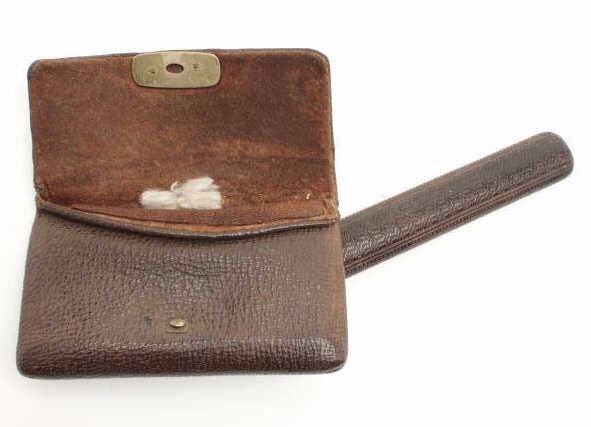
As George suggests it's a tobacco pouch clasp. The clue is the little oval hole in the back-plate. When mounted the decorative element would be on the outside of the leather or fabric and the backing plate inside, with the rivets passing through the material to lock the two plates together. This image may help to explain how it worked. The metal looks to be brass, with a little bit of silver on Mt Fuji's summit.
-
Actually, Jean, you've highlighted another of those misunderstandings in tsuba, that of the well tempered guard. If, as is claimed by some, these fine tsuba were actually capable of being hardened and tempered they'd need carbon...which would, as you point out, make the alloy less dense and heavy than pure and very much softer iron.
-
"the ring"; well I can make a simple plate of mild steel ring like a bell or sound as dull as lead. It all depends on what I do to it, it depends less on the inherent quality of the material. "tactile sense"; almost any surface texture can be applied to pretty much any quality of iron/steel///except perhaps the very coarsest wrought iron. "colour"; again, patina has very little to do with actual material quality but more to do with process, and care over time. There is no demonstrable link between so called quality of the iron and that of the patina colour. This become very evident when the nature and composition of patina, artificial and natural, is understood. "kitae'; I assume here is meant the quality of the forging? Again, good forging can make s**t iron come together well and thereby improve it...which was one of my points. But just because a piece of wrought iron doesn't show any obvious external flaws doesn't automatically mean that the material is entirely sound, flawless or even particularly clean. Metalsmith, of all ages, have been, and are, by necessity expert at presenting their metal looking its best. It this means plugging a casting flaw or working a crack closed, or even inlaying it shut, a pragmatic craftsman never wastes time, material or fuel. "...and weight" ; this one is, I'm afraid, the most subjective. Do you mean somehow that a more dense piece is somehow better, so that a heavier (than what) piece must be 'better"? Forgive me if I've missed your point... but the only objective way we can think about weight as a quality measure is to have to pieces of exactly the same volume of metal and then to compare the difference is actual weights. Only then can we say one is in fact heavier. All we really mean, imo, is that something feels heavier then we expected. But then I would argue that as someone who has bit of all sorts of metal in hand most of my waking life I'm almost never surprised at the weight of the bits I pick up. It wouldnt automatically occur to me that because something feels heavier then expected it must therefore be more dense. And besides, I doubt very much, even if we did have two piece of identical volume, and one was more tightly forged to try and force more atoms into the same space, any difference could be accurately sensed by human hands. Somehow sensing this with only one object would be beyond me, but I'm no dragon or Jedi.
-
The 'so called' masterpiece of work made by a journey man apprentice in the European tradition was always a complete work, ready for sale, and in fact often then a useful sale in terms of capital with which to set up independently. It would have been adjudged by the Guild of the apprentice's home city, and if considered good enough the applicant would be admitted to the guild as a fully fledge master himself. I've not come across any such similar customs in the Japanese traditions. What was sometimes done was that after the prescribed or agreed term a, now competent, worker would stay on with their master for a few more years as a 'thank you'. But merely perusing the careers and travels of many of the more well documented artists of the tradition reveals that time spent with masters varied quite a bit. There seems to have been much more flexibility in Edo Japan than in Europe at the same time.
-
I'd like to add what I find to be an amusing rule of thumb of my own. The larger the figures on a tsuba the later in date it was made. With regard to this example the lack of defined seppa-dai doesn't, for me, necessarily denote a piece made not to be mounted but rather the actual composition placement does. While the hair, beautifully engraved as it is, will be covered there remains enough visible to suggest the whole effect, the hand, also very detailed in its rendering, is lost. Designs encroaching onto the seppa area have been a feature of tsuba from at least the early 17th century so I think the intent of the artist/craftsman is better understood by considering their overall compositional decisions rather than us sticking to rigid rules. Rules the original makers probably didn't know about anyway
-
Thanks gents, for the kind comments. Hopefully that's a bit to help frame further thought and discussion.
-
Ok, I don't suppose I can put this off any longer. I've been thinking about how best to address the initial question, who made the 'best' iron. It's immediately complicated, as many have already pointed out, by a lack of precise agreement on what is meant by 'best'. To my way of thinking, whether the question is about the material itself, the mechanical and physical properties OR purely aesthetic, what it looks like, an absolute answer is neither possible nor meaningful. On the aesthetic assessment we must recognise that this is, in the first, a subjective quality. We can, and do often, agree, as a community of what we might call specialists ( as opposed to uneducated eyes) on what constitutes desirable visual and tactile qualities. For example we can point to the lumpy , wet and 'earthy' appearance of a fine Kanayama tsuba. We can then be taught that these qualities are characteristics of that particular group. We might go so far as to say, Kanayama does 'lumpy' iron best. But, while an individual may be satisfied with this state of understanding and even appreciate the qualities so presented it remains objectively true that this appreciation remains subjective and not a scientific and physical fact. Turning to a single physical feature of iron, by contrast, we might ask which group produced the 'best', but only if we define exactly what we mean by that. Lets say the fineness of the material, for example. Pretty much all pre-industrial iron and steel used in Japan was derived from tatara type processes. As I'm sure everyone well knows, this delivers a spongy looking mass that must then be carefully consolidated by hammering together. In the process of repeated folding and forge-welding together extraneous non-iron matter and slag ( molten sand from the ore and flux ) is driven out. This final product is called wrought iron, it's been wrought! Depending on how well/thoroughly this process is performed the usable iron produced may be very fibrous and coarse in its internal structure (easily seen when a piece is bent to breaking point) or, as in the case of the very fine late period carved iron work, almost flawless in terms of slag inclusions and having virtually no visible linear structure, to the naked eye at least. Interestingly though, when it comes to corrosion resistance the less well wrought iron resists corrosion better than the very pure stuff. This is due to the slag inclusions actually inhibiting the galvanic action that is an essential aspect of ferrous metal corrosion. So we can see that even a single, apparently straightforward, detail isn't so easily judged in the context of tsuba. As to the questions of battle functionality and mechanical suitability I'm strongly of the opinion that these aspects were of little to no concern to working warriors. There hasn't been a great deal of scientific examination of ferrous tsuba to date but the few that I have found, perhaps a dozen or so, reveal that the material is virtually carbon free (it's iron or low carbon mild steel and un-hardenable) an where canning electron microscopy has been used the internal structure reveal it to be wrought-iron as I've described. In addition, consider how routinely nakago ana were reshaped, hitsu added or enlarged, and even decoration added later. All of which are processes that would not be possible were the guards hardened. Also, it's worth remembering that the very first tsuba used on uchigata were extremely thin, 2mm being fairly typical. Lightness, would seem to be more of a consideration, with 2mm of unhardened iron plate evidently deemed perfectly suitable. So much so that they immediately stated cutting holes in them too . Pre-industrial iron and steel was far more 'organic' and variable than our modern metals and these variations are what the tsuba-shi explored, just like a potter would delve into his local clay. Would we ask which kilns made the best bowls? As a final thought perhaps it would be helpful to think of the varieties of iron in tsuba like we think of different woods. Different appearances, material qualities and differing degrees of processing....all having a legitimate place and use for those tsuba-shi who know the stuff so well.
- 45 replies
-
- 16
-