Jussi Ekholm
-
Posts
2,398 -
Joined
-
Last visited
-
Days Won
46
Content Type
Profiles
Forums
Events
Store
Downloads
Gallery
Everything posted by Jussi Ekholm
-
Very nice, thanks for posting this Jim.
-
Good find from Junk dealer, seems to be late Edo period tanto. Signature is - 近江国胤勝 - Ōmi no kuni Tanekatsu. This smith Tanekatsu was rather unknown but he studied under the famous Taikei Naotane. Age would be in the mid-later 1800's.
-
I believe your sayagaki reads the following 相模国正広 - 正宗末孫綱広十一代 - 文化十三年二月日 - 二尺三寸四分有之 Sagami no Kuni Tsunahiro - Masamune masson Tsunahiro 11 dai (Successor of Masamune, 11th generation) - Bunka 13 nen 2 gatsu hi (1816 a day in the second month) - 2 shaku 3 sun 4 bu (70,9 cm)
-

Hanafusa Bizen No-kami Minamoto Sukekuni. Signed, old kicho paper.
Jussi Ekholm replied to Karusk's topic in Nihonto
I think the hamon seems to be quite active. And sword might be quite enjoyable to view. I might be cautiously skeptical of the signature. If you look at signature examples that Jacques provided to this thread, look for example character 守 and how it looks on many of examples, and look at Sukekuni in the end 祐国 and compare it to validated examples. The one that was sold by Giheiya seems to be the only Jūyō sword by this smith. -
Please do post some pictures of the big one, I think many of us non-Gunto enthusiasts will love to see it too.
-
I think Piers is correct with the lineage for this smith. And the information his friend has gathered is very interesting. First there was Masanari (正成) his son was Masatsugu (正次) and grandson Masamori (正盛), this is according to tradition. In Fujishiro it seems Yokoyama (横山) Sukesada lineage is written to be their competitors/peers, and workmanship might show similar traits. For Masatsugu I think most sources list Manji (万治) 1658-1661 as the peak period.
-
Well as I mentioned bit earlier this year in a thread in here I have been working on a index of Jūyō items. It has been ongoing for a few years now but now I have the 1st version finished. It took some time as I originally planned to just have old swords (Kotō) in a document (as they are my own personal interest), but then I didn't want to do a partial job, so I took on all of the swords, and finally I forced myself to tackle all the fittings, attachments and kinzōgan, kiritsuke etc. As I typed probably few hundred thousand kanji characters in by hand the project took a while. Now this should have all of the Japanese characters that appear in the index pages, and I have written smith / school etc. into Western characters, followed by Japanese characters. However I am not yet comfortable enough trying to translate the style of fittings, kiritsuke-mei, kinzōgan-mei etc. as I would make too many errors so for those you have the Japanese text that I typed in. The format in this should be very simple to follow. It is the same as in my last index (Kokuhō, Bunkazai, Bijutsuhin). 691 pages, 66. Jūyō sessions and 14792 items (if I added them up correctly). Hopefully the PDF will be easily readable (it should be searchable too). Now as this has been a solo project spanning over a long time period, there must be some errors in there that I have made (there are definately some in rare fittings makers as fittings are not really my thing and sometimes I found 0 results with Google on some of the mei). If you spot some errors, send me a message and I will fix them for next release. I plan to make a yearly updates after NBTHK releases the session results. Might be bit boring stuff as it is just lots of pages with plain text. I hope some will find this enjoyable and can find some help in personal research etc. Juyo Index.pdf
- 16 replies
-
- 17
-

-

-

-

-
Experience with Giheiya?
Jussi Ekholm replied to Kanenaga's topic in Auctions and Online Sales or Sellers
Never dealt with them but met their staff briefly at Samurai Art Expo in 2018, as I looked at few modern swords in their booth. Staff seemed very nice. -
JP surface post tracking
Jussi Ekholm replied to shakudo's topic in General Nihonto Related Discussion
I am not sure how long it usually takes to Australia. The top end of estimate to Finland is usually c. 90 days. My last batch of books (shipped in November) by surface mail took pretty much 90 days to arrive, almost spot on 3 months. -
I am not too good with WWII mei as they are often so "chippy". I believe this is - 濃州関住武山義尚作 Nōshū Seki jū Takeyama Yoshinao Saku
-
Awesome translation again Steve
-
Translation & date/period help please
Jussi Ekholm replied to DaggerVez's topic in Translation Assistance
I believe it is Teruhide - 輝秀 WWII era smith. -
Here is my guess, unfortunately there are still some blanks. I believe the smith is Masateru from Kai Province: https://www.nihontoclub.com/smiths/MAS973 Signature & date - 甲陽住真定□源正照鍜是 / 明治巳二年八月日 I am quite uncertain about this, this is rest of the signature on ura side as far as I got it - 鉄甲棒□□之 / 相陽住平井信宜□依造 Sorry I don't currently have time to give translation of it and as I did it fast there can be errors.
-
The second sword linked by Daniel has been made by Gassan Sadatoshi (月山貞利)
-
Assistance with Barely visible mei...
Jussi Ekholm replied to Rookie's topic in Translation Assistance
Unfortunately I have only 1 mei example of Ōan period Sekishū Kanetsuna, and it seems bit different but the oshigata is bit unclear. I do think some of the Muromachi Kanetsuna from Mino might be better match based on mei & nakago but of course the workmanship of the blade should be the thing to judge. -
Authentication paper without signature?
Jussi Ekholm replied to Freddie's topic in General Nihonto Related Discussion
I do personally think the attribution for a mumei sword is the best option the shinsa panel is able to give at that exact moment. As Barry said earlier the higher you go in level the more time is given to each item. I remember few years ago I wrote a small topic where I praised the expertise of the shinsa panel, as there seemed to be lot of negative opinions about NBTHK shinsa around that time. Here is an example, in 2020 I saw live 0 new swords, while NBTHK shinsa attributed thousands of items, and most likely saw lots and lots of stuff aside from evaluations. Just for Jūyō 66 session 805 swords were sent in (of which 119 passed), add all the Hozon & Tokubetsu Hozon submissions and you'll understand the NBTHK shinsa handles very large amount of items every year. I do believe they will judge the item and appoint a plausible attribution to it with their combined knowledge. When you get to Jūyō and Tokubetsu Jūyō NBTHK provides more information about the item, which as described earlier can be fascinating. Lot of the items will have multiple possibilities but in their current format I believe they will choose one and I do think they go for the one they judge most plausible one at that moment. With higher level attributions you have the luxury to be able to read more about the item, where as for Hozon & Tokubetsu Hozon you will just have the attribution. I know there are some evaluations that are generally seen as "low level" or "buckets" but I do think sometimes the kantei features point towards making these attributions being plausible ones. There are still some good mumei items within these attributions. Also NBTHK can change their judgement for partial signatures too. I posted this topic on an interesting tanto I did some research on: I have seen similar thing happen also at Hozon/Tokubetsu Hozon level but it is much harder to track down than at Jūyō. Another shinsa session has judged the same sword to be the work of different smith (relations can vary). For example Mino swords signed 兼□ Kane X, there would be countless possibilities for the smith, hence usually the safe option would be just to put mei: 兼□ and possibly something like (Seki) in brackets etc. I know many seek commercial value with NBTHK attributions. I believe most people would be furious if the paper would come back with just something in the lines of Tachi - Mumei (late Kamakura), I assume people would prefer something like Tachi - Mumei - Enju etc. where the kantei points towards to as a plausible attribution. -
NBTHK Hozon Paper Translation Assistance
Jussi Ekholm replied to waljamada's topic in Translation Assistance
Very interesting item, thanks for sharing Adam. -
NBTHK Hozon Paper Translation Assistance
Jussi Ekholm replied to waljamada's topic in Translation Assistance
Yes you are correct Adam. Do you have pictures of the whole item? It looks to be an interesting item. -
Variations of NBTHK Hozon Papers?
Jussi Ekholm replied to quoshy's topic in General Nihonto Related Discussion
Here is some info about the frontside of the papers, that I have grasped from papers presented online. Date perforations were probably added around the beginning of Heisei 7 (1995), as both Hozon & Tokubetsu Hozon papers from Heisei 7 now have this feature. The location of small "日刀保" seems to have changed around beginning of Heisei 9 (1997), as Tokubetsu Hozon from February of that year still have old placement of these but Hozon papers bit earlier in February already had the new placement. -
My guess would be 岡代鍛之 for the 4 remaining.
-
I've been tracking interesting swords down bit obsessively for the last some years. When your item is really high quality (unfortunately I don't have any of those yet) you can see it appearing on publications etc., if it is for example Jūyō sword by NBTHK it gets pretty easy to track it down if you know some data on it. So I can (relatively easy) track down if/when that same sword has been for sale by online dealers that I am aware of . Sometimes it is possible for other papered items too as they can appear from several different dealers over time. The longest ownership history on a piece that I have personally owned was for a tachi from Nanbokuchō period. The previous owner that I purchased the sword from relayed me info and copies of his purchase from a Japanese dealer that he bought the item from. And I gave those printed pages to the new owner when I sold the sword. So he has documentation for 1 step further down in ownership tree.
-
Is this blade made by Kawachi Nagakuni?
Jussi Ekholm replied to Freddie's topic in Translation Assistance
I think auctions here in Northern countries are extremely poor representation of actual market. Japanese swords are very rare in here (at least they appear so to general public). Like John said I feel that 800 would be much more reasonable estimate for it than 8000€ reserve price. -
I think 上野 in this would be often read as Kōzuke, and I would assume Hōshū in this would point towards Bungo (豊後). I do have a book "Bungo Taikan" but unfortunately it does not have any smiths with name Kanesaki listed in the province. Of course it does not have every single smith historically working in there but it does all of the well known ones.
-
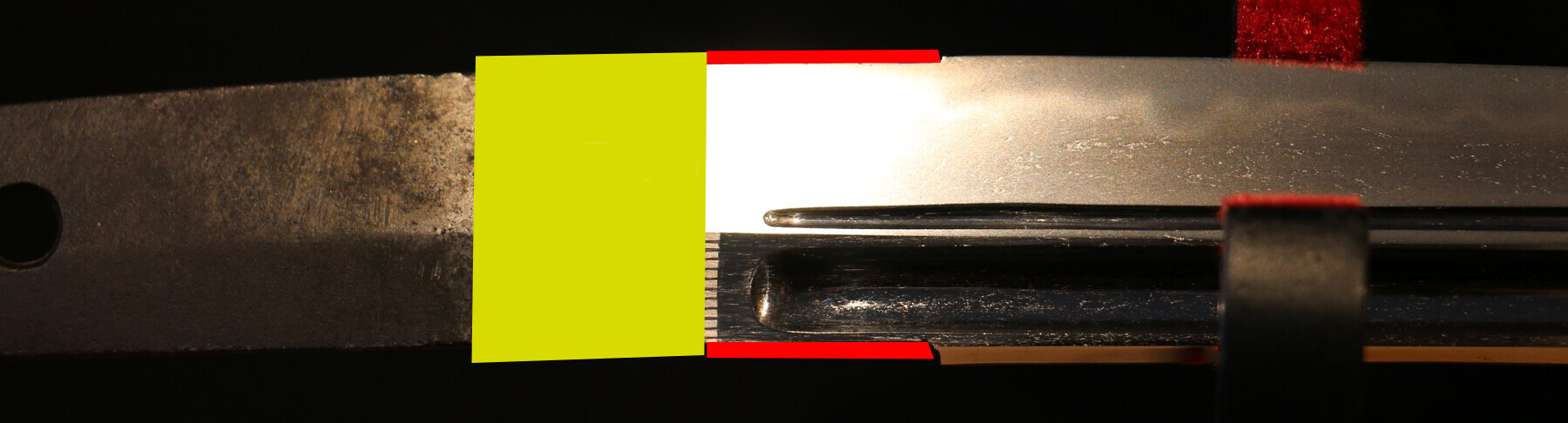
I was thinking about bit more simpler solution. Of course you have access to the sword and can see things differently than is possible through pictures. This would be the one possibility I see when I look at the pictures. (yellowish gold thing is supposed to mark for habaki). Red parts would be blade in the original length. Few things that made me think of this are the following, I do think the sword is in original shape, aside from moving the machi up. I see good shape to the sword when I look at it, and picture it as in my above picture. I can see this being a Muromachi Bizen wakizashi from 1400's to 1500's. Might be my eyes playing tricks but I might see some wear on the area behind my proposed habaki, which might indicate tsuba wear as also koshirae needs to be considered too. As the tang has only 1 hole, how has this been mounted? When you add tsuba & tsuka, where would the hole approximately be, would it be logical fitting wise too?

-
京X中尉 - Can't see the 2nd character well enough to identify it. I believe 中尉 - is a military rank, possibly Lieutenant. Those that know their WWII stuff would be far more qualified for this than me.