


Bruce Pennington
-
Posts
14,332 -
Joined
-
Last visited
-
Days Won
171
Content Type
Profiles
Forums
Events
Store
Downloads
Gallery
Everything posted by Bruce Pennington
-
 The tsuka looks like a tachi (forgive if the term is wrong).
 -
Kanenobu. Signed Noshu ju Kanenobu.
Bruce Pennington replied to Swords's topic in General Nihonto Related Discussion
You got a good deal on that gendaito, Steven. It's legit. -
what about this 94 sword set?
Bruce Pennington replied to Wangzi's topic in Military Swords of Japan
I don't study these, so I cannot say. It's 1:45am in Aussie-land, so it will be a few hours before John wakes up and sees this. Of course, anyone with tassel experience could help out. -
what about this 94 sword set?
Bruce Pennington replied to Wangzi's topic in Military Swords of Japan
Johh, @PNSSHOGUN, will chime in as his day begins on the bottom of the world! Does the seller know that is a general officer tassel? Those sell for as much as a full WWII Type 98 gunto. John will have to advise on the fittings. -
Meaning of Kanji and Katakana on fittings
Bruce Pennington replied to PNSSHOGUN's topic in Translation Assistance
John, Don't know if you're tracking these, in general, or just on gunto you own, but I thought of you when I saw this one on a Mantetsu. It's got "727" on one side and some other kanji on the other. It's on a cut blade gunto for sale on this Buyee.jp auction -
Another using the ">" as a 5, on a Mantetsu, found by @Ontario_Archaeology Matt at this Buyee.jp auction
-
OK, that was too much information already! Ha! Seriously, that’s a great photograph. Thank you.
-
Also interesting, the nakago shape is identical to yours, though I haven't surveyed other stainless blades to see if there is much variation. But the numbers were stamped differently, while the square is located exactly the same.

-
Thanks Mark! I have 22 stainless blades with numbers, now, all mumei except one. The hash marks are often modified Roman numerals. Not sure if that's what yours are as the numbers don't match the rest. Update: Browsing through those blades, I found the other square stamp. I seems to be different. Posted by @Butch, mumei blade, number 366

-
Japanese katana translation needed
Bruce Pennington replied to paleranger's topic in Military Swords of Japan
Hi Lance! Lots of good info so far. The style was a contengency model, designed in 1938, promoted for sale on the market in 1940, and really didn't become popular in the army until 1943 onward. Most guys call it a Type 3. You'll see all sorts of names, as it never got an official label. You can read all about it on the following links: The wartime type Gunto for army officers 1943 (Type 3 Guntō) (ohmura-study.net) History of the Type 3 Model Unveiling the Rinjiseishiki sword 1940 Once you've restored the tsuka ito (handle wrap), you'll see plenty of these for sale on ebay in the $900 - $1,200 range. The small stamp is the "NA" of the Nagoya Army Arsenal inspector. While not "traditionally" made, the vast majority of WWII swords were non-traditionally made, yet still attractive and quite deadly. -
Mark, I have seen that stamp only once before, and for the life of me, cannot find where I've filed it. Yours has more detail, though, so I'll start a file with it. Don't know what it is, but being at the end of the nakago, my personal feeling is that it is a shop stamp of the whomever did the fittings. I don't see your 647 in my chart. Can you post photos of the full nakago, both sides, and an overall shot of the sword?
-
Cost for Shirasaya and Tsuka
Bruce Pennington replied to William Jennings's topic in General Nihonto Related Discussion
Hi William! I am the least knowledgeable person to answer this, so maybe the guys that know will chime in, but from memory, it seems a shirasaya will run you $700. Don't know who makes them. Wrapping a tsuka runs $300. There are likely lots of guys who do this, but the only one I've personally seen online is Chis Lohman here: Japanese-swords.com. Of the many likely guys that really know, you might try @Grey Doffin. -
Thanks John! I have 3 others like this, though they are mumei. All 4, now, are stainless, kiagunto, and all 4 are numbered. I'm thinking it's a fittings shop stamp, but still unknown. This one is Kiyomichi. I have 2 other Kiyomichi under the Toyokawa file ND Mumei ワ 119 stainless Robinalexander, NMB kaigunto gourd ND Mumei 148 Stainless Phronsias, W-A, kaigunto ND Mumei, Tenshozan stamp 304 Stainless Luca, NMB, Kaigunto ND Mumei 353 Stainless Crimson Mist; souvenir ND Mumei 358; stainless KB1107, Toyokawa, souvenir ND Mumei 366 Stainless Butch, NMB Late Kai ND Mumei 453, stainless, Inaba stamp & unknwn stamp Conway S, NMB ND Unknown 384; stainless Kai-gunto, NMB, kaigunto; gourd ND Mumei 493inRomanNumerals; stainless; EnglishOnFitts Bangbangsan,NMB, kaigunto; gourd ND Mumei 414; stainless SofeAuction, Toyokawa, souvenir ND Kiyomichi 537; stainless John C, NMB, gourd
-
I have seen a good number of "immaculate" gunto coming out of Japan, and have been assuming they are full restorations, or new construction. The one at the top has a 1933 blade in it. Theoretically, the blade could have been re-fitted when the Type 94 came out.
-
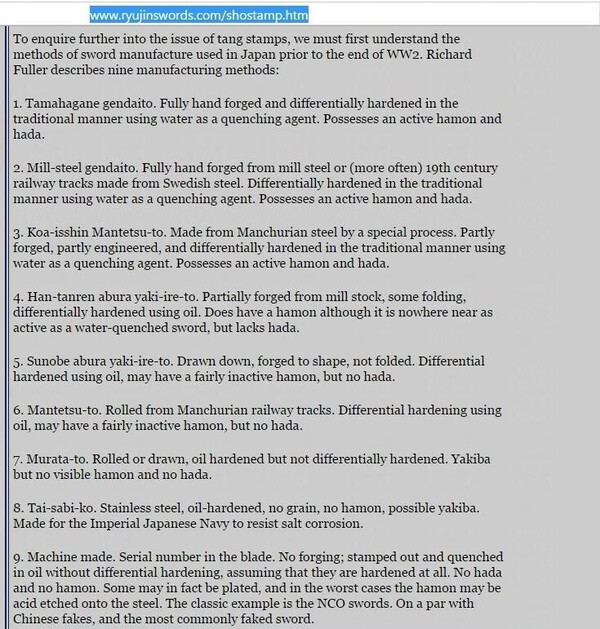
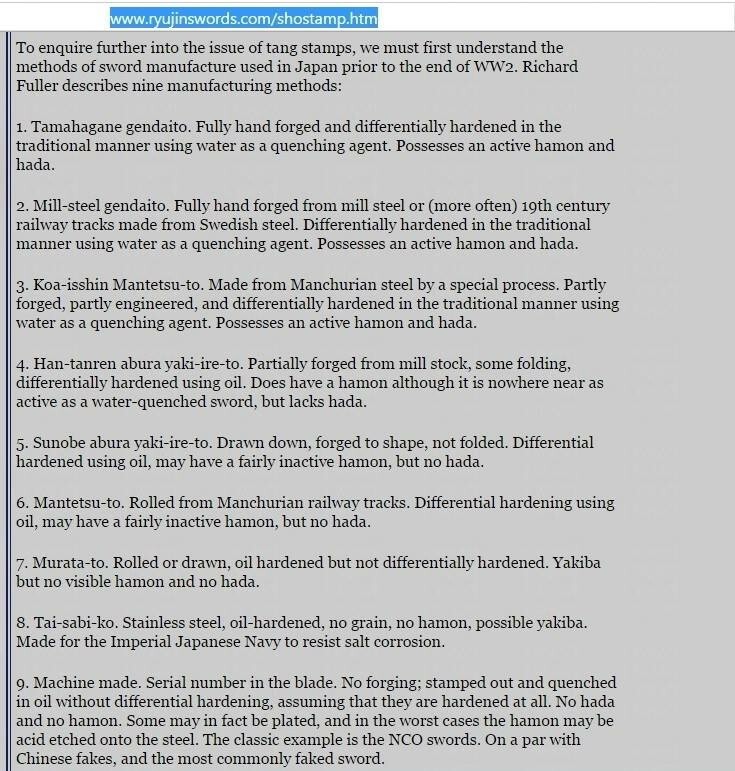
Not to beat a dead horse too much more, as you're already returning the sword, but his upgraded fittings still don't raise the price of a sword like this to the level you paid. Top end - $2,400 "Hand made" - Brian already hit it pretty good, but this blade could have been fully made by hand, hammered and folded multiple times, even water quenched, but if they used a steel other than tamahagane, then it gets a stamp as non-traditional. Here's a list of the 9 ways swords were made:
-
Need help to translate Star Stamp Showa Sword
Bruce Pennington replied to War Time's topic in Translation Assistance
I know I've asked this before but what's that kanji just before "Spring"? Showa 20 year ? Spring? -
Thanks, Peter. Yes, it is a Koa Isshin mei. Also, might just be the fuzzy photo at top, but could you post a clear shot of the kabutogane (end cap of tsuka)? Looks like there is a stamp at the top?
-
Interesting to read the provenance story at the end of the previous thread. He's certain the tassel came with the gunto. So, it must have been a replacement, too, using whatever was available.
-
It is so well made, I can see why it was a surprise, Dan! All the metal fittings, except the menugi, plus the nakago, look like something made in occupied territories. I'm just puzzled by the higher quality work, the alternating ito. I remember Nick Komiya's discussion of Japan's effort to transfer sword production out of Japan when Allied bombing started to wreak havoc on mainland production. If memory serves me, he said it was never fully completed, but that implies that it was being set up to some degree. Maybe this sword was made "over there" and finished out by Japanese fittings workers who had transferred over. Just speculating.
-
That's the earliest one on file now, thanks Conway! I also have one with the same mei from 1939. The rest are just Tenshozn Tanrenjo (Tenshozan Forging Workshop).
-
@Kiipu @BANGBANGSAN Peter, for the files, could we get a photo of the other side? I'm sure it says Koa Isshin, but I like having the photos for the record. I'm sure you already know, but the serial number is KU 947.
-
If it was a stamp, it's too partially struck to make out, for me. So far, I have only seen that stamp in conjunction with the Toyokawa anchor stamp.
-
Need help identifying samurai sword
Bruce Pennington replied to Ziggy's topic in Military Swords of Japan
Ziggy, I'm not a nihonto guy, but I've seen a lot of Chinese fakery. The practice of stamping numbers on habaki is a Chinese practice, whether legit military sword or a reproduction, period. The nakago and tsuba/sepppa set appears to have been coated with some brown substance. You can see where it has flaked off several spots on the tsuba. Also the one shot of the combined tsuba/seppa has 'track' marks, maybe like it was held in a vise? The nakago mei is uncharateristically low towards the end, not normal for Japanese swords unless the nakago is shortened after it was made. My two cents Like the other guys said, seeing the blade might add some clarity. -
Nlf Gunto Discussion
Bruce Pennington replied to Bruce Pennington's topic in Military Swords of Japan
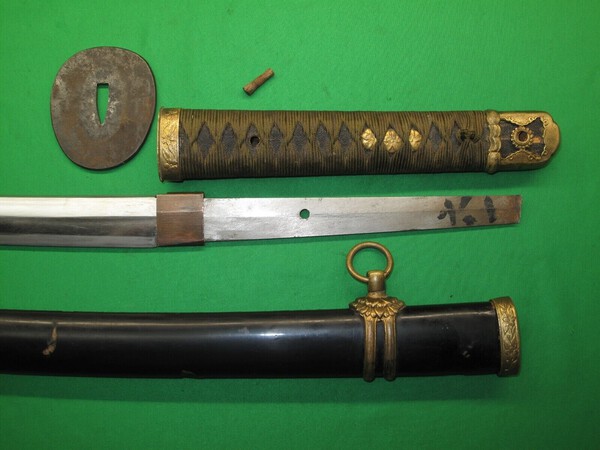
Welcome back John! Hope all is well. I want to post the photos of those last 2 swords before the links go dead 61 68.thumb.jpg.323f5a1bd48d2a43f96b99e7112d2bff.jpg)
.thumb.jpg.627b710c4504e7efb5ce0f95a107bb33.jpg)
.thumb.jpg.758c2cb631ad2ce5f7cc15c986ff285f.jpg)
.thumb.jpg.2b86418e5824acb862e4e08817c0c0b2.jpg)
.thumb.jpg.31674e0163f27d2b443da4f50dd5e70f.jpg)
.thumb.jpg.6fbb152d6f91631bc1b4ee6db14a2e30.jpg)
.thumb.jpg.a0d635fc136e30eb14d467c0c7743bcf.jpg)
-
1st Pattern Aluminiun Tsuka Type 95
Bruce Pennington replied to Banton989's topic in Military Swords of Japan
It's the Gifu variant of the idea. You can see it in the top photo of Stegel's diagrams. I wish he, or Steve Shamsy, were here. They could clear it all up. But I do think you are right that the years prior to '41 had slightly lower production numbers.



.jpg.70d1341a95b18603f75e29c17cef6db3.jpg)
.jpg.d39eee5d34b12b69f1cc2af789f9b0eb.jpg)
.jpg.ec35d440280dbec9b455d1eb10d2e4b0.jpg)

.jpg.2979458d26ffdafc2a3fc0ab0147c551.jpg)
.jpg.8f238cb6ac47827d44eef0a0589d33ca.jpg)
.jpg.ba66e4e3e318cd70ffdcef8f7f0fc479.jpg)
.jpg.66f88de371916eaef9bb5dea93d09456.jpg)