Bruce Pennington
-
Posts
14,698 -
Joined
-
Last visited
-
Days Won
176
Content Type
Profiles
Forums
Events
Store
Downloads
Gallery
Everything posted by Bruce Pennington
-
 Ha! 11 hrs to bids closing and it's only up to $26. I was tempted to go for it, until I saw the fine print. Auction found HERE.
 -
The only help I can offer you is to help take it off of your hands and into my collection! It's a nice one. Legit, if that is your question.
-
The link just goes to the .pdf Thomas added just above your post.
-
Missing character on Koa Issin nakago?
Bruce Pennington replied to matei's topic in Military Swords of Japan
That is "Ki" キ122. Mantetsu used katakana to serialize their production line. Ki was the ninth line (out of 15) for the year 1943. I do not know if their "year" was calendar year or fiscal year. Fiscal year started in April, but you can sort of guess-timate the timeframe. Ki was 3/5 of the year (9 out of 15), so around May or August, depending on which "year" they were going by. -
Need Help with RJT Star Mei, Please
Bruce Pennington replied to Bruce Pennington's topic in Translation Assistance
Sesko lists both father and son, but doesn't mention RJT status. I wonder if that is because the RJT blade is Tadamori? How do you have them linked? -
Missing character on Koa Issin nakago?
Bruce Pennington replied to matei's topic in Military Swords of Japan
Thanks for the update, Mat! Turns out I have this one charted already from a past seller online, but your photos are clearer, so I appreciate it. -
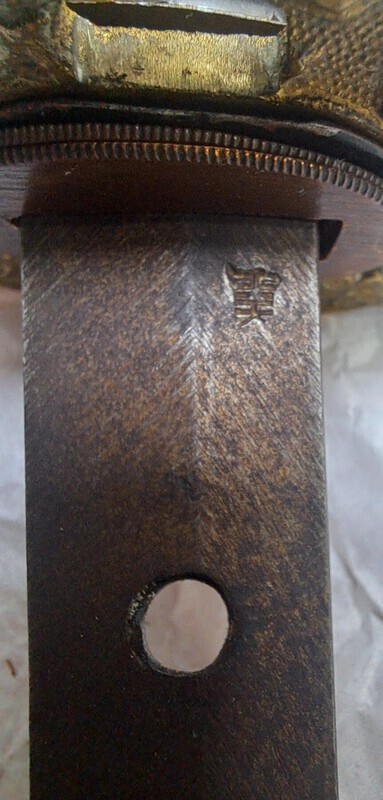
Ah, the Shoheikan Gunso Kabushiki Gaisha stamp. The shop made "army and navy koshirae. They also adverstise a wood saya gunto koshirae. The company was located in Tokyo and owned by Mr. Saito" -- Chris Bowen; Fuller & Gregory, "Japanese Military and Civil Swords and Dirks", pg 227.
-
Interesting video on Body Test Cuts
Bruce Pennington replied to Kyoto-13's topic in General Nihonto Related Discussion
Oh I wish I could remember all the things I used to know! I HAVE Markus' book "TAMESHIGIRI". The photo you reference is on page 174: On the next page, 175, Markus discusses multiple examples of cuts, 3 cuts through one body, one cut through 3 bodies, 2 body cuts, etc. And these were described on the nakago in detail. He also mentions blades that were tested multiple times by 2 different testers. I have a vague memory of that old feller in that video from another video, stating things that weren't exactly right. SO, disregard my original post, however it has all been a good refresher!
-
Need Help with RJT Star Mei, Please
Bruce Pennington replied to Bruce Pennington's topic in Translation Assistance
And I'm gonna milk that omniscience for all it's got!!! So, not a star-stamped blade, but the mei for comparison, then.
-
Need Help with RJT Star Mei, Please
Bruce Pennington replied to Bruce Pennington's topic in Translation Assistance
Retirements must be requested in triplicate, carbon copies, typed on manual typewriter!!! Thomas, I don't see the mei side of the Tadamori in your link. There are 3 photos of date, and no mei or mune. -
Interesting video on Body Test Cuts
Bruce Pennington replied to Kyoto-13's topic in General Nihonto Related Discussion
Which reminds me that I seem to recall a translation or 2 that did specify, in those terms, the cut position. Anyone else recall something like that? -
On a scale of 0-10, how fake is this sword?
Bruce Pennington replied to George KN's topic in Military Swords of Japan
Not really. They were just Japanese prisoners in a Japanese prison. I have never heard any interviews from prisoners during the war, but I would bet they’re nationalism and pride in serving their nation would’ve been quite a positive motivation for them to have been making these swords. -
Definitely not.
-
I thought Jewelry&coin and Showa22 were the same guy.
-
On a scale of 0-10, how fake is this sword?
Bruce Pennington replied to George KN's topic in Military Swords of Japan
Dang @Brian, you called it right! I want to ask how you knew, but you'd probably say a bunch of nihonto jargon that I wouldn't understand. That blows my mind! As to date, I don't know of a way to even guess. WWII is likely as close a range as you're going to get. The fittings aren't Type 94, which would give you an early war range, so after 1938 as they are Type 98 fittings is the best I could do. -
Interesting video on Body Test Cuts
Bruce Pennington replied to Kyoto-13's topic in General Nihonto Related Discussion
Thanks for posting this. He explains a common mistake in translating the cut test. It is often said a blade passed a "2 Body" cut test or "3 Body" cut test. But according to this guy, and it makes sense, the number is the cut position number "2" or "3" which were the most common choices for testing. Now, this begs the question - why don't we see cut tests of the other locations, say "12" or "7"? Maybe because they weren't hardly ever chosen?
-
SHOW US YOUR GUNTO HORIMONO
Bruce Pennington replied to IJASWORDS's topic in Military Swords of Japan
Albert, who was the smith on this one? How about a photo of the whole rig, too? -
Help with authentication of my Sword please.
Bruce Pennington replied to Nimm_'s topic in Military Swords of Japan
Which tells us the tsuba/seppa set were likely made for this blade re-fit. So, really, only the saya and leather cover are a mystery. These are always unknowable. Various options: 1. War legit, and shop used parts available 2. Blade came home from the war without saya and collector found one to fit. -
Shingunto with Koto uchigatana blade
Bruce Pennington replied to Beater's topic in Military Swords of Japan
If you mean this one, looks like paint to me: But you probably mean the other ones.
-
Seki Inspection Tag On Combat Saya.
Bruce Pennington replied to mauser99's topic in Military Swords of Japan
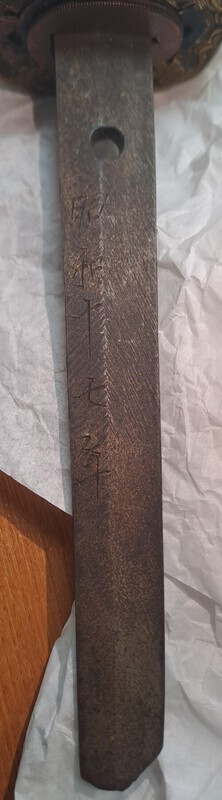
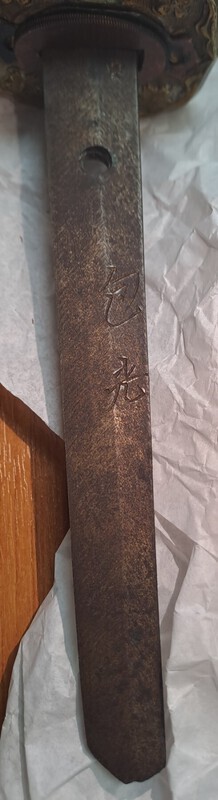
Another 3-pointed sticker from Adam, @Banton989. Has a 1942 blade in it, so it's either not a late-war practice, or the blade got a new saya late in the war: Edit: For future stamps searchers, this blade is a Sowada Kanemitsu with large Seki stamp: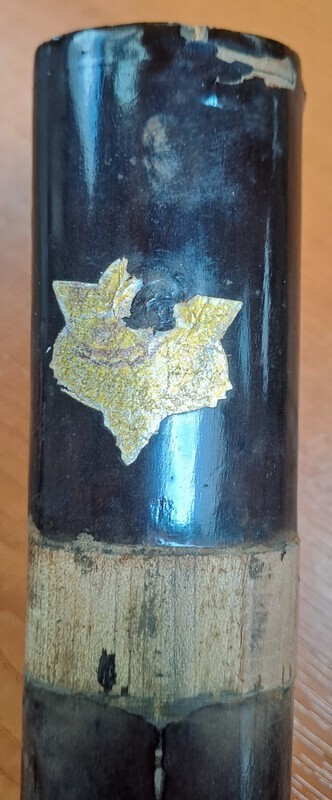

-
Help with authentication of my Sword please.
Bruce Pennington replied to Nimm_'s topic in Military Swords of Japan
I can't see any stamps, but you said they are very faint. Could you try a close-up of them? If it's an old family blade, as the guys say, I doubt they are actual stamps. Often, small irregularities and scratches cause marks that our eyes pick out as stamps. Happens to me a lot. General care and cleaning guidelines: https://japaneseswordindex.com/care.htm -
Help with WW2 Era markings.
Bruce Pennington replied to miketribal's topic in Translation Assistance
@miketribal Any stamps on any of these? -
Yokoyama Sukenaga Katana for opinion
Bruce Pennington replied to NathanLM's topic in Auctions and Online Sales or Sellers
Another for comparison:

-
I have 5 Kinmichi on file and their mei varies a bit on each one. But they are WWII blades whereas this one looks much older.
-
Is this a real WWII katana? if so who signed it?
Bruce Pennington replied to partyjam3's topic in Military Swords of Japan
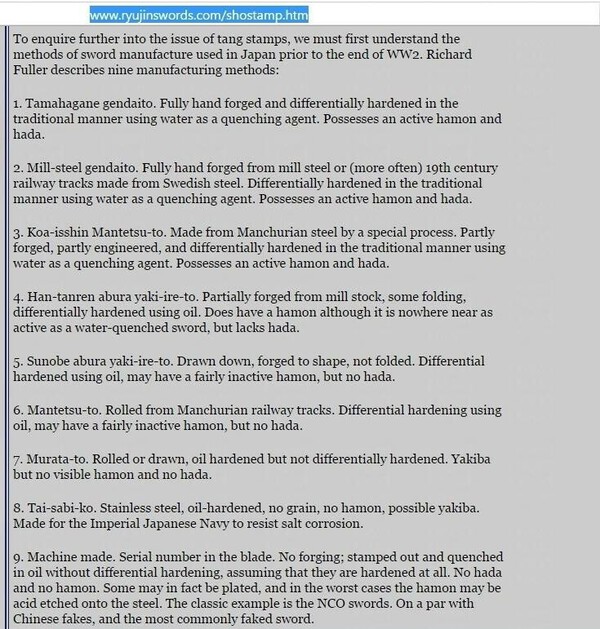
Matt, Terminology time! "Machine made" is collector short-hand for "non-traditionally made, which could mean a variety of things like hand forged but not tamahagane steel, or oil quenched, or other things." All blades were made by people. To increase production speed while maintaining reliability, factories began using a variety of methods like hydraulic hammers, oil quenching, rolled steel, all of which removes a blades from the "traditionally made" category. But often, the blades still have a good deal of quality workmanship put into them. Here is a list of methods from Richard Fuller's book: In my opinion, blades with the large Seki stamp tend to be nice looking and had a good deal of workmanship. They were most likely non-traditionally made, but I like them. But I am a WWII gunto lover, not a nihoto art aficionado.