Bruce Pennington
-
Posts
14,248 -
Joined
-
Last visited
-
Days Won
169
Content Type
Profiles
Forums
Events
Store
Downloads
Gallery
Everything posted by Bruce Pennington
-
I still have the first fake I ever bought (got a second one with a batch of 4 at an auction). Not sure why I still have it, but I'd hate to let it back out on the market to sucker another rookie like I was at the time. Pluse, it's still good to hold it and look it over in-hand. It's a stark reminder of the quality differences between these fakes and the real thing.
-

Gunto Stamps Document
Bruce Pennington replied to Bruce Pennington's topic in Military Swords of Japan
I've had a couple of requests for a hard-copy of the "Stamps of the Japanese Sword." I was skeptical because I assumed the photos would be more easily seen in digital form on a laptop or computer. But I've made a trial copy and I'm impressed. It's very readable and the images are quite clear. With double sided printing, the Stamps Doc is 30 pages long. I've added the articles on the post-war souvenir sword and the one summarizing our discoveries investigating the Mantetsu blades. Total pages - 45 (90 both sides). I can print it for $36 USD and will have to add shipping (which I haven't investigated yet). I'd assume under $10 for USA shipping and around $20-30 international, but I'll try to find out. So anyone that wants a copy, PM me with your mailing address. I haven't established an account with the paypal alternatives, but will do so ASAP. Due to copyrights of several of my outside sources, I'm only charging my cost to print and ship. Let me know if interested. For those who prefer the digital, I've uploaded 8.2 on the Downloads pages: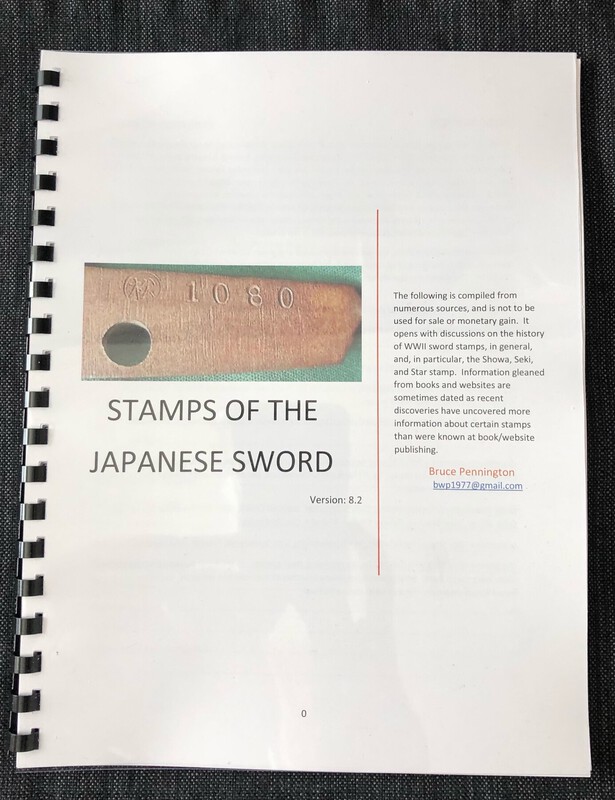


.thumb.jpeg.7bc691436a5c46e2904389026fd7c61e.jpeg)
-
Making blade steel in the 1930's
Bruce Pennington replied to Dave R's topic in Military Swords of Japan
Yup, got the same message. What kind of website is only viewable in it’s own country? -
Wonderful place to familiarize yourself with the real thing: http://ohmura-study.net/957.html
-
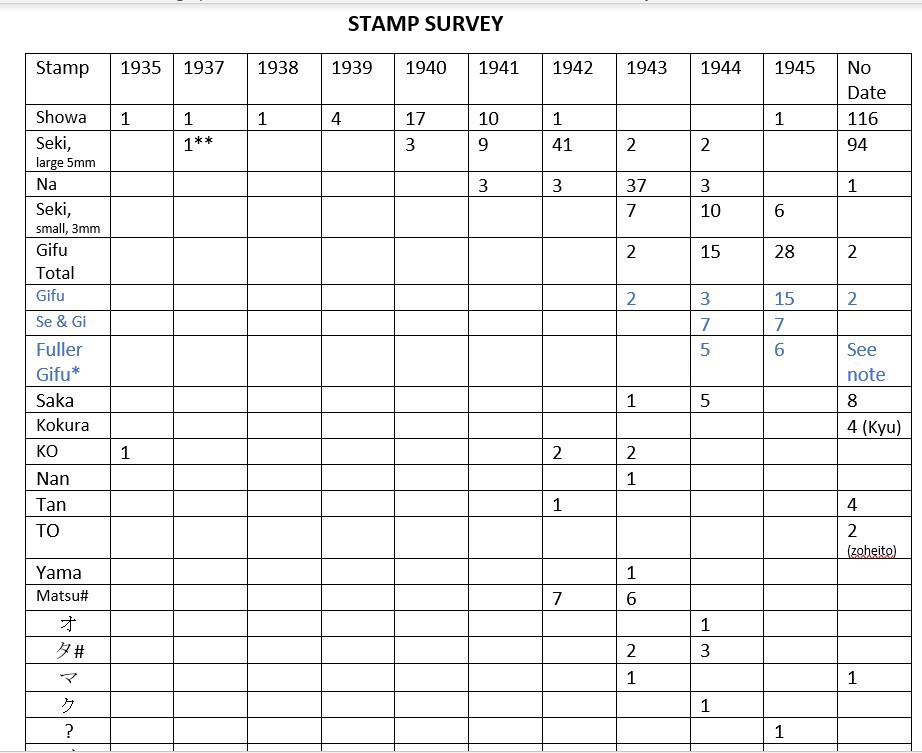
Here's a question - If stamping of showato was a requirement (law, but none found; military?; industry concern?) Why are all the stamps, even military ones from the Seki/Gifu area? When the military took over sword production/supervision in 1941/2, the commercial stamps, Showa and Large Seki, pretty much went away and by 1943 military stamps took over. In fact in 1943, the massive majority of stamps are the NA of Nagoya. Where are the Tokyo 1st and other stamps? Yes there are a small number of SAKA of Osaka Arsenal, but very few and VERY few "TO" of Tokyo 1st. Even knowing that the Seki area produce 70% of blades for the war, that still leaves 30% that should have stamps from the other arsenals and areas. Here is the current survey results:

-
Hi Charles! Welcome! Part of your answer lies in determining how you want to collect. Like, will it be just old Nihonto, or WWII gunto, or a sampling of both? When you know how you want to collect, then your place for searching might be affected. The NMB sales section is a great place to buy because you're not going to see any fakes being sold, and prices are going to be respectful. When I was collecting, I often found that what I was looking for simply wasn't being offered on NMB at the time, so I'd go to fleabay and/or dealers. It really pays, literally, to know your stuff before shopping with either, but I've been successful at filling out my WWII collection from multiple sources. Even buying books, like Michael said, can be driven by your taste -- books on Nihonto? Books on WWII gunto? Both? I agree, though, getting educated is your first investment. I don't know how much research you've begun, but for starters: The Japanese Sword Index Ohumra Study Both are free and full of a massive amount of vital information. There are other sites guys might want to give some links to.
-
Yes, that does indicate that military authorities were preparing as early as 1940 for their take-over of sword production, doesn't it. Not just the RJT program - the whole sword production of Japan.
-
Bryce, Welcome to the Data Collection Club! It's a great way to expand our understanding of the Japanese Gunto. Interesting finding. I know from one of Nick Komiya's discussions of kyugunto fittings that they did specify a movement/change of locking clips due to rain getting into the saya. So, it is possible there was a shift in location for the 94/98, like you are seeing. Of course, the sample is extremely small, so always keep an open mind, but maybe you've spotted in interesting development in the gunto.
-
Yes! That's what generated my questions. Good article.
-
Thanks Jean. Good explanation!
-
Link didn't work, but I found it on their website. I see what you're thinking. Boy the one on the blade is really crude in comparison. Like someone tried to recreate the image by hand.

-
I'm starting to catch on, I think. So, the tatara is foundational to "traditionally made" steel. The Yasugi Steel Co. created 2 more modern methods: "Seijo particle iron is made by smelting charcoal pig iron manufactured in a square furnace in an electric furnace and then putting it into a stream of water. It is used as source iron of a particle shape. Kaimen iron is made by putting charcoal and iron sand into a kind of rotary kiln called a tokamiro, reducing it at low heat, and producing iron that is spongelike in shape." Source: Hitachi-metals.co.jp So, Yasugi was using electric furnaces and rotary kilns. Regardless of the original ore, this would have made their steel, and therefore blades made from it, non-traditionally-made. Now, to focus on the ore - did tamahagane have to come from a specific ore type? Or was it simply the tatara smelting, regardless of ore source, that created tamahagane?
-
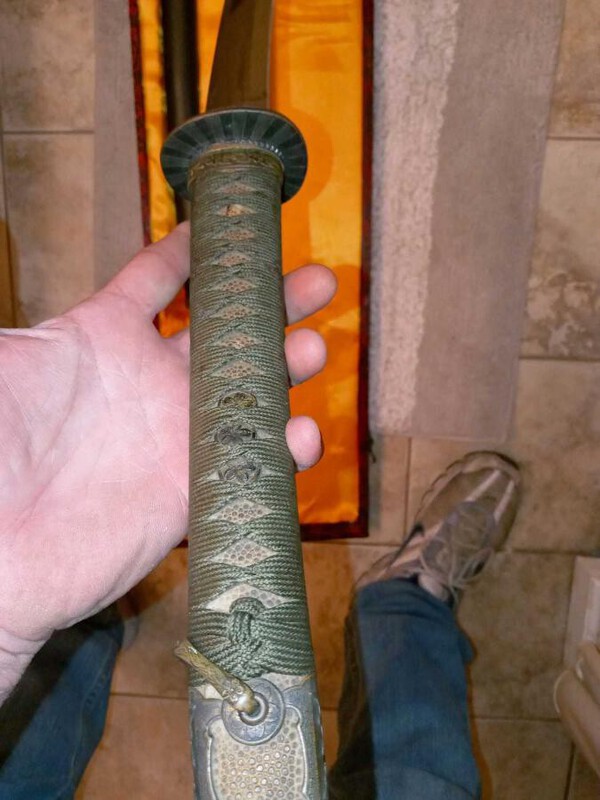
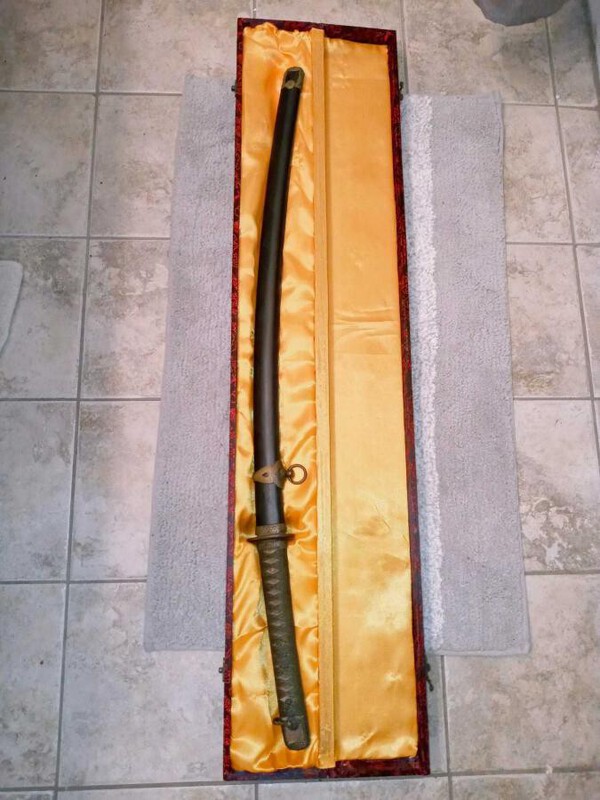
Found another possible late-war Navy kaigunto - June 1944 (Munemitsu); single haikan, no gold gilding, plain painted wood saya. HERE.


-
John, I was reading a site that ran some history of the Yasugi Steel company and they mentioned the "akome sand iron". Is this the same steel you've mentioned here? Can you help me understand how this sand iron differs from tamahagane sand iron and why it's use disqualifies a blade as being "traditionally made?"
-
The different Mei of Nagamitsu
Bruce Pennington replied to Daniel's topic in Military Swords of Japan
Cool your jets, my friend. Honest questions, you'll get honest answers. I'm enjoying your quest for knowledge and clarity. Let's keep it that way. Unless you are the one who did the acid wash, you have no reason to take offense. If not, then ask and learn. Neil's one of the greatest guys we have on this forum, I know him personally. -
Arsenal Mark on RJT sword Fittings
Bruce Pennington replied to george trotter's topic in Military Swords of Japan
OMG! You'd ruin me if you took it down! I go there almost every day, looking up Seki smith names, RJT guys. oshigata! It's my primary source for information! -
Arsenal Mark on RJT sword Fittings
Bruce Pennington replied to george trotter's topic in Military Swords of Japan
George, Did this document have an RJT smith list? I've got 44 RJT Star-stamped smiths (60blades) filed now, but 3 of them aren't on the Japaneseswordindex RJT Page. Masashige Tomonari Zuiho Hoping to get some confirmation about them. All 3 are dated 1943, 1944, so it's possible they joined the program after the lists we have were published. So, not a big deal, just something I'm chasing. -
I think you solved it Steve! There is a Kobayashi Masakiyo listed in the RJT page. Thanks!
-
I couldn't find a "Masaharu" anywhere, including on the RJT smith list, but interestingly, I found a reference that said Nobufusa, who was on the RJT list, sometimes signed as "Masaharu". But the kanji are different that the ones Steve shows. Could these be the same guy?

-
Grass script - Munetake?
Bruce Pennington replied to Bruce Pennington's topic in Translation Assistance
Ahhhh .... "missed it by THAT much!" Filing it away, I typed an "M" instead of a "K". Much better now! Thanks Steve! (down to 4 unlisted Star-stamped smiths!) -
Got another here: I have it down as "Munetake" but can't find any smith named that.

-
steel re-enforced gunto tsuka
Bruce Pennington replied to lonely panet's topic in Military Swords of Japan
@lonely panet do I already have the nakago pics and serial number on this one? -
I Don't See "Tomonari"
Bruce Pennington replied to Bruce Pennington's topic in Translation Assistance
Dang. I do my smith name searches over on Nihontoclub.com and I just wasn't using the right search criteria. I found it now. Thanks Moriyamasan! He's one of the few (7 out of 46) RJT smiths I have cataloged that aren't on the Japaneseswordindex RJT list. And my apologies - After another data search, looks like you guys translated this for Neil (IJASWORDS) a couple of years ago! -
steel re-enforced gunto tsuka
Bruce Pennington replied to lonely panet's topic in Military Swords of Japan
While I think it's possible SMR had been doing some of their own fittings, a large number of blades were shipped off to Tokyo, "unfinished", to fill Tokyo 1st Arsenal quotas. In 1943 (the only year we have a chart) they had to send 5,500. So lots of room for other fitting shops to get involved. -
Another from the files: Supposedly "Tomonari". But looking at the only 2 Tomonari (and neither of them WWII smiths) the kanji don't look the same to me. Any thoughts?




.jpeg.5428d2b433a935a5409b92e0c21918c9.jpeg)