SteveM
-
Posts
4,399 -
Joined
-
Last visited
-
Days Won
98
Content Type
Profiles
Forums
Events
Store
Downloads
Gallery
Everything posted by SteveM
-
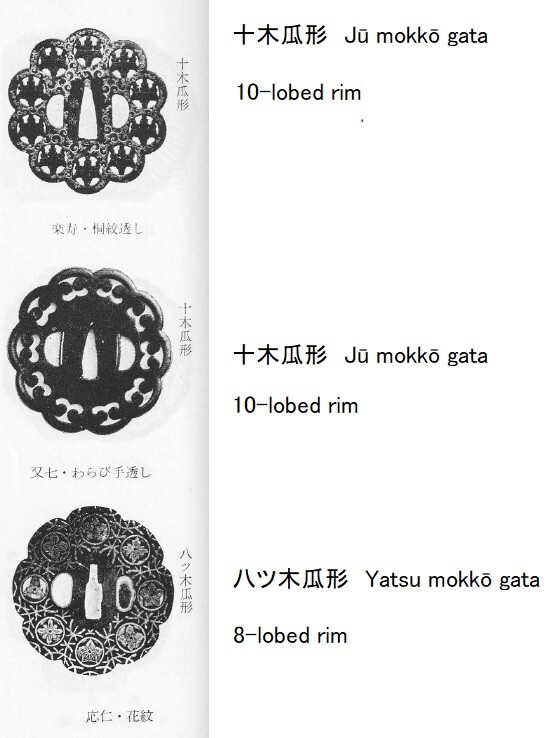
I think you are safe with Jū-mokkō-gata (十木瓜形). My bias would have been towards Kikka-gata (菊花形), but having looked in Iimura's "Tōken Yōran" which is a little almanac on swords first published in the 60s, I see he uses Jū-mokkō-gata for this kind of 10-lobed tsuba. And having double-checked with some papered tsuba, I see that NBTHK also uses "mokkō-gata" for tsuba with scalloped edges (8 or 10 or 12 lobes), always including the number of lobes when there are more than the default 4 lobes. But I don't expect these terms to be used with any consistency nowadays. You could call it Kikka-gata and get very little argument from anyone. Adding the entry from Iimura just for reference. I'm sure we could find examples where other authorities use other terms (as Dale has shown above).
-
I asked the All Japan Swordsmith Association about this some time ago, and they replied that there was no legal requirement to put the date on the sword.
-
Two blades I'm looking to buy, but unsure of age / signature
SteveM replied to George KN's topic in Translation Assistance
The tang of the WW2 sword does look slightly odd, but these swords, in general, are judged differently from traditionally-made swords. Some things are tolerated on WW2 swords, because the item is understood to have been made differently (and handled differently) and therefore you don't demand the same things from a WW2 sword as you do from a traditionally-made sword. With a WW2 sword you are basically looking for authenticity and condition (including the fittings). You aren't looking for esoteric crystal shapes in the cutting edge, and you probably aren't going to be too concerned about whether or not the tang was filed to fit inside the scabbard (but of course, the fewer deviations there are, the better). Oops - fixed the year. Would have been quite a WW2 sword to have been made in 1949 -
Two blades I'm looking to buy, but unsure of age / signature
SteveM replied to George KN's topic in Translation Assistance
First sword 粟田口近江守忠綱 元禄二年二月日 Awataguchi Ōmi-no-kami Tadatsuna Genroku 2 (1689), February Always best to look at the sword itself rather than the signature, but this one looks fake. Second sword is a WW2 sword, signed 直胤 Naotane 昭和十九年 (1949) 1944 Looks OK to me. Whether the sword is wakizashi or katana depends on the blade (the cutting edge) length. Over 60cms is a katana. -
This one is a hollyhock leaf. ("ichiyō aoi mon") 主水正藤原正清 Mondo-no-shō Fujiwara Masakiyo "Mondo-no-shō" is a kind of title. Smith's name is Masakiyo.
-
Yes, this sounds like a very plausible hypothesis. Steve
-
Bronze Tray with Pegasus over Fuji San
SteveM replied to Baka Gaijin's topic in Translation Assistance
英春作 Hideharu saku Kobayashi Hideharu is the maker's name. -
From Sasano (p.240) I think it's this direct translation of "hachi-no-ki" (potted tree) that gives rise to subsequent collectors in the US to jump to the description of "potted plant" or "flower vase". In reality, "potted tree" is a Noh story of a traveler (Hojo Tokiyori) who stopped at an inn in the middle of winter, and the innkeeper showed his hospitality by building a fire for the traveler. But, to build the fire, the innkeeper had to chop down his precious potted plants and trees; a kindness which was later repaid by Hojo Tokiyori. https://www.the-noh.com/en/plays/data/program_100.html#:~:text=These events take place during,and part of Tochigi prefecture). The tsuba in Sasano

- 7 replies
-
- 10
-

-

-
Was it shortened? I didn't see any shots of the butt end of the tang, but I was curious about the two peg holes.
-
Saw this one on ebay and remembered this thread. This is an interesting example of musubi karigane sukashi. Just for information and appreciation. Not advocating anyone get into a bidding war on this, unless you are already so inclined. https://www.ebay.com/itm/304771608687

-
尾崎源五右衛門助隆 Ozaki Gengoemon Suketaka Difficult to tell if this signature is authentic. Kogatana are often "decorated" with signatures of known smiths just to enhance the appearance/value of the blade. The blade in the middle one is signed 平戸包次作 Hirado Kanetsugu saku (Unsure about the "tsugu" character) As above, best to consider this an "homage" signature. I don't know of a Kanetsugu from Hirado, so that further adds to my uncertainty about the reading. . The signature of the kozuka on the right is Toshimitsu (利光). There are maybe ten smiths who used this name, and a bit hard for me to discern which one this is. Virtually all of them (with one or two exceptions) are working at the end of the Edo period. Personally, I think this kozuka is the best of the three posted in this thread. The catfish kozuka is interesting, but its had a rough life.

-
Identification of this Japanese Sword (Enigma).
SteveM replied to Augustus's topic in Military Swords of Japan
It was common to personalize the fittings with your family name or family crest, but I don't think it was common to scratch your name on the tang. But it strikes me as being more plausible to do this, than it would be to have a polisher scratch his/her name on the tang of a WW2 sword. -
Identification of this Japanese Sword (Enigma).
SteveM replied to Augustus's topic in Military Swords of Japan
横田 Could be either Yokota or Yokoda. I feel Yokota is the most common, probably because of the air base of the same name. Owner's name, would be my guess. -
鋤残土手金泥塗耳 Sukinokoshi, dote kindei-nuri mimi Kindei is a kind of adhesive with gold powder in it. I think a lot of people say "kin-doro-nuri", especially online, but I think "kindei" is correct. I will have to defer to the experts to clarify the technique of sukinokoshi. I think sukinokoshi is where the metal is scraped (carved) away from a design (or, in this case, the edge) leaving the design in a raised relief. In your tsuba it would be a dote mimi that becomes even more exaggerated/pronounced by removing metal up to the rim.
-
鉄地変形透 Tetsu-ji, kawarigata sukashi 無銘 Mumei
-
Hi Grev, I scanned the page from my book.

-
He's on page 67 of Wakayama's Tōsō Kinkō Jiten. Late Edo metalworker.
-
Bamboo with snow. (雪持ち笹) https://irohakamon.c...a/yukimochizasa.html
-
I didn't realize these were going for such high prices. Forget my original lowball estimate of $2000. The guys above are right - these are going for a minimum of $6000. North of $10,000 if the furnishings are in great condition.
-
Not crass - its a natural question. Just the Yasukuni sword alone is probably worth close to $2000. If all the fittings are in pristine condition, the ensemble would be worth north of $3000. Your mileage may very.
-
飯野 = Iino. Iino with a double i (not Lino)
-
Nothing on the paper indicating date or specific smith. If you or your friend can post detailed pictures of the blade, we might be tell some more about it.
-
Hello Roy, As Ed says above, the paper gives the attribution, and it certifies the sword as a "Specially Precious" sword. Specially Precious is one of the rankings used in the old classification system. You can find an explanation and a translation of the boilerplate at the link below. Specially Precious = "Tokubetsu Kicho" in Japanese. https://www.Japanese...ndex.com/origami.htm Under the attribution it gives the length of the sword, which it looks like 69.2 centimeters (長六九.二). Actually it's hard to tell if its 39 or 69, but if it were 39 centimeters the sword would be classified as a "wakizashi" (short sword). This paper specifies it is a "katana" (long sword), so...must be 69.2 centimeters. . After the boilerplate it gives the date of the certification: October 18, 1969, the name of the issuing organization (NBTHK) and chairman at that time, Mr. Moritatsu HOSOKAWA. Then it gives the name of the person to whom the paper was issued, which nowadays I'm slightly reluctant to translate and post to a public site due to privacy issues. Repeating Ed's comment, but there is, unfortunately, no mention of which Fujishima smith this might be. There are only about 4 or 5 kanji on there that are old style, but even most Japanese people today can recognize these old style kanji. The handwritten bits may have thrown them. Sometimes if people can't read the handwritten bits, their brain shuts down and they give up reading any of it.
-
Swordsmith is Hattori Masahiro (服部正廣). He was a Seki smith, making mostly arsenal swords (I think, others will correct me if I'm wrong). Wartime swordsmith, so date of manufacture is, say, 1938 - 1945.
-
Abalone shell on a string? Something of a common theme. https://tokka.biz/fittings/T172.html https://www.pinteres.../512143788877859363/