Fuuten
-
Posts
1,374 -
Joined
-
Last visited
-
Days Won
4
Content Type
Profiles
Forums
Events
Store
Downloads
Gallery
Everything posted by Fuuten
-
I must say though that as far as the signature of the other one you posted is much more beautiful to my eyes. The large hefty indentations (maybe a better word for them would be carvings), don't add to the tang artistically.
-
The inlays seem so large and can't put my finger on the specific thing or variable that makes them look 'boring' - that's not it but they appear so large and unsightly to me they just look like a bad imitation of what such inlay can be or is supposed to be. Also the dots that are 'missing' they just look like they were added to give that effect. I'm wondering whether Ford would lean towards a novice metalworker's work or just outright fake, albeit perhaps better executed than some cast of handworked imitation.. Now please don't take the above personal because this is just how it appears to me at this moment in time and I'm not even a layman or novice in this world. What do I know, curious to see more input.
-
Everything seems off plus the work seems terrible. I would vote bin.
-
 & On 10/31/2020 at 7:18 AM, Baka Gaijin said: Hokuetsu Seppu contains studies into Snow crystals by Doi Toshitsura, Daimyo of Koga. He wrote a book called Sekka Zusetsu (A Study of Snowflakes) in 1832. Daaamn I think this is it. https://en.m.wikipedia.org/wiki/Sekka_Zusetsu Apologies as it took me a while to go through all information shared above - it's not exactly the tale I remember but I'm fairly certain this is the subject from the information that does match. This will surely help narrowing the search for the story. Thank you both so much! 🥳
 -
Yeah very cool patterns. I have some tea utensils with similar abstractions from crystals. I'm still trying to identify the story I opened with, or exactly where the idea came from. these kind of 'argh I can't remember' can bug me to no end. Part of the story I'm relatively sure about is the part about the subject having bargained a microscope from somewhere and also that the only way during that time to study the formations happening was to be outside in the cold. So in the story it mentions the subject being outside (I think it was said to mainly take place during nights and on the castle grounds, so subject had to be wealthy and of some power), during the night for 9 or 10 hours at a time, this is what I think I have read at some time or another. This thread might just be complete nonsense as having no one else recognizing it makes me doubt my memories even more😒 heh
-
Sorry for derailing this thread but to be honest I'm far more curious as to what attributes or different characteristic attracted you to this piece. Care to expand?
-
New acquisition follow-up, Iyo Matsuyama Ju Seiken shinsakuto daisho
Fuuten replied to Yama Arashi's topic in Nihonto
Sorry, ~20 years. I can no longer edit my previous post. -
New acquisition follow-up, Iyo Matsuyama Ju Seiken shinsakuto daisho
Fuuten replied to Yama Arashi's topic in Nihonto
Having near zero knowledge of the actual movements or rigid guidelines I think for 39 years ago that seems impressive. No offense intended 🙏 Do you have your own mountain retreat and long flowing white beard now? Seeing those videos and calculating the age you must be one cool grandpa now👍 -
But.. Tengu are just the coolest folklore creatures! In those times i would opt for a mask instead of kabuto but either, Tengu's have appeal. I'm fond of the Dai Tengu's appearance/characteristics. Something about it.
-
2020 Shinsakuto Competition Results?
Fuuten replied to piryohae3's topic in General Nihonto Related Discussion
Oh wah, thanks for sharing that photo, what a hamon! If I find an hour free time I'm going to use it to see if I can find some more by this smith. -
Thank you kind gentlemen. I'm still thinking of an older period, where a microscope was really modern equipment. Perhaps I'm entangling multiple stories. Thank you both👍
-
Hi everyone, For the life of me, I'm sure i once read a story somewhere about a Japanese lord or Daimyo that was obsessed with the formation of ice crystals and had some sort of microscope to see them close up. Maybe it was on Markus Sesko's website but I couldn't find it.. Someone know what story I'm getting at? Could one of you nice gentle ladies or gentleman help me out? Not being able to verify the story or locate the source has been nagging in the back of my head for a while now. Thank you,
-
New acquisition follow-up, Iyo Matsuyama Ju Seiken shinsakuto daisho
Fuuten replied to Yama Arashi's topic in Nihonto
Everything posted seems to be thought out and of good or great quality. I like the tsuba. Are these you're first swords? If so great start🙏 It is a pain though when you're set on a fuchi & kashira and they don't end up fitting the blade. I've had the same problem but opting to adjust the set was something I couldn't bear. Have you decided how to proceed? -
2020 Shinsakuto Competition Results?
Fuuten replied to piryohae3's topic in General Nihonto Related Discussion
Thanks for adding the link, as mentioned by Brian, it's very cool to see name, face and submission so conveniently organized. So much diversity in the submissions too, not just type but all attributes it's really a unique craft. The tanto signed Kiyofusa with choji early in the list really resonated with me. Like it's on fire.
-
I'm not an expert but just to add I read about 'replacement' pieces made of wood such as shown above for use during the tea ceremony where being armed was not permitted. I've seen a few come around and they were shaped imitating tanto koshirae.
-
Thank you Markus! In that case I suppose we should go with the Juyo paper's description.
-
Ah sorry for the confusion, now I see there's also references to o suriage. I didn't have much time earlier and didn't read line for line. The ubu reference is also in the sayagaki according to the listing, maybe someone can quickly check. As for the length it could very well be shortened. When I check for funbari it's like my eyes are tricking me, sort of looks like there's some.
-
I also never have seen this shape in combination with the rest of the piece listed before, but for such an ancient piece, ubu and the above mentioned rarity at juyo with this attribution I feel its not all that expensively priced. It seems to be a very nice package. I wonder what price a second or third tier school attribution with the aforementioned shape, age etc with Juyo origami would have.
-
Tanto What do I have here?
Fuuten replied to Guns Knives and Swords's topic in General Nihonto Related Discussion
Hello, Michael, maybe add your name to your avatar. Excluding any comments on the swords value etc. it appears to be a real Japanese sword as in not a fake. I think maybe Edo period but I don't know much. The polish is not so great with rust but it's not too bad and maybe you can still appreciate the attributes of the steel. Does it have papers or a shirasaya? Might be worth repolishing. The koshirae, fittings it is in appear to be relatively simple as far as the materials used because the copper stands out to me but it has a very nice theme and workmanship in my opinion. Not excessive but sophisticated in a sense. Unique habaki too the moon against a drunk soldier who sees everything not double but triple during the day?!. I think it's a unique koshirae someone went all out. Not bad at all👍 how did you acquire it? I hope others add their thoughts. Oh and http://www.nihontomessageboard.com/faq.html -
Super cool item I think. If I had the means I would seriously consider this one. Over 80cm, nice koshirae and hozon. I think this one is a fine package. https://www.aoijapan.com/nagamaki-mumei-kanefusa/ Anyone have an eye on it? Would've added sugata image but it's too big.

-
Hi Everyone, Having neglected my browsing in the last few months, I checked out aoi art this afternoon and saw the following item. https://www.aoijapan.com/jumonji-yari:bushu-shitahara-ju-yasushige/ Now this piece raised some questions for me mainly because of the bohi on both sides. Now I'm not saying it is for sure a shady horimono job and I acknowledge there there might be a creation of a smith which he feels is top heavy and add these kind of bohi on the upper portion, but it seems to me (as this isn't the kind of carving you see often (this is true for me at least)), this is exactly what someone of lesser morals would opt to if there was a single part that seemed to have a flaw. What are your thoughts?

-
Well honestly, i don't know much about armor. I think the shape was pretty much reserved for such class of warrior/governor etc. Perhaps also to be a clear recognizable image on the battle field? I know kabuto are also tricky as they rely heavily on condition, and many a laymen (like me), do not know what to pay attention to and perhaps buy something they regret later, after reading a little about it. I suppose here to one can probably better buy books to learn before buying something. Hopefully someone else will chime in.
-
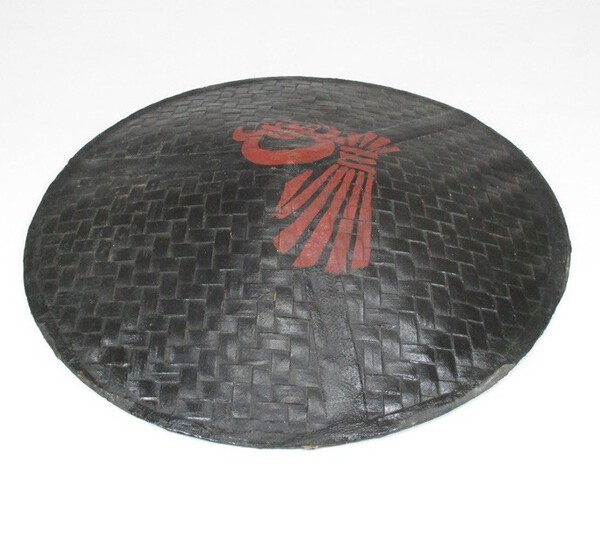
Don't take it as fact, but I think most jingasa were made with a base material (wood and other natural elements), and finished with lacquer. I think the general type was simply to keep the head dry, but there might be a large amount of foot soldiers that could not afford or simply wouldn't get a kabuto or full armor and thus opted for a lacquered jingasa for the above stated reason and probably because the lacquer was quite strong and would still protect the head area more than a hat made of reed in case for instance an arrow hit that region. Then again I'm not sure as most I've seen were reasonably simple. The shape you show is sometimes referred to as a Daimyo class but I'm not sure if its correct. It is most likely lacquered wood. I have one of such objects but surely it was not used for battle as it offers less protection than a wet towel!🤣
-
A quick search (on google), turned up a few good threads from the NMB.
-
If i were in a better financial (not making water), position then it would be items like this, chanoyu or tea ceremony related items that would float my boat👺👍