ROKUJURO
-
Posts
6,718 -
Joined
-
Last visited
-
Days Won
30
Content Type
Profiles
Forums
Events
Store
Downloads
Gallery
Everything posted by ROKUJURO
-
Translation assistance of Katana Tang wanted.
ROKUJURO replied to Kantaro's topic in Translation Assistance
Paris, they are of course factory made for mass sale to those who cannot compare to genuine Japanese swords. They are not "old" (how old is old?) but mostly made after WWII. In Japan, "old" swords are pre-1600. Fortunately, swords like this were made by workers who never saw a genuine NIHONTO but just blurry pictures of them, so they are easy to spot. The blade in question shows a bad version of a MEI, so I suspect it was not made in China where many people can write the characters correctly. -
Unfortunately, the TSUBA is a cast copy. You may brush off the red rust without fear of damaging the patina. (Photos are upside-down)
-
Wasn't SHIBUICHI a material that was introduced quite late into TSUBA making? Also, the surface is surprizingly well preserved (or, with other words, does not look 'old' to me). I vote for the late EDO estimation.
-
B. Ashton, I am in the westernmost part of Germany, and you are welcome to send me the SAYA or come by my workshop in person (I would not charge you for the repair). But I am confident you will have competent people closer by than just me. Did you contact the British Token Society?
-
YASUNORI I think. TAISHO date?
-
Horinomo'd to death wakizshi
ROKUJURO replied to Gerry's topic in Auctions and Online Sales or Sellers
....if you have a day off and are bored.... Horinomo > HORIMONO -
Thank you David, the images are not so good, but it is a nice KACHUSHI TSUBA with DOTE MIMI as decoration! I like it as well!
-
There are some: https://nihontoclub.com/view/smiths?page=163&order=title&sort=desc but the MEI on the NAKAGO you are looking at is probably recent.
-
Steve, the photos of the blade are not helpful but the TACHI MEI is meant to read RAI KUNIFUSA. Certainly not by the famous RAI school.....
-
He didn't even ask a question....
-
Tutankhamun's meteoric iron dagger
ROKUJURO replied to vajo's topic in General Nihonto Related Discussion
No, you can forge with stone tools and stone anvil. -
David, I don't know if it would be helpful for you, but I would like to see them.
-
Looks like a traditionally made blade in high quality military mounts. With good photos of the NAKAGO (plain, dark, non-reflecting background, photos presented as cut-outs, no HABAKI) and close-ups of the blade you may get more feedback in the NIHONTO section.
-
Thank you Mauro! Is that water drops?
-
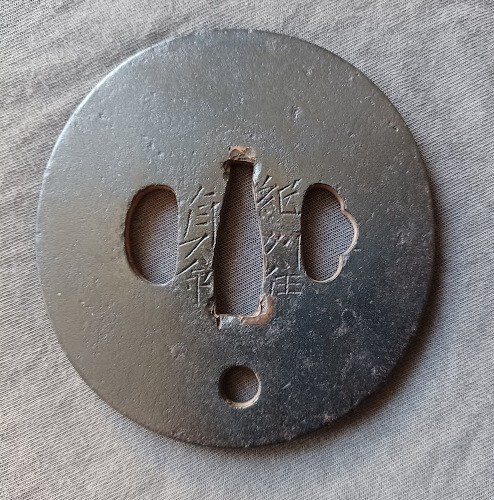
Thank you Piers! The upper one is an atypical TEIMEI TSUBA, the lower one is a WAKIZASHI-size TÔSHÔ type/age TSUBA.
-
Hi Charlie, in my experience, most IAIDO teachers will not use or even recommend sharp swords for it. Basically, it is practiced with BOKKEN, and only some advanced masters may sometimes use sharp swords in IAIDO demonstrations for show. Also, there is no cutting involved in IAIDO. A blade without much taper in the KASANE will have a tendency to wobble when a stroke is stopped mid-air. TAMESHIGIRI is another thing, and there, wide heavy blades are used by some experts.
-
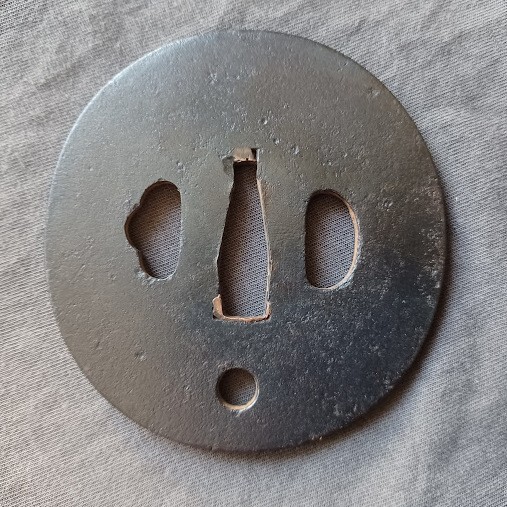
Gentlemen, how would a very humble 'decoration' like this be called on a TSUBA? 'HAN UDENUKI' ? A star?

-
It was inherited by 8 children of a family and they planned to share it fairly?
-
Line Auctioneers- Huge Suspect Lot (Mostly Tosogu) From Beverly Hills
ROKUJURO replied to cluckdaddy76's topic in Tosogu
In my opinion, the problem is not the production of cheap faked items. The sad thing is that people with no feel for the subject, for Japanese culture, and with no knowledge fall for it and buy them.
-
Lee did not mention TAMESHIGIRI, and I don't think one would seriously practice it with a sword that has HORIMONO. BOHI in this case are q question of aesthetics and of course money. I would discuss this subject with a competent polisher.
-
Zachary, as far as I know there are no limitations for TOSOGU or KOSHIRAE except if very old/rare and of national or cultural importance. But that would not be something you buy as souvenir.... I am confident you can have a TSUKA made to your specifications if time was not a factor but I do not believe you could get one without the space for a NAKAGO in it - that would not be a TSUKA. For presentation as TOSOGU set, you would need a TSUNAGI and then of course a SAYA to complete it.
-
Line Auctioneers- Huge Suspect Lot (Mostly Tosogu) From Beverly Hills
ROKUJURO replied to cluckdaddy76's topic in Tosogu
Well, this "half" DAISHO TSUBA (they probably don't know what that is) https://collectorsfirearms.com/20702-dai-sho-tsuba-mgj1405.html/ seems to be a genuine cast trinket. -
Okan, very fine and regular NANAKO-JI like this is only found on quality TSUBA! A good one, I believe!
-
The SHIRASAYA's purpose is to protect the blade from moisture (and other possible damage). HONOKI wood works fine in that respect as it can absorb moisture which might accidentally be on the blade or in the air. Any oil, lacquer, varnish, or paint in or on the wood of the SHIRASAYA will stop this effect. Moisture will be trapped in the SAYA and lead to corrosion. IBOTA wax will not form an air-tight layer on the wood. - Did you ever hear about the damage that may occur in a wooden house in case it was insulated with Styrofoam boards? -