Gakusee
-
Posts
1,929 -
Joined
-
Last visited
-
Days Won
22
Content Type
Profiles
Forums
Events
Store
Downloads
Gallery
Everything posted by Gakusee
-

Important, But What Does It Mean?
Gakusee replied to Ken-Hawaii's topic in General Nihonto Related Discussion
Ken, it is somewhere in the new blog. Can not attach it as it is 7MB and the limit here is 5.8. But it is freely available -
Important, But What Does It Mean?
Gakusee replied to Ken-Hawaii's topic in General Nihonto Related Discussion
Ken Firstly, I suggest you download the entire document (available from Darcy’s blog). Next I would recommend reading it all a couple of times. After that you will start intuitively to interpret the odd, beginning-of-20 century translation by a Japanese university student. Glory = nioi, boiling grains - it talks about nie, straight edge = suguha, cap = boshi , etc -
Jean, thank you for transporting us there. Incredible and outstanding exhibition.
-
Difficult to agree with the assertion it is from 12-14 century. It has had a few polishes as can be seen from the tapering, but not numerous, and cannot be related to the suggested period. I have looked at Sukenao smiths just to understand what the person who made it / altered it was getting at. A few Bizen smiths, some Osaka, some Edo smiths but not much to point to the workmanship here.
-
Troublesome Sword ...
Gakusee replied to TheGermanBastard's topic in Auctions and Online Sales or Sellers
Why discuss problematic swords rather than high-quality or even just good swords? What a good sword can teach us we can never learn in bad swords. -
Most of the analysis above, with the exception of Paul’s, hinges on the nakago being pristine. In fact I have seen various blades with removed gimei where the patina, yasurime etc do not like right for the putative age of the blade and yet it papers to something older. I humbly agree that the yasurime and patina here are newish. However the worn down hada does not scream shinshinto. It could have been made to deceive but why put a Sukenao signature on it? Given the state of the hasaki and polish, it could have been an earlier blade which has been polished down, and a gimei placed on the nakago (after filing it anew). One should also look at the thickness of the blade and compare it to the thickness of the nakago and also closely inspect the transition between polished surface and tang
-
Samurai Art Expo Utrecht
Gakusee replied to paulb's topic in Sword Shows, Events, Community News and Legislation Issues
Marius Give us 48 hours. Things are fluid and dynamic. I suggest buying tickets next week to avoid reimbursements etc. As a first event, there are some small teething issues but actually things are getting changed for the better. -
Samurai Art Expo Utrecht
Gakusee replied to paulb's topic in Sword Shows, Events, Community News and Legislation Issues
Both the venue was changed and the prices were reduced recently. This is due to feedback received around security, ease of obtaining permits and making the experience smoother and more attractive for everyone. What you have here is the final outcome. There are two adjacent hotels to the Expo, and the main organisers are negotiating some preferential rates at the moment. Utrecht is a short train ride from Amsterdam, for those who wish to stay there during their trip. -
Even if the second character is unintelligible, this is considered a signed blade.
-
I like the tsuba. To me it looks like the character “Masa”.
-
Thanks, Peter Treasure trove could be the poetic , albeit not literal, interpretation. Warehouse / hoard of treasures or masterpieces is another way of construing it.
-
Tsuruta San is pretty sharp. He would have an idea (and might have already tried papering it, as the wak went on sale in 2017). For the price, you can get a shoshin wakizashi.
-
Thanks so much for the pricing, Chris! Actually it turns out it is cheaper than I thought and not that far off a shinsa fee! It is definitely worth considering for higher-value swords, where there is a debate as to generations for example or even period. I just need to find some organisation in the U.K. which might undertake it commercially (not necessarily for research), and will also do it noninvasively and nondestructively.
-
Practically speaking - where can radiocarbon testing be done commercially (in Europe and US) and how much does it cost? If only at academic (bespoke, expensive) level just yet, then it will remain academic.
-
What does "yuhindo" mean?
-
Alex From your lengthy response about the owner of that blade and how he died and was buried, it is not clear whether you are trying to claim you know the provenance of the blade, participated in the excavation or what? Interesting artefact by all means and it does seem old to me but would need spectrography in my view to analyse properly. Oxford Instruments or Nikon or KM or Canon scientific tools and the like.
-
Beautiful archetypal blade, with typical traits and elegant koshirae. Great package
-
Give Back To Caesar What Belongs To Caesar
Gakusee replied to Jean's topic in Auctions and Online Sales or Sellers
Another one of Aoi’s “specials”. Of course, in the rush to read comments, not many of us looked at the Hozon certificate before we commented. Saiha and not disclosed - that is shameful. Time and again we flag Photoshopping and other things.... With Aoi, one needs to be super sharp and analytical when buying only through photos..... -
Give Back To Caesar What Belongs To Caesar
Gakusee replied to Jean's topic in Auctions and Online Sales or Sellers
One of the truly great Shinshinto masters. I have only handled and got close to short blades but he did make long blades and beautiful on that. A reasonable number of Juyo rated katana, which in itself is a testament to the quality/shinsa perception, given that he is handicapped by the period. -
62Nd Juyo Sword Auction On Aoi
Gakusee replied to Vermithrax16's topic in Auctions and Online Sales or Sellers
As so often here, the thread has become a mishmash of comments about majorly different things. In particular, posters have comment on three very different swords: - Juyo Sa (reasonably good deal currently; do not think it will deviate majorly post auction and probably a buyer could negotiate a bit further down) - one could see the machiokuri, the hasaki chip close to the hamachi which probably led to the shortening (also notice how the gentle Photoshopping of that kizu shows the omote and ura looking ever so slightly differently) and the corroded nakago but still I think a very good blade with great Nanbokucho sugata and features - Tegai (the shorter blade with good hada etc but very cheaply priced) - the vivid, flamboyant Korekazu (which I like but might be perceived as too vulgarly hadadachi by some) So perhaps we should comment (not particularly allowed) on these in separate threads? -
62Nd Juyo Sword Auction On Aoi
Gakusee replied to Vermithrax16's topic in Auctions and Online Sales or Sellers
For Koto and Kamakura era blades, 70cm nagasa is not “maybe a bit elite” but it is outright outstanding and elitarian. In fact, there seem to be two lengths to which really old blades were shortened to in Muromachi and early Edo period: one around 61-63 cm and the second around the 67-69cm. Of course, as we move into Shinto era and later blades, 70cm+ becomes much more common and in fact - almost a prerequisite. Darcy had done some statistical analysis somewhere showing those local peaks on a chart. For a top school dating to Koto in good condition, length while taken into consideration does not seem an issue with regards to Juyo papering - Rai, Awataguchi, Ichimonji, Soshu etc. However, it does become more of an issue at TJ level from my modest observations. -
How And Why Of Modern Collecting
Gakusee replied to Peter Bleed's topic in General Nihonto Related Discussion
Actually Darcy has another older post about the high and narrow versus wide approach earlier on, when he started the blog. It is a worthwhile read. I also quite like Guido’s pamphlet on collecting, which is also quite exhaustive and trenchant. Personally, I have adopted the narrower approach of trying to have very good examples of a certain school across two - three sword eras. I have been a stamp collector and I do not apply the same approach (not least because these are very different objects). There is always kantei involved as that is an evaluation and assessment based on certain principles - whether it is about lower end stuff or higher end artefacts. -
Norishige Pricing (Katana No Kura)
Gakusee replied to Gabriel L's topic in Auctions and Online Sales or Sellers
Norishige is a premium name. It is getting more difficult to find (as is the trend with good Soshu in general). Personally I would also go for a signed tanto or something at this price point but for Norishige this is probably fair. There are some mumei Norishige waki at Juyo level but mostly it is katana length blades. -
Please do. It helps with learning. Regrettably, I am with Stephen on this one - it looks like a Chinese fake to me.
-
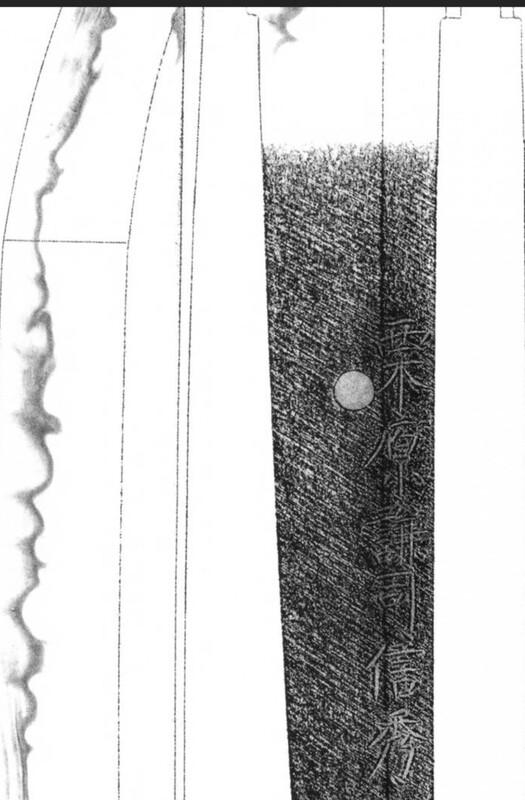
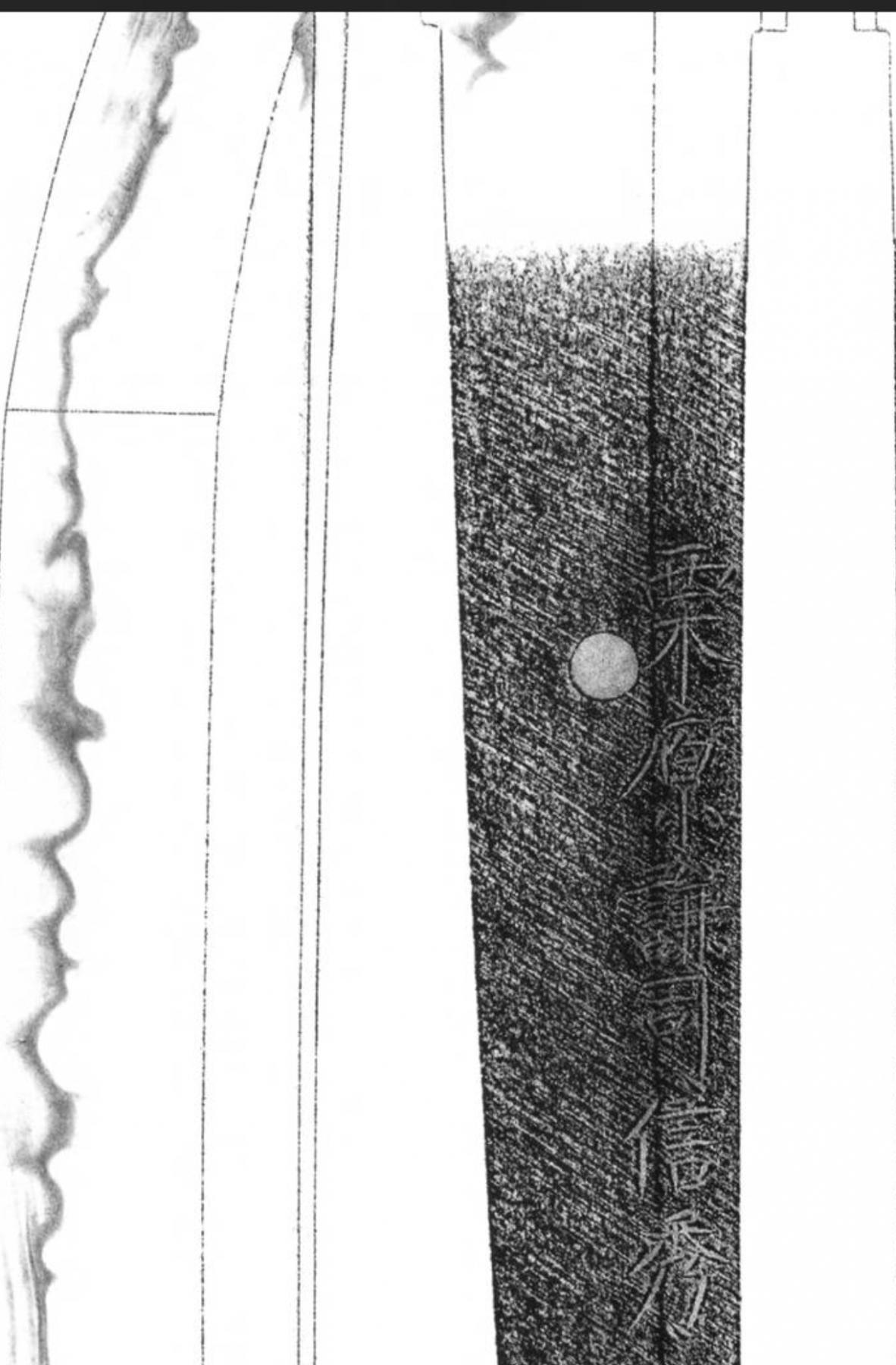
Guys, without being too forthright here, I shall enedeavour to be objective and constructive to our fellow member as this to me appears gimei without a doubt. So, Michael, while this is not my area of collecting and I am not familair with the smith, below are some thoughts and suggestions: - look at the execution of the chiselstrokes of your mei / signature and compare it to the one posted by Geraint. Analyse the confidence and smoothness of execution of both signatures - look at the yasurime (filing marks) strokes on the nakago of a genuine nakago/mei (the one from Geraint or the Juyo image which I have attached) and compare them to the left hand side of your omote nakago - look at the spacing between the different kanji (characters ) - do you notice how your forth one is almost dangling lonely, separated from the ones above by too big a gap? Compare to the genuine ones. - do we think the makura of the mei (the raised edges of the signature) would not be affected by subsequent scratching (ie one would have difficulty scratching or cleaning just around the mei and chiselstrokes)