Gakusee
-
Posts
1,951 -
Joined
-
Last visited
-
Days Won
22
Content Type
Profiles
Forums
Events
Store
Downloads
Gallery
Everything posted by Gakusee
-
 Oh, well, as you are so very interested …..


-
Source for Quality Uchiko Ball + Powder
Gakusee replied to tbonesullivan's topic in General Nihonto Related Discussion
Well, I use Fujishiro sensei oil. If it is good enough for him, it is good enough for me :)) Never asked the family for uchiko, but it might be that they also sell uchiko? After all, it is a residue of their normal polishing process, and the so-called 'polisher uchiko' (I still have one ball left) is the best one can buy. However, I do not use uchiko any more, after I scratched some blades, so cannot comment on sources of uchiko. -
Congratulations! Looks splendid.
-
Collectors have different tastes and desires, so one cannot group everyone in the same category: be focused or be broad. Often collectors start broad and eclectic and after, say, 10-15 years they decide to specialise. But they decide to do that because that specialism gratifies them and they have finally realised, after trying out different aspects, what really pleases them and evokes the emotional response that keeps them collecting. There are others who prefer to accumulate and every new acquisition causes the adrenaline and dopamine spikes that make people euphoric. To them it is not so much about what they buy, as long as it is likeable in the broadest sense of the word, but the identification, negotiation, acquisition, restoration (“the journey rather than the destination”) count at least as much. It is all very well to draw parallels with fine art or coins or stamps but this hobby is different. It has its own peculiarities even though I admit understanding collecting and human psychology evinced in all fields of collecting helps rationalise certain general behaviours. How the OP proceeds is up to them. But being educated about the hobby, what is out there (and where it is), the price levels and dynamics of the resale market afterwards and most importantly - about the swords themselves - is paramount. How their taste evolves afterwards is up to them.
-
Well, be careful. Not all is chikei. Some is merely laminations ie mokume or itame. The chikei would be accumulations of nie mostly and be dark but shiny
-
Customs wait for antique arriving in UK
Gakusee replied to shanegt's topic in General Nihonto Related Discussion
I have dealt with Parcelforce numerous times. Sometimes something gets stuck in there, sometimes the postal slip gets delivered to a neighbour (who does not know me or has no idea how to give me the slip or just cannot be bothered to do so), etc. My recommendation is to be pro-active and keep checking with the overseas (EMS, UPS etc) reference number, which the Parcelforce online checker tool will convert automatically to the UK Parcelforce reference. If you notice in the online history tracker that your parcel has been stuck in there (eg Coventry hub or London depot, etc) for longer than 3-5 business days, I suggest you either telephone them (034485522427 or 03448004466; cannot remember which one worked for me) and clear the payment on the phone or email them (pfw-ccb@parcelforce.co.uk) to accelerate the clearance through the customs bonded warehouse. Sometimes, it might help to speak with a local depot (for me this was the London S East on 03442096101). Always be pro-active: when requesting seller / sender to document items (both inside and outside the parcel, with the correct codes, with the appropriate description, with as full documentation in English as possible even if this means translating the Hozon certificate, etc) and also when dealing with Customs or Parcelforce. Do not rely on others to do the job properly and always double check everything. If you are too eager or the item - too precious, yes you can go and collect the item in person. Note: the hubs do not accept cash payments. If you are there on the spot, you could pay the fee using their card reader. When the card reader does not work (happened to me once), they ask you to call a line or speak with a colleague of theirs upstairs (using the telephone lines mentioned above, etc) and you clear the payment on the phone, then hang around in a small unsightly cold waiting room while they potter around doing their jobs behind the bulletproof screen, you and need to remind them to check their screens the item has cleared. Once, it took me 45 minutes to an hour of just hanging around there due to faulty card readers even though there were only 2-3 customers there. -
Mark I maintain approximately 45-50% humidity and temperature of 20-25 degrees. In line with the NBTHK. No need for multiple dehumidifiers - just the one, where my swords are. Now when the radiator comes on due to winter coldness, humidity drops to 35-40% sometimes but that is when it becomes too hot, so I try to control for that by reducing temperature.
-
Ok, gents, this has been covered several times on this board. Humidity in the air and its composition will cause the steel blade to rust and therefore you counteract it by: - oiling the blades (very thin, invisible, film, not the usual thick oily and greasy splotches that many people tend to err on the side of) and when beading occurs - wipe the excess with paper tissue. The paper tissue will leave a minimal oily layer in any case; - containers or receptacles (shirasaya or controlled cabinet); - dehumidifier in the room or inside the cabinet. That is how the NBTHK stores and exhibits blades (large dehumidifier and temperature system connected to display cabinets) and so do dealers (floor-based smaller dehumidifiers) in Japan. Often they do not oil blades much or at all but they have dehumidifiers. Some people are more adventurous and do not oil their blades in the UK, even when they live in very humid areas, but I personally both oil and have a permanently plugged dehumidifier. Other options include large but unsightly rechargeable desiccant pouches. I am not a fan of Dri Rods due to the heat / potential fire hazard in the display space or in close proximity to a blade or shirasaya.
-
To The more experienced members ....
Gakusee replied to Paz's topic in General Nihonto Related Discussion
I have never regretted joining the To-Ken Society - in fact one of my best decisions ever, together with following this portal/community for well over 16-17 years. The NMB provided theoretical knowledge while the To-Ken meetings enabled me to see swords and koshirae first hand and hear more experienced people describe these items while teaching us. Of course, once one builds an own network of contacts, then it becomes easier to navigate the field solo. But still, the social and educational elements are valuable. In informal and interpersonal meetings, one can learn and share a lot more than publicly..... People sometimes focus too much on price. Price is an important element of a purchase but so is the quality of the item, the guarantees, the deferred purchasing methods that some offer, the trustworthiness, the investment in a relationship with someone who might offer you items that will never be published officially on a website et cetera. Also, my main piece of advice is to defer a purchase until you can make your own judgment rather than rely on judgements by others. If it takes years, so be it. It might be better than burn money, burn bridges/relationships, get disappointed, acquire something that in a year you will not like anymore as you have changed your mind or did not know what you were buying in the first place. -
Advice on a potential purchase
Gakusee replied to John F's topic in General Nihonto Related Discussion
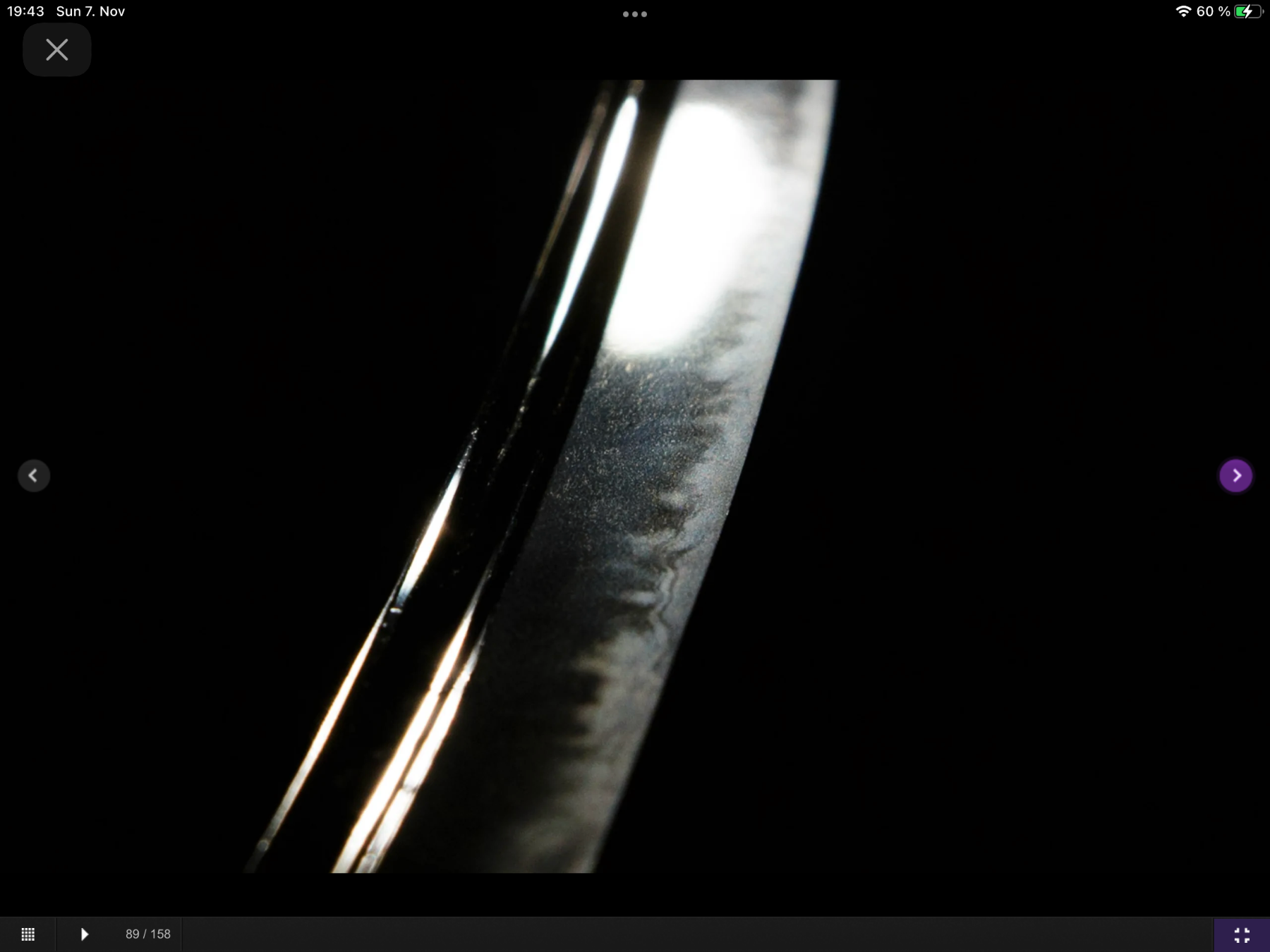
John, thanks for the additional photos. Unfortunately, I cannot tell anything with this remnant of a gakumei, so apologies. For me it is too corroded, but others could be able to discern something. The hada is consistent with the purported age. But regarding the last two photos (the post immediately above), there is a bit of a question mark there: the hamon seems to drop off the edge. So, please request for sidewise photos of the blade with the kissaki pointing towards a light source and the nakagojiri towards the photographer (sort of like this below a bit at an angle). The idea would be to see the actual hamon through the hadori polish, which is a bit heavy at the moment.
-
Piers That is a tough one indeed. Even M Sesko’s volume is not clear on that perfectly as it has a couple of second and third generations and I have not looked too much further. But below are a couple of blades with dates 1570-1580 signed by Yosozaemon. The Juyo one of 1570 in the oshigata is specifically highlighted in brackets after the signature as the nidai. I would not get my hopes up by expecting an Yosozaemon (at least not until confirmed by the NBTHK)as he would most likely have signed with his name but even a school piece work with a date is great.


-
Brian You need to look at “Sukesada” as, at best, a large workshop and at worst a school in terms of size, designation and taxonomy group. What I mean best / worst is simply: best chances to identify a particular smith or slimmest chance, due to the sheer size of that family of smiths that survived the big Bizen flooding which wiped out the Bizen 1000 forges… If unnamed, it will be extremely difficult, unless the condition and quality are topmost and then again - you might struggle. One of the leading Sukesada who signed during 1580 is the second (nidai) Yosozaemon. So, it is a bonus that the sword is signed.
-
Advice on a potential purchase
Gakusee replied to John F's topic in General Nihonto Related Discussion
John, I would not get too discouraged by comparisons to the blade Ray linked above, as that particular example is among the very best Tomomitsu. In fact, it has participated in various NBTHK exhibitions such as the “Sword Country Bizen” one and has featured as the main sword in articles of the NBTHK magazine. Its hamon is more active and variegated than the usual Tomomitsu hamon, which is more similar to Kanemitsu in style (wavy notare). The polishing style (sashikomi vs hadori) as well as the age of polish and its state of preservation also have a bearing on how the hamon looks. Your (or to be yours) sword does overall look fairly good to me and I wish I could inspect it a bit more closely, especially the mei. -
Advice on a potential purchase
Gakusee replied to John F's topic in General Nihonto Related Discussion
I agree with almost all of the comments above and you have some great advice there. My personal observations are: - often people submit and re-submit (if they can afford it and is feasible) until they are happy with the outcome - this could entail multiple submissions to the same or both organisations - sometimes, the judgements are different but they tend to be within the same broad period (eg late Kamakura or late Koto or something Muromachi or a specific era within Shinto, etc) and within the same broad level of skill (eg, very rarely a 'second' tier smith or school will be interpreted to be a 'top' tier master; also, extremely rarely are there any disagreements as to whether something is pristine Koto or ShinShinto) In my case, I have had a sword that a previous owner had passed through the NBTHK and NTHK. The NTHK agreed with its Oei Bizen designation and issued the papers. But the NBTHK disagreed with the mei and pronounced it gimei. The previous owner had the mei removed and nakago repatinated. The sword then passed through NBTHK as Ichimonji with flying colours. Also, Tanobe sensei when he saw it commented it was a typical Yoshioka Ichimonji. So, in some ways, the gimei was bringing it down to an extent. The NBTHK seems to be more commercially recognised and in Japan dealers prefer their papers. At levels below Juyo, the turnaround is actually 3-4 months (not 6) and one gets the judgment / result in a slip reasonably quickly after shinsa. The actual certificate takes another two months or so. As to this blade, could we actually see some more of the blade? As pointed above, Tomomitsu is a reasonably big Koto name and it will be interesting to see this example. Thank you. -
https://blog.yuhindo.com/daisho/ If you want truly matched swords, go for Shinto, or more likely - ShinShinto or Gendaito. If it is the koshirae only - it has been discussed in the referenced links.
-
Happy New Year … an explanation … and an apology !
Gakusee replied to 16k's topic in General Nihonto Related Discussion
JP, you are one of the “good guys”. In life, sometimes we are bashed and battered, but still overall I am a believer in the great balance of life overall. Good karma and energy will come your way and our wishes are with you for swift recovery from the setbacks. As an aside, just before Christmas, I went to a house party hosted by a couple who also sheltered cats. They had 65, including the 4 newborn in a litter who appeared the day before. I hope your lot will also give you joy and you find joy and peace in this community and life. Stay the strong support to your family and community that you are. -
Japanese Wakizashi authentication issue
Gakusee replied to Vlad8405's topic in General Nihonto Related Discussion
Very solid thoughts above. I concur with Mark that unless you have bought something substantially below market (and that is extremely unusual and rare), if you are to seek nihonto as investment, you should go for high-grade items, preferably also rare. The problem is that many people are chasing such items despite their high price and they are acquired fast. With wakizashi blades, I am afraid to say, it is very, very difficult to hope for rarity, value appreciation, etc. If genuine and signed, by definition they will be Muromachi and later blades. And one needs to be careful with the quality/desirability of some Muromachi blades (many were produced back then and quality was not always good). If Shinto and Shinshinto, then you need to factor in the maker/rarity. I personally do not buy wakizashi blades unless they were shortened early Koto pieces as I am interested in Koto. On this particular blade: - some Fuyuhiro are very pedestrian and uninteresting - some are highly rated Juyo pieces and seem quite flamboyant, in decent Soshu style - the white papers seem 'legitimate' but are old/outdated/discontinued and replaced by other, modern papers (this is a separate and involved topic) - one of the papers is a registration card (torokusho) = an internal, Japan-only licence for the sword to exist within Japan legally (normally not exported outside of Japan) -
Sunny, I like your vivid imagination on this but I think it was probably more prosaic: the narrative on that website that David Stiles linked (describes in detail what was stolen and when and from whom) mentioned Kodama san was in hospital during the burglary. It must have been orchestrated by people who knew well what he had, so might have been in his wider circle of acquaintances.
-
Daniel M, Neither the NBTHK nor the To-Ken Society of GB are commercial organisations or professional intermediaries for services such as shinsa, restoration et cetera. They are both non-profit educational membership organisations. So, the To-Ken Society of GB has never had anyone doing the service you describe. What you probably mean is that Paul Martin, who used to come back to the U.K. to see family and for returning /taking items, has not been doing it for a while? Paul does these activities professionally and outside of the remit of the To-Ken Society. There have been other people in the U.K. who have done it or can do it (eg a London dealer comes to mind, Eddie Wertheim of the Japanese Gallery, but I know of others do it). I have sent blades out of the U.K. but not in the last two Covid-defined years, when everything has been three times more difficult than in ordinary times. I think the way to think about this is: - which airline and postage method works for one to ship a blade to Japan (eg EMS used to be very good and Parcelforce). One can do it without an intermediary but needs an agent in Japan. - can one do the paperwork for such outbound shipping - finally, could one get the contact in Japan who will a) clear the blade through Customs and obtain temporary torokusho, b) get permanent torokusho which will be needed for shinsa and the blade’s stay in Japan, c) submit the blade to the NBTHK and deal with the NBTHK on one’s behalf d) de-register the blade with the Ministry and apply for export permit and e) package and ship it back to you. Many people can do all of this in Japan for you. People tend to use dealers for these services but there are other specialists like Paul Martin, Kelly Schmidt, Bob Hughes (Keichodo) etc in Japan who also used to / do that. So, if you want an end-to-end service, depending on your country of residence, my recommendation would be to get in touch with one of the Nihonto dealers in that country and enquire. If you have contacts in Japan and encumber yourself with shipping and posting to the agent there, they will handle the difficult part.
-
Steve M I think someone bought it for “bragging” rights. The buyer knows he is not buying a genuine zaimei Muramasa (these are well over $70k for a papered daito and over $30-40k for the short swords) and the seller knows he is not selling a genuine Muramasa. If we go into the actual sword, it looks like a nice Shinto sword. I note that: - it does not seem to have the nagare and “not-so-pretty” hada of a genuine Muramasa - the yakiba lacks the kinsuji and sunagashi and some other niesuji one often encounters in Muramasa - also the hamon neither seems symmetrical nor has the “ha-kissing” low tani that characterise this family I suppose someone bought a nice looking (mumei after mei removal) Shinto sword for around $4.5k.
-
Yes, I agree Stephen. The ana normally is sort of between Mura and Masa. Also, the vertical lines of Mura are nice and parallel in Shoshin. The jiri is also a bit off.
-
刀剣乱舞 Touken Ranbu blades
Gakusee replied to Bugyotsuji's topic in Sword Shows, Events, Community News and Legislation Issues
No problem, I shall just go through all of them, including the food and other stuff :)) -
刀剣乱舞 Touken Ranbu blades
Gakusee replied to Bugyotsuji's topic in Sword Shows, Events, Community News and Legislation Issues
Thanks, Pierce. We appreciate your kind sharing with us. Are there close-up photos of the Yukimitsu and Nagamitsu somewhere? Found the Chogi. -
刀剣乱舞 Touken Ranbu blades
Gakusee replied to Bugyotsuji's topic in Sword Shows, Events, Community News and Legislation Issues
Piers, yes, thanks. I check his Twitter from time to time (ever since you posted a link to him a couple of years ago), but I am not always certain which blade is which because he also runs a kantei and posts the kantei swords and then other swords and then explanation of the kantei and then other swords and so on and so forth. For someone who does not speak Japanese, it is a bit confusing. For sure, I do enjoy the photography and where I can read the kanji, I do confirm what I think or where I am wrong but overall it is a bit confusing. In any case, thank you for posting. -
刀剣乱舞 Touken Ranbu blades
Gakusee replied to Bugyotsuji's topic in Sword Shows, Events, Community News and Legislation Issues
Excellent! Were you allowed to take pics of the blades? Probably not but if you stole a moment or two , please share!