Gakusee
-
Posts
1,939 -
Joined
-
Last visited
-
Days Won
22
Content Type
Profiles
Forums
Events
Store
Downloads
Gallery
Everything posted by Gakusee
-
 I do hope this time the members from France, Germany and BeNeLux will make the trip. After all, the Utrecht location was chosen for the benefit of its centrality, relatively easy access to Schiphol airport and reasonably priced venues. If 10-12 hard-core members from each of for instance Germany, France, Netherlands, Belgium, Italy, UK, Nordics and Italy make the trip plus let us say 3-5 from each of Switzerland, Austria, CEE, etc plus the people who walk in during the event, that should be possible. Funnily enough, the distances are smaller than in the US, but people here are just not used to travelling to sword shows the way our US friends do it.
 -
Nice shape, the nie and utsuri and hamon sort of point me to Unju/Unji.
-
Dear all I have recently heard of this European event: https://www.japanartexpo.com/about Personally, I am excited at the possibility of this event going ahead, especially given the uncertainties around travel to Japan and whether there will be a 2022 DTI edition or not. The 2018 exhibition and educational programme were great last time, the dealers were very friendly, there were some exceptional items to see. This year, the formal educational element will be much scaled down, I understand, but viewing and handling items in person will be a great learning experience for those who participate. To make it happen, prospective participants should sign up to the Kickstarter campaign in order to demonstrate their interest and commitment. If there is sufficient interest, the organisers have put in place the procedures, venue, etc to realise the event. Caveat and clarification: I am not an organiser and have no financial or otherwise interest apart from the enthusiasm to see friends, fellow collectors and community members. It is the successor the the samurai art expo which took place in 2018, for those who remember it and attended:
-
Interesting Short Documentary on Nihonto
Gakusee replied to Ronin 47's topic in General Nihonto Related Discussion
Austin, thanks, very well shot film and even though it is quite old, I like the angles, shots, etc. There are some inaccuracies (a sword does not take "many months or sometimes years" to make), but the depictions are beautiful otherwise. And Hisashi's own travelogues around Japan and interviews with his colleagues or his clients are also extremely insightful. -
Late Kamakura could also mean 1300-1330s here, so per Kirill's remark, not strictly speaking 13th century but very early 14th century. Rai Kunitoshi did work into the 1300s and has signed blades in 1319, for instance (eg a nice tachi dated Genno 1, when he was 79!!). So, it could be that Tanobe sensei thought that on the basis of the high quality (probably clearer jiba than 'standard' Enju, lack of shirake utsuri but instead finer jinie in the hada, the boshi not necessarily being the larger Enju o-maru but somewhere in the middle, etc) this could be a borderline case or even Rai.
-
Yes, you are both right, the masculine sugata, lower curvature and okissaki or rather extended chu kissaki are of course more Nanbokucho. But it is one of these where the blade is +/- five to ten years of the watershed (1333, which demarcates the end of Kamakura). It is not as though these blades are from towards the late/ end of the 14 century
-
Gary, thanks for posting. Could you please post some closer photos of the hada / hamon? It will be interesting to see the chikei and jinie. Tametsugu and Sanekage are the close followers of Norishige and probably there are strong traits unifying their workmanship. Thanks
-
John, did you pursue Taima as a collecting area of interest? So, out of around 1000 Juyo Yamato blades, I reckon the largest specified number, over a quarter, are Taima. This signifies their quality and in fact they are at the top of the Yamato pedestal in terms of sophistication and quality.
-
My first katana, opinions please
Gakusee replied to Enrique S's topic in Auctions and Online Sales or Sellers
Looking at that hamon, Shinshinto is plausible. Torizori sugata with not too deep sori is consistent with the period. You should ask for closeups of the hada, nakago, boshi and photos of the certificate. -
Thank you, Gary, for posting a beautiful and old blade. It is rare nowadays for someone to post Kamakura period blades on the board. Most action seems to be elsewhere.
-
Japanese Exhibition
Gakusee replied to kissakai's topic in Sword Shows, Events, Community News and Legislation Issues
And well done for donating your time and sharing your items with the public, Grev! That is very generous. -
Inazuma, sunagashi, imozuru - or?
Gakusee replied to george trotter's topic in General Nihonto Related Discussion
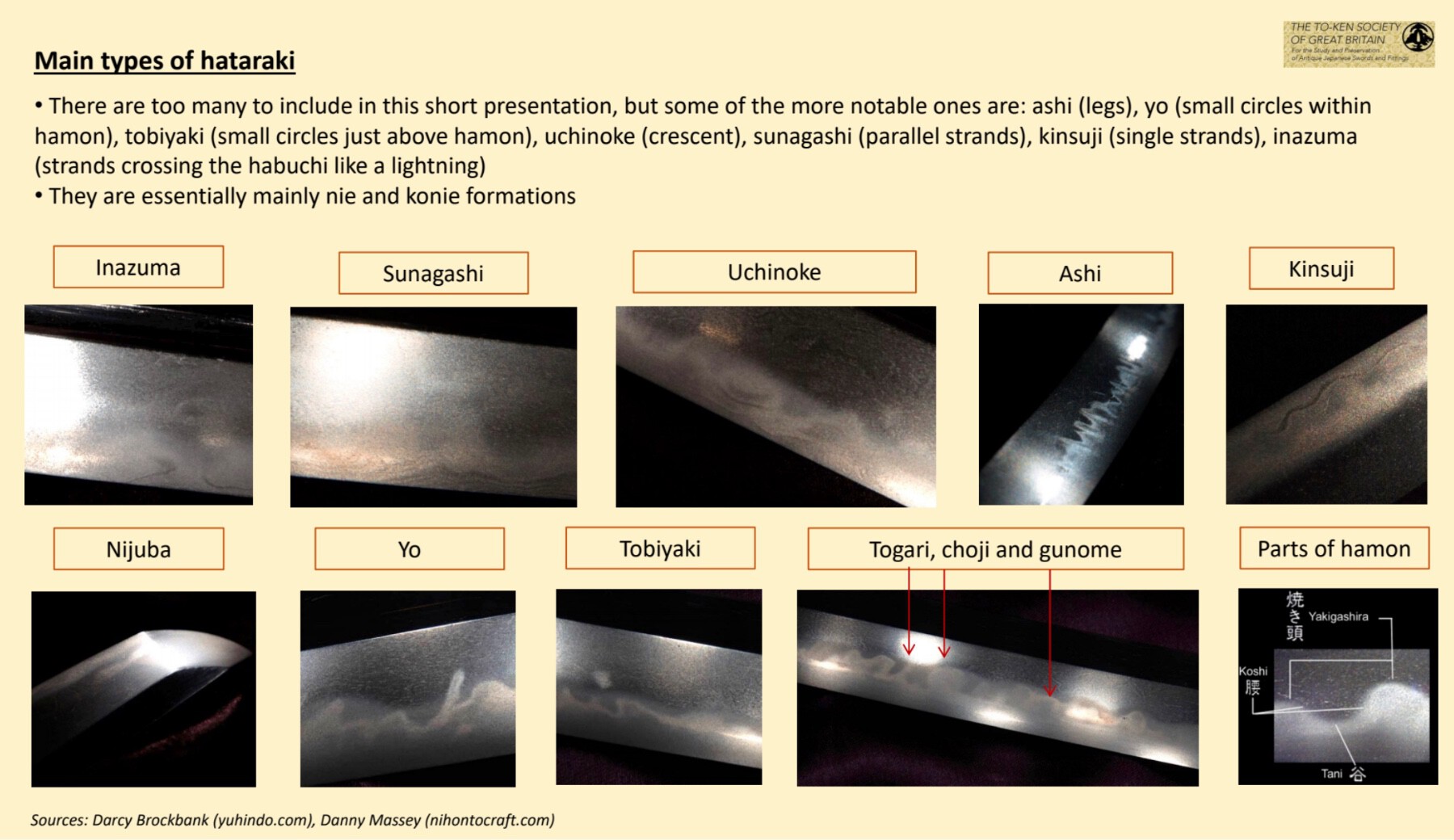
George, yes, probably best referred to as sunagashi in your oshigata, as these are several stands one beneath another. As mentioned previously - kinsuji are single lines (they do not have other lines above or below) and sunagashi are multiple lines above/below another. The name sunagashi (sand lines) itself is pictorial and allows one to imagine how these are multiple lines.
-
Inazuma, sunagashi, imozuru - or?
Gakusee replied to george trotter's topic in General Nihonto Related Discussion
George, the author (Pepin) of that photo and post on their website simply chose a representative photo of the hamon. What he is saying is that the hamon contains ashi, yo, sunagashi and ko-nie. He is not saying that the photo above contains all or any of those. Can you see the konie in there? Or the ashi? Or the yo in that photo? I struggle to see anything but a couple of dark lines in the habuchi (which would likely make it sunagashi as there is more than one line) but I cannot see or tell if there are smaller finer lines between the two darker lines. That is the issue you have with blurry, low quality photos head-on.
-
Inazuma, sunagashi, imozuru - or?
Gakusee replied to george trotter's topic in General Nihonto Related Discussion
George, are you sure Tokuno san refers to a a single line as “sunagashi”? Perhaps there are sunagashi on your sword and the other swords you are referencing, but those sunagashi are not single lines. Maybe Tokuno san was referring to something else, not the particular feature you think he was referring to. Is there a photo with an arrow or a diagram where you can see specifically Tokuno pointing to a kinsuji but labelling it sunagashi? Just as a Satsuma blade can have sunagashi and imozuru at the same time. Just as a blade can have (and very often has) both kinsuji (several sequential or separated single lines) and sunagashi (clustered together lines). -
Mark, very valid points. But frankly a random engineer or even a smith, who does not have knowledge of Japanese swords, and in particular metal-smithing and forging methods for antique Japanese blades and is not trained to see ancient blades versus modern blades might also struggle. It all depends on what lengths the court is willing to go to. The same applies to an antique shop owner, unless they specialise in Japanese swords or at least sell many of them. In the past, Border Force have occasionally not recognised Token Society members as experts. Or auction houses in the U.K. have also been conservative. Sometimes, auction houses or border force have preferred to use the option /opinions of polishers but that also becomes problematic if there is no traditionally trained polisher around or at least the polisher cannot prove they are traditionally trained or have a certificate or attestation form some authoritative organisation. The polisher might be very good or experienced but proving it to or accepting it as fact by a Court might a different matter. Authenticating the papers and proving not forgeries: can be done directly on the phone and by fax (you read that correctly) with the NBTHK. It is not straightforward (and good luck finding people there who know English well and are willing to step up) but can be done. I have used an agent in the past for that (Japanese and English speaking dealer might do it). Proving age: well also carbon-14 dating (AMS) is possible but someone will have to swallow a bitter pill for it. Of course, the issue is that a small sample needs to be taken and converted to graphite. Would I recommend this for a Juyo sword - hmmm, doubt one would want someone to mess with their sword unless it desperately needs polishing or a sacrifice can be made somewhere on the nakago. The best form of non-invasive evidence I can suggest is relying on the NBTHK/ NTHK certificate. Next would be an assessment by perhaps a panel of independent representatives such as a Museum specialist, polishers and ToKen Society members (effectively a mini shinsa in the U.K.) acknowledging that this is how it is done in Japan when a blade enters their territory (for the issue of a torokusho) and also admitting that any such U.K. based panel will be grossly inferior to the Japanese equivalent.
-
Tony If you need an explanatory note from the To-Ken Society, please do not hesitate to ask. You are doing everything right by the sounds of it, and the legislation can be copied and pasted from the .gov website. What I have discovered in past dealings is that it is important to have kanteisho or shiteisho certificates presented and translated in English and whatever original source paperwork from Japan still remains. Sometimes this gets lost but it is worthwhile to obtain replacement certificates from the NBTHK or other respectable institution. i have seen on this board statements that people do not care about papers, which might be so because they are very confident in their own abilities, but certificates do help authenticate and prove provenance more favourably than one’s opinion.
-
Inazuma, sunagashi, imozuru - or?
Gakusee replied to george trotter's topic in General Nihonto Related Discussion
Thomas, I don’t think there is any argument imozoru is Satsuma related and also perceived as inferior to kinsuji. But there is a reason for that: imozoru is dull and ill defined (due to the ara nie) and blurry. -
Darcy Brockbank
Gakusee replied to Ted Tenold's topic in Sword Shows, Events, Community News and Legislation Issues
In a separate thread Bob Hughes also wrote a touching tribute to our friend... -
Inazuma, sunagashi, imozuru - or?
Gakusee replied to george trotter's topic in General Nihonto Related Discussion
Kinsuji Note how clearly defined it is... The difference with imozuru is that the imozuru will be more blurred, speckled with ara nie/nie and in the right light will not shine so brightly.
-
Inazuma, sunagashi, imozuru - or?
Gakusee replied to george trotter's topic in General Nihonto Related Discussion
George, just a few clarifications: - kinsuji tend to be singular and very bright (after all that is why they are called gold lines!) - sunagashi tend to be multiple lines - inazuma tend to be single lines and sharply crossing the habuchi at an angle. All of the above are high-quality and reasonably sharp hataraki I think your blade has imozuru. Imozuru is not quite as glamorous, is usually duller, thicker and often in ara nie based hamon. It is associated with Satsuma blades specifically. Some of the hataraki here are imozuru but not all: www.aoijapan.com/img/sword/2014/14153-2.jpg, www.aoijapan.com/img/sword/2015/15199-2.jpg Another Satsuma blade with imozuru
-
Conissours of the Japanese sword needed
Gakusee replied to Paz's topic in General Nihonto Related Discussion
The book cannot be just read and then left lying around, as it is de facto a textbook. You retain some of it, perhaps 10-30% but then you return to it for reference. The back of the book has a lot of in depth useful stuff that helps kantei but there is so much info that I wish I had photographic memory. -
Darcy Brockbank
Gakusee replied to Ted Tenold's topic in Sword Shows, Events, Community News and Legislation Issues
You are so right, Brian. Hyper intelligent, cerebral and over analytical, which naturally lent itself to dissection of behaviours, moral codes, ethical standards…. And sometimes approaching matters clinically and logically, while in our life often emotions and irrationality rule. He sought honesty in people and would give people second chances, even if the initial reaction might have been explosive. But I appreciated that as we connected on that moral plane in the approach to the world. For him, the commercial aspect took second place, way behind the educational aspect and connecting with people. He would love to find the “right” item for the “right” person, sometimes going through years-long hurdles and obstacles and personal difficulty to facilitate this for his close circle. And the sleepless nights he spent answering even the most ridiculous of emails and random enquiries in his honest, lengthy, didactic manner. Trying to teach, elucidate, steer. Often taking other people’s burdens upon himself. Anyway, I am sure several of the board members can go on and on and on even more than me. So very sad really…. shattering ….and frankly unfair to have gone so young, with so much potential and with his big, generous heart…..- 81 replies
-
- 14
-

-

-
Darcy Brockbank
Gakusee replied to Ted Tenold's topic in Sword Shows, Events, Community News and Legislation Issues
Heartbreaking..... -
Ken, was that Osafune Kagemitsu?such a find is exceptional and congrats
-
UK Import Tariff Change - PSA
Gakusee replied to Lareon's topic in Sword Shows, Events, Community News and Legislation Issues
As mentioned in the separate thread, it should be 9706.1000.00 / VAT footnote 03001. https://www.trade-tariff.service.gov.uk/commodities/9706100000?country= And, Jean the tariff for over 250 years old (9706.10xxxx) is a sub tariff of the one for over 100 years old (9706.xxxxxx).