Gakusee
-
Posts
1,934 -
Joined
-
Last visited
-
Days Won
22
Content Type
Profiles
Forums
Events
Store
Downloads
Gallery
Everything posted by Gakusee
-
Jean et al, it is pointless to argue. I have numerous Juyo Zufu examples which mention the mokume hada in Naotane’s work. I just do not wish to waste my time attaching them here. The other participants enclosed numerous quotes from books and the Token Bujitsu magazine. Yet, some people like being argumentative and entrenched.
-
Jacques, you are absolutely right that the Juyo 66 Naotane’s kitae posted above is described in the setsumei as having koitame hada overall. 鍛:小板目肌つみ I thought you were referencing a different blade, but you did enclose the setsumei to the Juyo 66 Naotane, which is the one on Aoi Art’s website. I am not contesting what the NBTHK is saying but it is possible to have some mokume here and there in otherwise itame based hada overall. Here, however, this is not mentioned, I shall concede that. Personally, I am surprised by that, but it is a fact. What is mentioned however is that this blade is believed to be an utsushi of Osafune Kagemitsu, which I find quite interesting.
-
Jacques, but this is a different blade entirely. It has some itame and some looser hada and nagare and if one looks really hard, one can find the ko-mokume. The Naotane in the post above clearly has mokume (not ko-mokume and not ko-itame) in the red circled areas highlighted by the OP for clarification. The rest of the Naotane blade has itame as you correctly identify. I also agree with you that Tsuruta san is a very skilled businessman and knows the game well and panders to our Western tastes accordingly. All in all, the wood burls in red circles and elsewhere are mokume. You could not really have only and exclusively mokume hada (even though it could be predominantly mokume hada) and in reality it is usually combined with some itame. Ko-itame hada is a tight and small and is a good compliment in general.
-
 These have some hallmarks of hand-forging and look impressive for Chinese swords (definitely better than the Chinese iaido katana I own). Do you know more about how they were made etc?
 -
This is not ko-itame.
-
Mokume , isn’t it? Nice blade, in a style I like
-
Are organizations obsolete
Gakusee replied to Peter Bleed's topic in General Nihonto Related Discussion
So, Colin, thank you for the suggestions. Below is a heartfelt outpouring and please do not take it as a diatribe but a reality description of what is happening in the U.K. As you mention both the London and Birmingham arms fairs, you must be familiar then with how both of these (much wider arms and antiques, going beyond the purview of only Japanese swords) fairs have diminished and degraded in the last 10 years or so. Poorly attended with barely a few interesting items available. Why? Commercial reality and advancement of technology (ie Internet) and awareness / knowledge. Side events/ gatherings of ToKen members around the time of the fair though do oftentimes take place in smaller informal groups. Then, do you think there will be enough support for a purely Nihonto based fair as in the US? The answer is unfortunately a resounding No. Such fairs seem to have had their heyday in the pre-Internet era when all the Nihonto aficionados had to go by was John Yumoto’s book and the arms fairs to buy or sell a sword. Sadly, when Eddy tried to organise the second edition of the Japanese / Samurai arms fair in Utrecht this year, please try to conjecture how many sign-ups (ie prepayment of a daily ticket) he had? Sad, very sad and very disappointing outcome. A couple of dozen. And this was supposed to be an event aimed at the large European countries surrounding the Netherlands, a well connected place and easy to travel to. The first instalment was a fine event with numerous Juyo and TJ items to view and study, with 10-15 dealers present, with iaido demonstrations and sword kantei, with sushi and lectures, with socials and drinks….There were only around 100 attendees over 3 days. Unfortunately, nowadays when one can buy a sword from Aoi Art with three clicks of the mouse (ask Paz for instance or other new ToKen GB members) or when people can place a “like” here or on Facebook, or view a NihintoNoBi or TheJapaneseSword YouTube video instantaneously, the Token of GB are struggling to attract more than 10-20 attendees to our physical events even when we roll out various Juyo swords by Saijo Saku top smiths. But our Zoom sessions, on the other hand, are often attended by 30, sometimes over 40 participants. I honestly believe that we have enough publicity and awareness among interested people that if they really wanted to join and participate, they would. In fact, we have been attracting foreign members in the last few years, whose only interaction with is via our newsletters and Zoom sessions. Believe me, the fact that gunto and gendaito are not mentioned in our statement is not stopping anyone. As mentioned before, one of our most prominent members with close to 100 swords in his collection, actually specialises in gendaito. What is hindering people is often apathy, reluctance to travel / participate / come out of the shadows / inertia. Or similarly to Kiril, they might not believe in organised events, mentors, sensei, authorities (whatever you might call them, we don’t have them in our organisation anyway). Regarding “for sale” publicity: we are not a commercial organisation but an educational one. Members can sell to each other as much as they wish. However, it is not our purview or ambition to facilitate or organise such endeavours since there are plenty of venues, dealers, arms fairs, auction houses and the like for such activities. Our little creative energies or available time are dedicated to indeed expanding the popularity of our subject, organising events and advancing knowledge of our members. What we are truly lacking is: individuals who have the commitment and energy and enthusiasm to share what they have, to organise regional events, to make presentations or to write content for the magazine or help with the editing of the magazine. Or even to attend / participate. People are often passive consumers of content. Nowadays, younger people crave instant gratification and knowledge and have no time to learn kanji, know about the Gokaden or Roads or traditions, or go and visit museums or study sessions to learn about swords rather than instead look on the Internet or search for answers on this forum and other such venues. How often do we cover the same ground even on this forum because newcomers did not bother to even use the Search function? Better inter-member communication and discussion is something we have been thinking about for a while and need to resolve. We are pondering a member-only section of our Token website akin to a forum. But that will also need volunteers to monitor, oversee, curate, administer. Any help putting it into practice will be appreciated. Anyway, as Tom Helm in the US has been advocating for a while, it boils down to participation. People often good-naturedly make recommendations but it is indeed the same committee members who often need to implement things or try to change things. If more people volunteer and participate, things could improve. Otherwise, we are all growing older, grumpier, less capable and energetic or willing to shake things up. -
Are organizations obsolete
Gakusee replied to Peter Bleed's topic in General Nihonto Related Discussion
??? Paz, what do you mean by the last paragraph? You probably have one of the most accommodating regimes in Europe ( believe me - it is actually tougher in continental Europe), with the longest standing Japanese sword society in Europe (established in 1964), where museums are helpful and assist with viewings of their collections (if done appropriately) and with long relations between the British Royal and Japanese Imperial families…. I can only ascribe your comments to your tender age and lack of experience and only recent membership of the Society. I would encourage you to make the effort to join us at the Royal Armouries in September (distance is not an excuse - eg, I shall be travelling 3-3.5 hrs each way from London) for some sword and Katchu viewing and socialising with members. We are having a Zoom session this weekend and we are yet to plan a physical session in London perhaps in October. -
Thank you, Kiril, it was rather challenging. One thing to point out - with Sadamune and Go the nie is not so large and ostentatious as here. It is somehow more refined. Overall, I was also expecting much cruder and more archaic looking jigane for Senjuin than this tighter hada in places. So, this blade surprised me. So, could you please recap the 4 attributions? Apart from Senjuin Yoshihiro, were the others merely saying Kamakura Senjuin or even just Senjuin?
-
Very interesting that it comes with some many opinions and alternative views….. I would never have gone Yamato Shizu on this one…. The nie seems a bit too crude and ostentatious to me compared to the typical Yamato Shizu. But when Tanobe sensei mentions an alternative, he also gives his main opinion and I am curious what it might be. Well, looking forward to more info
-
Going out in a limb here as truly outside of my knowledge comfort zone. Some suriage Satsuma Shinto disguised to look older.
-
Are organizations obsolete
Gakusee replied to Peter Bleed's topic in General Nihonto Related Discussion
I do not believe sword organisations are obsolete. They perform several functions: a) social: allow like-minded people to have fun together; b) educational: whether through hands-on study of attendees’ items in physical meetings or formal lectures or kantei or Zoom sessions etc they can teach a member something. Few are those among us who know it all and do not learn anything; c) informational: some members do not know how to go about submitting or sending swords to one place or another or how to go about restoration, for instance. Members of sword clubs and societies can usually help (sometimes members are restorers or people can be pointed one way or another); d) credibility-providing: often membership of such an organisation is viewed as a positive factor, among others, by law-enforcement authorities when evaluating an individual’s possession of a blade; e) institutional: sometimes auch organisations can secure access or events that an individual, on their own, cannot. Examples include privileged access to museums’ collections or arranging a lecture provided by the NBTHK (in Japan, Europe or US) or other body. For instance, around the annual DTI, lots of overseas collectors gather in Tokyo. There are usually several educational events provided by several circles and one of these usually includes a session at the HQ of the NBTHK. Let us also not forget that often some of the members of such “organisations” have rare or precious or valuable-as-study-material items that an ordinary collector might not have. In this category, one can also include factors such as that the institution can write to authorities supporting a member or collaborate with authorities to shape legislation or regulation. The list can go on. That is not the point. We are social animals and cannot exist/operate in isolation, especially when pursuing a reasonably arcane hobby such as ours. Blades are best studied in hand and that happens in an environment where there is usually more than 1 person. And frankly an organisation does not need to be a formal club or society etc - it could be a small circle of friends too. That is how most “formal” organisations in our hobby commenced anyway. A point was raised about militaria items and how they feature in such societies. Actually, in the West, we are not so discriminate. At least in the To-Ken Society of GB there are many collectors of gendaito, gunto or showato, and even shinsakuto, despite our name including “To-Ken”. Things are probably different in Japan, where these are viewed as weapons and disallowed. But gendaito etc are quite common and owned. Different members own different grade swords of various merit, manufacture, condition. A lot of the U.K. members have a strong historic or practical interest in blades (several are martial artists), so again, one cannot claim that we are a group of elitists or theorists arguing over whether a hataraki should be called tobiyaki or yubashiri. I understand the frustration with organisations but I feel our discontent or dissatisfaction stem from the fact that we want these organisations to be protean, all-encompassing and fulfil all our needs - and that is not possible. They will meet some of the objectives but rarely all, or even the majority. If we find even one reason that is valid for ourselves, I feel we should be members of such organisations, provided we can afford it and can participate.- 152 replies
-
- 10
-

-
Hey, Mark - from which textbook / book are these technical diagrams? Very interesting…. Thanks
-
I like good prints But true, once people start displaying their items, one naturally starts calculating monetary values and starts comparing, drawing inferences….And that is what I was referring to about privacy and people’s perceptions.
-
Mark, and you think the second approach might have nothing to do with privacy, concern for their items (being damaged), etc? How can you unquestioningly take at face value such statements as axioms and truths? You can also apply the second statement to other high end items such as eg expensive paintings (I am aware that approach is flawed) - do most people know where various private Renoirs and Rembrandts (merely examples) are and are these paraded publicly (if not owned by a museum or foundations or other public bodies)? in Japan, collectors are also very private. Perhaps with the exception of the top 3-4 individuals who are required by virtue of their ownership of Bunkanzai and Kokuho to display swords for the public to view. I feel Nihonto collectors allow their items to be discussed but only in a trusted circle of people who can appreciate them and who can be trusted not to damage them, not to disclose too much (private) information to the outside world (often for privacy reasons). At least that is my experience.
-
Is this the NTHK shinsa session in the US? And under whose senior stewardship was it done? Thanks.
-
I agree Jacques that it would have been ideal to watch the shinsa so that I could verify if they indeed do that. But as I said - it is closed to observers. So we have to go by hearsay, which I also don’t like. Jussi’s analysis is the closest we can go to a scientific analysis of what might happen.
-
Ok, Kiril, good conversation finally in otherwise dispiriting sea of posts. Thanks for the intellectual challenge. Agree on the point that it is not always lesser schools and can apply to Sue-Sa, Shizu-Naoe Shizu spectrum, etc The Hiromitsu daito (one of 'lost' ie repatriated out of Japan 25 JuBi, discovered in California, etc etc ), which recently went to Switzerland at the plump cost of €600k: indeed both Dimitry and Darcy speculated was a Sadamune blade....one of the Sadamune signatures per some old scriptures. Could be they did not want to stick the necks out and redact old books/approaches. So fair point. Den is too complex to summarise here and in a short argument. Den evolved over time (so, say up to sessions 10-20 it is one thing, then different afterwards in the mid sessions and slightly different from sessions probably something like 50/55 onwards or whenever the shinsa committee went through a wholesale change (Tanobe sensei retirement, etc). Also, den is influenced by factors such as documented provenance, presence/lack of kinzogan, etc. But it is rather important to differentiate between kinzogan, kinpun, shusho etc as they have different weights and also of course - who put the signature / which judge. Also placement of Den is important and although rare, there have been instances of Den XX or XX den.... To mei ga aru: well, you take the harsh/conservative path in discounting them as gimei. Probably half of them are such. But as we know it means 'there is a signature of...'. The reality is there are various 'to mei ga aru' blades which lost that statement in transition from Juyo to TJ. So, you cannot wholesale discount them. In fact, I dare say, and that is a more advanced topic for the more adventurous here, that sometimes if one does the homework and pursues a to mei ga aru Juyo, they might get a discount (as to mei ga aru could) and might lose the to mei ga aru and get an uplift overall. It has happened that a Juyo blade with to mei ga aru was resubmitted in a later Juyo shinsa and got the statemet removed still within the confines of Juyo. So, it could simply mean that it needs more study/more research/more conviction or the one (or two) judges who voted against studied more or changed their views or the shinsa panel changed whatever....That game is a game of patience and deep research and study and conversations with authorities etc.
-
Mark, it is not quite like that :)) I have heard Juyo and TJ take several days. They approach it seriously.
-
The NBTHK shinsa is not open to outsiders and is behind closed doors. So Darcy would not have been able to attend a session. And why even ask that question in such a petty and irrelevant manner, as it is not pertinent to the discussion whatsoever! In fact Darcy has not talked about the shinsa panel being pressed and looking at signatures only. That statement came from elsewhere (two different sources in fact) and I do not wish to quote names. But I have also heard that when an attestation is obvious (eg a very clear Sanbosugi hamon with some nie and some sort of nagare itame, etc) and the signature is OK, they would not spend too much time and give it to the obvious maker with the signature on the tang (eg Kanemoto sandai, yondai, whatever). Next, not all members of a shinsa panel are disclosed or known outside of the NBTHK so as to minimise external influence. What is however possible is to sit down with a shinsa member some time afterwards and ask about a certain attestation or the opinion of the shinsa (member). I have had the pleasure of such a sit-down, facilitated by another well-known friend and contact in Japan, and listened to the gentleman explain what he thought. Fortunately, the friend could translate for me what the NBTHK gentleman was saying. Is this part of the standard procedure? Or is this something that my friend could organise because he was well known / connected in sword circles? I do not know... But it is possible to get a little extra colour beyond just the paper. However, it happens at the NBTHK HQ in Tokyo. As far as I know, only in the USA, with the NTHK, were some of the American organisers allowed in the shinsa room. But again, I have not really participated in those processes so US members will know better. I have read reports here of submitters being able to peer over in the shinsa room, and also some of the NMB members. Kiril makes some very good points, which Darcy also made by the way. Darcy had an excellent post about 'fungibility' of certain attributions. Some nondescript schools, or indistinct makers, made such generic work that an attribution could swing one way or another on a mumei blade but roughly fell within the same quality bucket with the similar features and craftsmanship. One should not take it personally. It is what it is. So for the blade here, indeed Mino seems right and fair enough. The owner could spend a lot of time looking for features that differentiate it from other sub-schools of Mino but the blade will not become a Soshu masterpiece. However, the owner can still learn in the process and eventually that is part of the hobby and pleasure of this pursuit.
-
I have always been taught not to look a gift horse in the mouth.
-
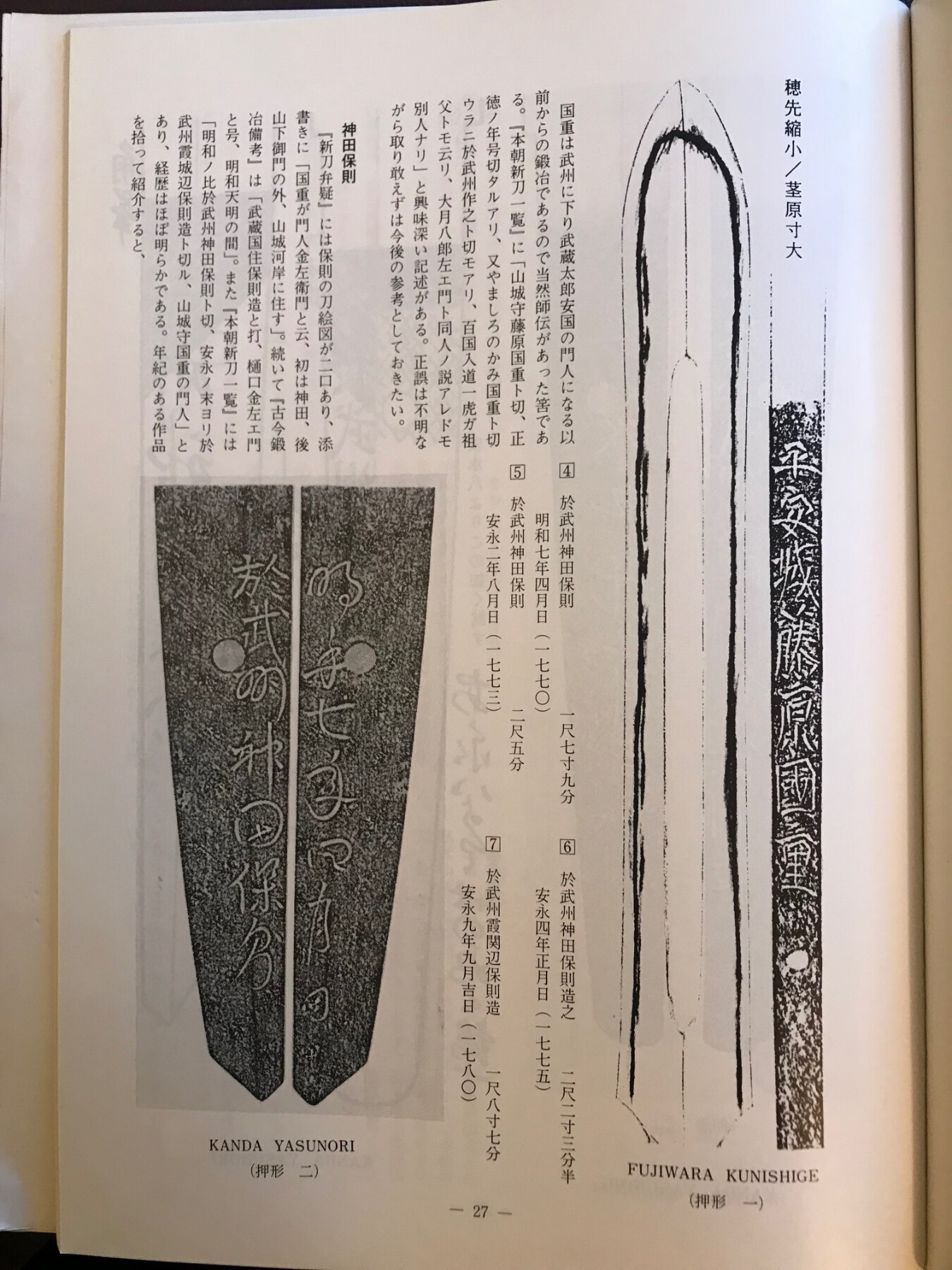
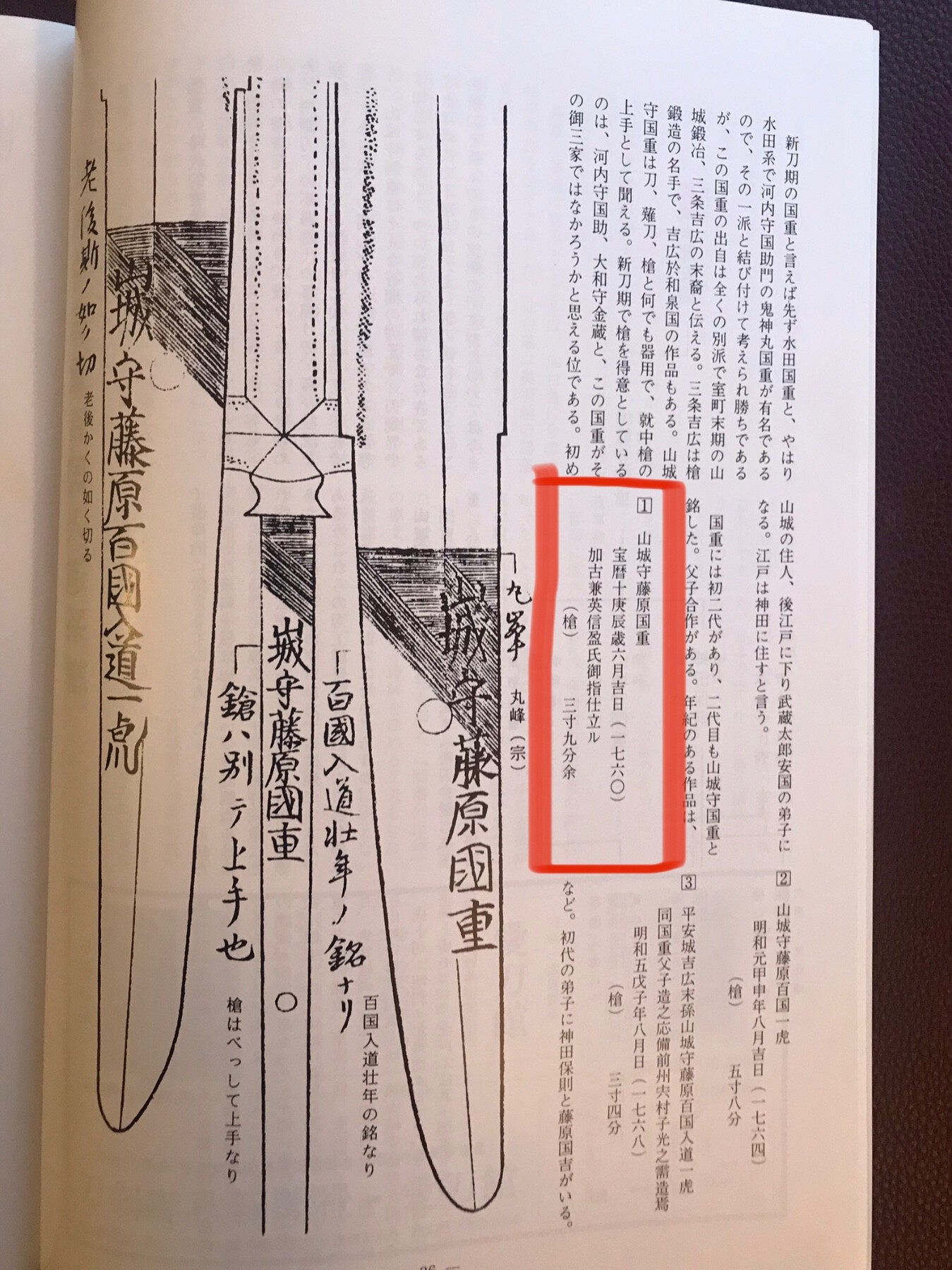
Mark, it is not a big issue. It is kind of giving back... we all started somewhere and frankly I learnt a lot when I was starting to use NMB some 15+ years ago, initially as an unregistered lurker/reader, then as a registered passive user and eventually as a poster. I find if people are polite, balanced and courteous, and come across as genuine (making an effort to do some work themselves or to study) we can get a lot out of the board. Now the text I circled I think talks about a Hidenobu Kako (the rest is that it is a spear, the date 1760 and length and by Fujiwara Kunishige). The actual Japanese speakers here can chime in on the actual meaning. However, it seems that your yari is the one on the following page / p27 (the top page here) as opposed to the first page (with the red rectangle) on p26. So, apologies I circled the wrong text above. Ganbatte!
-
Ok, there you go. You are lucky it is one of the few issues I have. Unfortunately I do not have a translation of that page. The NTHK branch (Gordon) translated some pages of each publication but not all.
-
Thank you, Georg! There were several generations of HI, spanning from the end of Nanbokucho well into Muromachi and their origins lie in Yamato via Mihara Masaie and Kokubunji (but apparently HI did more nie than these). Interesting.