Gakusee
-
Posts
1,962 -
Joined
-
Last visited
-
Days Won
22
Content Type
Profiles
Forums
Events
Store
Downloads
Gallery
Everything posted by Gakusee
-
 Yes please, Piers. They are great. Thank you!
 -
Thanks, Piers, these are beautiful!!
-
Well, I see absolutely no reason unless they live in London permanently. So, I do not see the relevance here whatsoever. People asked about museums in London and the fact that a Japanese individual asked and commented about what he saw in the U.K. does not preclude the same individual from seeing much better and many more swords of top quality in Japan. People in Japan have an almost unbound capacity to see masterpieces. At museums or even at the DTI or at dealers. The TNM Kokuho exhibition running at the TNM at the moment has around 20 blades including Dojigiri, Mikazuki, O-tenta, Kikko, KoRyu, and so on. I have to say the Dojigiri was nice but the O-Kanehira outshone it. In fact, the smart thing to do, if living in Japan, is become an NBTHK member for a reasonably modest annual fee, and in their monthly sessions they often roll out JuBi, JuBu and Kokuho swords to study in hand. Despite being a life member, unfortunately I have never been there to benefit from a session like that. However, from friends I know that even regional chapters of the NBTHK outside of Tokyo often have TJ+ and JuBi blades to study. The photos of their sessions are publicly available on social media. Separately, some of the more prominent dealers hold monthly study and kantei sessions, sometimes under instruction, which are very educational too. We are talking about different types of Masamune, different Sadamune, different Mitsutada, Moriie, Nagamitsu, Gojo, Awataguchi, etc placed next to each other for comparison and study. For that, it is true you need to be part of the circle and have the right friendships, but that applies everywhere. Many of these are behind closed doors and unfortunately not open to everyone. In fact, often such events (even dealer auctions by the way) are by invitation only. Alas, indeed, the best place to study and appreciate this hobby is indeed Japan and the Japanese nationals have an advantage over non-Japanese because of living there, having access, speaking the language etc. This is all natural. We can try from outside to work hard on it, and go from time to time, but that is no substitute.
-
Well, I beg to differ and therein lies the beauty of this hobby - different people have different tastes and preferences. However, as we delve more deeply of course the devil is in the detail. Of course, not just broader categories are insightful but specifics. So, during our BM viewing we could hold and see zaimei Tsunemitsu (rarer than Yasutsuna), Tsunetsugu (ditto), Yoshikane, Sueyuki, Shintogo (only behind glass), various glorious Fukuoka and Yoshioka Ichimonji. I know they have various named Sukesada and also some Ise Sengo blades. I do not remember many of the lesser stuff but across 500 BM blades there are bound to be some sleepers. So, the BM collection is far superior to the Royal Armouries and V&A (even though the V&A has a fairly decent blade, with kinzogan to Masamune, which is a top Soshu blade - now whether it is a Masamune or top Shizu, that is too big a call for my modest knowledge but the Honami whose mei is there is one of the respected, pre-generation-14 ones). Next, it is true that Ko-Hoki Yasutsuna is rare but there were two Yasutsuna at the last Nov 2022 DTI - one mumei and very healthy (it went to a friend) and another one, less healthy but zaimei that personally intrigued me as I like signed blades. Both could could be held for a chunk but not unreasonable amounts. And the DTI zaimei Yasutsuna was not a “top collector “ stuff. There was another (third) one two months ago, also zaimei and slightly better than the DTI zaimei one but it sold in late summer. Regarding Masamune - please let us not even go there….
-
Kiril With all due respect the topic is about museums in London. Extensions to the rest of the U.K. are also fine and pertinent. At the end of the day some of the Royal Armouries collection was originally in London before :), even thought the Japanese swords were mostly not. We are not comparing London (or with the above extension, UK) museums with the Met or MFA, which are both exquisite and well endowed institutions in their own right. We are also not comparing them to the collections put together by modern-day multimillionaires (whether it is the Soshu collection of Dmitry or the Samurai Museum in Berlin; let alone the huge Japanese collections put together by 2-3 very large and affluent individuals in Japan, or the smaller but pinnacle-oriented collections of some Japanese dealers/collectors). The latter are financially stronger than the original benefactors to the aforementioned U.K. (and probably US) museums and it is no surprise that their collections are superior. Also, one needs to put things into perspective and ascribe aesthetic or historic (not only monetary) value to individual blades within the collections. So, is it more valuable to have a few Soshu blades (but not Masamune for example) or a number of Ko-Bizen / Ko-Aoe or to have 14,000 blades or to have only 100 but half of them TJ/JuBi and above? These are all complex nuances. However, you are right that a lot of the early collectors of Japanese swords (19 century) simply did not have the knowledge or understanding to build a superior collection, even if they had the financial muscle. Sometimes they bought fakes, there was no “papering” of such blades (and the concomitant research by the NBTHK or NTHK), they were indeed led by dealers or post-Victorian fashions.
-
To Paul’s excellent post I would add that the BM has probably an unparalleled-in-the-U.K. collection of swords but indeed usually only a handful are exhibited. It all depends on the curator’s forte and predilection. However, we have been privileged to have had private study sessions at the BM as part of organised ToKen of GB meetings. Some of the swords we have seen are very special and precious.
-
Thanks Reinhard I now understand what you refer to. These are valid points you are raising. And indeed there are various inaccuracies. And also because of these points the texts mentioned are beginner texts and not advanced texts. It is more purist indeed to start with texts which perhaps do not have these but you will then be starting with something much more advanced. With Basil Robinson’s choice of swords as illustrations - well, it is true that daisho is not what it is purported to be. But who is going to start studying swords with Basil’s tiny black and white 5x10cm low res old photos? Visual illustration nowadays starts with the Internet (more often than not Aoi Art). The illustrations in Robinson’s are anecdotal at best. But yes, we need to extract only the introductory text chapters. Regarding John Yumoto. Well, like many he did use old texts - that is true - and perpetuated some old errors. But a lot of texts have such errors (eg the multi generational theory behind many smiths, which in many cases is not upheld currently). That is why one needs to read many books and progress from the starter texts. In relation to his poor old chart of values - well, for a complete beginner it could be valuable to know that a Lada is worth 20 a Lamborghini is worth 500 or whatever proportionately. Or that Osafune Nagamitsu is more highly rated and valuable than a Ko Mihara ceteris paribus. It is a shortcut and guideline just like Fujishiro’s or Tokuno’s system (I think Yumoto’s is loosely based on Tokuno’s but cannot remember the details now) and should be taken as such with the relevant caveats. So I agree with Kiri here - the fact that the Marshal daisho in Robinson’s comprised one modern / Shinto piece disguised as a Masamune and a [Yukimitsu], well that is irrelevant to a beginner. Or what the legend behind Amakuni is…. Let us abstract ourselves from these factoids that a beginner might not even notice. Also agree that Nagayama is not a first choice of beginner book. It is too advanced and requires solid understanding gleaned elsewhere or in combination with it.
-
Thanks, Reinhard. Which assertions did you mean? I read it too long ago to remember anything controversial and thought it a very basic and good starter book, which helped with basics and kanji etc. Cannot comment on B H Chamberlain at all.
-
John Yumoto’s and Basil Robinson’s books are a good very basic start together with Yurie’s and Markus Sesko’s (but the latter could also have advanced stuff, such as kantei by boshi or the kantei from the NBTHK magazine). I would leave Fujishiro, Nagayama, Honma/Sato (eg the translated Koza) for more intermediate and advanced studies. Tanobe’s Gokaden books. Etc. Then, for most advanced stuff, the various meikan, the particular school’s Taikan as well as the big Taikan, the Juyo Zufu, the NBTHK magazine. Here one could include all sorts of more advanced literature (eg the Kanto Hibisho, or Showa Dai Meito).
-
Some good books at very good prices.
-
Congratulations! Great outcome.
-
Shinsa decisions….justification?
Gakusee replied to Matsunoki's topic in General Nihonto Related Discussion
Hey Kiril, could you please specify if that kodachi was awarded a Juyo status? If so, firstly, congratulations and secondly - what was the Juyo judgement as to school / smith please. If I may, I would like to contrast it with the Kaga school you refer to in the NTHK comments. Thank you. -
Shinsa decisions….justification?
Gakusee replied to Matsunoki's topic in General Nihonto Related Discussion
Colin, it might seem unfair but that is one of the charms and secrets as to why it is such a coveted rank. Firstly, Juyo swords by definition are the ones which deserve it / qualify for it on qualitative, aesthetic, historic grounds and secondly they are additionally swords which happen to excel (in their tradition, time period, smith, school etc) in their category and be superior to others in the same category. So, there are two sets of criteria: absolute and relative. Sometimes swords fail on the relative set of criteria, even though they might otherwise qualify on the absolute set. If someone analyses the published swords in the Zufu which passed in the unfortunate shinsa that disappointed someone, that someone then can probably deduce why his / her sword failed: it could be that his failed Hizento just was 5cm shorter than the ones that passed, or his failed Kagemitsu was gakumei but the one that passed was ubu and zaimei, or that there were too many submitted Bizento and they have their statistical distribution to adhere to (and hence have to pass some Yamato, some Shinto, some Gendaito) which obliterates his otherwise top-notch Yosozaemon Sukesada, etc etc. Sometimes, we feel deprived and cheated but that is how it is. If we do not like it, we can always choose not to submit. But if you play the game, it helps to have an understanding of how it works. -
Hi Georg Please do not give up. It might be that they did not reach a consensus this time or there was a superior Kiyomaro in the line-up. I have had instances where an item failed a particular shinsa and then, the following time I submitted it, it passed. It has happened to me with koshirae and also with swords. It is a great sword one way or another.
-
Hi Jacques, I thought it made it clear in my post that the wakizashi was more in Mino style and described by the Ministry as made when he moved to Mino? I talked about the wider hamon (cf what Honma sensei wrote) and the word “Noshu” in the mei. Also, referencing the zaimei tachi, I qualified it as a transitional blade. One cannot say “this blade does not look Soshu” on the basis of only oshigata, as Soshu hamon could take lots of shapes just the way Mino can (even though Mino is much more specific). If you are looking only at the hamon of that tachi, you cannot definitively say that it looks pure Mino either. In fact it looks less Mino than something else. With Soshu, it is much more about the colour, the purity (and wetness) of the steel, the elegance of jinie, the presence or not of chikei (and also size), the way sunagashi and kinsuji show up (more elegant than the cruder Mino work). As you move into later Soshu (Hiromitsu, Akihiro et al), the elegance is starting to dissipate and we see some gaudier work. But the problem is all of this needs to be seen in hand an and oshigata cannot render it adequately.
-
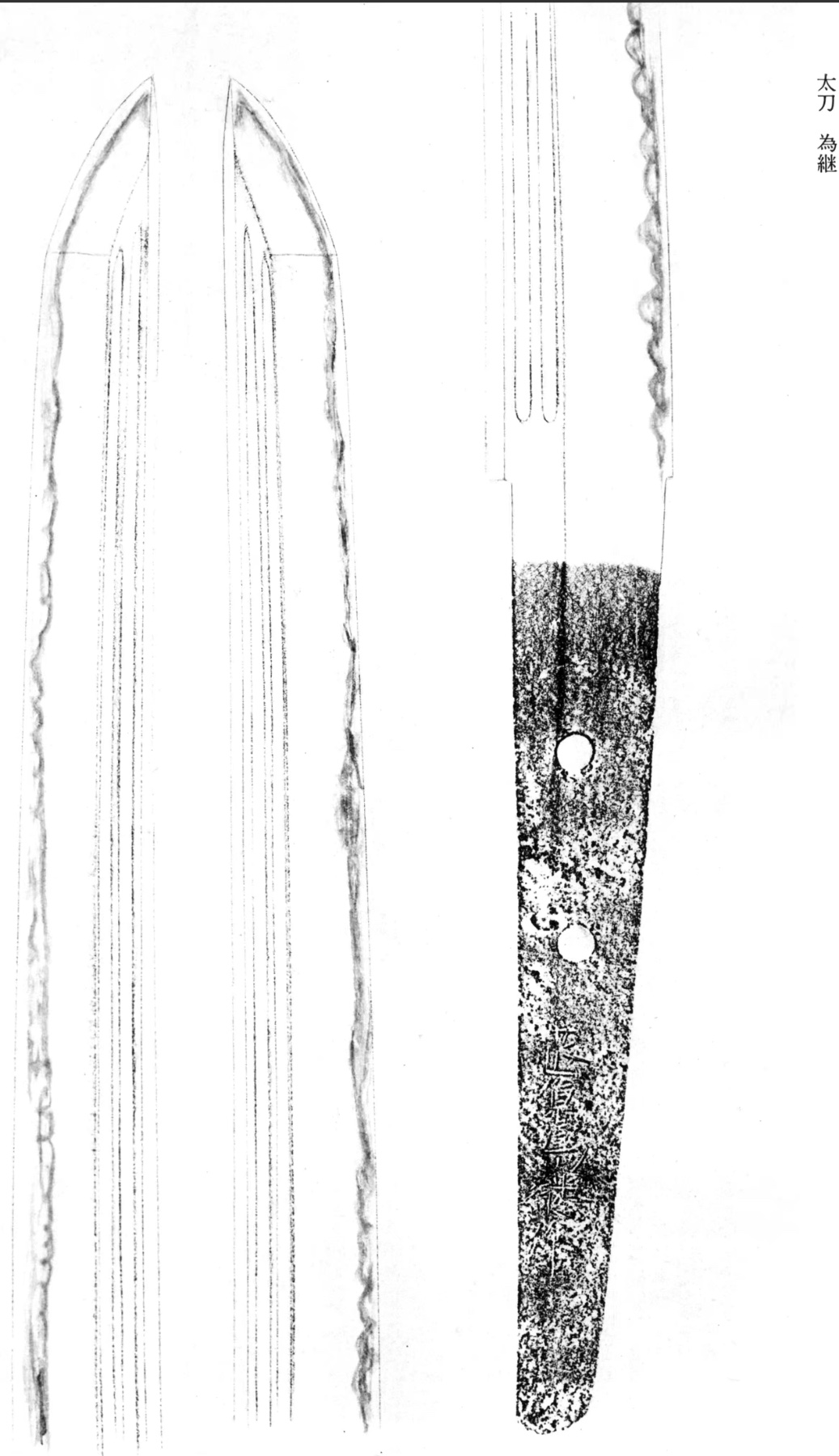
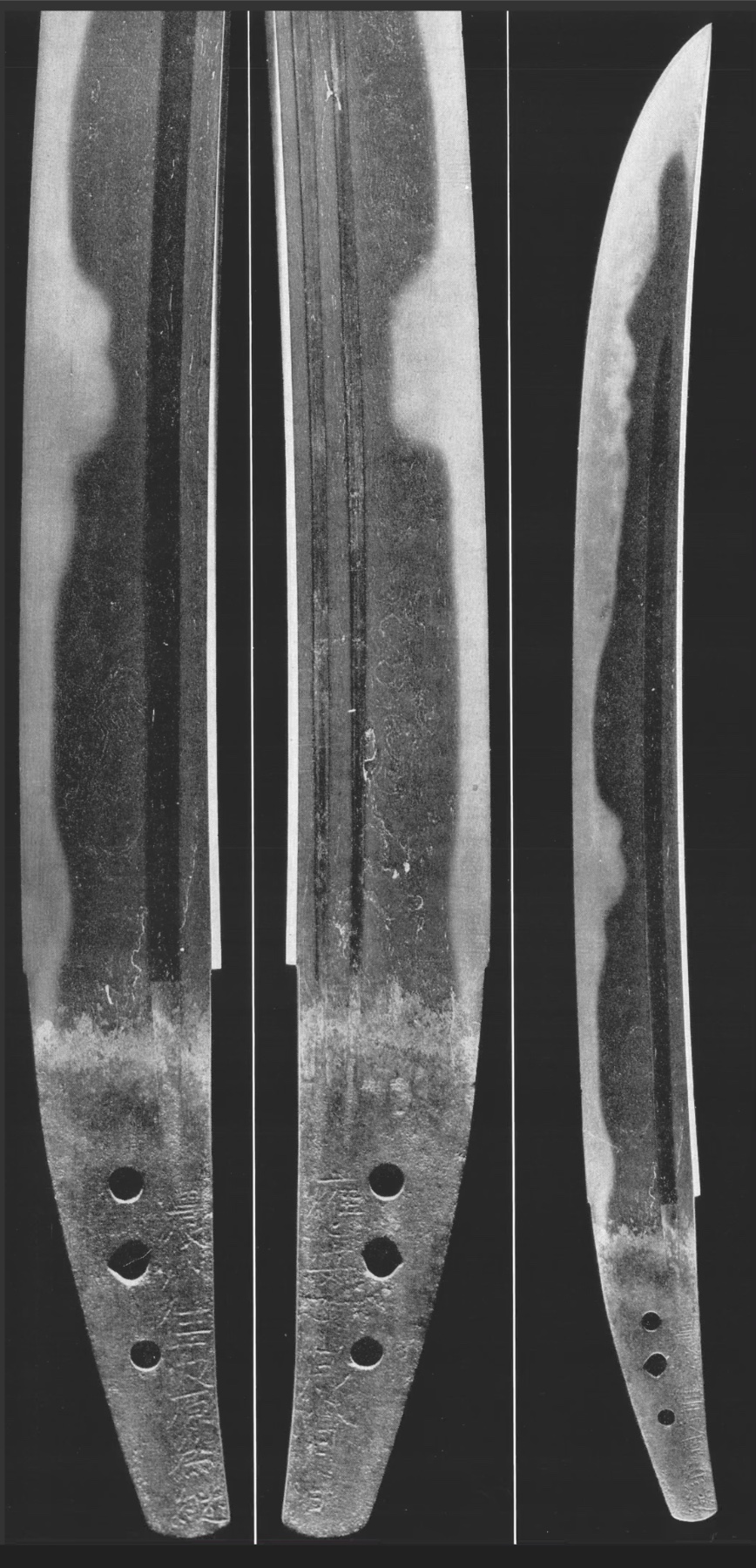
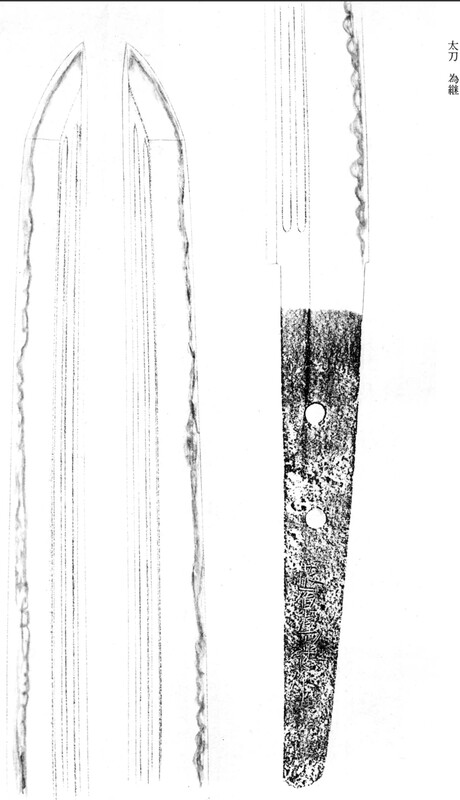
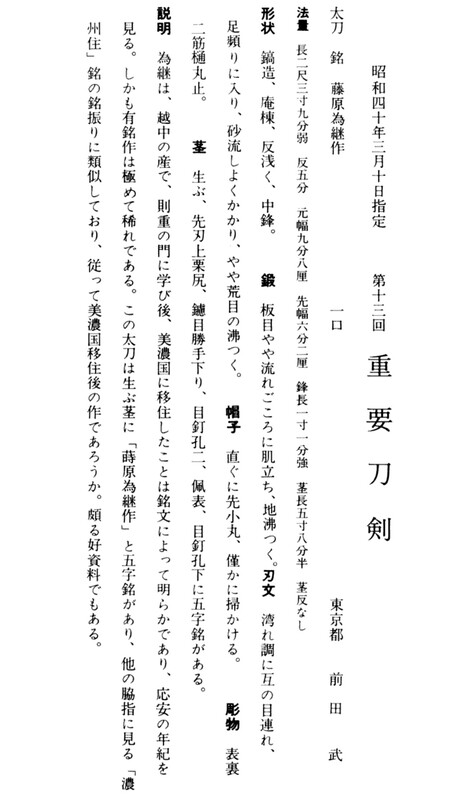
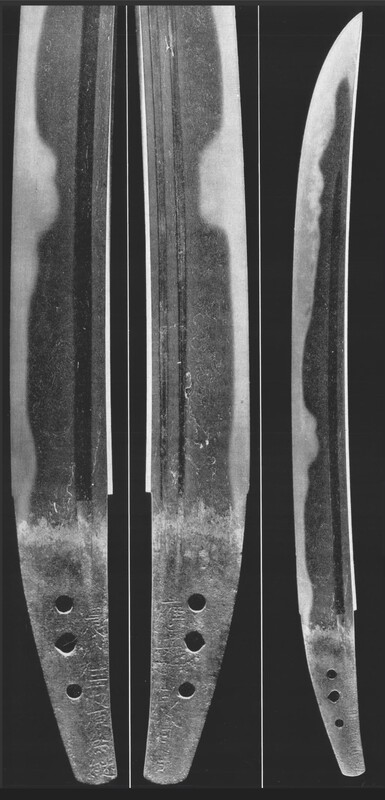
Tametsugu (similarly to Shizu) is not a straightforward smith to put in a category. He moved from Echizen to Mino but maintained his “Northener” Etchu stylistic elements. The NBTHK says of him: “ As for his workmanship, Tametsugu’s jiba is quite nie-laden and we see a standing-out itame with nagare, a blackish steel, a notare-based hamon that is mixed with gunome and that features a very noticeable amount of sunagashi, and a bōshi with much hakikake. Thus, we recognize a mix of northern Hokkoku and Mino elements.” The Zufu entry for the zaimei blade Chris is referring to is attached. The text therein speculates that since it is signed with “Fujiwara”, it is therefore a bit similar in signature to the attached JuBi wakizashi, which is signed with “Noshu Fujiwara” and hence the tachi could possibly have been made after he moved to Mino (but more phrased as a question is how I understand it, rather than a statement). However, as always with Japanese swords, things are not straightforward. The hamon of the tachi does not “look” or feel (at least per the oshigata) stereotypically Mino-ish in nature (with the various symmetrical or pointy gunome features along the entirety of the blade). Per se, that is not an issue as early Mino did not have much symmetry or regularity (cf Naoe Shizu), even though one would expect perhaps more “pointy” elements than in this tachi here. Yet, this tachi seems to have gunome in there. Overall, the zufu setsumei of the Tametsugu tachi highlights the plentiful sunagashi and larger nie in the setsumei section, which I believe is what Chris is interpreting (together with the notare style hamon) as Soshu in style. Lastly, the JuBi setsumei of the attached wakizashi mentions that per Honma sensei the Mino yakiba of Tametsugu is larger / wider while the Echizen (ie more typical Go/Norishige inspired earlier ha style of Tametsugu) is narrower. So, here I believe we have an interesting transitional blade with a more Soshu hamon but a signature that indicates a time period closer to when he moved to Mino.
-
Not easy per your definition. In person and in Japanese. Even though there are some younger, English speaking staff there now too.
-
Kiril, thanks. On average, how many signed Kamakura Yamato swords do you come across annually would you say? A rough estimate is fine and the paper could be Hozon and up. You obviously go to various trade shows and buy/sell, so you are in midst of it. Thanks
-
I see. OK, I agree - people should not follow blindly but understand what is being said in context. Nagamitsu, Rai, etc - these are minefields and a lot of study, research and understanding is required.
-
Of course, one cannot take out of context private correspondence between Jean L and Darcy and just extrapolate..... I think the point is that overall proper Yamato (ie Koto) signed blades are rare. It almost does not matter how many there are (eg 100, 110, 120, 150, 200) - the population is very small. Jussi's numbers include Muromachi, which one can argue is a bit misleading. Mumei Yamato are way more numerous.
-
The post and comments that Jean L made referred to signed Yamato blades, and also of certain quality. There are plenty of mumei ones. At Juyo and above level, there are fewer than 170-180 (one needs to double check the entries but my rough count is reasonably accurate, perhaps +/- 5) and that includes some Muromachi stuff. If we are just focusing on Kamakura, then we are in the realm of 110-120. Unfortunately, it is almost impossible to know what the situation is at Hozon/ToHo, unless one has some insider connections into the Honbu and they double check their registers. But chances are that if an Yamato blade is a zaimei and of adequate quality, it will get elevated to Juyo, so the Juyo/TJ Zufu are very good proxy for the overall population.
-
The nakago has been reworked and is thinner than it probably was originally. That could explain some of the large hamachi remaining on the sword. The upper ana could have been the original one, indicating a potentially slight machi okuri. The lower, later ana was probably centred after the nakago had been reshaped.
-
???? https://to-ken.uk/Meetings/2018%20meetings.html
-
The blade subject to the original discussion is an honest, decent and genuine blade in acceptable polish. I am not sure what people are looking for in terms of polishing windows, etc. Everything is visible on the blade and in fact it is is in better shape than most blades found 'in the wild'. It can be appreciated as is. Often one needs to factor in not only the economic cost of a polish but also what can be gained in terms of [incremental] appreciation after the polish, and then all of that should be weighed against the removal of metal and diminishing the blade for posterity. Sometimes, it is just not to be done and the blade is best kept as it.
-
Ah, I see, Ray, now I get it. Of course, you are right, we should see the full sayagaki and both sides if available. Also, the blade photos need to be in higher res and closer for evaluation. Well, will be keen to hear how this develops.