Nobody
-
Posts
4,090 -
Joined
-
Last visited
-
Days Won
66
Content Type
Profiles
Forums
Events
Store
Downloads
Gallery
Everything posted by Nobody
-
 Open from 10 a.m. to 6 p.m. However, closing time will be 5 p.m. only on the last day (Oct. 29th).
 -
Hi Henry, The Mei reads Koki ni sen roppyaku nen aki (Autumn in 2600 Imperial year (= 1940)), Inoue Sadakane saku kore (Inoue Sadakane made this).
-
He was registered as one of Seki sword smiths for making Showa military swords on Oct. 25th, 1939. Ref. http://www.touken-kasugado.com/faq_2.html
-
reads, Seki ju Ishihara Yoshisada saku (関住石原義定作). His real name seems to be Ishihara Joichi (石原錠一) according to the following web page. http://www.touken-kasugado.com/faq_2.html FYI, http://home.earthlink.net/~ttstein/yoshsad2.jpg
-
The Mei is Yasumitsu (靖光). FYI http://home.earthlink.net/~ttstein/yasumits.jpg
-
Hi Tim, I do not object to the conclusion of NTHK. But I think that there is a logical weakness in the reason. How can NTHK deny a possibility that the carvings were added after the cut down? And I also realized the filled old mekugiana as you already mentioned.
-
Hi Dave, The Mei reads Kashu ju Fujiwara Iehiro (加州住藤原家廣). If the mei is genuine, it might be a blade of around early Edo period.
-
Had anyone been able to translate this?
Nobody replied to a topic in Auctions and Online Sales or Sellers
The mei could be Yoshifusa (吉房) with my 2 % certainty. -
Omote: 南勢住藤原永利作 (Nansei ju Fujiwara Nagatoshi saku) Made by Fujiwara Nagatoshi in Nansei Ura: 慶應二丙寅年三月吉日 (Keio ni Hinoe-Tora nen san gatsu kichijitsu) A lucky day of Mar. in 1866 Nansei is a place in Ise (伊勢) city. The tanto does not seem to be made in Meiji but Keio.
-
安政三丙辰季冬 (Ansei san Hinoe-Tatsu Kitou) late winter in 1856 應田宮則須君需 responding to Mr. Tamiya Norimochi's order Actually, the translations also teach me a good lesson. :D
-
Hi Martin, Thanks for the info. I did not know the page, though I have seen the home of the site before.
-
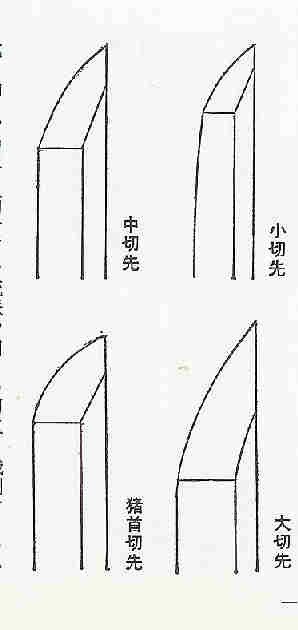
Hi Justin, Actually, that is the point. As for ko-kissaki blade, because the blade width near its tip is narrow, the kissaki has to be small naturally. As a result, that becomes ko-kissaki. This is only my understanding. I am also a beginner.
-
Hi, I understand the theory. However, I think that the difference between ko-kissaki and chu-kissaki is not the local proportion of the kissaki. IMHO, the difference may be identified from whole proportion of the blade. On the picture below, upper right shows ko-kissaki and upper left shows chu-kissaki.
-
I am sorry, but I cannot agree with the theory. If the kissaki is Ko-kissaki, Chu-kissaki, O-kissaki, or even Ikubi-kissaki, generally the distance from the tip to yokote of each type of kissaki is always longer than its yokote.
-
It reads as follows. Shakudo Musha Tsuba (赤銅武者鍔); Musha (samurai) Tsuba made of Shakudo Yoshihide zaimei (良秀在名); a mei of Yoshihide exists
-
They are Kanteisho issued by NBTHK. Most of the descriptions are fixed pattern and you can understand 80-90 % of them by referring the following Dr. Richard Stein's web site. http://home.earthlink.net/~steinrl/origami.htm The Kanteisho on the left is for the blade. The specific description says that Katana, unsigned ((attributed to) Mihara), length ni shaku ku bu han (about 63.5 cm). The Kanteisho certifies the katana as a Hozon Token and was issued on Apr. 3rd, 2006. The rignt Kanteisho is for Koshirae. The Koshirae was certified as a Hozon Tosogu on Feb. 16th, 2006. The Koshirae was described as Kuro Isokusanuri saya Uchigatana Koshirae(黒磯草塗鞘打刀拵). That means a Koshirae for a Uchigatana with black lacqurer work of seaweed pattern. Other descriptions are details of F/K, Menuki, and Tsuba.
-
As for the link in my previous post, the seller called it Genpuku To (元服刀: sword for coming of age) from its purpose, and also called it Hinakoshirae (雛拵: miniature koshirae) from its physical features. However, I do not know the true name or purpose.
-
Refer the sword on the site below. It is described as a miniature katana (雛刀: HinaGatana) which seems to be worn by a child of wealthy samurai. http://page4.auctions.yahoo.co.jp/jp/auction/d67118433
-
I do not know the answer. I only think several possibilities. As Curran said, it might be the annual sawing off of the deer's horns. The event begun in 1671 to protect both people and deers in Nara (奈良). I also think other possibility. Horns of a deer come off naturally in every spring. Watching the first tsuba, the cut sections of the horns look as if they came off naturally to me. And there are some insects on the tsuba, though at first I thought they were birds from their faces. What kind of insects they are? I thought they are bees or winged ants, maybe bees. Then fell out horns suggest spring, and the season word for bees is also spring. That makes sence, I think. Then why are there horns and bees? I found an old proverb that a bee stings the horn of a deer. The meaning of the proverb is that being indifferent whatever have be done. IMHO.
-
Also this site shows the tying the bag as well as other tyings. http://collect.jp/~sword-ebay/musubi/imageidx.html
-
The date is not Keian but Kansei. It reads Kansei san nen ni gatsu hi (寛政三年二月日). Kansei 3 = 1791
-
autumn sale by Token Shibata
Nobody replied to Nobody's topic in Sword Shows, Events, Community News and Legislation Issues
It is just bounded on the east side of Tokyo Station. -
I identify the first 7 characters as 肥前国住近江大 (Hizen no kuni ju Omi dai). So, the title may be Omi Daijo (近江大掾). IMHO, if we assume "Hizen (no) kuni ju Omi Daijo", the possible name of the smith may be as follows. 1. Tadahiro (忠廣) II 2. Tadayoshi (忠吉) IV 3. Gimei 4. others
-
An exhibition and sale will be held by Token Shibata (刀剣柴田) at 10th floor of Daimaru Dept. Store in Tokyo, from Oct. 11th to 17th.