Nobody
-
Posts
4,099 -
Joined
-
Last visited
-
Days Won
66
Content Type
Profiles
Forums
Events
Store
Downloads
Gallery
Everything posted by Nobody
-
The Mei reads Bishu ju Masachika (or Masazane) (尾州住政真). This Bishu is not 備州, but Owari no kuni (尾張国). Unfortunately I have no information of the smith.
-
Hi Curran, I do not think that "ichi gatsu (一月)" means the first month in that sence. But of course there are always any possibilities that I do not know. At first, I thought a possibility that Feb. 1864 was expressed in the current solar calendar and was equvalent to Jan. 1864 in the old luni-solar calendar on that Mei. But that possibility was denied, because I found the first date of Genji era was Feb. 20th 1864 and it is expressed in the luni-solar calendar at that time. The date was Mar. 27th 1864 in the current solar calendar.
-
Hi Leroy, I found a strange fact. The date on the nakago is "Genji gan nen ichi gatsu hi (元治元年一月日)". It means January, 1864. But actually, Genji era started on February 20th, 1864 and ended on April 7th, 1865. So, a day in January 1864 could not be a day in Genji era.
-
looking at the translation of the shinsa paper......... have a question. The part about the name of the person who turned the sword in for shinsa. You translated that as so and so " dono " and interpret that as a honorific ( as Mr. )......... I always thought that " dono " means submit, as so and so submit ( this sword ). Can anyone clear this up ? May be Herr Nobody ? milt THE ronin Hi milt, The Deron's translation is correct. "dono (殿)" is always a honorific as Mr. Usually more official than sama (様).
-
Hi Leroy, I do not intend to deny the signature. But I do not know the Sukenaga in Genji era (1864). Maybe someone can give us his information. Later generation of the famous Sukenaga? I know one Yokoyama Sukenaga (横山祐永). He is thought to be the best smith in Bizen Yokoyama school at late Edo period. His hamon was famous as Kobushi Choji (拳丁子) or Kikka Choji (菊花丁子). He died in 1851.

-
photo of a famous smith at late Edo
Nobody replied to Nobody's topic in General Nihonto Related Discussion
Hi Bernie, I definitely do not want to do that. I have watched the same performance on TV when I was a child. If you do not slide your feet on the blades, you might do that. -
I found a rare photo of a famous smith at the link below. His name is Izumi (no) kami Kanesada 11th (和泉守兼定). http://www.dokidoki.ne.jp/home2/quwator ... esada.html One of swords which Hijikata Toshizo (土方歳三) used was made by the smith, and the sword is still kept. http://www.tamahito.com/ishida24.htm Hijikata Toshizo was famous as the sub-leader of Shinsengumi (新撰組). http://www.dokidoki.ne.jp/home2/quwator ... ikata.html Also there are many photos of famous persons from late Edo to Meiji period on the following site. http://www.dokidoki.ne.jp/home2/quwatoro/bakumatu.shtml
-
nihonto vs. bullet; http://www.youtube.com/watch?v=pNiX_l-HEGM p.s. from the same TV program of "nihonto vs. watercutter" which Stephen posted.
-
I just found similar menuki on bidders. http://www.bidders.co.jp/item/77372485
-
Isn't it an impersonated spider?
-
Michael, Koichi et all. Firstly, the fuchi is signed Soyo, not Muneoki. It is Soyo ( Kao ) This is the mei of Soyo II, the next in line after Somin and a very famous maker. He worked in the late 1700's. Thanks Rich. I failed to identify the 2nd kanji. The correct inscription must be 宗與.
-
The Mei on the fuchi reads Muneoki (宗興) and Kao. But I do not know its genuineness.
-
Though I cannot read clearly, the Kanji could be as follows; 1st) 清 (kiyo) 2nd) 監 or 竪 or 堅 3rd) 根 (moto or ne) 4th) 朋 (tomo) or 明 (aki) Especially 2nd and 3rd Kanji are by guesswork. BTW, the photos are upside down.
-
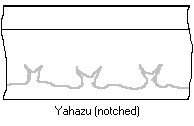
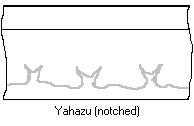
I also think that the hamon is basically "Koshi no Hiraita Midare". And it might be especially called Yahazu (矢筈; end notch of an arrow), though I have not seen the hamon before and am not sure. Ref. http://home.earthlink.net/~steinrl/terms/terms.htm
-
Hi sencho san, There is an interesting background from a Chinese legend; At the Tou (唐) era, a white deer (白鹿) came in the palace of the Emperor Genso (玄宗皇帝; 712-756), and a hermit found it out that the deer had been living for 1,000 years. Examining the deer, a copper plate was found among the white hair around antlers. On the plate, there was an inscription describing the name of a garden to which the deer belonged. The garden existed in the Kan (漢) era and that was 1,000 years before. The Emperor was pleased with this auspiciousness and made a big feast to celebrate the longevity of 1,000 years (千年壽). This is the origin of the name of the Sake.
-
Hi, The Mei reads Seki ju Fujii Kaneoto saku (関住藤井兼音作). He was one of smiths for WWII military swords in Seki. His real name was Fujii Otoji (藤井音二). Ref. http://www.touken-kasugado.com/faq_2.html http://home.earthlink.net/~ttstein/seki.htm
-
reads Seki Ito Yoshihiro (関伊藤義弘). He was one of Seki sword smiths for WWII military swords in Seki. His real name was Ito Yoshio (伊藤芳雄). Ref. http://www.touken-kasugado.com/faq_2.html
-
maybe Seki ju Kaneyoshi (関住兼義). But I need a larger pic of nakago to make sure.
-
I am not sure about the mei. But the mon could be Gonoji (五の字). The shape of Go (五) is the motif of the mon. Ref. http://www.alte-studio.com/inkan/kamon_ ... on_id=4926
-
The characters themselves are upside down. As for the date, I can only identify 年 and 月吉日. They mean a lucky day of ? (month) in ? (year). So, there is no important information. IMHO, it could be a fake. I do not think that the shape of the Nakago and the position of the Nakago ana are correct, though I am only a biginner.
-
The Mei reads Suikosai Kaneaki (粹光斉兼明xx). I cannot identify the last two characters. However, the mei was chiselled upside down. IMHO, I also suspect its genuineness. FYI; Japanese swordsmiths of the Showa (WW II) era from the site of Dr. Rich S. http://home.earthlink.net/~ttstein/kaneaki4.jpg
-
boshi; notarekomi (湾れ込み): wavy shape remarks; Musashi (no) kuni (武蔵国), Tenpo goro (天保頃): around Tenpo era (1830-1844)
-
I found that the following sites which are included in Recommended Links of NMB are lost. The reason is unknown, though I heard some rumors. ========================================= Japanese SWORD SCHOOL Osaru runs this wonderful page with a mountain of information. There are both English and Japanese pages Japanese Sword School - English http://www.hi-net.zaq.ne.jp/osaru/e_index.htm 日本刀豆知識 - Nihongo http://www.hi-net.zaq.ne.jp/osaru/ =========================================
-
Sagami (no) kami Fujiwara Kunitsuna; http://sinogi.ddo.jp/syasin/katarogu/16 ... 14667.html Echizen ju Sagami (no) kami Fujiwara Kunitsuna; http://www.e-sword.jp/sale/0610_1057syousai.htm
-
The second kanji is rather strange, but maybe Shinshu (神洲). That means the country of gods or divine country (= of course Japan ).