Nobody
-
Posts
4,129 -
Joined
-
Last visited
-
Days Won
69
Content Type
Profiles
Forums
Events
Store
Downloads
Gallery
Everything posted by Nobody
-
Hi, The attached photo shows an expample of a true Mune mei of Izumi no kami Kanesada (maybe 11th gen.). Your example looks like only a mark of something to me.

-
It is a clear fake, I think.
-
The 3rd kanji is "niju (廿)" (= 十 + 十).
-
maybe "Seki ju Kawai Kaneyoshi saku (関住河合兼義作)", by guesswork.
-
Hi John, I am afraid that I cannot catch your point. I hope the following table satisfies your question. 嘉永七年 (the 7th year of Kaei): Jan. 1st, 1854 - Nov. 26th, 1854 安政元年 (the 1st year of Ansei): Nov. 27th, 1854 - the last day of Dec., 1854
-
HI sencho san, Yes, I realized that. Kaei shichi nen (嘉永七年) ended on Nov. 26th, 1854.
-
Hi, I think that Seiryushi is his pseudonym. As for the date, after all it looks like Kaei (嘉永) to me, though the kanji for "ka" (嘉) is simplified.
-
Rai Kunimitsu is a smith's name of Rai school. However, there were a lot of cases to chisel a famous smith's name on Kogatana as only a trademark. I do not know if the mei is real or not.
-
Hi, I think that it may be a smith's name of Umetada school. But I could not find any Munehisa in Umetada school from my books.
-
Basically, a sword with Torokusho is a real nohonto. I do not know if it is common or not, but a fake Torokusho does exist. Ref. an example of a fake Torokusho http://collect.jp/~sword-ebay/gimei/official.html
-
I think that the mei means as follows; Ford ---> Fu-Ou-Dou (歩王道) means "walking on the royal road", right?
-
The following items are to be written on the certificate. Shubetu (種別): classification such as Katana, wakizashi, tanto, and so on Nagasa (長さ): blade length in centimeter Sori (反り): curve in centimeter Mekugi-ana (目くぎ穴): number of mekugi-ana Meibun (銘文): mei, date, etc. Biko (備考): notes FYI: APPLICATION OF THE SWORD LAW AND RELATED TOPICS http://www.nihontokanjipages.com/japane ... _laws.html
-
Actually, I cannot identify the mei. However, by pure guesswork, it could be "Umetada Munehisa (埋忠宗久)".
-
That is a rank for smiths of an evaluation system. Although my translation might not be exact, the meanings are as follows; CHUGE SAKU: below avarage made Ryoko no Joi: above good smith
-
Does it mean the sword is still in Japan? If so, it must have its certificate (Torokusho; 登録証) and that means it is genuine. Ref., http://www.nihontokanjipages.com/japane ... _laws.html
-
HI, The mei reads "Toshihide monjin, Numazawa Toshimitsu saku (俊秀門人 沼澤俊光作)". That means "a pupil of Toshihide, Numazawa Toshimitsu made". FYI; He is listed in the group of CHUGE SAKU (中下作) on the following page. http://home.earthlink.net/~ttstein/tosho.htm
-
Hi, The mei on the Kogatana seems to read "Mitakigawa Rai Kunimitsu" (御瀧川来國光). 御瀧川 is an old expression of 三滝川 (Mitakigawa = river Mitaki), which is in Mie prefecture.
-
Hi sencho san, I made a brief seartch and found a simple explanation of "Shinbu Fusatsu" on the site below. Please read the 3rd paragraph. http://www.classicalbudomalta.org.mt/jiujutsu.html http://www.heartaikido.com/terms.html And I also found its connotation about the 1st Emperor Jinmu as you say. It is based upon a tradition that the Emperor Jinmu conqured from Kyushu to Kinki region without staining his sword with blood. http://blog.so-net.ne.jp/applemint/2005-12-28
-
They are; Tyu (忠): loyal Kou (孝): piety
-
Hi, I have just finished my breakfast! Shinbu husatsu (神武不殺): Excellent Budo does not kill people. Takayama-to (高山刀): swords made at Takayama Forge (I heard they had unique features.) Ujinaga saku (氏命作): Ujinaga made
-
Hi morita san, Thank you for the confirmation. BTW, I could not understand one point. There are two 藤 (fuji) in the mei, but they were differently chiselled. Does anybody know the reason?
-
It may be Seki junin Fujii Kanefuji saku (関住人藤井兼藤作). But I am unsure about the 1st kanji. He was also one of Showa WWII smiths in Seki.
-
Hi, Toen sha (刀苑社) is the organizaion in question. Ref. on the bottom of the following page of your site; Toen sha origami http://home.earthlink.net/~steinrl/origami.htm
-
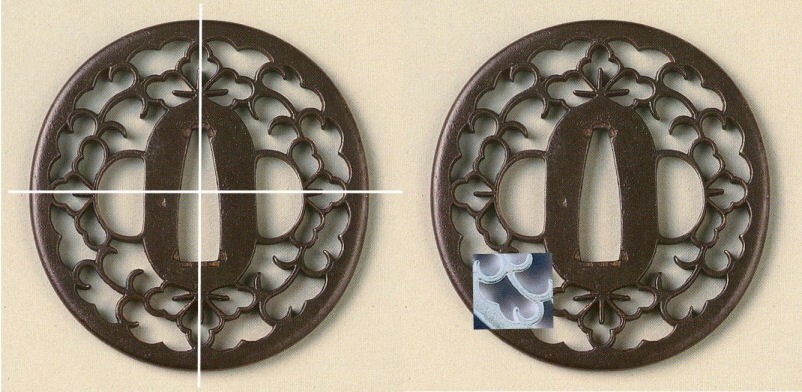
Sorry, I know this post does not relate to the theme of this thread. But I realized a strange thing about the Tsuba. The pattern on the tsuba seems to be symmetry both vertically and horizontally except nakago-ana. But only lower left part is different. When I flipped over and rotated the part, it fitted in the tsuba correctly. So, I suspect that the maker made a mistake to assemble parts when he made the tsuba.
-
the 1st one; Zoshun-tei Seiho zou (蔵春亭 西畝造): Zoshun-tei Seiho made (this). (*seems an Imari; 伊万里) the 2nd one; Kutani (九谷): (a place name) Dai-nihon (大日本): (big) Japan Oda sei (織田製): Oda (*seems a name of a shop) made Kaga (加賀): (a name of a province)