Nobody
-
Posts
4,120 -
Joined
-
Last visited
-
Days Won
68
Content Type
Profiles
Forums
Events
Store
Downloads
Gallery
Everything posted by Nobody
-
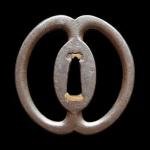
by guesswork; Imashige (今重)
-
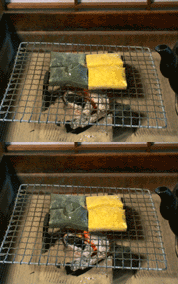
Hi, I do not know the exact motif of the tsuba. But I cannot help connecting it with mochi (餅: rice cake) and ami (網: grill).
-
Hi, I think that the mei is Sako Kaneshige saku (酒向兼茂作).
-
Hi, That surely is Noshu (濃州). FYI; some examples http://home.earthlink.net/~ttstein/kanehir2.jpg http://home.earthlink.net/~ttstein/kanehis2.jpg http://home.earthlink.net/~ttstein/kanesan5.jpg
-
It could be that. But I really do not know the customs in war times.
-
I think you are right. The mei looks Bizen (no) kuni Sukesada (備前國祐定) to me. But I am rather confused with the mei, because the script is quite different from common style of Bizen Sukesada. :?
-
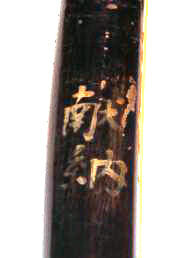
I modified the photos a little to see clearer images. The first one reads Kenno (献納). That means dedication to a shrine or country. As for the second photo; Last two kanji may read Toyosato (豊郷). That may be a place name or a given name. I am unsure about the first part. It could be Matsumoto (松本), which also means a place name or a family name.

-
Though I do not know its correct reading, 兼嗣 also can read Kaneaki or Kenji. Mt. Shiun may be the mountain near to the Park, I think.
-
Hi, I still cannot understand the mei and the tsuba, though I could read the first four kanji at the first glance. As sencho-san reads, they are 於南紀製. I cannot identify the last character, but I suspect that it might be a Kao. The mei seems to mean "made at Nanki" without specific maker's name. Are there any possibilities that the tsuba is a souvenir from Nanki?
-
Hi, The mei reads as follows; 讃州 紫雲山麓 住 Sanshu Shiun-san-roku ju residing at the foot of the Mt. Shiun in Sanshu 森兼嗣之作 Mori Kanetsugu kore (o) tsukuru Mori Kanetsugu (森 兼嗣) made this. (I am unsure about the smith's name. It could be Morikane Tsuguyuki (森兼 嗣之).)
-
Please help to save Noma dojo in Tokyo
Nobody replied to Paul Martin's topic in General Nihonto Related Discussion
For members who want to know more about Noma Dojo. http://www.kodansha.co.jp/dojo/noma_dojo_e.html -
The mei reads "Naminohira (波平)". But actually, it may be a name of a school in Satsuma rather than a specific smith. The date looks "Tenmei Hinoto-Hitsuji (天明丁未)". That is 1787.
-
Hi, That reads as follows; 大分縣 宇佐郡 明治村 Ohita-ken Usa-gun Meiji-mura (seems to be the owner's address) 全北益山郡 礪山面 ?????????? Yeosan-myeon (seems to be a place name in Korea) 清永 宗雄 Kiyonaga Muneo (owner's name)
-
I found the following page on the web site of National Diet Library, Japan. I think they are quite interesting. Portraits of Modern Japanese Historical Figures: http://www.ndl.go.jp/portrait/e/index.html
-
Some of you are experts in image handring and may be familiar with CMS (color management system). Although I only know the elements of that, I think that you had better adjust the colors of your scanners through calibration before tweaking the image. I have adjusted the colors of my monitor, printer, and scanner with a CMS tool. I used "Monaco EZ color 2" and "Monaco OPTIX", and it was not so expensive as a CMS tool. (Monaco was acquired by some company lately.)
-
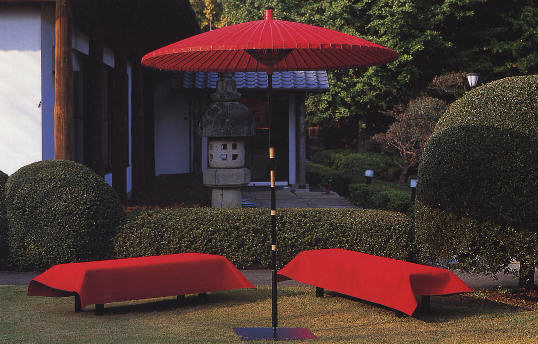
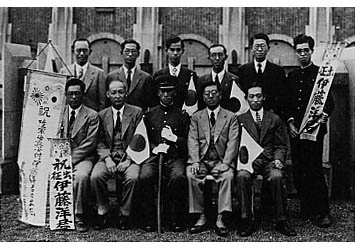
As for the motif, the explanation for the attached image says "Ichimegasa (市女笠) and Yukiwa (雪輪)". However, I think that the explanation is incorrect. Ichimegasa is a something like a hat shown on the 2nd photo. And I think that the parasol may be more like Nodategasa (野点傘), which is a sunshade usually used at outdoor tea ceremony. See the 1st photo.


-
WW2 Flag Pouch Can anyone translate?
Nobody replied to pcfarrar's topic in General Nihonto Related Discussion
I made a brief search and found that "Kagayaku Kokki" seems to be a trademark of a small flag in the war time. See the attached photo.
-
Yes, it is a likely story. I bought a new PC last week, but I opted for Win XP Pro. over VISTA.
-
WW2 Flag Pouch Can anyone translate?
Nobody replied to pcfarrar's topic in General Nihonto Related Discussion
Hi, The inscriptions are; Kokui Senyo (國威宣揚): to spread national prestige Kagayaku Kokki (輝く國旗): glorious national flag -
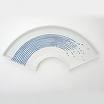
Hi, The five characters are 末廣図 and 容彫. Suehiro zu (末廣図): a shape like attached photo katachi-bori (容彫): carving in the shape of its motif

-
That seems to be written in Manyogana. I can convert most characters of that. But it is still difficult to understand the poem. Ref. http://en.wikipedia.org/wiki/Man'y%C5%8Dgana (note: the link is not shown properly because of (') in it)
-
Kang-Hsi is 康煕, I think. The name of the Emperor is pronounced Koki in Japanese. However, 煕 can be read in many ways when it is used as a part of one's name, such as oki, sato, teru, nori, hiro, hiroshi, hiromu, or yoshi, according to my ultimate weapon (my dictionary ).
-
Hi, I did not write the 1st one, because I thought you already read it. It is Kamo (鴨).
-
The 2nd kanji may be yu or suke (祐).
-
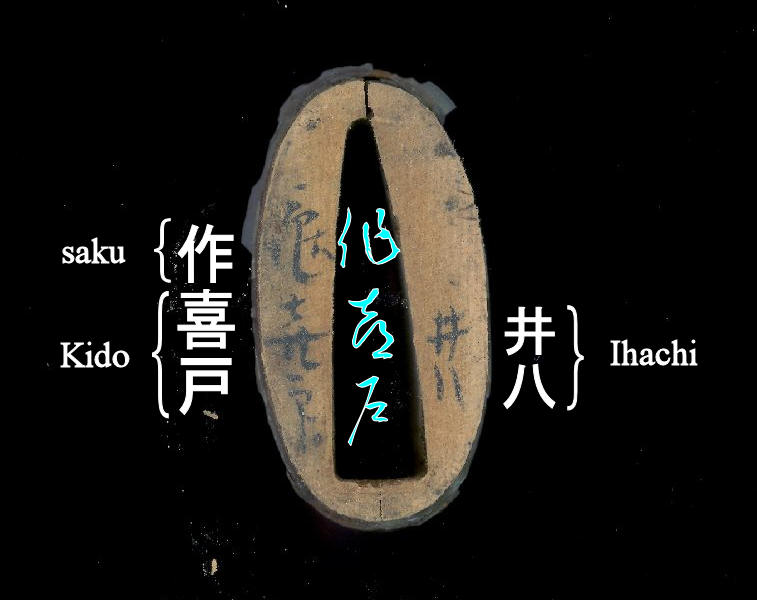
Hi, By guesswork, I tried to read. Ihachi on the right column might be a given name. On the left column, Kido could be a family name, though I cannot identify those kanji with confidence. I am absolutely unsure about the last two characters on the left column. FYI, the characters in blue color are the same kanji for 作喜戸 in sosho style.