Nobody
-
Posts
4,162 -
Joined
-
Last visited
-
Days Won
70
Content Type
Profiles
Forums
Events
Store
Downloads
Gallery
Everything posted by Nobody
-
Here are the translations. Original red texts for Part 2 and 6 are not 100 % correct. BTW, is this the sword you bought? (through an agent?) http://page18.auctions.yahoo.co.jp/jp/auction/w25519648 Part 1: At Imabari, Nagakiyo of Yoshu made (this). 豫劦 (Yoshu) - province 於 (oite) = at 今張 (Imabari) - town 長清 (Nagakiyo) – smith name 作 (saku) = made Part 2: A lucky day in January of 1976 昭和 (Showa) 五拾壹 (go-ju-ichi) = 51 年 (nen) = year 丙辰 (Hei-Shin or Hinoe-Tatsu) 正月 (Shogatsu) = January 吉日 (Kichi-jitsu) = a lucky day Part 3: This is an early signature and a good reference. 初期 (Shoki) = early 銘 (Mei) = signature 也 (nari) = be 好 (ko or yoki) = good 参考 (Sanko) = reference Part 4: 和泉 (Izumi) - province 大掾 (Daijo) – (honorable) title 藤原 (Fujiwara) - clan 國輝 (Kuniteru) – smith name Part 5: Blade length: a little more than 1 Shaku 7 Sun 刃長 (Ha-cho) = blade length 壹 (ichi) = 1 尺 (Shaku) 七 (Shichi) = 7 寸 (Sun) 強 (kyo) = a little more than Part 6: 寒山 (Kanzan) 誌 (shirusu) = wrote +(花押)
-
Sorry again, but the sword got a Tokubetsu Hozon paper. Which sword are we talking about? The one on the previous page? I thought this one. Den Sadatsuna; http://www.nona.dti.ne.jp/~sword/katana ... atuna.html
-
Sorry again, but the sword got a Tokubetsu Hozon paper.
-
They say that Hakobore (刃ã“ã¼ã‚Œ) have been acceptable unlike other fatal flaws such as Hagire (刃切れ) in the context.
-
Piers, Your translation is excellent. The translation was difficult for me. I still cannot 100 % understand the Japanese text, as it is grammatically incorrect. (But I might be wrong and it is just old-fashioned Japanese?) [nonliteral translation] A Kissaki of a Katana is basically compared to a fan shape which is naturally cut out from (coaxial) circles. And the original shape is completed as the kissaki of a Katana. From the right, O-kissaki, Chu-kissaki, Ko-kissaki.
-
As a wild guess; Fukuro Shinai (袋竹刀). Ref. http://samuraigwynne.blogspot.com/2006_ ... chive.html

-
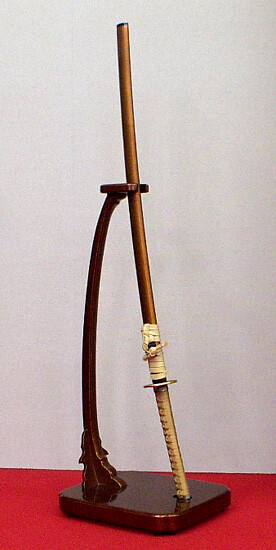
Why don’t you store nihonto vertically like this position to avoid messing the scabbard with oil etc?
-
Maybe this shop? Masamune kogei bijutsu seisakusho (æ£å®—工芸美術製作所) Refer to the bottom of the foll0wing page. viewtopic.php?f=9&t=558&p=4126&hilit=yamamura#p4126
-
Hi, I just found an interesting web site, though I do not intend to recommend the shop. Typical kitchen knives; http://itkitchenknife.com/Japanese.shtml and more products; http://itkitchenknife.com/j_catalog/j_index.shtml
-
The reading may be;
-
Based on the excellent find by Ford, I could find some pictures. http://bbs.cfan.com.cn/viewthread.php?t ... orid=14955

-
My wife holds a master's degree - and teaches - Ohara-Ryû å°åŽŸæµ Ikebana. She never used, or even heard about Nata being used, in flower arrangement. I, OTOH, have seen (the modern day version) in use by quite a few gardeners. I think we can safely assume that they are strictly gardening tools. Not really; Sometimes manual labor seems to be necessary in flower arrangement. http://www.kaneshin-seki.com/arrengment%20tool.html http://www.s-sato.co.jp/seika/f/kad/fre-2.html
-
And for the last part; A narrow Kozuka Hitsu (Ana) is opened.
-
Yes Stephen, that could be Norimitsu (則光), I think.
-
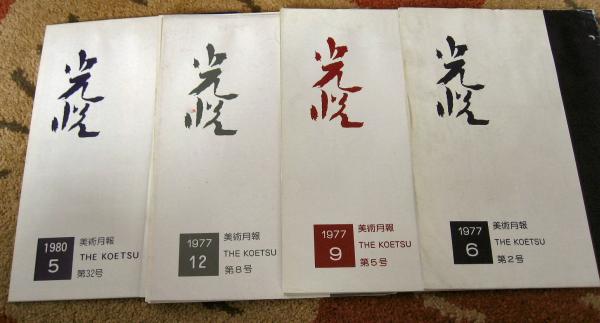
Any info on the periodical Kôetsu 光悦?
Nobody replied to Guido's topic in General Nihonto Related Discussion
The seller of this ended auction said that he/she thought that the monthly KOETSU had been published by a sword shop named Honma in Ueno Matsuzakaya (department store). Ref. http://page4.auctions.yahoo.co.jp/jp/auction/d84778181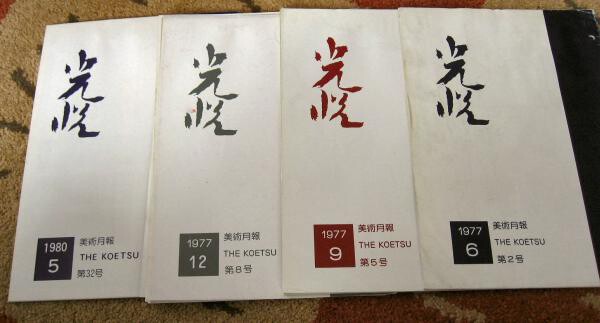
-
Here you are; Replica armour for 121,000 Yen http://www.yoroi.co.jp/syouhin/l034.html
-
The characters on the tsuba look like Bonji. But I cannot decipher them. BTW, the pictures of the tsuba are upside-down. The mei on the nakago could be Sadamitsu (貞光). But this is only my guess, as I actually cannot read the first kanji.
-
FYI; Nagashi viewtopic.php?f=9&t=536&p=3345&hilit=nagashi#p3345
-
Thanks Morita san, So, can we think that the inscription may be genuine?
-
Piers, I really could not read the kanji. It could be æ°, but I am unsure.
-
The inscriptions look strange and they may be suspicious, though I am not 100 % sure. 戸石合戦 (Toishi kassen) - The battle of Toishi - [村上義清 (Murakami Yoshikiyo) vs. 武田信玄 (Takeda Shingen), ca. 1550] 内藤 (Naito) - family name? 人馬トモ切落 (Jinba tomo (ni) kiri-otosu) - Cut off both man and horse. 光元 (Mitsumoto)
-
The mei reads Noshu ju Asai Toshihide (濃州ä½æ·ºäº•æ•ç§€). Ref. http://home.earthlink.net/~ttstein/seki.htm The kanji for Toshihide (俊秀) of Horii are different.
-
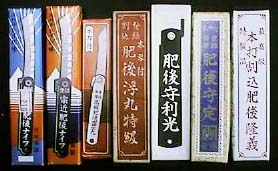
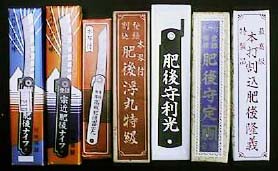
That is a well known Japanese old-style folding knife. The style is said to have been established in Meiji era. The name (肥後守 +something) is a registered trademark. FYI; Higonokami (Japanese text only) http://www.higonokami.net/index.html
-
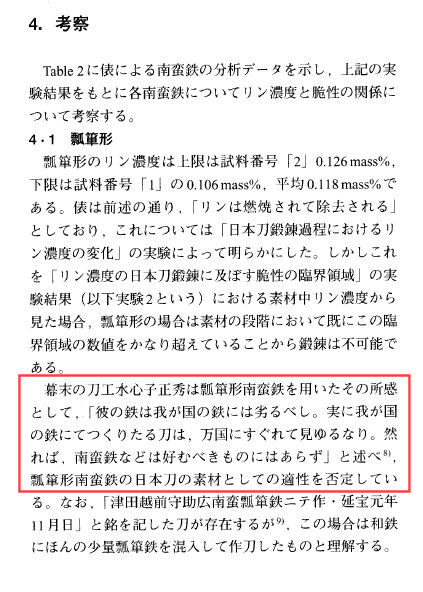
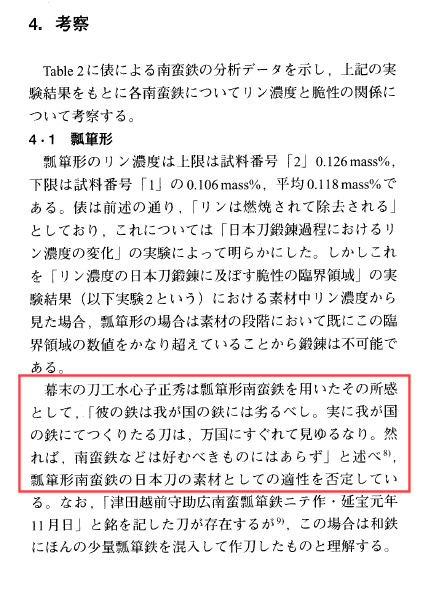
However, it was largely used and by some big smiths such Masahide. As for gourd shaped ingot at least, Masahide denied its applicability. In the article which you introduced, there is a description of Masahide’s words. After using gourd shaped Namban-tetsu for his sword, he said his comment. That is loosely as follows; “The iron is inferior to Japanese iron. The swords made of Japanese iron seem to be the best in the world. So, we do not have to prefer Namban-tetsu.â€