Nobody
-
Posts
4,159 -
Joined
-
Last visited
-
Days Won
70
Content Type
Profiles
Forums
Events
Store
Downloads
Gallery
Everything posted by Nobody
-
interesting Satsuma Masayuki inscription...
Nobody replied to Darcy's topic in Translation Assistance
[Omote] 伯耆守平æœè‡£æ£å¹¸ (Hoki no kami Taira no Ason Masayuki) [ura] æ¤åˆ€ãƒæ˜å’Œä¸‰å五年春於æ±éƒ½ç›®é»’å·æ”¹ä¿®ãƒŽæ™‚河底ニテ發見 ä¾ãƒ†å¾Œä¸–ノ記念ノ為家å®ãƒˆã‚·ãƒ†æ°¸ä¹…ニä¿å˜ã‚¹ãƒ«å刀ナリ This katana was discovered in the spring of Showa 35th year at the bottom of the river Meguro-gawa (目黒å·) in Tokyo during its improvement work. Therefore, This is a celebrated sword to be preserved forever as a family treasure, and to be remembered by later generations. 文化八年未八月七åä¹æ³é€ (Bunka hachi-nen Hitsuji hachi-gatsu, shichi-ju-kyu sai, tsukuru) August 1811, 79 years old, made -
This Week's Edo Period Corner
Nobody replied to Bugyotsuji's topic in General Nihonto Related Discussion
Actually, I use a cabinet of other maker below. http://www.toyoliving.co.jp/index.html And my cabinet is like the smallest one on this page. I bought mine 4 or 5 years ago, so the exact model does not exist now. http://www.toyoliving.co.jp/individual/index.html Moisture control system is very simple and you cannot expect precise control. However, that is enough for most of us, I think. You do not have to maintain anything as far as it is working. Refer to the bottom of the following page, as for its mechanism. http://www.toyoliving.co.jp/individual/feature.html -
This Week's Edo Period Corner
Nobody replied to Bugyotsuji's topic in General Nihonto Related Discussion
I use a moisture proof cabinet like those on the following site. Though my cabinet is a small one and contains only small objects, it is really useful especially during this season in Japan. http://www.dry-cabi.co.jp/wet-seihintobira.html http://www.dry-cabi.co.jp/inglish-catalog.html http://www.dry-cabi.co.jp/inglish-wet-catalog.html -
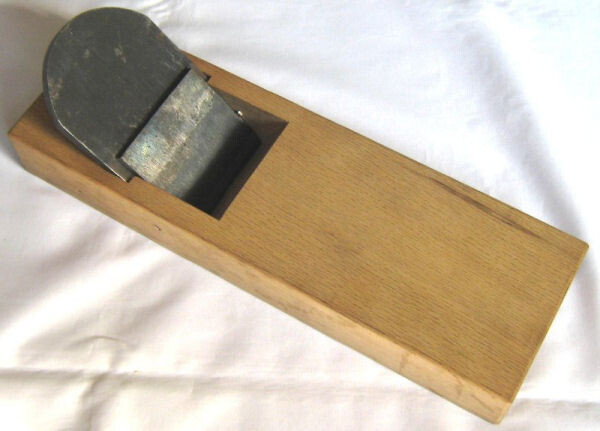
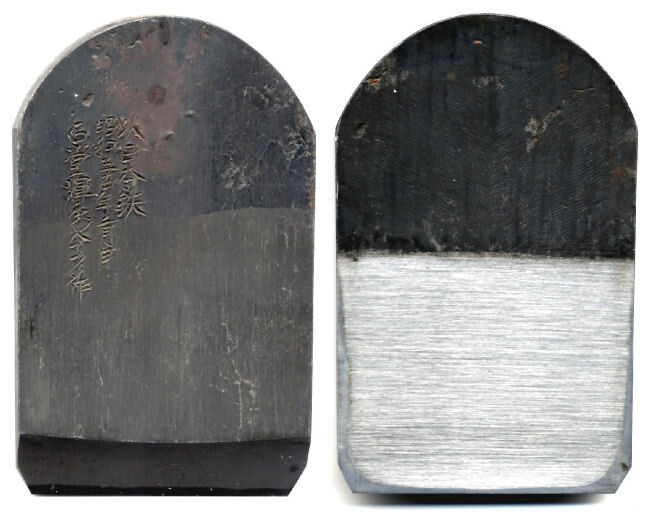
$20K?? Wow.. and you aren't limited to 2 a month. The attached pictures show a plane of Teruhide made in 1979. Mei: 以日本鉄 – With (traditional) Japanese steel æ˜å’Œäº”å四年二月日 – February 1979 çŸ³å ‚è¼ç§€å…«åæ‰ä½œ – Ishido Teruhide made at 80 years old His successor is still making planes. http://www.hct.zaq.ne.jp/dougu-no-kao/isidoukanna.html
-
The mei reads Ishiyama Mototada saku ; 1672-1734). Ref. Ishiyama Mototada http://www.cgfinearts.com/select_produc ... alleryID=3 http://db.am.geidai.ac.jp/person.cgi?id=4805
-
help with Cutting test inscription (i think)
Nobody replied to Mark's topic in Translation Assistance
Just had a quick look throught the dictionaries and it says that Saidan, using the same characters, is the 慣用 "Kanyou" Yomi for Setsudan. Very roughly speaking; Setsudan (åˆ‡æ– or 截æ–) – cut off with blades However, æˆªæ– also reads Saidan as a customary reading. Saidan (è£æ–) – cut out with scissors 切, 截, and è£ are different kanji. -
help with Cutting test inscription (i think)
Nobody replied to Mark's topic in Translation Assistance
è²®ãƒ„èƒ´æˆªæ– (Futatsu Do Setsudan) – cut two trunks 森å°åŠ©å°šåˆ© + kao (Mori Kosuke Naotoshi) – tester’s name (unsure about the reading?) -
I think that you can read the kanji if they can be seen clearly. Do you want to try? 時代 延å®ä¹‹é ƒ é•· 壹尺 四寸 八分 五厘 有之
-
According to the explanation of the seller, the 2nd sword (Tanto) was registered in May 17, 2000 at Saitama. Then, how could the sword get a Kanteisho in 1984?
-
The papers do not look defferent to each other as for their grades to me.
-
The mon is called “Maru ni Mitsu-uroko (丸ã«ä¸‰ã¤é±—)â€. That literally means three scales in a circle. The mon does not correspond to only one family, so I cannot specify one. Shimada Kai (島田é) of Shinsengumi used the mon at least. Ref. http://www.bakusin.com/kamon.html The mon of Hojo-clan is also Mitsu-uroko, but the scales for the mon of Hojo are not equilateral triangles.

-
I do not know any backgrounds of the papers, but there are some points I feel uncomfortable. - The 1st paper was issued in 1976 and the 2nd paper was issued in 1984. However, the serial number of the 2nd paper is lower. - All characters except serial numbers seem to be printed. Even the specific mei and the date are printed, not hand written. No one had a PC and a personal printer in 1976, so it seems strange to print such a paper with specific characters for every one kantei.
-
With this site, you can view the fine pictures of national treasures and important cultural properties which the national museum of Tokyo, Kyoto and Nara possesses. However, the stored data do not seem to be so many so far. e國寶 e-Kokuho: http://www.emuseum.jp/ How to use: http://www.emuseum.jp/html/help.html
-
This Week's Edo Period Corner
Nobody replied to Bugyotsuji's topic in General Nihonto Related Discussion
Can't you see a ghost behind it? -
Koichi san could it be read Masa? I am not sure about its reading, but it seems bo be a place name in Chiba-ken, not an art name. Maybe Sasazutsumi (ç¬¹å ¤). Ref. http://www.museum.tokushima-ec.ed.jp/oh ... 30-004.htm
-
The mei is Hamano Yasuyuki (濱埜ä¿éš¨). I cannot read the first kanji of the art name on the right. (笹?,芒?)å ¤
-
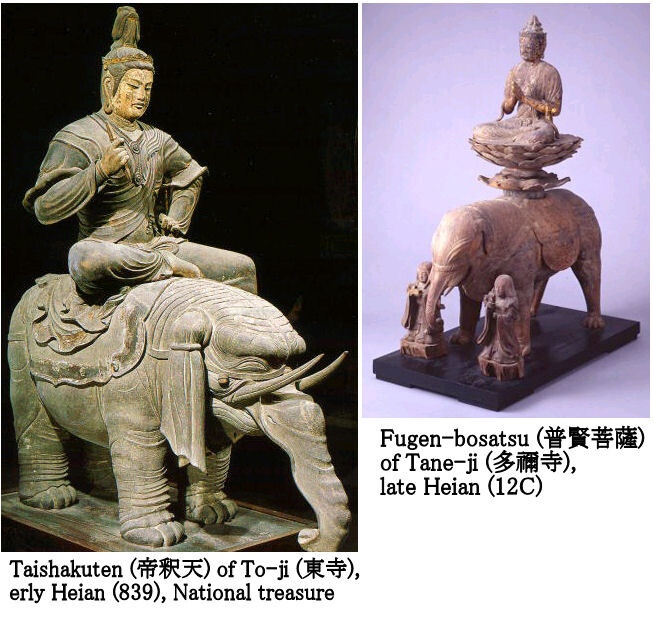
reinhard, Thanks for the interesting picture. I did not remember the exact image but I think I saw the picture sometime somewhere. Your theory may be right. But I do not know the correct answer. Since elephants were important animals for Buddhism, their real images seem to have been well know from old times. The attached picture shows examples of statues of elephants in Heian period. However, I suspect that the public might not know them. If the image of an elephant of later period does not look real, it might be an intentional stylization. Or that is simply because the artist might not know an elephant. The Kazo Jigoku (ç«è±¡åœ°ç„) may show a fiery elephant as you say, or a mythical Baku. I really do not know. But I also suspect as an amateur’s theory that Kazo (ç«è±¡) does not mean fiery elephant but only fieriness. Zo (象) in that usage might not mean an elephant but something like image or phenomenon.
-
The animal on your tsuba seems to be an elephant as others already said. However, actually it is not so easy to distinguish between them. The attached picture shows statues of a Baku and an elephant for structures of shrines/temples. One point you can see to distinguish between them is the appearances of their ears. Ref. http://www2u.biglobe.ne.jp/~naruhiro/syaji.htm

-
That does not seem to be for sale but only a photo album of someone (or some dealer?). Refer to the parent directory. http://photos.yahoo.co.jp/ph/heiseitoke ... %26.view=t
-
translation assistance please~ surrender doc in japanese
Nobody replied to vermont4me's topic in Translation Assistance
The upper document is a note which seems to have been written by Lt. Gen. Miyashita at Sanbongi (in Aomori prefecture) in Oct. of 1945 (directly after the end of WWII). It describes that he gave his Gen. Badge to Lt. Co. Shultz (?) in remembrance of their friendship. There was the 157th Army Division in Sanbongi, and Lt. Gen. Miyashita was the commander of the division. The lower document seems to be farewell words to a sergeant major Chaen (reading?) at his departure (to attack?) given by his colleague and younger colleagues. -
Translation assistance for two Shin-Gunto
Nobody replied to stephan_hiller's topic in Translation Assistance
æ˜å’Œåä¹å¹´ (Showa ju-ku nen) – 1944 濃州関ä½æ¾ç”°å…¼é«˜ä½œ (No shu Seki ju Matsuda Kanetaka saku) I am able to read the mei only because I already knew his name. http://home.earthlink.net/~ttstein/kanetak3.jpg -
I think that Mumon (無文) means no design or figure on the tsuba. Mon (文) in the usage means Monyou (文様 or 紋様).
-
The mei looks å³æ£å¿ƒ to me, too. I suspect that the mei might be a bad joke. The mei could also read “Migi Shoshinâ€. Although the last kanji is different (å³æ£å¿ƒ -> å³æ£çœŸ), that is a common phrase often appears on Kanteisho, and that means that the item on the right is genuine.
-
How about asking the studio directly? fujiwara@diana.dti.ne.jp Ref. http://www.diana.dti.ne.jp/~fujiwara/
-
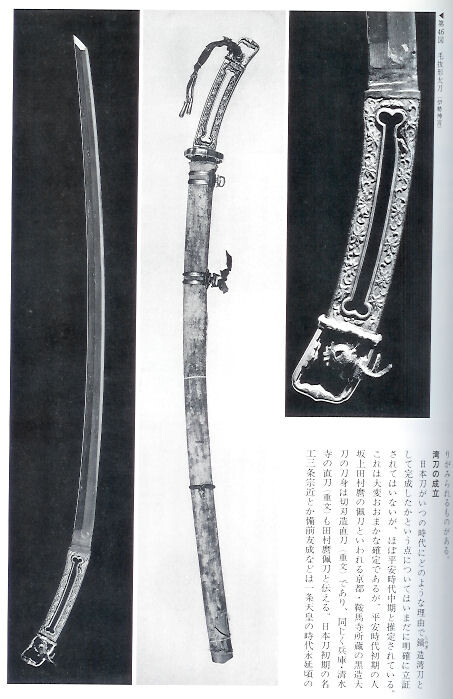
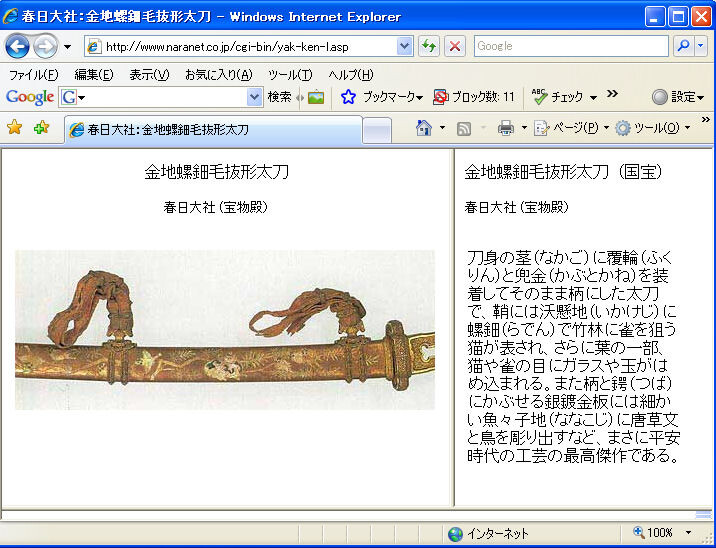
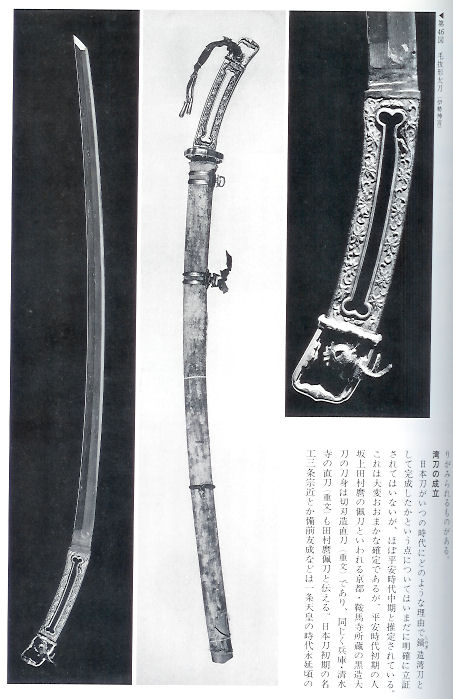
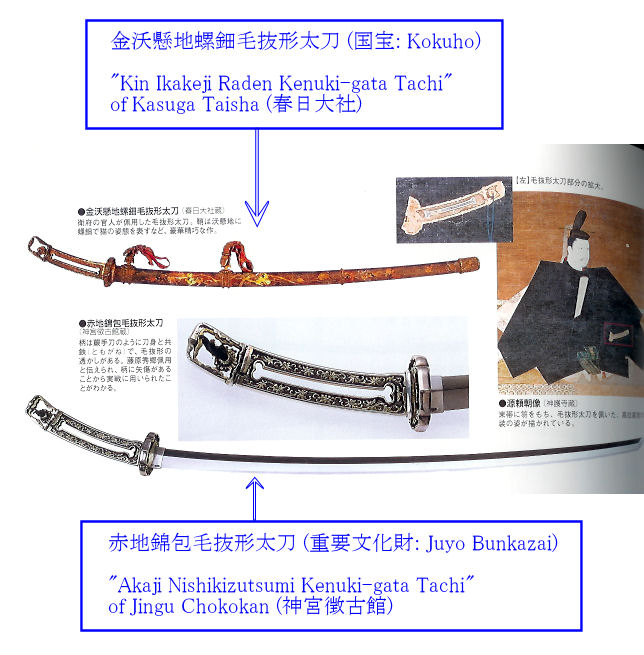
Hi Moriyama-San. I'm writing from work. My fault. I've cut a frame from the original page and I left the caption of the item above (not showed in my post, actually the orignal sword) together with the modern reproduction. The caption you've translated is referred to the original item I've cut away. Sorry for the confusion I've caused. Carlo, Actually, I have the book which includes the picture you showed. There are two similar Tachi on the page. However, they are different Tachi. And both of them are real. The lower one is not a replica of the other. Please see the attached pictures. The 2nd picture shows the Upper Tachi on Kasuga Taisha site. The 3rd picture shows another image of the lower Tachi of Jingu Chokokan. EDIT (Aug. 2, 2008): A typo in the 1st pic is corrected (Nishikizuzumi ---> Nishikizutsumi).