Ford Hallam
-
Posts
3,091 -
Joined
-
Days Won
78
Content Type
Profiles
Forums
Events
Store
Downloads
Gallery
Everything posted by Ford Hallam
-
A few more observations, now that I've had my first cuppa... Mosle and the experts he's advised by don't offer any evidence for their claims regarding Mitsutaka's nefarious activities. This is simply guesswork on their part. Any extrapolation based on that source is merely further clouding the issue unnecessarily I think. It's, of course, possible that Mitsutake did alter the surface colour of Yujo pieces to follow the fashion. But to verify that we'd need first to find evidence that there was in fact such a fashion. Can we point to contemporary documents where such a taste is described? Or is this merely post hoc 'reasoning' on the part of Mosele and his Japanese experts? And to be really thorough we ought to ask, what is the actual evidence that those pieces, signed much later with attributed mei to Jujo, were in fact made by him at all? I might argue, with real literary evidence, that pieces attributed by later Goto masters to the first three are quite possibly 'inventions' created to emphasise the historical legitimacy of the house of Goto as part of the Shogunate's authority. There was, in fact, something of a mad rush at the start of the 17th century, by Iemoto schools in all of the various arts, to invent older hereditary lineages with which to secure their place in the new Tokugawa controlled society where the age of an institution equated to authority and legitimacy. This is well documented in a number of scholarly works. The fact that the early history of the Goto family is generally unchallenged may have more to do with their use to the Shogunate as the managers of the mint and overseers of fiscal policy (often quite disastrously) and their role in creating an impression of an unchanging status quo.
-
Cheers Ian, saved me the trouble And I very much doubt that these sorts of processes were the sole preserve of the Goto nor that Mitsutaka came up with the process. Surface enhancements of gold alloys have been part and parcel of the goldsmith's profession from day one. There are even records of such processes dating back to the 8th century in Japan.
-
As this would constitute a consultation service for a business concern who do the membership or NMB admin invoice for the expertise sought?
-
I'm flattered by Pete's confidence in my abilities and while I'd agree that adding such a mei post production would be relatively straightforward I would have to keep at least one eye open. More revealing, to me, is the poor quality of the nanako as shown on the close up of the flower, as well as the very weak carving of the veining on the lotus leaf. The flower itself is similarly rudimentary. No student of the Goto had anything at all to do with this kozuka.
-
If I have to cast a vote it would also say it's cast. Which means a modern, post 1950, copy/reproduction. Most likely not even 10 years old imo.
-
Rob, yes, that's the unmistakable 'TAG' of Seriryuken Eiju. Imo he and the 2 generations of Sekibun did the funkiest signatures ever.
-
This is a classic example of a tosogu-shi's design book. Records of made pieces and drawing for pieces yet to be made. A number of similar such books have been reprinted in modern times, most notably those of Kano Natsuo as published by Marcus Sesko. and in the Natsuo Taikan. Funny enough my own sketch/scrap books look a little similar. Plain seppa-dai are fairly common and not necessarily indicative of an intended use on a bokuto, which has a different cross section anyway.
-
It's not always wise to trust those as the only give away. A clever caster will position seams on corners where they can more easily be removed after casting.
-
Those scratches are actually just really rough filing marks. Someone has given all of the outer surfaces a real going over with a coarse file. What ever it once was it's now destroyed. But I rather suspect it may in fact be a cast copy.
-
Brian, James watched me do it ...and if I'd aged that rosary bead tsuba it would look properly old :-)
-
-
I have a copy, which one do you need a scan of?
-
Steven, there's an old saying from the 18th century in Europe. If you know nothing of gold at least know your goldsmith
-
I'm with Stephen, I don't like the look of that tsuba one little bit. Far too many worrying points to trust it at face value. The birds were possibly designed by the same 6 year old who did the crane on that brass one. Mismatched fuchi kashira (fuchi marginally better quality) but not particularly good work. An assembly of oddments imo. The say is nice enough but I reckon very late maybe even Meiji.
-
Thanks Gents, glad my musings were of interest
-
Cheers Ken glad you enjoyed that. I woke up far too early this morning so decided to give it a go.
-
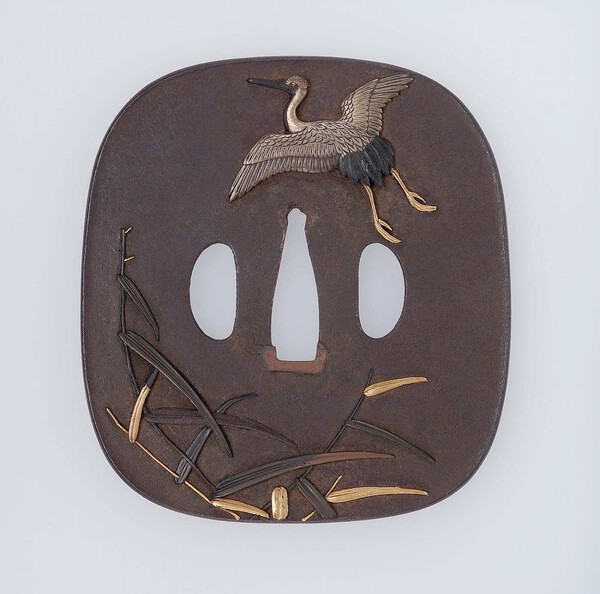
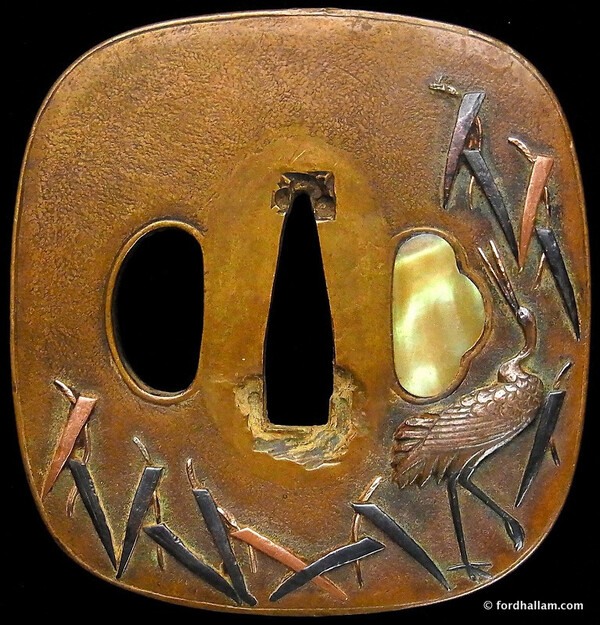
I'll try and offer some observations as to why this piece gives itself away as a modern amateur work. The brass tsuba is the questionable one. I've chosen another one from the MFA collection to make some comparisons. I've deliberately chosen a piece that isn't actually all the brilliant, merely generic, but it does exhibit all of the craft characteristics we should expect from professional Edo period work. And I recommend spending time in the MFA on-line collection getting a sense of what real tsuba look and 'feel' like. The first point is the actual design/composition. Unless a tsuba-shi had received some degree of training as a painter they were unlikely to simply make up their own designs. Professional artists were commissioned by publishers to produce designs specifically for the applied arts, like lacquer, metalwork etc. Many of these design books still exist and you can even buy modern reprints of them. Studying these design books and indeed Japanese painting we learn that there are certain conventions that are followed, rules that are rarely broken. Japanese society in the Edo period was remarkably sophisticated in its appreciation of visual culture. Poor design and a weak aesthetic sensibility simply would not pass muster. So, if you weren't properly trained as a painter you relied on professional designers. It's worth noting too that originality of design wasn't always the first priority either. Certainly, novelty was appreciated but in terms of metalwork appreciation it was the technique and expressiveness in the way the metal was carved, shaped and finished that counted first and foremost. Let's consider these two designs then. The MFA version isn't particularly inspiring but it at least doesn't appear too awkward. There's a sense of openness about it and the elements of the crane and the leaves each have sufficient space in which to 'live'. One aspect of design that professionals inevitably keep very much in mind is the negative spaces a composition creates. These 'negative spaces' are the areas between elements of the composition. Have a look at the arrangement of the leaves (on the MFA example). Now don't look at the leaves but rather the shapes that are defined by them, those little patches of the iron ground. Notice the patterns and rhythm that is formed. I'll remind you that this is not a great example but never the less these open spaces are at least interesting and relate to one another. That relating is what is called its rhythm. In this case it's a little obvious and predicable but when we compare this arrangement with the brass tsuba we see the leaves there are arranged in a very regular way and lack any sense of liveliness. The legs of the bird even follow the same sort of arrangement, which misses a chance to make the bird stand out or at least contrast against the leaves. The bird is the central motif but appears almost subordinate to the leaves, it lacks emphasis. The bird seems further 'suppressed' by the way it's squeezed into that space. That black leaf tight up against its breast looks very uncomfortable. And that curve of gold (?) coloured metal strip arching out of its tail end makes it look like its having a pee. That's obviously an accident in the design but not one that a professional designer would make. Turning to the actual craft technique now. The leaves are very poorly cut out, they lack a sense of springiness and flow. The MFA example is a fairly good illustration of what the leaves ought to look like, or at least be trying to look like. The shaping of the leaves on the brass tsuba is crude and unfinished. We can clearly see facets where the metal was chiselled in some place but in other areas they leaves have obviously been polished more carefully. An 'as chiselled' finish is something I use myself but in this case it's not a deliberate aesthetic decision but merely a poorly finished job. The leaves are 'flat' without any real definition and detail, like a central stem as on the MFA example, they look as though they were done with the very least amount of effort and care. I mentioned conventions earlier, the legs of cranes in Edo period metalwork and paintings tend to be yellow or gold coloured and the scales, claws and textures are well defined. In this case our poor crane appears to be wearing the avian version of black rubber Wellington boots . Have a look at the MFA version. It's not especially great but the details are understood and neatly defined. It's not very difficult to make those marks if you know what they should look like and what they represent. And then there's the plumage on the two birds. The MFA examples is coherent and complete, and while clearly a very stylised rendering is still 'understood' visually as a reasonably convincing image of the feathers on a crane. The layout on the brass tsuba's bird looks like it was done by a 6 year old. The head of the crane on the MFA tsuba has a little bit of attitude and character. The Brass tsuba's crane looks like a sausage with a pair of chopsticks sticking out of it. In my opinion the brass tsuba was probably made sometime in the past 30 years and in Japan. The traces of tonoko polishing clay in the kuchi-beni around the nakago ana and the leaves at bottom left is a pretty obvious attempt to make it look older. Anyway, those are just my own observation and opinions, for what they're worth .
- 12 replies
-
- 10
-

-
One last update. As a consequence of this discussion I went back to some materials I studied last year while working on the brass and zinc question and their arrival in Japan. Two major analysis surveys of Chinese coinage from the very earliest times until the end of the 19th century have been carried out by the British Museum and Professors Dai Zhiqiang, Zhou Weirong of the Chinese Numismatic Museum. "Chinese Coins: Alloy Composition and Metallurgical Research is a new book by Zhou Weirong, published in Beijing (Zhongguo gudai qianbi hejin chengfen yanjiu, Beijing: Zhongghua shuju, 2004, ISBN 7-101-04089-6/H.195). It brings together the results of the metallurgical and numismatic research on Chinese coins undertaken by Zhou Weirong since 1985. In the largest metallurgical project on coins ever undertaken in China, he applied classical methods of chemical analysis (wet method) to over 2,000 Chinese coins from the 6th century bc to the early 20th century. " Metallurgical Analysis of Chinese Coins at the British Museum. Edited by Helen Wang, Michael Cowell, Joe Cribb and Sheridan Bowman. 2005. Over 550 coins were analysed in the BM survey. Drawing on these corroborating sets of data we can now fairly confidently know what Chinese coins were made of in particular periods. So with reference to the dates Mr Rivkin refers to for copper coin importation to Japan. There were 5 trade mission from Japan to China in the period quoted. 1433 - 5 ships 1435 - 6 ships 1453 - 9 ships 1468 - 3 ships 1477 - 3 ships "Japan in the Muromachi Period, John Whitney Hall, Takeshi Toyoda" Payment for trade goods with Chinese 'copper' coin is noted. Only, they weren't copper at all... This would be a little earlier than the middle of the Ming Dynasty (1368 to 1644). Coins actually minted in 1433 contain 70 - 77% copper, between 1.5 and 0.1 % zinc, 8 to 9% tin, 18 to 23% lead and very small traces of iron, arsenic, antimony, etc. These results from 6 samples analysed. Coins issued before 1503-05 (Hongzhi reign) contain quite a narrow range of copper between 70 to 78% with the balance being lead and tin. Again, these are bronze coins and not any use if you wanted to remelt it and forge in into workable plate for kinko work. My bet would be all those Chinese bronze coins ended up in giant bronze Buddhas when the Shogunate outlawed them in the mid 17th century (1652). There do exist some very early, almost pure, copper coins c.25 to 220 AD (late Han period) but these appear to be an exception to the rule. Up until the 16th century Chinese coins are bronze composition, ie; copper with tin and lead. then there's a transition to a bronze/brass alloy starting in 1503. But all the way to 1736 these zinc containing coins also still contain significant amounts of lead and tin also. Obviously I'm ignoring the cast iron coins in my comments.
-
Brian, perhaps this rambling discussion on copper production and export could be split off from the original topic and renamed so as to make the information provided more easily searchable in future.
-
"The Sado complex of heritage mines, primarily gold mines (hereinafter referred to as “the Sado Mines”), is located on the island of Sado in the sea between the Japanese archipelago and the Eurasian continent. Over the course of more than four hundred years, gold and silver mining techniques and methods were constantly being introduced here from both home and abroad and then further developed at the Sado Mines." "The history of gold and silver mining on Sado can be traced back to ancient times; placer mining at the Nishimikawa alluvial gold deposits is considered to be the oldest production method." http://whc.unesco.org/en/tentativelists/5572/ Not so hard to dispense with the notion that copper came from Sado island in any appreciable amount. Let me quote Izawa Eiji from his paper I cited earlier. "The newly established Qing dynasty (China) also had a large demand for copper. From 1645 to 1699, the Imperial mints used over 1300 tons of copper annually. Before the development of rich copper resources in Yunnan, the main source of copper was Japan. Although Chinese ships were allowed to export silver again from 1671, on their return from Japan they mainly carried copper. In the late 17th century, old Chinese coins and Kan'ei tsuho flowed from Japan to China and circulated there. Counterfeit Song coins such as the Yuanfeng tongbao were cast from 1659 to 1685 at Nagasaki as export goods." edit to add: the same article by Eiji gives typical analyses of these old Chinese coins as being around 80% copper with lead and tin, essentially a bronze alloy. If these coins were the source of much copper used in tosogu production ( as Mr Rivkin claims) these compositions would be easy to spot in analyses of Edo period fittings. We may yet find some but I have my doubts because an alloy like that won't be very malleable so would only be of use as a casting alloy. Copper production in Yunnan picks up dramatically around 1690. He continues... " Choson Korea also needed copper for coinage, and imported more than 100 tons annually from Japan in the late 17th century." "Annual copper exports (from Japan) during the years 1676 to 1714 ranged between 2000 and 5900 tons annually. In addition, between 1693 and 1700 smelters in Osaka sold on average 948 tons of copper annually for domestic use. Hence by the late 1670's Japan had become the largest copper producing and exporting country in the world." QED hmm, I see I've written quite a bit here, perhaps I should put it all in a book
-
Rivkin, with reference to this statement; Can you point me to some books or references/analyses that illustrate these gold substitutes that you seem to referring to here, please. I'm aware of the European varieties like pinchbeck but haven't encountered any similar faux gold alloys in tosogu. Obviously brass alloys were extensively used in the Edo period but these inevitably appear to have been deliberately patinated.
-
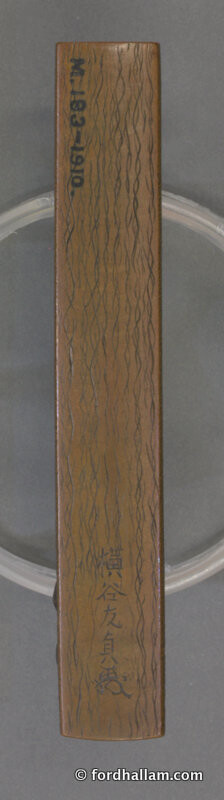
Metal Supply for the Metropolitan Coinage of the Kangxi Period (1662 - 1721). Michael Cowell and Helen Wang. Appendix 2. 1998. I can't reproduce the table of analyses here but the analyses are of a number of copper export bars (saodo) that were recovered from a ship wreck of 1697 in Table Bay. The copper came from the Besshi mine in Japan (established by lead isotope examination). Copper purity of 99.9 to 99,2% is recorded on six bars. Lead ranges around 1 and 1.5%. Iron, Antimony, Arsenic, nickel, Silver and bismuth are all present as traces below 100th of a percent. Archaeological work at the site of the Sumitomo copper refining company in Kyoto reveals similar results on bars found below a fire level from 1724 and are recorded in " The Sumitomo Copper Refinery site: Copper production in the Kodo Zuroku and in archaeological excavation." Murakami Ryu. These copper bars, called saodo, were analysed to reveal degrees of purity ranging from 97.44 to 99.01% copper with lead ranging from 0.089 to 0.68%. Other types of copper were also produced at this refinery revealing a differing degrees of refining and different degrees of purity being offered for sale. Marudo was recorded as 99.33% copper with 0.0016% lead and Chodo (trade copper) 99.76 % copper with 0.0021 lead. Similar degrees of purity and trace elements in copper have been recorded in analyses of tosogu of the early 18th century by myself at the V&A in London only last week. These results will be published in the Autumn. Developments in Japanese Copper metallurgy by Izawa Eiji provides a very detailed history of Japanese copper mining , processing and export trade. Ming Dynasty China was dependant of Japanese copper around half of it's copper requirements as is shown through reference to actual period trade documents. Kobata Atsushi references a government document dated 1686 that records 200 000 miners and 100 000 charcoal producers at 50 copper mines in central Japan, and 10 000 workers at refineries. As an example, the Besshi mine was opened in 1691 and produced 102 045 tons of crude copper between 1691 and 1867. Japan's copper export trade is documented in a number of publications. The Intra-Asian Trade in Japanese Copper by the Dutch East India Company ... By Ryūto Shimada. The Economic Aspects of the History of the Civilization of Japan, 3 volumes. Yosoburo Takekoshi. Mining, Monies and Culture in Early Modern Societies (Monies, Markets and Finance in East Asia 1600 -1900). A series of scholarly essays by Nanny Kim and Keiko Nagase-Riemer et al. For analyses of copper, shibuichi and shakudo used in tosogu during the Edo period see Alloys of Japanese Patinated Metalwork, La Niece, Harris and Uchida. 2014 The subject of copper production and export in Japan is now extensively researched and well published. I could go on to to cite literally dozens of research papers and books at this point but hope the few references I've provided will satisfy curious minds until I can complete my own publication in which everything will be meticulously documented and described. And just to provide a little relief from all the text this is the back of a copper kozuka I recently analysed at the V&A. I think it may be early 18th century. The mei suggests it's by the 3nd generation Yokoya master, who's civilian name was Tomosada. I haven't had a chance to verify the mei though as we moved house last week and my library is presently a mountain. If the mei is right this was probably made before 1734, according to Markus' Sesko's genealogies, when he changed his mei to Soyo. The results: Copper 99.89% Lead 0.062% Iron 0.035% if there were any other elements present they were below the detection limit of 3 decimal places. I'll be publishing many such examples shortly.
-
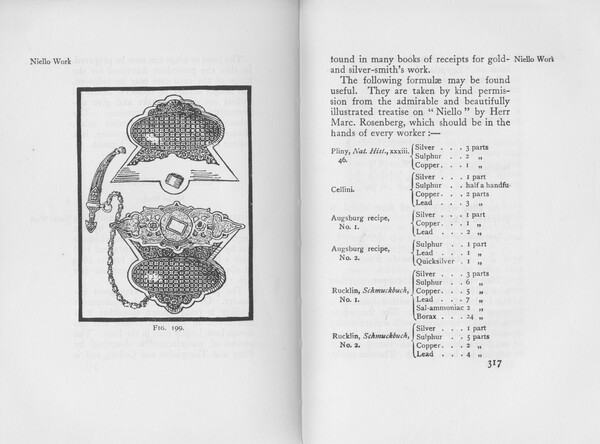
I can see various bits in the first section of this post (about copper compositions and patina) that I can guess at in terms of what is being referenced but it's all a bit jumbled so I'll leave it alone. There are a few other points I must address though. Gold was available to all kinko workers in the Edo period. In the form of coinage it was debased with copper and silver, around 20% but it varied depending on the economy. Having said that countless analyses of Edo period gold on tosogu reveal a sophisticated expertise in terms of gold refining. An extensive series of tests carried out only last Monday at the V&A on Yokoya school pieces revealed a range of gold alloys from about 20% up to virtually pure gold. Gold with around 20% silver is generally described as Ao-kin. Green gold. A copper alloy with 20% gold looks just like copper when un-patinated but after patination (or even handling over time) in the regular rokusho based solution used on Edo kinko iro-e pieces it colours to a deep grey, but it requires a bit of imagination to see much purple in the patina. Never the less various texts claim a purple tint for this alloy and it's thus called Murasaki-gane/kin (Purple gold/metal) The expense of all that gold to merely produce a dark grey/black makes this alloy very rare. I've not yet found an Edo period example (nor Meiji for that matter) in any of the many analyses I've done myself. I don't think I've ever seen it shown in any other research work either. Bakamatsu period alloys of both shakudo and shibuichi contain gold. Literally dozens of analyses of pieces made at this time suggest there was no shortage of gold being added to alloys. No black alloy I've ever analysed looked anything like niello nor is there any record in the literature of any such niello-like alloys used in Japan in any period that I know of. Note: Niello is essentially a low melting point infill alloy. Sulphur and lead are two of the major elements, along with copper and silver. The alloy is very friable and is ground to form a powder that is used like enamel by melting it into prepared cavities. It can't be used to make actual objects on it's own because it lacks any strength, as it's ability to be ground into a powder demonstrates. The only alloy I know of that has any link specifically to Natsuo is an artificial yamagane he is said to have created at the Geidai. This was made up of copper with 2% zinc, 1% tin, 2% lead and 2% silver. It patinates to a pleasing chocolate brown in the standard rokusho based solution. I'm intrigued to learn of which publications refer to a niello-like Natsuo shakudo though as his own workshop notes don't mention any such alloys. There is one pseudo-shakudo that was developed in the Meiji period as a casting alloy. It can't be forged at all due to it's specific composition but was patinated to a very deep and clean black that actually looks like black lacquer. This seems to have been developed by a Mr Koga at the Imperial mint at the time Prof Gowland was working in Japan. It was frequently used when casting 'bronze' models of crows and ravens but is rare beyond that particular application. I have some analyses of this alloy. It's around 80% copper and contains 11% lead along with zinc, iron, tin, antimony. Compositions of niello are shown below, I can't see any similarities. The patination procedure is as yet unclear but I'm on the case.
-
You're welcome.
-
Rivkin You've got me beat. I can't counter a Gish Gallop.