Ford Hallam
-
Posts
3,091 -
Joined
-
Days Won
78
Content Type
Profiles
Forums
Events
Store
Downloads
Gallery
Everything posted by Ford Hallam
-

Seiryuken Eiju Sold For 1,132,000 Yen (€10 346,48) On Yahoo.jp
Ford Hallam replied to Thierry BERNARD's topic in Tosogu
I just happened to have one lying around too...tsuba seem to just appear out of nowhere in my studio, it's weird.

-
Seiryuken Eiju Sold For 1,132,000 Yen (€10 346,48) On Yahoo.jp
Ford Hallam replied to Thierry BERNARD's topic in Tosogu
Rob, you might be interested to see that there's a very similar tsuba to yours in the Ashmolean. http://jameelcentre.ashmolean.org/collection/7/10237/10392/20814 -
Piers, so is there any period evidence of this sort of thing actually having happened? This adding of brush flicks here and there to confuse and add deniability? You made two specific claims there, that the authorities got wind of this supposed hidden sign of the cross and then that, naturally, people responded by adding flicks etc. to avoid being crucified or burnt alive. Seems to me that if there was such a huge risk it would make more sense simply not to write the cross at all, why gamble with the lives of your whole family in such a simplistic way? I have to confess it all sounds highly improbable and a bit post hoc in terms of reasoning. And even if there is now a 'tradition', as you describe, of brushing a cross/number 10 in a specific way can it be shown to date back to the Edo period or is this perhaps merely a couple of generations old?
-
Darcy just a few points. You demanded to see a Gold Oxide molecule when you emphatically stated gold does not 'rust'. I showed you the molecule. I didn't suggest it happens naturally nor that menuki would 'rust' over time. The kinsabi process is an artificially applied cosmetic finish, on this we're agreed. We cannot say when it became fashionable to use this process or who started it. Gold is rarely used in a pure state in Japanese metalwork. In almost every case we find that silver has been alloyed with the gold and in some case a very small amount of copper is also present. Various depletion gilding processes that have been in use in Japan since the 8th century use combinations of copper salts, and other oxidising salts to leach the non-gold elements out out the surface of the metal to leave what appears to be a fine (pure) gold finish. Some of these processes also leave a slight reddish 'blush' on the gold surface, presumably this is a copper oxide film. This does not wipe off like the frankincense type finish but the exact nature of the bond has not been investigated as yet. I suspect it's some sort of flash plating. If this depletion gilding process hasn't been carried out on alloyed gold then it's perfectly possible for the non gold elements in the alloy surface to react with atmospheric pollutants, oxygen, hydrogen, sulphur etc. In this case it's perfectly accurate to regard the resulting "corrosion product' as rust. Perhaps not gold rust per se, but certainly gold alloy rust. The whole discussion here demonstrates that in fact they did do things to make gold look like it had rusted. We can get into a discussion about the aesthetic tastes of the era but it's self evident why they did it, they liked the look of it. Gold was used as a metal as part of the artists palette, yes it was valued for it's preciousness but it was also manipulated in a number of ways to extend it aesthetic range. The variety of gold alloy colours being one example. So called rusting of gold or gold alloys was another way they pushed the range. But to reiterate, we don't know when or who started this fashion. We do know the processes were known from the very start of the metalworking tradition in Japan and played a fundamental part in gold coin production from earliest times. And as we all know that Goto were the mint masters so they certainly knew all about kinsabi and depletion gilding from time of Goto Yojo at least.
-
Dale I like your frame, the metal fittings are a nice touch on the corners. Can't say the appropriation of a sacred Shinto "gateway' as a picture frame is appropriate in my opinion. Then again, our local garden centre sells plastic Buddhas as garden ornaments
-
I should add that while I have a problem accepting random tsuba with crosses on as self evident examples of secret Christian Samurai I do think the pre Edo, so called, clock gear tsuba are supposed to be seen as the Jesuit emblem of Christ's flaming heart. The attraction of the Jesuit teachings and its acceptance among a number of Daimyo is well documented so these do appear to be supported by the historical context that produced them. For anyone wanting to get into some real research into the Christian tradition in Japan and from that to explore the possible ways it may have been expressed by secret Christians the following book might provide a solid start. Handbook of Christianity in Japan Edited by Mark R. Mullins http://www.brill.com/handbook-christianity-Japan
-
Piers, so we're back where we started :-) A bunch of tsuba that are claimed to have Christian symbolism but with no direct supporting evidence from other sources. So personally I remain unconvinced these are candidates. As for the argument presented in favour of these 'candidates' I suggest a degree of confirmation bias is at work here. This from the article: I wouldn't be all that quick to agree with this either. Ignoring the crucifix inside for a moment if a tsuba like the front of this example was presented here it would be dismissed a later fake simply on the basis the appliqué designs impinge on the seppa-dai areas rendering it unmountable. That and the design placement is not at all convincingly Edo period nor is the workmanship, they look like simple applied plaques, not inlay.

-
Seiryuken Eiju Sold For 1,132,000 Yen (€10 346,48) On Yahoo.jp
Ford Hallam replied to Thierry BERNARD's topic in Tosogu
Alan, hard to judge from the image but it this iron or non-ferrous? If looks brass/bronze to me.... -
Piers, why do you claim there MUST be candidates? To make that claim is to guess the validity of the evidence in advance....hardly an objective point of view with regard to what may come to light. As for the 'experts' in the Asahi article, if they can provide credible and reasonable supporting evidence and coherent arguments I'm all ears. I'm not holding my breath though.
-
Piers, your first point is fairly well established in any number of books dealing with Jesuit art, so called Namban art and it's influences. I'm not sure I fully understand what you mean by your second point though. I mean, if a motif had to be THAT ambiguous or deniable back then such that we are unable to make a call either way then as far as I can reason we can't reasonably posit the existence of these post 1637 tsuba....can we?
-
Piers well I think this is the point. Real research and a clearer picture of history is dependant on evidence being tested or verified. Interpretation, naturally, will vary but the material we're referring to needs to have some credibility to begin with. If, for whatever reason, an artefact cannot be placed confidently in a particular historical time-frame or context it must be put to one side. If we don't do this we simply muddy the waters. As to your question regarding age; like any other artefacts it has to be about context and supporting evidence from other sources that converge on a consensus. If we found, for example, a literary reference that could be reliably dated to the Edo period and that mentioned someone being prosecuted for having a tsuba with a cross on it we might then have the start of a case for accepting that such objects existed, if only one , in the Edo period.
-
Yesterday I was asked for my thoughts on this article about Bushido, specifically how it was presented to the West by Inazo Nitobe in his infamous book Bushido: The Soul of Japan. From my own reading of various authors and researchers I'd have to say the article in question is pretty accurate. From the article: Given that this then shaped the Western imagining of Samurai culture at the end of the 19th century and start of the 20th century I wonder to what extent this might be reflected in the later addition of obvious Christian symbols to tsuba intended to appeal to Western tourists and collectors. More simply put, how do we know when the various Christian crosses as occasionally seen on tsuba as simple cut outs, and the like, were actually made? If a curio seller in Yokohama in 1900 knew that a Christian cross on an otherwise uninteresting tsuba might catch the eye of an approving Christian gentleman I have no doubt there would be no scruples in getting that cross cut out post haste.
-
There appears to be a slightly raised edge to the chiselled kanji that make up the mei. If this were as old as it appears then I'd expect that to be much more level, in fact it would be usual to polish the ground with a stone/charcoal after chiselling which would level the ground around the cuts completely. It also looks far too crisp for me to be comfortable that this isn't a case of ato-mei, ie; a spurious signature added sometime after manufacture. In this case fairly recently I suspect.
-
Jean the curious brass tsuba seems to have on one side of the seppa-dai area in iron. I think an additional piece was riveted to the thinner brass plate to create a more substantial seppa-dai. So two part assembly but I wouldn't call it ni-mai ether , maybe kawari- tsukuri.
-
Hello Dale I think that your deer antler tsuba is actually a modern era production. The gold coloured insets on the seppa-dai are not Kakihan in the classical sense nor are they engraved. They're stamped makers marks of the sort modern jewellers generally use. This sort of 'signature/makers mark wasn't employed in the Edo period by tsuba makers. The one in the rectangle is simply the kanji for Oni or demon. The unimaginative placement is another clue pointing to their modern origin. There's a passing familial resemblance between this antler piece and the previous, brass, tsuba you posted. While that one is quite imaginative in it's conception I reckon it too is not of Edo period manufacture. As to the Saotome style tsuba you posted first I would be less certain of making a judgement without seeing it in hand but from what I can see I can't say it fills me with confidence. For one thing the relatively sharp edge of the mimi seems incongruous with the overall condition of the surface. The nakago ana and kozuka hitsu also don't look right somehow. But those are merely my opinions. Ford
-
Seiryuken Eiju Sold For 1,132,000 Yen (€10 346,48) On Yahoo.jp
Ford Hallam replied to Thierry BERNARD's topic in Tosogu
Pete, my apologies, I didn't delete my comments to make you look silly. I thought your response, "to each their own", merely meant you were not interested in discussing the points I'd raised. So I thought, there wasn't any point in my having written anything in the first place. I wrote that I felt the reliance on a few examples as used by Shinsa judges was not satisfactory. The notion that mei were relatively unchanging over the course of an artists career is simply not credible to me. The reference mei that we and the NBTHK et al, in Japan are reliant on is woefully inadequate. The quality of the tsuba under discussion is excellent, quite probably as fine a work as this artist is likely to have made. With this work the equal of Shoami Katsuyoshi and Hagia Katsuhira, imo. I don't see the mei as being less fluid than the examples in Wakayama either, if anything it's more confidant and expressive. And the seal is not supposed to be all level and square in Japanese art, the examples in Wakayama are hardly all regular either. So, when you responded to those points I made by simply saying, "to each their own" I recognised there was no discussion to be had with you. I felt you might just as well said; "what ever..." -
Seiryuken Eiju Sold For 1,132,000 Yen (€10 346,48) On Yahoo.jp
Ford Hallam replied to Thierry BERNARD's topic in Tosogu
-
Seiryuken Eiju Sold For 1,132,000 Yen (€10 346,48) On Yahoo.jp
Ford Hallam replied to Thierry BERNARD's topic in Tosogu
superb! :-) -
Lenny I realise you're 'down under' but that's not really a good reason to post these images upside down. I think I just put my neck out! Judging from the style I'd say Brian's call is on the money. Pretty good Omori look to these and, despite the slightly out of focus images, I'd say fairly good quality. I see no reason in the workmanship to think the mei is false.
-
In my opinion something this fragile should be best left alone by non-specialist. It's falling apart because it's made of organic materials that have dried out. To safely preserve it would require the advice of a couple of specialists in the various materials involved, wood, fabric, animal skin etc. There are various stabilising and consolidating processes and materials that might be employed but along with those the manner of storage and/or display must also be considered. None of this would be a cheap or quick option though. A new copy of the tsuka, using the existing metal fittings, might be the most practical approach. There really is no point in putting new same and silk wrap on a knackered wooden core. That way you'll have recreated the handle for the koshirae and can still keep the old remnants as a reference to what is was. And old but no longer functional parts are always useful for study purposes. As for lacquering it, that'd be like painting a badly rusted car body. It may look ok for a short while but with nothing stable underneath it won't last long. And you'd be completely altering the original appearance anyway, so what would be the point?
-
So this Shimazu mon is and isn't a Christian one then...

-
what an odd detail to add to a gift for a king.
-
To apply the crucifix would require the cleaning of the patinated ground so no original patina would be expected underneath the cross, nor the immediate surrounds. Having said that the complexities of rust patina are incredibly varied and subtle so I doubt any conclusive or absolute evidence could be deduced from this sort of analysis. It's not a new problem in archaeological analysis. But even if clear differences in the chemistry of different areas of patina could be discerned this would still not provide any reliable time reference.
-
Hi Barrie what book is this you're quoting from? please. :-)
-
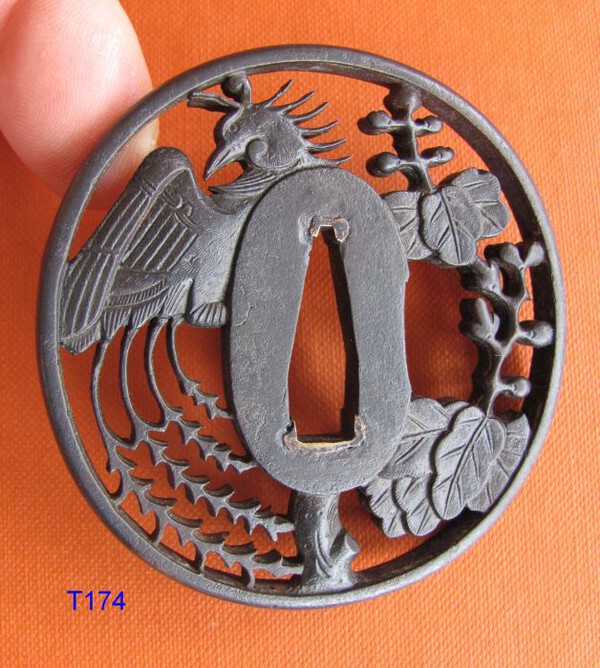
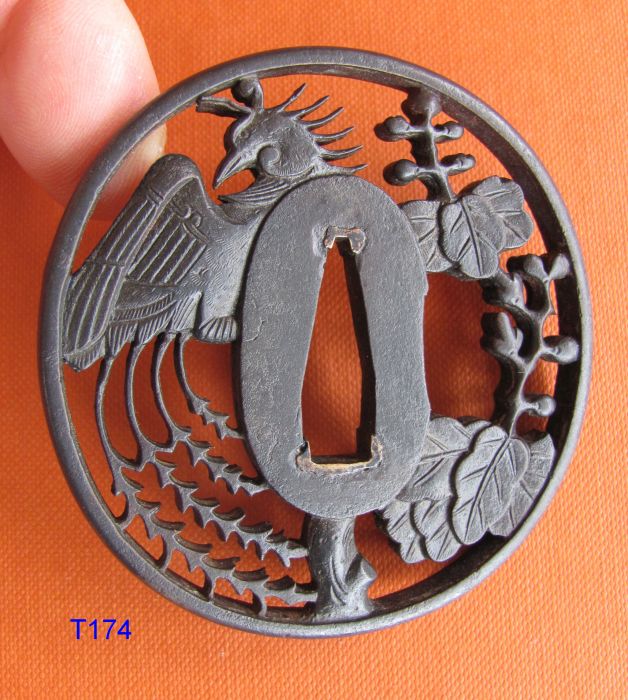
Hi Junichi I suppose if we want to look for evidence of anti-Tokugawa sentiment in tsuba we might start by examining the works produced in Choshu and Satsuma, both these domains being veritable hotbeds of dissent. Here's one example that might count, a Choshu tsuba featuring a Ho-o-bird and the Imperial Paulownia crest, an overt signal of allegiance to the Emperor as opposed to the Shogunate perhaps? From Grey's site btw. I imagine it would be a fairly simple project to survey Choshu and Satsuma tsuba to look for similar possible anti-shogunate expressions. We might discover the hidden language of Choshu botanical themed tsuba designs. Perhaps this might be a new thread, the topic might yield some interesting observations and there are certainly more than enough fine examples of both schools published in print and on-line.