Ford Hallam
-
Posts
3,091 -
Joined
-
Days Won
78
Content Type
Profiles
Forums
Events
Store
Downloads
Gallery
Everything posted by Ford Hallam
-

Data And Details On Teppo Needed
Ford Hallam replied to Ford Hallam's topic in Tanegashima / Teppo / Hinawajū
Thanks so much Steve, from the look of what you've provided I think I'll be able to garner exactly what I need. You're quite right regarding the apparent scarcity of zinc in Japan. In fact there were sufficient deposits of the ore but as they are not the same types as those found in China they weren't identified as such until the late 19th century, and then by an American geologist called Lyman. In the 17th and 18th centuries literally tons of distilled/refined metallic zinc was imported from China in to Japan and was one of the major imports of that period. -
Greetings Denizens of the gun club :-) As part of my ongoing metals and alloy research I'm trying to develop an accurate picture of the introduction of brass in to Japan and an idea of the sort of volume that might have been imported or made locally. From what I can gather much of the early brass used in Japan would appear to have gone into the manufacture of Teppo and the like. What I'm interested in at this stage is any texts that might present historically verifiable data about the numbers and types of weapons made, where and when. The number of gunners, for example, at specific battles whose dates we reliably know. I'm familiar with the origins and early development from Portuguese examples etc. So I'd be most grateful to receive guidance and advice from those of you gentlemen who are far more familiar and well versed in this subject than myself. Thank you Ford Hallam
-
When Did Screws Appear In Japan?
Ford Hallam replied to Peter Bleed's topic in Tanegashima / Teppo / Hinawajū
This little tit-bit may be of interest in this thread...oops, almost a pun. "Although our house was built in Japanese fashion, I wanted a door that could be locked, so I called a metalworker to make hinges. No screws were to be had. The man asked what they were, so I showed him an iron screw from one of my boxes. He took it away and the next day brought a dozen brass screws beautifully made and polished. He had embedded a round stick of wood in a cylindrical mass of moulding sand and then in twelve places on the sides, screwed my screw in as far as the wood. Then he had encased the whole in moulding sand and had withdrawn the screw, withdrawn the stick and poured in the brass. He had made several such moulds, and showed me a core with the rough screws attached....That man could do anything in the way of metalwork." My Reminiscences by Raphael Pumpelly. 1918. Pumpelly was one of the first foreign experts (he was a mining engineer and geologist) to be invited to Japan and lived in Edo in 1862. -
The first question is wrongly worded as it presupposes that tsuba and fittings were actually cast in the past, ie; pre-industrial Japan. I think the more appropriate question should be; Do we have any evidence that iron casting of tsuba and fittings took place? As to Namban tsuba (with the appearance of age) that might appear to be cast, this notion remains contentious because both claims are unsupported by evidence and rely solely on subjective guesswork. Both points, "is it really cast iron/steel", and "how old is it?" must be reasonably accurately established before we can proceed from that claim. I've yet to examine a genuine ferrous Namban tsuba (I've been looking, with the eyes of a professional craftsman for well over 20 years now and must have examined at least a couple of 100 by now) that looked cast to my eyes and the few that have been scientifically examined by material analysis or 'x-ray' have been revealed to be wrought iron. The 'x-ray' (not actually real x-rays) technology being employed in recent years is very sophisticated and is actually properly described as Time of Flight Neutron Diffraction (ToF-ND). This is a non-destructive technique that allows for the characterisation of the micro-structure of archaeological artefacts to be established using the power of the neutrons to penetrate through several centimetres of metal. There are countless research papers and archaeological reports going back over the past 30 years that explore the broader subject of ferrous technology in Asian, in particular China, Korea and Japan. A familiarity with present academic understanding of the subject will be enormously helpful in building a more evidence based understanding of the uses of iron or steel casting in Japan. In addition I would direct interested readers to the 1712 encyclopaedia the Wakan Sansai Zue, itself derived from earlier Chinese encyclopaedias and expanded to reflect the Japanese context. This comprises 105 volumes (or subject headings) in 81 books and took 20 years to compile. It's regarded as the definitive document of the period. Edo period technology, metallurgy in particular, is well documented. Spoiler alert, there is no chapter on the sophisticated technology of tosogu casting in ferrous metal.
-
wittier than I thought.
-
Hi Chris sorry to be the barer of bad news but I'd confirm what has already been suggested. This is indeed a cast copy. This means that it's relatively modern, certainly no older than 30 years. The type of technology needed to replicate a tsuba in steel by casting, (making a mould of the original etc.) simply wasn't around in the Edo period. As Brian pointed out the seppa-dai (the oval flat form in the centre) looks 'wrong'. I'd describe it as appearing ever so slightly over inflated, if that makes sense. And the finish on the flat is pretty crude, it ought to be a neat and level plane suitable to be a platform for the seppa and to provide a secure and stable assembly. The edge of the nakago-ana (the tang opening) on the front, left side, shows that the mould didn't fill properly. That 'lumpiness' is a give-away. A similar effect can be seen on the narrow edges of the ryo-hitsu (the two framed opening on each side of the seppa-dai) too. There are other, less easily described, features of the metal surface that add the the overall impression of it being a cast copy.
-
Peter the column of characters (hard to properly make out in the photo) on the right appear to suggest this is a Goto school work. Questions of authenticity aside. Mitsukatsu isn't ringing any bells here either.
-
Hi Brian, Alex I think the workmanship is very good and does convince me that this isn't a simple copy. There's something about the confidence in terms of the carving and regularity of the little wave crests that suggest this maker was very experienced in carving these forms. The thing is we actually know very little about studio practice and convention. Big names and studios signed their works because it was advertising and the customers were paying for that big name label too, how else to impress your less refined mates? so I'm not happy ascribing big name status to unsigned work, and don't buy the 'it was commission' story either. No other artists in the Edo period were that humble Having said that it might be the case that a senior student, prior to being granted the right to use a school art name, was allowed to sell work done in the school style but unsigned. Atomei (a fake signature added later by nefarious scoundrels) would then be a strong possibility. And this brings me neatly to one of my gripes about the state of tosogu study. We need to start looking at these works in the same way as other fields of art are studied. I made mention on another thread recently that to date there has been no thorough or comprehensive study of the varieties and styles of wave carving within the Omori school. Just that visual analysis alone would be a helpful start. I would suggest that within the scope of such a survey it might become possible to discern the individual traits of specific masters technique and perhaps even how those details were carried on by their students.
-
In genuine mei the 4th kanji doesn't have that little upturn hook. As this one is written it's correct in terms of the actual kanji but Teruhide 'wrote' his simply sweeping down. Lucky find in any case.
-
For a reasonably thorough introduction to the various tsuba/tosogu schools and makers I'd suggest that the Red Cross catalogue might be a good start in forming a basic understanding of the broader subject. It's all b&w photos but it does provide a great many examples to help form a visual reference in terms of what each school's work looks like. Japanese art & handicraft : an illustrated record of the loan exhibition held in aid of the British Red Cross in October-November 1915. by Henri Joly. (the 1976 reprint is generally available for under $100 or perhaps as a free pdf on0line) Helen Gunsaulus' text in the catalogue of the Field Museum, Chicago would be an alternative although the Red Cross catalogue is better for the images. Here's a link to my dropbox for a pdf of the Gunsaulus book. Happy Christmas :-) Japanese Sword Mounts By Helen C. Gunsaulus
-
Just to clarify, Darcy, because based on what you've written it seems you didn't 'get' my point and completely misconstrued what I wrote. (Strawman?) All I was pointing out was that the different generations of the Omori school have their own characteristics and are quite distinct from each other. That is all. The reason I made that point is precisely because when we speak of a genuine Omori piece we ought also to be clear about which particular Omori master we mean. Not to do so merely leaves it all a bit meaningless.
-
Brian, a friend of mine had one of these, but un-gilded. I was covetous of it for many years :-) Actually the base is classic Miyao Co. stand but the figure is incongrous. It it were a genuine Miyao piece the skin of the man would typically be a ruddy reddish copper, and the bronze a more brown tone. I'd expect to see some silvered details also. I think this has been 'fiddled' with or jazzed up to enhance its saleability. And that gold hammer head is too much :-) . If you do an image search for Miyao bronze you'll see how this fellow is a little different.
-
Stephen, that was actually why I wanted it, to do a study of the technique as I think it's a very fine example of that type of chiselled iron work.
-
Chen Chen you made this a black Friday for me ...I've had my eye on that one for a while now, and have been saving up spare tsuba cash and hoping it would still be available when I was able to grab it. I suppose the family will now at least get some Christmas presents instead
-
it is possible to completely 'erase' a gimei from tosogu. Done skilfully the job would be undetectable and shinsa judges unaware of the 'correction'.
-
ah, how stupid of me not to have known and taken it into account.
-
the 'star' at bottom centre clearly impinges on the seppa-dai. Both the dead centre, bottom position ( a complete 'no no' in Japanese design terms) and the intrusion onto the seppa-dai indicate a fake/ tsuba-like-object. I merely mention this additional point for other readers who might be interested in a reasoned analysis of what we're looking at.
-
Plum 'vinegar' is mostly a salt solution (I believe there's a little acetic or malic acid present) that is a by-product of pickling Japanese apricot/plums, ume-boshi. It will effectively strip off all patination ferrous and non-ferrous metals. Unless the metal is thoroughly neutralised after this process the salt and other residues trapped in the now very 'open' steel structure will reasonably soon begin to rust again.
-
The rust we see in the first images is perfectly natural and the resultant surface condition as seen in the image after cleaning is exactly what I would expect to see as a consequence of that degree of rusting. It's important to understand that pre-modern Japanese steel was never fully molten with the result that when it corrodes it does so at the gaps between the fused particles of material as consolidated in the forging process. This is why it may appear porous and friable. The tsuba itself is a genuine Edo period work and was, when new, evidently quite a fine tsuba. The piercing and carving, the shaping of the nakago-ana and hitsu etc. are all very skilfully done. The 'softness' of the detailing is quite deliberate and is evidence of a skilful carver's hand. From what I can see the rust was removed by means of an acid pickle which while completely eliminating all trace of rust also leaves the metal looking very grainy and coarse. This is not a good surface to develop a decent protective patina on.
-
I have to agree with Grey on this one. Pretty bad modern casting. The biggest 'give-away' is the flaw in the cast at the bottom, 6 O'clock, on the rim. A fukurin is an applied strip of sheet metal, what we see on this 'tsuba shaped object' is clearly not sheet metal. Some silver plating that looks like bird sh1t and gloss black enamel paint ground completes the attempt at deception.
-
Brian, I've been patiently waiting for someone to put things right here...I couldn't bare the suspense any longer
-
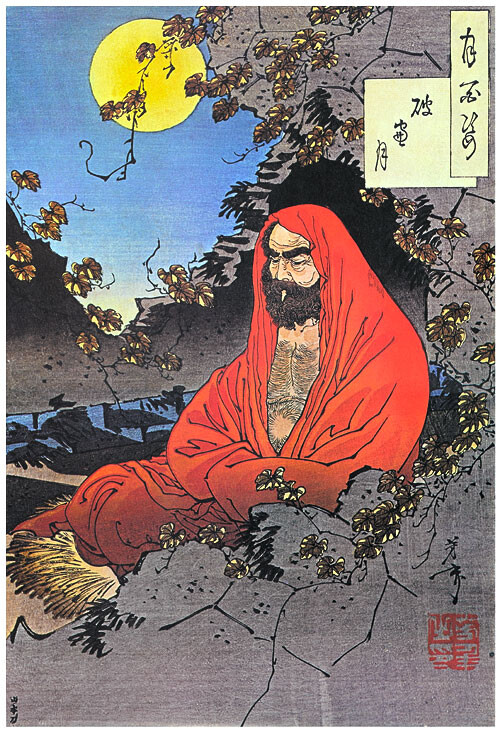
David, I would have to agree with Henry. My understanding is that today the Daruma is generally considered to be the roly poly doll which is a representation of the historical figure, Bodhidharma. The print you cite is described as being of Bodhidarma despite being in the wikipedia entry on Daruma dolls. But Daruma and Bodhidarma are actually the same person anyway.
-
Johnny ...for your edification and your delight and while I'm feeling mellow, now that my bags are packed and all of my usual concerns must be shelved while I'm off in 'the colonies' for a couple of weeks teaching as of tomorrow, i want to say how much I actually appreciate and enjoy our community. Don't worry, on my return (26th October) normal service will resume
-
Jean, you know me, I'm like the Mother Theresa of the Tosogu world. But on a serious note, if I am correct, and I'm pretty sure I am, then this is the third modern fake of this 'cleverness' I've seen in the past 12 months. It was only a matter of time before modern jewellery casting processes ( high definition vacuum casting) were used to copy genuine old pieces. I'm off to the USA tomorrow morning early but when I get back in a few weeks I'll try and put together a primer to help spotting this new generation of fakes.
-
The mei is a very half hearted attempt at a Goto Mitsu ? and were probably added by someone with a sense of humour :-p The workmanship is as rough as an old goats knee. Looking more closely I would guess these are very recent cast copies of mediocre (I'm being kind) late Edo tat. Probably not even shakudo. Edit to change my opinion from 'I would guess' to 'I'm pretty confidant these are modern, (very recent) cast copies.'