Ford Hallam
-
Posts
3,091 -
Joined
-
Days Won
78
Content Type
Profiles
Forums
Events
Store
Downloads
Gallery
Everything posted by Ford Hallam
-
Manuel, Brian We do see copper and brass together on Heianjo work. The shibuichi drops are more likely silver, it's possible they're original but may have been added later. If they are actually shibuichi they'd have been added after the start of the 18th century. Personally I wouldn't regard these brass inlay guards as belonging to organised schools as we think of them in the Edo period. It seems to me to be more of a communal production in that certain styles became popular and were centred on certain areas of production. It is often claimed that brass was at one time very expensive in pre-Edo jpan but I can find no evidence to support this assertion. In fact although zinc was never actually mined and refined in Japan until the early 20th century and was always imported from China it was used to make copper go futher. It was cheaper than lead and allowed the alloy to melt more readily. Brass coinage in China only really appears in the last 1/4 of the 16th century so that source of brass for the inlays is likely also unlikely in my opinion. It's also important to recognise that what we today see as a lack of originality was not necessarily regarded as a negative thing at all in the past. Continuity of style was highly valued. One only needs to consider the survival of the Goto to recognise that the 'powers that be' valued that tool (unchanging styles) for maintaining a sense of stability and continuity.
-
Sergei this one is about as easy as they come. A 5 minute image search for "brass inlaid tsuba" will bring up many similar examples. Half an hour of study will then leave you pretty well eductated as to the varieties of brass inlay on iron tsuba. I could give you a fish and you'd have a meal for today but if you learn to fish yourself you'll have a hobby you can waste money on for the rest of your life Good luck Ford
-
http://www.nitonuk.co.uk/xrf-analyser/# I've used one of these in my own research recently and have plans to organise a broader analysis project but that must wait until my present work is completed. And £25 000 f0or that handheld gizmo may take a while to raise. However the data it will deliver may in some cases transform our present understanding of Japanese metalwork datings and in others serve as a valuable confirmation of authenticity. I may even issue papers. At least mine will be objective.
-
Luca there are a couple of non-destrustive methods for analysing metals but nothing is cheap, I'm afraid.
-
A systematic analysis of the brass used in these pieces would be a helpful start. Specifically the cadmium levels which recent research has revealed may determine a pre or post 1573 ~ 1620 dating. And btw. it's highly unlikely there's any validity in the notion early tsuba with brass inlay used Chinese brass coinage as the source of the brass.
-
-
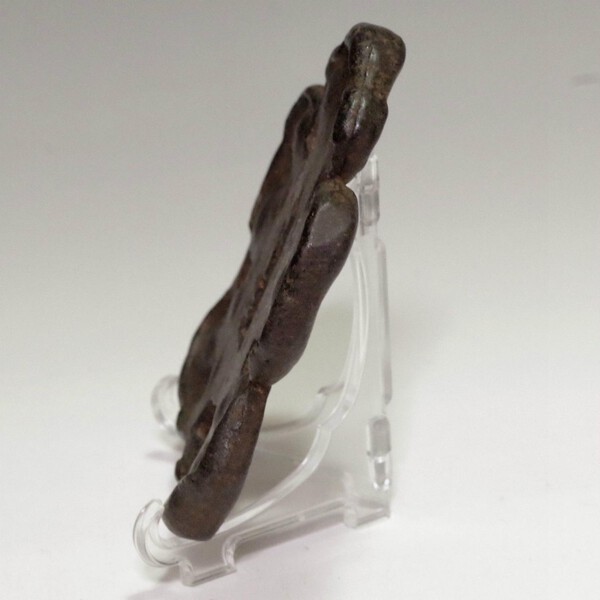
and another one, evidently these things breed like rabbits. http://www.ebay.com/itm/Tsuba-Antique-Japanese-Iron-Sword-Hand-Guard-Myochin-Munetoshi-Signed-2062/321895958315?_trksid=p2047675.c100010.m2109&_trkparms=aid%3D555012%26algo%3DPW.MBE%26ao%3D2%26asc%3D34008%26meid%3D4b32f982ec74449982dd18b873e600aa%26pid%3D100010%26rk%3D1%26rkt%3D11%26sd%3D331700689525

-
This incense burner motif was a 'seal' of Mitsuoki Otsuki, I've never see it used on its own without an additional inscription. For a similar example on a kozuka see the Lethal Elegance catalogue or search the MFA on-line collection. Sadly Mitsuoki didn't make this piece, he really was one of the very finest artists of the tradition and this work simply doesn't meet his standards. Technically it is ok but lacks flair and the composition feels very predicatable. Mitsuoki's was one of those artists who actually did paint their own designs, his work very strongly reflects his paintbrush.
-
Hello Bruno It is customary to use the term 'Nara School' but to my mind this is problematic in terms of stylistic attribution. The three most notable 'Big names' of this group are Nara Toshinaga, Tsuchiya Yasuchika and Sugiura Joi. We must also include Hamano Shozui and Horie Okinari. Each of these artists was a product of the Nara family group but each is so distinctly individual that it isn't helpful to regard them as being representative of one school style at all. Once this distinction is recognised it may be possible to descern a variety of influences in the work of less famous or unknown Nara group workers. To my eyes your tsuba mainly exhibits traits of Nara Toshinaga. This is not to suggest the maker was a member of either Toshinagas studio but merely that he was conciously working in their style. I am firmly of the opinion that if a work is unsigned then it ought not to be attributed to any 'big name'. One or two Higo artists might be exceptions. (Musashi is not one of them ) What you call sentoku is almost certainly brass or shinchu. Sentoku is quite a different alloy and doesn't appear in tosogu until the Bakamatsu period at the earliest. Despite the claims of an earlier tsuba-shi who was clearly just monkeying around. ( a nod to the wise). Having said that the yellow metal on your tsuba seems to be gilt, or gold alloy. I hope that adds a little to your appreciation of your tsuba. It's a pleasant enough work. regards Ford
-
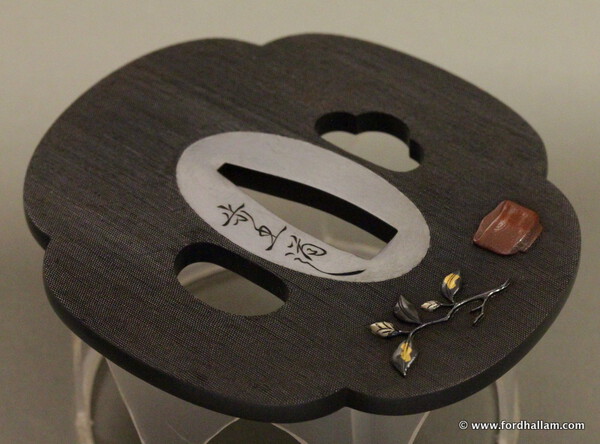
Thank you Gentlemen, glad to hear you approve. :-) It's hard to capture the actual colour of newly patinated shakudo, this image is a little better. I was rushed as the piece had to get in the post to go to London for installation today.
-
signed, details added and patinated.

-
https://www.youtube.com/watch?v=3OESAtriTKk if you'd like to see a tiny bit of film showing nanako being created.
-
Brian, it always has to be a single dot punch, multiples take too much force to impress ( I liked the pun btw ) and the grouping would inevitably be visible as a patchwork in the finished ground. I was averaging 1000 dots an hour, that's an area of about 1cm square. By the end of the job I was comfortable doing 90 minute sessions but it's really quite exhausting to focus so tightly for so long. Your mind really does have to be utterly quiet and your attention completely unwavering.
-
Cheers Gents, glad you enjoy the piece. As for going mad doing nanako, I actually found the process quite relaxing, even contemplative once I really begun to 'get it'.
-
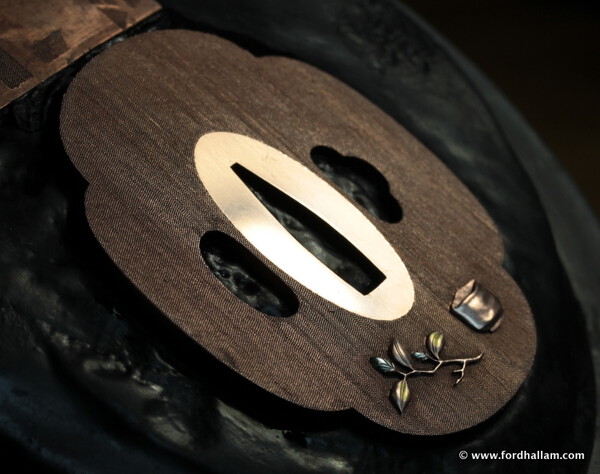
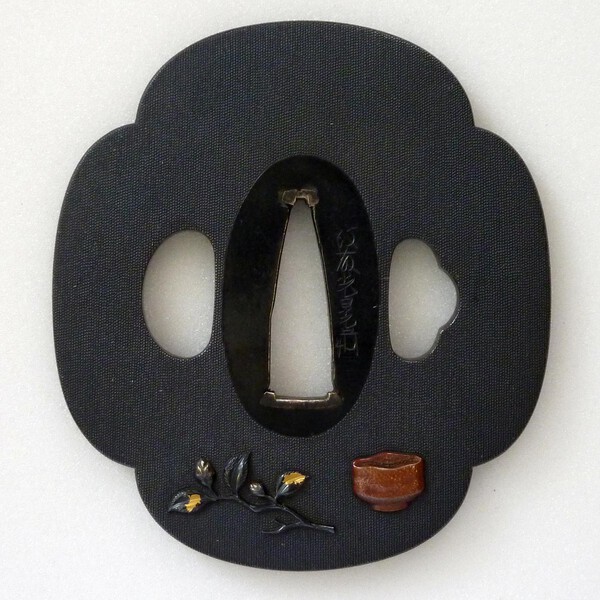
Why is nanako just a long drawn out joke? 'cos it takes ages to get to the end of the punch line. (apologies to Greg Irvine) About 25 000 individual grains on the front, each about 0.3mm in diameter. I've estimated that the front, back and sides would be about 60 000 grains and take around 60 hours to produce. This is an utsushi (unpatinated and with some fine details yet to be added) of a piece by Goto Mitsuakira (16th gen Main-line. 1816 ~ 1856. ) held by the V&A in London. It will be on display alongside the original (below) and a short film showing some of the processes used in the making of work like this. The new Japanese galleries will be open to the public from the 5th November 2015.
-
"...before plating the tsuba in Shakudo" !
-
I think it looks a little too flat and relatively featureless steel to be very early. So not 'Ko' anything imo. As for school it may be a moot point given that later in the Edo period designs were routinely copied or shared by any number of tanko groups which makes often absolute categorisation impossible. One could argue for Shoami, Owari even Nishigaki... Having said that, when in doubt say Shoami there were so many groups of them all over the place you couldn't toss a tsuba without hitting one, back in the day.
- 1 reply
-
- 2
-

-
I'd agree with Brian, but lean a little to Nara with a decidedly Toshinaga school/style influence. The pose of the tiger isn't exactly classic but therin lies some of it's charm I think. If the gold stripes are slightly raised this may not indicate they are applied gilding though. One consequence of patinating shibuichi can be the slight etching of the metal which would leave the gold slightly proud. The stripes do look to be inlaid wire to me.
-
sooo...photo is still not much good the focus is on the first strip of hilt binding not on the actual fuchi. But from what I can make out I'd offer the following. The waves seem fairly well delineated and shaped. The gold details seem fairly lightly gilded ( fire or murcury gilding rather than a more robust foil application called uttori) this suggests a later date of manufacture, perhaps the latter half of the Edo period. Stylistically they appear to be the work of the Mino school. The Kiku or Chrysanthemum flower is a symbol of longevity in Japanese tradition but also (in a more stylised form) the crest of the Imperial family. The chrysanthemum and waves/water motif (kiku-nami, kiku-sui) is quite common in Japanese decorative art. The ebb and flow of waves may suggest strategic flexibility.
-
Pictures of the whole tsuba, front and back would help. As for the 'kiku' punch mark on the seki gane I very much doubt they can be regarded as any sort of trademark. Hana-tagane, (flower punches) of which the kiku pattern is probably the most commonly seen, were a part of any professinal metalworker's tool set from at least the early Edo period. I've seen it used in many different schools from early Higo pieces to late Mito works by Unno's Shomin, Moritoshi et al. where they appear to have been applied as a variant of 'kuchibeni'. It's just too simple a tool to make to regard it as distinctive. I use one myself, ocassionally
-
Cheers Ed , my book, which has morphed into an encyclopedia, will hopefully provide a reasonably reliable introduction to metals and alloys as used in Japan in the past.
-
Hi Curran , glad to be able to add something of use. In my opinion Ko-Mino work can often be of very good quality. Both in terms of workmanship and materials. After all, who taught Goto Yujo his 'Mad Skillz'? At present there really is a darth of hard data in terms of metal and alloy analyses so it's hard to be certain about the gold caratage they might have used. Having said that my impression is that it tends to look like 18 to 20ct. That's 75% ~ 83% gold content. Pure gold would simply be far too soft I think. And as you noted they didn't seem to fiddle with the surface colour. I think that coinage is very likely to have been the source of the gold at this time also.
-
Steady on chaps, I don't even love me but I appreciate the sentiment.
-
Thank you Jean it's nice to know my input and time is appreciated by some.
-
Kin sabi (gold rust) has long been belived to be an indicator of age on things like menuki. However this is not the whole story. The effect is in fact an artificial one and quite easily applied. The process is explained in 'The Craft of the Japanese Sword' as used by habaki-shi Hiroshi Miyajima. It's described as restoring the original pure gold colour to the gold alloy being used. And while the ingredients do leach out the non-gold elements from the surface, thereby creating an enriched skin, it also leaves behind traces of copper salts. It's these copper salts that we recognise as 'gold rust'. Other recipes omit the copper so will enrich the gold surface without leaving that red tinge. The mixtures typically contain things like salt, saltpetre, ammonium chloride, frankincense and copper sulphate. I think the important thing to remember is that gold is rarely used in its pure state, particularly when the whole object is to be gold. Generally speaking Japanese craftsmen alloyed their gold only with silver. Copper addditions are rare and when present very small. It would appear, from analyses, that gold coinage was often simply re-melted for use in studios. The debasement of the gold coinage was a feature of Edo period economics. Any amount of silver might then further added to create more alloy to work with. The appearance of a richer gold would then be recreated once the piece was finished. This surface enrichment, being quite superficial, wears away over time. This is why we see many gold menuki that are quite pale. It's unlikely they left the shop looking that insipid 'back in the day'. There is also class of gold alloy called ao-kin (green gold), with up to about 20% silver added, these have a distinct lime yellow tone which you will have seen in contrast to pure gold on pieces with fine inlay work. Where menuki appear more pale than ao-kin it follows that more tahn 20% silver is in the alloy. It can be as high as 40 or even 50% and still be treated to look like pure gold on the outside. Gold and silver was also bought from official Shogunate appointed guilds, called Za in Japanese. Gold from the Kinza, which was run by the Goto and silver from the Ginza. And yes, that Ginza was in Ginza in Tokyo. :-) These guilds were first established by Hideyoshi and continued by Ieyasu.