Ford Hallam
-
Posts
3,091 -
Joined
-
Days Won
78
Content Type
Profiles
Forums
Events
Store
Downloads
Gallery
Everything posted by Ford Hallam
-
Jason no. If you place any ferrous metal tsuba in a rokusho bath it results in an electochemical reaction and the tsuba, and any inlays, are copper plated. Trying to mask out the iron is a waste of time.
-
Jeff, I only meant the patina that was on the copper and brass was unlikely to be original. I say that because of the overall condition of the tsuba when you aquired it, clearly it hadn't been cared for. Best to leave it alone to develop a patina on it's own. Anything you can apply may tarnish it but it won't be 'right' and will stand out as an obvious touch up.
-
I think you did a very credible job, nicely done. I wuldn't worry too much about the loss of patina to the copper and brass, it wasn't original anyway and will redevelop soon enough.
-
It makes even less sense to refer to kinko work as 'mass produced' given that we know essentially nothing at all about Edo period workshop practice. And what, in the context of Edo period technology, does it mean anyway?
-

What's All This Then?
Ford Hallam replied to Brian's topic in Forum Technical Details and Maintenance
Brian I approve Much better overall feel to the forum. -
Patina on metal are unaffected by paintstrippers. They're two completely different chemistrys. But if it's just a small area I'd use nail polish remover, as Alan suggested. It's advisable to re-wax once you've removed the paint.
-
oops, it was late more than 2000 years BC, was what I meant to type. I was just writing from memory. And Brian, that article actually perpetuates the myth that the technique was lost and only redescovered in the 19th cent but this is not correct at all. This is partially true in Italy but the process has been in use pretty much continually in various places. The birth of the myth of the rediscovery of the ancient technique co-incided with the interest in archeology and antiquities in the 19th century in Europe. Here's a more accurate paper on the subject, and written by an authority the other article mentions yet evidently failed to properly consult :D The author seems to have read hos 'Short History' but not his later work ' A re=assesement of established concepts'
-
Brian, gents for what it's worth here are my thoughts. The shakudo surround and nanako are undoubtably of Japanese (Edo) manufacture. The gold inserts, while having some similarities to Hirata work (the enamellists) features some significant technical differences. tThe counter twisted wire border for one. But the main difference is the fact that in Hirata work the wires and beads are secured by the actual enamel. They're held in place while firing by means of an organic glue paste. In the Meiji period is was made from Hibiscus sap but fish skin glue would be more probable 'back in the day' On these little pieces, though, the gold appears to be fused, and without the use of solder. This means it's true granulation work. A technical explanation of the technique would be too tiresome to type right now but it can easily be googled. It's generally beleived that granulation was originally developed by the Sythians (Siberia , Russian Steppes) more than 2000 years BC. It subsequently spread to the rest of Asia, the Near East and parts of the Mediterranean ( essentially Greece and Italy, then Etruscan, but also Egypt) so these present examples may have come from almost any of those cultures. The Japanese metalwork culture does not seem to have practiced he technique at any time in the past though. Stylistically speaking they're fairly basic in terms of the sorts of arrangements of beads and wires. We can probably find similar elemants in every tradition that practiced the technique so picking an origin may be impossible. As to age, again, we can find similar work being made exactly the same way today as 1000 years ago. My bet would be 19th century Indian or maybe Thai work of a slightly earlier date. Having said all that it is possible that some clever fellow, back in the day, just got a bit crazy and made something completely different....but I doubt it Granulation work is pretty clever stuff.
-
Hmmm....this provides some interesting food for thought. With reference to some thoughts expressed on the NMB previously that contemporary tsuba can't really be considered true tsuba as they are not made with their primary function being the protection of the hand I am now forced to regard this 'sword' in the same light. As has been pointed out this blade was made with it's sole 'function' being that of a shrine offering. Given that a real sword's primary function is to cut does this then render the present example a 'sword shaped object' ? Yes, it could cut, in the same way a contemporary tsuba can offer protection to the hand if need be but if definitions are to be based on the motivations of the maker this 'not a sword' was not made for combat so does that make it a 'sword shaped object' ? :lol:
-
Jeffrey I suppose the quote was directed at anyone who might be offended by it... you evidently felt qualified to make a judgement call on ebay but fell for an obvious fake. And you trusted a 'legitimate dealer' there. Some might cry at that admission...or laugh. But I think what happened here was really inevitable. You presented a piece that you clearly didn't know much about, as you wrote; "I really don't know." There really is no doubt nor lack of consensus as to what the 'tsuba' is yet you attempted to save face by citing unidentified alternative authorities. "Interesting since I have opirions (sic) from members and other sources that disagree" This is both nonsense and rude. If you cite anyone or anything in a discussion like this it's only correct to identify your source so that others can evaluate your evidence for themselves. By keeping your 'other sources' essentially secret you're telling us you're not interested in continuing the discussion with us and that we're all wrong because you have counter evidence. And to continue with; "Sorry legitimate dealer said it was genuine so there you go. I'll fly it by some other sources just for the heck of it..." When you claim the backing of a 'legitimate dealer' ...on ebay you immediately reveal your vulnerability and leave me thinking you're a sheep waiting to be fleeced. But by all means fly it by other sources, until you hear what you need to hear. Your dismissal of the input here was obviously seen as very arrogant by most people. Now you may feel that some posts were a bit blunt but frankly, as has been pointed out, there's no reason to be so gullible. It's up to you though, how you respond in the long term, to this experience. For myself, I tend to ignore members who've reacted as you did, until I see a change of heart. Getting all bent out of shape and prickly rarely leads to any good here because most of us are past masters at being awkward buggers :D BUT you won't find a more supportive and encouraging group anywhere else. edit to add: Jeffrey, you wrote this in reply to a perfectly reasonable post from Jean. Jean simply pointed out the obvious and he's absolutely right. You are ignorant of the subject and your behavious was moronic. You really have no idea how knowledgeable he or anyone else here is....you're the one with egg on your face. It seems to me that you're the real loser, in every sense, and it's probably best if YOU bugger off now.
-
Bruised egos aside I think this paper is perhaps apropos. http://www.jerwood-no.org.uk/pdf/Dunning%20Kruger.pdf "In essence, we argue that the skills that engender competance in a particular domain are often the very same skills necessary to evaluate competence in that domain."
-
Hmmm...I owe the members of my forum an apology methinks. I reckon they'd do a better job, or they'd better!
-
I'm afraid you appear to be the proud owner of an ebay school 'tsuba'. The bee is in fact an etched decoration. The etching process was used in the Edo period, notably by the Jakushi group and in Higo province. However, in this case the design placement and overall feel of the workmanship look essentially new to me. It actually looks like something any one of the tsubamakers on FTIB might make in a day or two.
-
Screams Higo to me. no puzzle I can see...
-
Thanks all, glad you enjoyed the transformation. For me there's something intensely satisfying to be able to recover work like this. and Brian, you snooze you lose
-
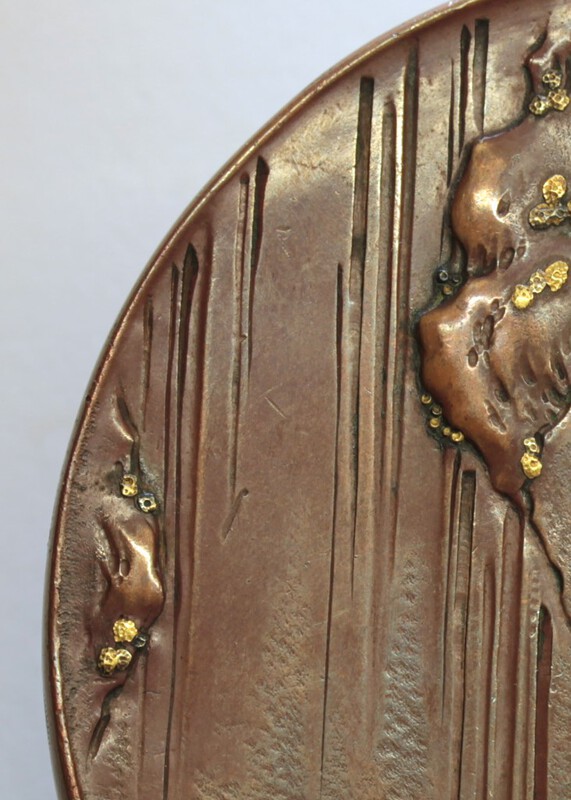
As I think my earier comments indicated I felt this tsuba was not too shoddy a piece of work. Bob thought so too so he grabbed it and then sent it to me to revive. The 'crack' on the bottom edge of the nakago ana turned out to be a hair so that issue was easily resolved :lol: The dent on the edge near the figure's head needed a little bit of enouragement to push out but the result is pretty neat, I feel. Reshaping the rim did result in a cavity of the outer face of the mimi so that had to be filled with a bit of copper inlay. As you can see the repair is now invisible. The mimi has also been repolished to eliminate a number of ugly scratches and dents as has the main section of the waterfall on the rear to similarly eliminate a rather distracting dent. This close up shows sulphide crusts, traces of verdigris, grime and oxidised wax deposits. Much of the gold had developed a silver sulphide crust as a result of the silver content of the alloy tarnishing. This has now been removed as has the sulphide layer on the silver ken and the dents worked out also. Various minor marks on Fudō's face have been polished out and the original colouring overall re-established. I finished the piece off with some gentle 'aging' and wax. And this is what it looks like now.


-
The original was designed by Kitao Kōsuisai (Shigemasa) and is named Sankō ni-ju-hachi Kishō. The image I posted is actually of a scan on an original woodblock print. The artists shown are, from top centre and going clockwise Yokoya Sōmin (1670 ~ 1733) Tsu Jimpo (1667 ~ 1737) Nomura Tomoyoshi Ozaki Naomasa , with spectacles (d.1782) Ichinomiya Nagatsune (1722 ~ 1786) Tsuchiya Yasuchika I , examining a kozuka and also wearing spectacles (1670 ~ 1744) Yoshioka Buzen (no Suke Shigehiro) (d.1753) Hamano Masayuki, pointing discreetly at a banana peel. (1696~1769) Hamano Noriyuki ((d.1787) Then, in the green Haori and resting his chin on his hand is, Iwamoto Ryōkwan (teacher of the more famous Konkwan) to the right of him and speaking over the shoulder of the man in front is , Furukawa Genchin The older gentleman at bottom far right is, Umetada Naritsugu (1678~1752) next to him, and holding his haori-himo in his hands is, Hosono Sōzaemon (Masamori) (c.1700) In the yellow haori with green number 'two's" is, Nara Masanaga slightly behind him, holding a fan (?) and in the bottom centre is, Ishiyama Mototada (1669~1734) just behind Mototada and to his left is, Nara Sōyō (Toshiharu) In front of Sōyō, in a striped haori and wearing a head scarf is, Nara Toshimitsu Behind him and leaning slightly backwards is, Nara Tsuneshige Behind Tsuneshige we have, Goto Seijō, in a green kimono. Above Nara Tsuneshige and Goto Seijō, and holding an opened fan we have, Mito Michinaga (d. 1768) Next up is, Murakami Jōchiku, the name plate only reads Jōchiku but I never forget a face. Incidentally two of his daughters were tsuba-shi also, Jōsui and Jōtetsu Behind Jōchiku and wearing a yellow haori is, Ōmori Terumasa (1705~1772) To the left and just above Terumasa we have, Inagawa Naokatsu (1719~1761) To the right of Naokatsu and looking off to his right is, Yanagawa Naomasa (1692~1757) Above him and facing us directly is, Yokoya Sōyo (d.1779) Behind him, and sporting two swords, is, Sugiura Joi (1700~1761) Behind him, and with what looks to be a Tachi, is, Hashinobe Masasada and lastly but cetainly not least, the grand old master, Nara Toshinaga (1670~1733)
-
Brian, They're all named in B W Robinson's book. And every decent self respecting collector ought to have a copy of THAT. :D if only out of respect.
-
Hi Peter this is the largest version I can post on the forum but I can email you a full sized copy at full resolution if you like. Just message me through my website and I'll send it on in reply.

-
http://fluorite.sakura.ne.jp/contentspage/kodougu/b_n_contents/bn003_072/bn003_072.html
-
Steve, well perhaps we've learned one thing, Kamiyoshi rakuju was a plagiarist. To be serious though, I wonder why there's this notion that the original tsuba on the Kasen Koshirae is considered to be Shoami if, as you point out, Kamiyoshi claims it as his design? I still don't think it's very representative of butterflies. Maybe Kamiyoshi 'borrowed' the design and he's the culprit that first misidentified the motif. My last 'defense'.
-
As written by the first Kamiyoshi?....even though it's supposed to be a Shoami piece by an unknown maker.... What I don't understand is that if 'so called'experts are going to make stuff up why they can't be more creative. Oh!, that's right...it's because they're generally not very imaginative. And therin lies the rub. And as has been observed; if all the 'authorities' say the same thing it may merely mean only one operson did the 'thinking'.
-
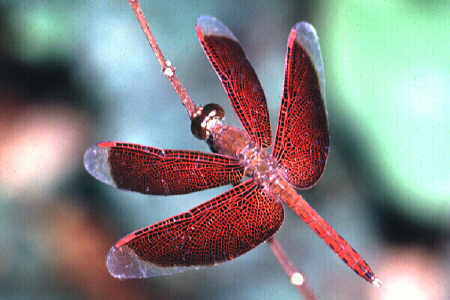
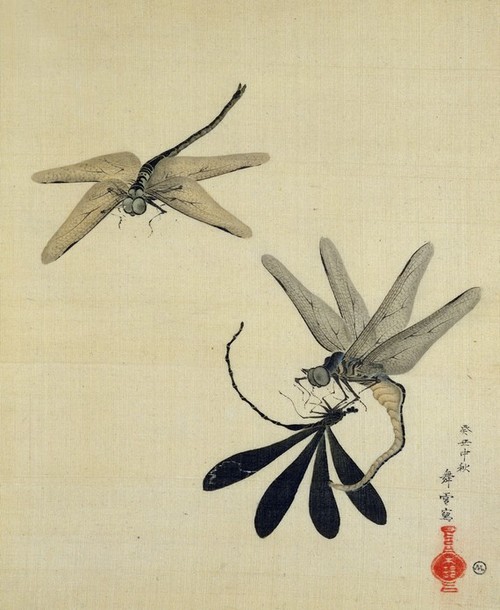
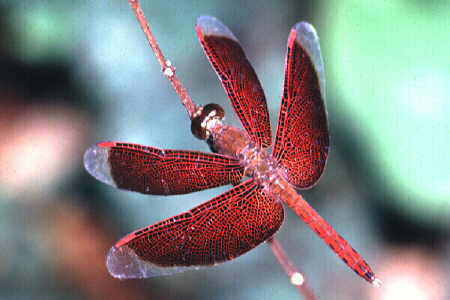
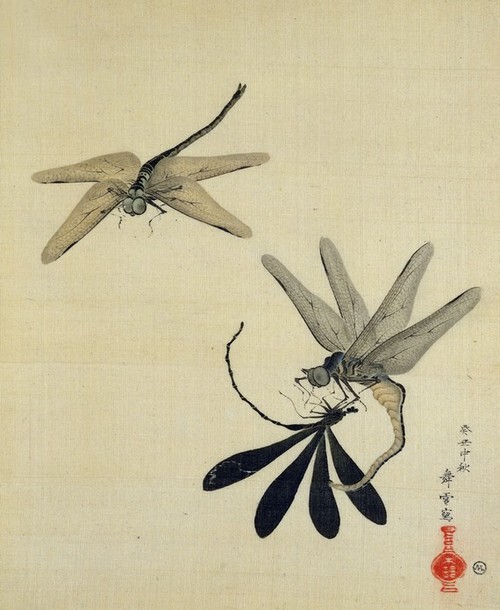
mea culpa :D I felt that given that butterflies are depicted with their antennae quite prominant as part of any design in Japanese art and that the Shoami tsuba didn't have any indication of them the motif was more likely to be dragonflies. Also, eyes are a minor design feature of butterflies wheras they are one of the most notable features of dragonfly designs. Butterflies are usually shown with pairs of wimgs, and wings which move slower compared to the whirring of d'flies. Dragonflies have long slender bodies and butterflies have short stubby ones. The angularity of the tsuba design feels more 'dragonfly' than the flitting, fluffy nature of butterflies. The negative spaces on the tsuba seemed to evoke the space the d'flies wings would span. Either way we'll never know for sure. I just find it boring that designs like this get labelled and then all thinking stops. When in doubt say 'butterfly'
-
Fantastic old film about the legendary swordsmith Miyari Akihira. This is shared with us on my good friend Allen Rozon's youtube channel Tamahagane Arts. The narration is well dodgy though https://www.youtube.com/watch?v=f7z9pkQnz_0 and another one, evidently a little later.
-
hah! the gold plating solution I use is stupidly expensive £1200 for 100ml!