Ford Hallam
-
Posts
3,091 -
Joined
-
Days Won
78
Content Type
Profiles
Forums
Events
Store
Downloads
Gallery
Everything posted by Ford Hallam
-
Sorry Brian but I need to clarify a very important point here before I am yet again misrepresented. David, I did not call you arrogant so please don't misunderstand. What I wrote was; To clarify, this is to say the act I described may be regarded as arrogant. That is all. Of your character I know nothing nor would I make any personal judgements of you personally. To do so would simply be rude and judgmental.
-
Yes David, all nice examples but according to your 'logic' all gimei until you've proved otherwise
-
I remember reading in B W Robinson's charming little book that one of the easiest ways to appear to be "one who knows" is to condemn everything as a fake. David, your own approach to the subject, such as it is, is your own business but to publicly offer an opinion like this based on a self confessed lack of any relevant knowledge seems presumptions not to say arrogant. That you then claim to regard everything as fake until proved otherwise in respect to something you are ignorant of is even more bizarre. Wouldn't it save everyone time if you didn't comment on things you "really don't have time to study" ? Or if you really need to be heard on every thread then maybe warn the OP that while you actually don't know anything about the specific piece in question your stand point is to regard everything as fake until proved otherwise. That way people can at least evaluate the usefulness of your contributions for themselves.
-
As John wrote this artist's mei does vary. The workmanship is very distinctive and absolutely spot on, in my opinion. The mei as inscribed on this piece is also pretty much the same as at least one I have in my reference books. Having said that there is a dated piece by him from 1691 (he's recorded as being born in 1656) but, as Joe Earl (in Lethal Elegance) points out this date appears too too early for the majority of pieces baring this mei. And while the style of the workmanship is always very much alike the mei do vary as do the kao. The suggesting being that there were 2 or maybe ever 3 generations working in this style. David will have to explain for himself why he maintains it's gimei, frankly I think he's very wrong in his estimation. David, have you compered any verified mei with this example? and how many bad copies of his work are there floating around that you've seem to find far more common?
-
Christian, I'm not so sure about the natural remedies aspect. I tried Shitan bark for my leprosy but it still hasn't cleared up.
-
Karaki.. 唐木, China tree?, and as Shitan was known as the Emperor's tree in China perhaps a synonym. An image search using these kanji delivers similar images
-
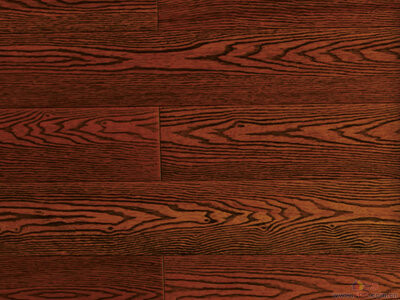
Cheers Chris, much better images search results with the proper kanji. This image shows nicely how the particular grain as seen on this tsuka is a result of cutting the wood at an angle through the direction of growth.
-
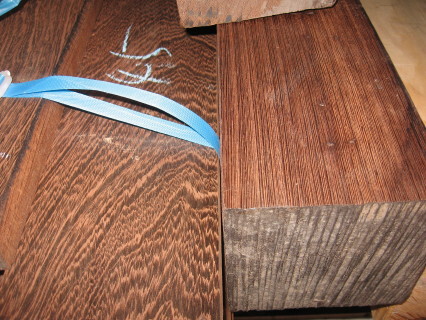
There are two woods most frequently seen as either tsuka or saya, these being red/purple sandlewood, called Zitan in Japan the other being ironwood. I think this one is Zitan. There are a few examples similar in the Boston MFA catalogue and the lacquer artist Shibata Zeshin used it often too. edit to add; I see Geraint got there before me :D That settles it then
-
John The lost wax process is around 6000years old and was employed in ancient Egypt also. As far as the Ashanti are concerned they appear to have been natural inheritors of a technology that developed in Africa, the Middle East and then India. It seems that it spread in to Europe via Greece and Rome somewhat later. None of the original developers of the process spoke French though, (French not having been invented back then) nor had flags. (Eddie Izzard colonialism reference) :lol:
-
Because this is a beautiful process AND it brings us back to Africa here's link to some great images that illustrate many of the sorts of details I've been describing. Ancient Ashanti castings are some of Africa's greatest treasures. This technique might have been perfect for casting iron or steel if it wasn't for the fact that the temperatures needed would turn the clay moulds into stoneware. I might have to give it a shot though. Here's the link.
-
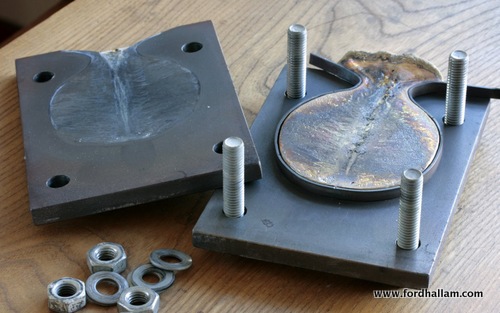
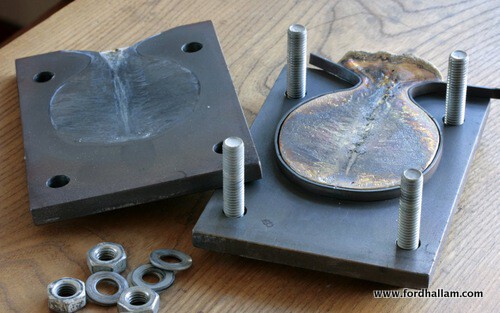
Geraint, hello, thanks for that link and description. Interesting technique but I can't see it having any use on a relatively small casting. Tsuba are around 200 grams, add that again for runners and the pouring sprue and we still only have 400g. With small items like this and so thin, one of the major issues is getting the mould properly filled before the metal starts to crystallise and solidify. Filling a mould as quickly as one can and then applying a damp cloth onto the casting sprue would probably be too late, I think, to have any effect. Even casting a tsuba sized plate (5mm thick) into a very hot steel mould results in the button, the big lumpy bit at the end of the pour, being solid almost as soon as the pour is finished. On a large bronze vessel it does take a little while for the metal to solidify so in that case I can see how that might work. I don't think I'll try it though. :D This is a photo of a brass type alloy I cast. Note the volume of the button at top, this provides a bit of extra pressure, but also note the fine layers on the face of the plate. This is not quite the cold shuts I referred to earlier but it's that sort of wave action of the metal 'freezing' as the metal fills up a mould that is such a problem to overcome when casting relatively thin section material. This is a largish open void to fill, imagine the vortices that are caused when molten metal is sent down the sort of network of tiny tunnels a Nanban tsuba has. Apart from issues of shrinkage, always a problem with thin plate casting, and the fineness, or lack of it, on the cast surface it would have been possible to cast simple plate like tsuba but again, for practical usage reasons, I'd be doubtful of it being in practice in the Edo period. Barry, yes, the Chinese were casting iron as early as 2500 years ago. There are many examples of a variety of cast iron farming implements and even thin walled vessels. But the leap from that to casting the sort of detail and delicacy we see in Nanban tsuba is a big one, especially without any literary record, as I wrote earlier, in a country that recorded all their technological and crafts processes. If Japan was capable of cast little delicate things like this at the end of the Edo period I think they'd have been very keen to show the world how clever they were at the various trade expositions they exhibited at. I think the real problem is that this notion is so entrenched that the usual approach to research has been inverted. All we have are the objects themselves. If they are cast tsuba we need then to establish a likely date of manufacture. But dates have been assigned before the issue of the technology has been studied properly and an idea of what was possible, and when, more accurately established. Here's another point to consider. Castings are generally identified by the presence of casting seams, as they are erroneously called. One explanation being that these lines or bits of flash (as they are properly called) result from the incomplete fitting together of the 2 sides of a mould. How then are these mould carved to allow molten metal to form interlocking loops etc. and the once the metal is cool be separated? Those seams we see are in fact evidence of the rubber mould that the wax model was created in. No seam results from an investment lost wax casting unless the seam was on the wax to begin with. And vulcanising rubber and high pressure wax injection wasn't available until after the second world war.
-
Morning John can't say I understand what steam might do in terms of improving a casting. The issue is really one of very specific technical problems. As flexible rubber moulds were not available we have to start with a carved wax model. Jewellers waxes today are amazingly well made to allow for remarkable detail and finnesse but in the past artists had to use a far soften composition of bees wax and rosin. There are limitations as to what you could do with the stuff, baring in mind the wax model is later melted out. Then we have to consider the mould itself. What refractory material could be so delicately worked into the interstices such as those we see on many Nanban tsuba? Plaster of Paris wasn't available. Bronze and tea kettle casting used a system of built up successive layers of various mixtures of clays, chopped straw and finely ground charcoal powder. And bare in mind the need to apply to the wax model a runner to allow the molten metal to be pored in, and various additional feeder runners to make sure the metal gets everywhere and sprues to allow for air and gas to escape so that there would be no trapped air pockets. And then the final problem to overcome is that of actually getting the molten iron/steel to flow fully and without what are called cold shuts (basically tiny hesitations in the flow of metal that causes a imperfect fill. A bit like adding wet cement to an already dry surface, it tends to crack off eventually) . The standard approach was simply to rely on gravity to draw the metal down to fill the mould. And you can easily imagine what a maze of potential air traps a complex composition of tendrils would present. With modern practices this might be overcome by the use of very controlled centrifugal casting. The moment the molten metal enters the mould it is spun thereby flinging the metal hard into the mould, or, more reliably and typically nowadays the use of a vacuum chamber around the mould. As the metal enters the mould the vacuum is released which sucks all the air out of the mould and instantly sucks the molten metal in to take it's place. Vacuum casting on a small scale for use in small workshops was only developed in the early '80's. the 1980's There's a good explanation here;http://www.bronzecasting.co.uk/5_kiln_cast/vaccasting_10.html Edward J Blackley, in the UK, produce very fine cast replacement parts for antique pistol restoration. But this sort of thing simply wasn't available anywhere until about 30 years ago. Of course there may be a way that cast tsuba in steel were made back in the Edo period....

-
John, sorry to confuse you. Simply put, detailed casting steel items like the Nanban pieces we're discussing would not have been technically possible until at least the latter half of the 20th century. In small scale workshops perhaps even more recently. As I've tried to explain, the technology simply didn't exist. No confusion really, if it's cast iron/steel (and who's analysed these pieces?) it's post Showa by a long shot. My point about the plethora of cast fakes being to demonstrate exactly how distorted this subject is, that so many who are making deductions about manufacture are so ignorant of the practicalities of real iron or steel casting and are also unwittingly adding to the subject these irrelevant modern fakes. I would add that in my own experience I've learned that many scrupulous students of tsuba have examined Nanban tsuba and interpreted various marks of their making as being proof of casting which I can't see in the same way. To reiterate my central point;
-
I don't believe there is any evidence that the technology required to cast such complex forms as many of the Nanban type tsuba exhibit existed in Edo period Japan, or anywhere for that matter. No one has even attempted to describe how this form of manufacture might have been accomplished using the same sort of processes that tea kettle casters might have used ( simple gravity feed of the molten iron in to a hot mould) nor has anyone found any literary evidence nor archeological artefacts that might suggest this was possible. I maintain that if a steel tsuba is shown to be cast then it's a modern fake or copy. Consider, if casting such relatively small and finely modelled pieces in iron or steel was possible in the Edo period why this wasn't rightly exhaulted as a technological marvel? Instead, it's use was reserved for producing lesser quality Nanban tsuba...and apparently nothing else. This simply seems a bit too far fetched for this pragmatist metalworker. In a culture where every conceivable craft process was recorded there is no mention of this remarkable ability to reproduce, one assumes from a carved wax model, steel items of such complexity without centrifugal or vacuum casting, which would be essential to force the molten iron/steel to properly fill the mould. Professor William Gowland produced some incredibly detailed accounts of cast iron and bronze technologies used in Japan at the start of the Meiji period (almost a DIY guide) , if there was any suggestion that the sort of iron or steel castings we're talking about were produced back then you can be sure he's have trumpeted it to the heavens :D ...but he didn't. :? and he was probably the most thorough researcher of the period we can refer to. And if I may refer to an old thread I started I would offer the following; "Cpt. Francis Brinkley arrived in Japan in 1867 and remained there until his death in 1912. This from Brinkley's "A History of the Japanese people" (1915)(vol 7, p 256) " For anyone unable to sleep at night here's a link to the thread i refer to where I lay out my position regarding cast steel tsuba and address various objections and speculations. I'll be sure to include it all, with more, in my books, the present volume coming along nicely viewtopic.php?f=2&t=10717&st=0&sk=t&sd=a&hilit=last+word+on+cast+steel+tsuba
-
I don't know John. Your own appreciation of this broad group is obviously far more nuanced than most but impression I get is that for many people the appellation nanban is almost synonymous with poor quality imported goods. Of course this isn't helped by the plethora of cast fakes floating around either.
-

On NHK tomorrow
Ford Hallam replied to Ian's topic in Sword Shows, Events, Community News and Legislation Issues
Great program for sure, and speaking personally it felt very intimate also as I know these people very well. Even more relevant for this community, I feel, is the fact that this film was originally supposed to be about Andy Inckeringill, who won a gold last year in the NBSK competition. Andy has just recently completed a full 7 year apprenticeship under Sasaki Sensei and has now set up his new business back home in Australia with his masters approval and blessing. Knowing Sasaki sensei and his standards this is no small accomplishment. And just to emphasise, as pointed out by Chis earlier, the competition is the one run by the newer NBSK NOT the older NBTHK. The general feeling among practitioners of the various crafts is that the NBSK is more concerned with the living craft as opposed to the more antique business side of the field. -
Hi Dr John thanks for that reference. To be honest it had slipped my mind but I now notice it's cited it the Nohonto Kozan Vol7 on tosogu by Ogura Souemon. I note also his suggestion Chinese workers were possibly brought to work in Nagasaki. And the interesting comment; "A summary of the Nanban Tsuba is as presented above, but these were welcomed by the public, which likes novelties, and there is the impression that they suddenly overwhelmed a generation. Because of this, domestically made copies are extremely numerous, true imports are unexpectedly few, and the areas where the copies were made are mainly the manufacturing areas of Nagasaki, Hirato, Hakata, Kyōto and Aizu nado, but I think a great deal of copying was also done in other regions." An evidently obvious exception would be guards 'signed' Da Ming Peng Cheng Fu. :D (possibly a place name) The author also writes that he believes the popularity of Nanban tsuba was after Genroku (1688 ~ 1704) which further raises the possibility that the imports that arrived around 1600, as attested to in your reference, were the initial inspiration but didn't necessarily form the bulk of these items as we know them today. But this is, of course, just the author following the logical progression his own reasoning. I'm not trying to be deliberately contentious but I find myself still unconvinced that the majority of what we designate as being Nanban were not made in Japan. I can accept that some were but there remains the issue of their accurate identification I think.
-
Hi Guido no, I got the oblique reference to Reinhard :lol: I was teasing and perhaps just a little envious of his reputation and popping bubbles is such fun
-
Well I certainly hope my comments weren't seen as unnecessarily mean I merely intended to caution against stating as fact things that are not supported by evidence. I fear that what we see all too often in this field is exactly such theories being made and then subsequently being repeated, unthinkingly or unknowingly, as established fact on which to build further thesis'. And while it's fine to speculate what is happening all too often is that any chance of actually getting to what we really can say we know is obscured by loads of pet theories that have to, rather tediously, be dismantled first. This is not the way to build a reliable history I think. Anyway...back to the tsuba that started this thread. I think it perfectly reasonable to conjecture that the figure might represent an African. This is a 16c. Kano school painting depicting Portuguese traders at Nagasaki. Of possible interest is the similarity of the sword hilt in the painting and this typical example (one of many) illustrated in the Rijks Museum book (which I cited earlier) and which are thoroughly documented as being made in Nagasaki specifically for foreign trade and traders. This example is thought to date from the 18th century, some significant time after the painting.

-
John, again the obvious question; is there any evidence for the notion that tsuba were seen or obtained from Korea? in whatever style. And we should remember that to date (pun intended :D ) we have no way of really establishing exact dates of manufacture of these Namban tsuba so perhaps we need first to establish where they were made before we guess when they were made. Any theories we build or posit must be based on at least some sort of verifiable evidence and not just complete conjecture.
-
Dr John L of course we must agree to disagree but as I have already mentioned this hypothesis is as yet without any substantiation. I am well aware of both of the references you cite but am unswayed by authority lacking evidence. Just because Morihiro Ogawa Sensei and Mr John Harding ( the Syz catalogue) made these claims does not make them fact, especially as neither of them cared to provide any substantiation. At least Mr Harding contented himself with merely suggesting the possibility. I'd suggest that Ogawa's suggestion of an Indian origin is completely fanciful as is the dating of possible VOC importation. Perhaps Brian might now add how we don't simply accept answers without evidence anymore because we don't kowtow to exalted Sensei....at least that's what I was quite clearly told recently. As I maintain, this idea is as yet without substantiation and rather muddies the water in terms of getting to the truth. David, no, I didn't miss anything...and now I have no idea what you are getting at, Sorry, unless you're suggesting 'Namban tsuba' might have been imported in the Muromachi Period, which would require some serious evidence methinks Hypothetical speculations are really not very helpful in trying to establish what we can rely on as reasonable 'fact'.
-
Hi David I think it goes without saying that everyone in the Muromachi period and onwards kept detailed trade records the point is whether anything relevant to tsuba importation is still extant. The VOC records are remarkably well preserved in the Hague , Cape Town and Jakarta (Batavia) and elsewhere. These records comprise over 25 million pages But my point is, VOC trade with Japan, from Batavia is still remarkably well documented and if the VOC archives in Cape Town are anything to go by we're talking about the minutiae of day to day business. Batavia in the Edo period was a very wealthy and cosmopolitan Colonial enclave and it is primarily their that the luxury goods called Sawasa were exported. Some later made their way to Europe. It seem logical therefore, to me anyway, that along with the skakudo/gilt sawasa wares similar swords accoutrements were made in iron to test out the local market. These evidently caught on, and not necessarily just among the Samurai class, as exotic and therefore fashionable. But I'd recommend the book I cited earlier to anyone wanting to get a more in depth grasp of what foreign trade trade out of Nagasaki was like in the early to mid Edo period and to examine the pieces for themselves to see how they compare with our notions of namban tsuba.
-
I don't think we can safely say this at all. It has been speculated that this may be the case but as yet no definitive proof in the form of period documents has come to light. Given that there does exist a reasonable body of such documents but that there hasn't been any record uncovered that points to tsuba having been imported I think we ought to be cautious in positing this speculation as fact. Frankly, I don't think the Shogunate would have allowed tsuba to be imported. The country was awash with tsuba-makers perfectly capable of meeting Japanese demands so why 'bring coal to New Castle'? and thereby add a debit to the trade balance sheet. We know that foreign steel was imported, and this makes economic sense, but it wasn't worked into a finished product. That was left to local artisans. VOC company records are pretty detailed and there are records of trade in a type of shakudo and gilt ware known as Suwasa dating from the 17th cent. These were exported from Japan. A cursory study of these objects suggests that in all likelihood so called Namban tsuba were made by the same artisans. The areas of manufacture were around Deshima, in what is today Nagasaki.
-
Jean we'll be in Besançon on thursday evening and leave on the 20th.
-
Excellent Thierry you can bring that cast tsuba of yours for us to examine. regards Ford