Ford Hallam
-
Posts
3,091 -
Joined
-
Days Won
78
Content Type
Profiles
Forums
Events
Store
Downloads
Gallery
Everything posted by Ford Hallam
-
Stephen, I'm happy to send you a bit of whatever metal you like to use...as long as it's not solid gold :D
-
whoa! what's with all the brass? the closest the old guys got to modern brass was around 18% zinc. Modern stuff, the standard commercial brass, is around 30 ~ 40 % zinc. This will never patinate well in an old piece of Japanese metalwork. And if you want a shakudo black at the end (like the rrest of the kogai) you need to do some thinking on this matter..... :? "Japanese metalwork!...you can't just make this s**t up in your garage." The next big internet meme. Or it ought to be.
-
Stephen it depends on the depth of the recess into which the plate must fit and how deep you want it to be. The type of decoration, engraved, raised or flat inlay, nunome-zogan, ought also to taken into account. So really, no-one but you can answer your question yet.
-
Actually Jay, you might check out Grey's own website for some decent examples at very reasonable prices. I'd daresay the best prices around, on average, and in terms of what's offered. Hope it's ok with the admin bods but here's a handy link.
-
Brian I would be beneath me to gainsay the opinion of someone who by his own admission has such an "inadequate" and " humble experience." It really isn't worth debating. There is absolutely no reason I can see to suggest they are not what they appear to be. edit to add: Roman Urban: I believe Roman was referring to David's comment that the tails were solid. As this initial misapprehension has now been corrected and David has confirmed that the tails are in fact formed out of sheet metal squashed together, as I described, perhaps Roman would care to reasses his position.
-
The problem with an attribution based on such an obvious an easily copied device is obvious, I hope. An attribuition ought only to be made where a distict relationship in terms of style and workmanship with certified genuine examples can be shown. In this case I actually find David's tadpoles to be far more expressive and characterful than any of Misumi Harunobu's work, certainly they appear to be more elegant and sensitively rendered than the one pair of tadpole menuki in Ito's book. That these are shakudo with gold inlaid eyes is not particlarly noteworthy. These are pretty common features and not in any way evidence of a relationship other than the fact they're both examples of Edo period metalwork. I daresay I could copy them, with the triangle ashi, equally well but that'd not make them by Misumi Harunobu. In short I think these are better than the Higo artist's work. So the triangle ashi are simply a co-incidence OR these are intended to decieve as to the real maker. In my opinion.
-
Why thank you Robert, I might almost blush :D Glad to have been able to offer a few thoughts on your fine koshirae.
-
Just a comment I feel worth making regarding Edo period aesthetics.... In line with the aesthetic philosophy espoused by the cult of Cha-no-yu sets of matching anything would have been eschewed. A koshirae that displayed only tadpoles would have been regarded as terribly dull, possibly reflective of an uncultured and unimaginative mind and lacking a refined sense of taste. Having every piece decorated with the same subject hardly requires any thought at all, the Edo period equivalent of matching Louis Vuitton luggage The use of frogs for menuki is not unexpected but they are so well rendered as to provide a delightful contrast to the plump tadpoles. And these tadpoles not only have their eyes inlaid in gold but the pupils then further picked out in shakudo! The tsuba adds further distinction being of iron rather than shakudo and echoing the tadpole forms but not actually being tadpoles (I think). This sophisticated pairing provides relief from any sense of monotony. In Haiku tadpoles are a seasonal reference (kigo) to late spring while frogs themselves are associated with all of spring. Of course, the frogs may also be a pun. The word for frog, kaeru, is also a homonym for 'to return', so may be a lucky charm of sorts expressing a desire to return home safely after a long joirney. I'm rarely coventous but Robert's koshirae is, in my estimation, quite special and quite perfect as it is. Having said that I'd also happily relive you, David, of your tadpoles whould you tire of them at some point. They have a very different feeling about them but are no less charming to my eyes. One point about the tails though; menuki are formed from a flat sheet of metal and what appears to be a solid section forming the tails is in fact merely the result of the sheet being pushed up to create the volume for that part of the form. If you look carefully you can see the seam where the two sides are squashed together. kind regards to all, Ford
-
A tree?! damn! I was sure they'd have gone for 'butterflys'.
-
I love these :D more pics please, David.
-
Mark, I'm afraid I still can't see enough either way to make a fair call. This design of a peach is a Nobuie school design and the leaves are typically partially inlaid in soft metal. There's an uncharacteristic graininess to your example along with various other subtle 'softnesses' that seem out of place. To be fair though an 'in hand' study is what's needed to properly determine it's true nature. Sorry I can't offer any more. Ford
-
Hello Mark my initial impression is that this is a modern cast copy. A close up of the nakago ana area might help to make a more considered judgement call. regards Ford
-
I very much doubt that this was the case. The reputation of any workshop, then or now, rests on the consistancy of the quality of the products produced in any given time frame. The notion that workers made tsuba at different levels of skill in the same studio reveals a misunderstanding of how traditional training worked. An apprentice tsuba-shi would not be allowed to complete a tsuba until the master was sure the finished piece would meet his own standards. Anything less would undermine his own reputation. The late Ningenkokuhō Higo tsuba-shi Tahei Yonemitsu (1888~1980) made his own trainees practice nunome-zogan and the fundamentals of tsuba making for 10 years before he would allow them to make a tsuba.
-
Well I'm with Brian, I don't think it's a write off at all. The actual composition has some very strong and well considered lines and the carving can't really be faulted. The little shimenawa inlay on the pestle is evidence of care and skill. It design is also very funny and in fact quite ribald, once you know who it is and what she's suggesting. Because of this I don't think it was made for export either. I'll leave it for others to figure out that aspect
-
hah!...when in doubt say 'elephant' or Shoami. Meaningless 'attribution really. Might as well have said, 'Japanese, sometime in the last 300 years' for all the use it is.
-
Higo - Nishigaki Kanshiro school, maybe early.
-
Bob no need to soak as such. I merely place the item in a dish (glass or ceramic) and pour on just enough to cover the piece. A couple of tablespoons of the gloop will usually do. Don,t use a toothbrush in the nitromors as it will melt. To make handling less messy you might tie a bit of string through the nakago ana and lift the tsuba in and out of the nitromors that way. Work outside and keep the stuff of your skin. A few minutes is usually enough to lift off all and any varnish, paint and old wax. I reuse the nitromors where I can so try to get most of it back in the tin. What remains on the piece can be wiped off with old newspaper and then neutralised with white spirit or turpentine. It can then be washed in warm water with soap (as described) and with an old toothbrush. Patina are uneffected by Nitromors. Bazza, yes, as I said it is vile stuff but if handled sensibly (and the safety guidance on the tin followed) should not pose a significant risk. Having said that, I'm an enthusiastic supporter of the Darwin awards.
-
I have to agree with Roman, after more than 30 years in the jewlery trade and being a specialist in Japanese metalwork restoration the notion of cleaning antique tosogue in an ultrasonic cleaner is somewhat shocking to me. Roman explained most of the issues perfectly well.
-
It's perfectly safe to use a modern paint stripper on Japanese metalwork. I use Nitromors, it's vile stuff to handle but removes all trace of old wax, varnish and other organic coatings. It won't damage the patina or gold at all, unless either are just paint :D and if it is paint it doesn't belong there anyway. Once that step has been carried out any remaining grime and dirt can be gently scrubbed off with and old toothbrush, warm water and a mild liquid soap. I use Fairy Liquid. Attempting to re-punch nanako is unlikely to yeild satisfactory results, I'd go so far as to suggest it's practically impossible to do without merely creating a glaringly obvious patch of differently patterned ground. In this case I don't think the wear is really an issue, it's simply part of it's history and the patina seems to have healed where previously worn anyway. Bringing back the patina on worn shakudo is relatively straightforward and should present no difficultly to someone versed in traditional processes. If the colour is all still intact the piece can be rewaxed using Renaisance wax to protect and enhance the patina.
-

Yugen - a study in the dark. Another free film in HD.
Ford Hallam replied to Ford Hallam's topic in Tosogu
Thanks again, chaps, for the generous comments. I'll be sure to pass your appreciation on to Brad also. Chris, yes, the cat's out of the bag now I suppose. It's a good thing we edited out the 'state of the art' CNC milling machine that does all the really tricky bits -
Yugen - a study in the dark. Another free film in HD.
Ford Hallam replied to Ford Hallam's topic in Tosogu
Guido, I don't suppose this will work... -
Yugen - a study in the dark. Another free film in HD.
Ford Hallam replied to Ford Hallam's topic in Tosogu
Thanks for the kind commments Gents, much appreciated and I'm pleased to hear you enjoyed the film. -
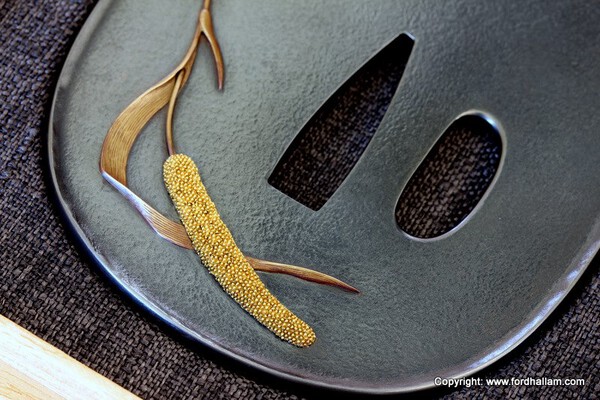
Many of you will have seen images of this tsuba in my photo gallery here but not so many will have seen how it was made. This is the premier public 'screening' of the latest offering from the acclaimed South African film-maker and my most excellent friend, Brad Schaffer and with the indispensable support or our ever reliable Mr Bob Morrison. http://bradshawschaffer.com/Bradshaw_Schaffer___Filmmaker___Yugen.html It's shorter than our previous collaboration, only 12 minutes, but we believe it packs quite a punch. You may be pleased to learn you won't have to listen to me rabbit on as there's no commentry. We did, however, comission a piece of music specifically for the film from Sasha Sonnbichler, a leading South African composer. We actully wanted some Miles Davis but what we ended up with is far better I think. The film is deliberately more arty and moody. This is to reflect various aesthetic sensibilities both Brad and I were leaning towards after trying to grasp the essence of Junichiro Tanizaki's 'In Praise of Shadows.' The film is also availible to view in high res. by clicking on the big black block. Enjoy, and please share it far and wide. regards to all, Ford P.s. And if this inspires you to pick up a chisel you might want to join me on some classes I'll be running in New Hampshire next month. Drop me a message via my website if you're interested.
-
Thank you gentlemen, for your reasonable and generous comments. I'd also like to apologise if my tone was unintentionally rude. Jean, I'm not snogging any of these chaps...I can guess where they've been.
-
I'm sorry to see you struggling with this Brian but I nowhere implied that everything David says or does is idiotic. As I said I don't know him well enough to make that judgement, I was merely referring to a specific statement, that was all. That you wish to take that and turn it into a sweeping generalisation is unfair and, as I feared, yet again misrepresents what I said. The problem with this forum is that when people post unsubstantiated opinions posing as authoritative fact they all to frequently get snotty and dismissive when asked to validate their input. That's the real arrogance at work here.