


Ford Hallam
-
Posts
3,091 -
Joined
-
Days Won
78
Content Type
Profiles
Forums
Events
Store
Downloads
Gallery
Everything posted by Ford Hallam
-
 As some may already know Taro Asano, a swordsmith from Gifu, is presently working and demonstrating his craft at The Citadel of Besançon in Franche-Comté, France. Taro has a rare talent for making the inner workings of the steel accessible to non specialists so if you've never really seen what a Japanese swordsmith does with hot metal this may be a rare treat. Here's a link to the sites website. Next weekend I'll be joining Taro for 6 days to demonstrate my own craft as well as giving a short talk about the work. Bob Morrison will also be joining us and bringing along a significant number of fine tsuba which will be on display. Some of my own works will be on view too. So, if you're in the area or can make it there we'd be pleased to meet you.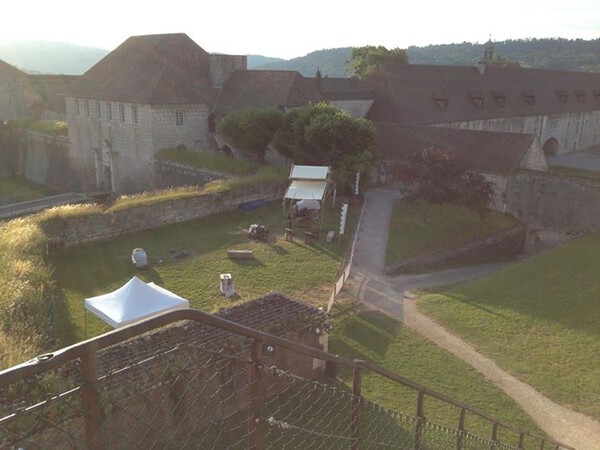
-
I don't think it's cast either.
-
I would agree with Roman, modern cast copies with poorly considered gold plated stripes. I'm afraid a post to elucidate the various details that make these observation self evident to experienced eyes would require far too much time at the keyboard...and even then be subject to armchair 'debate', so that's all I have to offer.
-
Hi Grev have a look at those lines inside the walls of the various opening in the plate. They're actually very clear signs this piece is a cast copy and those lines are reproduced from the rubber mould that produced the wax model. sorry, fh
-
The reason I queried that idea was that unless some sort of metal stripping solution is used in the tank ultrasonic cleaning won't remove the patina. It only loosens surface dirt. It will, along with, that remove any wax etc. and a degree of reasonably loose rust but any remaining real patina will not move. It may leave the surface looking quite dry but revealing the true state of the metal. My point is ultrasonic cleaning isn't necessarily a bad thing, it's merely a first step to reviving or recovering a piece.
-
I'm just curious as to why you think it's been (specifically speaking) ultrasonically cleaned....?
-
I'm not at all convinced this tsuba is an antique. Apart from the nakago-ana and seki-gane not looking like they were made to do a job those grooves look as though they were made with an angle-grinder. Sorry, but that's my opinion. regards Ford
-
Izuminokami Koike Naomasa tsuba on ebay real or ??
Ford Hallam replied to Jim Rogers's topic in Tosogu
To my eyes these look like very similar workmanship. Poor photography and perhaps some overzealous cleaning may make the ebay piece look weak but I actually think it by the same hand as the more acceptable example already shown here. -
well I'd think it self evident it's not a fake tsuba.... :? That call would involve a debate that this community has not yet even begun to properly frame. The label 'fake' in this instance must clearly refer to the suggestion the signature implies. The mei, or label, chiselled into the piece is a deceit. The chiselled inscription is a lie, therefore rendering the piece a fake. The mei might be a later addition or by the original maker but either way the object is not what it is presented as. It is a fake on the basis of this very simple set of criteria. If we 'remove' the 'misleading mei' we must simply asses the workmanship. I find the work to be competent in a purely technical sense albeit somewhat rough in terms of finish. The design and/or composition is almost generic, or regular, and lacks any real sense of dynamics or movement. What we see is a fair bit of complexity, reasonable craftsmanship but poor expressiveness in respect of the end result. All of this points to a copyist trying to emulate the master but failing to grasp and/or able to express anything similar.
-
As Chris suggests it's undoubtably a fake. The work is nowhere near good enough in terms of quality and the way the last kanji in the mei is cut is wrong. The right hand lower stroke doesn't hook up when Omori Teruhide signed his work.
-
The broom and the scroll (of poetry) alludes to Kanzan and Jitokku. A quick 'google' of the names will clarify that aspect. The hammer/mallet alludes to Daikoku, one of the seven 'Gods' of good fortune. The mallet is known as Uchide-no-Kozuchi and can make any material desire manifest.
-
One of my latest aquisition - your thoughts are welcome!
Ford Hallam replied to Thierry BERNARD's topic in Tosogu
hmmm...plumping for Tosa Myochin once Akasaka and Higo are discounted seems far too safe a bet for my taste. I'd suggest this may be a Bizen Shoami version of the common Akasaka/Higo design. -
I see, I must have missed that prior thread...
-
Wow! this "estate one" would appear to be a dead ringer for the one on Mike Yamasaki's site. :? http://www.tetsugendo.com/kodogu/T-123_kanshiro.html
-
Brian, the Tanaka got pretty funky with their decorative seki-gane, a kantei point you might say. A quick google image search will show what I mean. :D
-
Brian, these are in fact gilt copper, brass would be unusual. :D This style is characteristic of the Tanaka School. The tsuba does bear some similarities with that group but is unlikely to be a product of the core group, imo. The other one has some intriguing brass inlay that feels a little 'Heian-Jo' to me....I'd want a closer look at that one.
-
oh! and Curran, while the book cover you posted was amusing perhaps this one would be more appropriate if you meant to direct it at me

-
and another one very similar. http://www.nihonto.eu/de/schwerter-und-beschlagteile/antike-stuecke/beschlagteile/tsuba/katana-und-tachi/++/art_id/16/table/tsuben_articles/
-
Steven, Judging from what Robert Haynes suggests is Aizu Shoami I think yours might get a similar call. http://www.shibuiswords.com/haynesTsu48.html So you appear to have an early (circe 1750) Aizu Shoami tsuba that's signed. Not too shabby at all and would probably get papers, if only Hozon.
-
It seems I made a mistake... When I pointed out the file marks on the back of these disputed menuki I had assumed their significance would be immediately apparent to anyone who cared to consider them. Traditionally made, genuine, menuki are formed from flat sheet metal and the backs, once all shaping has been completed are filed lengthwise to provide a curved cross section that allows the menuki to fit more snugly against the tsuka. This is why whenever you see file marks on the edges of the back of menuki the lines always run lengthwise. If you think about how you'd go about using a half round cross-sectioned filed to file in that curvature it becomes self evident. Of course this shaping must be carried out before the ashi (those little pegs) are soldered in place because they'd be in the way otherwise. When I referred to those file marks on the cast copies I was pointing out that those marks were in that direction because the faker couldn't easily file in the usual direction, nor readily establish any curvature for that matter, because the peg was cast as part of the whole thing and was in the way of a proper file stroke. This is a fairly common feature of cheap reproduction casts. There are a number of other details that confirm it as a casting but I hope I've made my point about the importance of understanding what you're seeing when it comes to trying to analyse these objects.
-
No Brian, I wasn't condescending. I merely pointed out the obvious, that there's too much conjecture offered as reasoned opinion when in truth it isn't based on any relevant technical understanding. The original poster expressed confusion as to the conflicting opinions offered. I simply provided a perfectly reasonable suggestion as to how he might evaluate those opinions. Seems to me there are some here who are quite happy to talk down to newcomers but get just a bit bent out of shape when the tables are turned. And let me spell it out, I don't care how carefully anyone examines work, or under what magnification, unless they understand the processes used and the behaviour of all these metals and alloys in any number of conditions they are still utterly in the dark as to what they are seeing. It seems to me what is being argued for here is some sort of parity between professional opinion and those of hobbyists. Frankly, that seems a bit presumptuous to me. Would anyone here argue for the same sort of equality in respect of opinions on technical matters relating to polishing or smithing if we had active Japanese sword-smiths and polishers on the board? I don't bloody well think so. I leave you to it, good luck. さようなら Ford (that tsuba bloke who's being doing this stuff most days and all day for 33 years)
-
My point was simple enough. The fact is there is far too much conjecture and speculation among collectors regarding technical aspects of the craft that is conducted without any real grasp of the actual processes involved. Not to mention interpretation of what we see based on no references other than those imagined by collectors before us. And I made no presumptions, or are you claiming in-depth knowledge of tosogu manufacture?
-
My objection to the idea these decorative plates were originally parts of an armour is based on the simple fact that these are evidently perfectly flat plates and armour for humans rarely is. Granted, metal can be reshaped but invariably this requires heat and that leads to a degradation of gilded decoration, not to mention distortion of delicate etched surface patterns as a result of whatever force is utilised to flatten the plates.
-
Perhaps when evaluating input you might consider the qualifications of said input. As an example if I asked for opinions on a dental issue I'd probably take the comments of a qualified dentist more seriously than, say, an amateur dental 'historian'
-
I think it's a pretty fair purchase. Needs a little care but all in all a decently made piece in reasonable condition, certainly enough there to enjoy and appreciate I think.

