Ford Hallam
-
Posts
3,091 -
Joined
-
Days Won
78
Content Type
Profiles
Forums
Events
Store
Downloads
Gallery
Everything posted by Ford Hallam
-
Grev That last one is a pretty classic Chinese, probably Ming period, sword guard. The original rectangular tang opening (plugged to allow a more suitable nakago-ana to be cut) and two opposing dragons are dead give-aways. Kogai hitsu cut later. I think that as an example of a converted Chinese guard it's a significant piece of the puzzle.
-
Hi Curran Could you clarify the kantei point please. I'm a little unsure what is meant. Are waves with two 'fingers' then regarded as being Goto? And are two 'fingered' waves indicative of nidai Kanshiro also? I have to confess I am ignorant when it comes to kantei points
-
I do indeed, Jean Your Mino kogatana sound very nice, it's the one's signed by Kiyomaru and the like that I'm suspicious of What you need to go with your Mino ko-gatana is a Ko-Mino katana.
-
I think it's best not to take the 'mei' on ko-gatana too seriously, I wonder how many such signed blades would get Hozon papers edited after Jean pointed out my slip up. :-)
-
Gentlemen, the confusion, perhaps too strong a word but you get my meaning I'm sure , over the use of the kozuka makes my point. We don't really know what the function was, was it actually a tool that saw real daily use? The fact that we almost never find the blades securely fixed seems to suggest that it wasn't regarded as a real tool for most of it's history. In the beginning it was the kogai that was more likely to be seen on an uchigatana, and that did have a daily use as an ear cleaner and hair 'fixer'. If this was in any way supposed to be a proper utility knife why turn the handles into some of the most delicate and fragile art in metal the world has ever seen? Way back when uchigatana first sported little accessory knives perhaps they were handy when on campaign but certainly by the start of the Edo period the kozuka and kogai, along with menuki (all that post hoc 'grip improvement, justification for munuki aside), had lost any utilitarian function and were essentially sword jewellery, status symbols. Most antique pieces I've handled were a simple spring fit. The tang was given a little wave/bend that then allowed it to fit in the ko-tsuka (little handle) under tension. Sometimes the tang was also, or instead of, wrapped with paper to provide a snug fit, but not so tight it was jammed in. Ko-tsuka are sometimes found with traces of rosin/resin inside but we must be careful about jumping to conclusions as to what that means. I have a bag of 24 silver blades and forks that were removed from ko-tsuka. This conversion was seemingly not uncommon back in the Meiji, and I imagine even Taisho periods, when tourists avidly bought them as curios.
-
Sorry, I simply have to interject here...not merely on this kozuka matter but because it highlights an interesting tendency on the part of us 'moderns' to 'know better'. The quote is from the site linked to earlier. Here we have the observation that most, we may even suggest almost all, blades are loose in kozuka. That is the undeniable fact the historical artefact presents. Yet because this contradicts the expectation of someone who has no actual experience and understanding of what kogatana/kozuka were really about a 'solution' is offered to improve matters. A kogatana must be functional despite the obvious evidence to the contrary. No hesitation is in evidence during which the actual reason for the looseness of historical examples is examined. So a chance to 'see' kozuka more clearly in the appropriate cultural/'functional' context is lost. And another aspect of sword history/culture is muddied by altogether well meaning yet culturally myopic commentary. As is commonly quoted in artistic circles, "rules are made to be broken" ...but only when you completely understand the rules.
-
Andy, I'm sorry your attempt at furthering your hypothesis was treated so harshly elsewhere and I'm glad I wasn't directly involved in such vulgar discussions....some people. I'll offer some observations on this new find but would like first to point out that finding evidence of possible brass casting in no way supports you assertions regarding cast iron/steel tsuba. There is very little real correlation in the two technologies when we come down to the actual details of the practice. For me the biggest issue with the iron tsuba you suggest was cast is the clear appearance of layering in the edge. But a little scientific examination would easily establish how that artefact was made, cast metal and wrought iron are as different as chalk and cheese. It is a little problematic that the finds you bought are without any firm provenance fixing their date. As far as the evidence you presented back in 2012 here and the snapshot you've just posted all all I can say is that the items are far from clear with respect to what they mean. Crucibles and tuyere in themselves are not uncommon. We expect to see them in any dig that finds evidence of metalworking. What then needs to be done are some fairly simple analyses. Traces of oxides and metals inside the crucibles can point to what was melted in them, for example. Have the results of such basic tests been published? on the crucible you have or the ones more recently found in Nara? Another test would be to establish the composition of the crucibles and to determine, by means of a microscopic examination of the structure of the clay body, what temperatures they were heated to. Clay does very specific things at fixed temperatures. If your crucible has been used to melt iron or steel we'd expect the clay body to be pretty well vitrified, that is, turned from earthenware to ceramic. Traces of iron oxies etc, in the crucible would also be supportive evidence. Turning to the moulds found in Nara and your tusba blank. Neither exhibit clear evidence of either pouring flange/ spout nor runners. Runners are a network of small channels running from the impression of the object out to the edge of the mould. They are vital to allow the air inside the mould somewhere to escape through when molten metal is poured in, especially as molten metal tends to heat air up very quickly in enclosed spaces and heated air expands a lot. Therefore, the absence of runners in what appear to be a mould is problematic. Apart from the matter of the runners finding evidence of brass casting is not a huge revelation though. Brass is very easy to cast. The real question is, where are all these cast brass tsuba and menuki? ( in the shipwreck of the San Diego, perhaps) But have the moulds been tested to see if the inner surfaces bare any traces of brass having been cast in them? I remain sceptical about whether these are in fact casting moulds until more detail is published. And, even if these do turn out to be casting moulds for brass this is only that, evidence for brass casting. Which was introduced by Korean craftsmen in the 8th century. Metallic zinc was available from China only in the last few decades of the 17th century. Prior to that zinc was introduced to copper melts to make brass by means of adding crushed calamine, zinc ore. This process, called cementation, was used by the Greeks and the Romans more than 2500 years ago and the technology was in widespread use in Asia more than 1000 years ago. Cementation brass has a limit to the amount of zinc it can absorb and hold before it burns out. To get the maximum amount into the brass takes repeated melts. The point of diminishing returns is about 15%. There is another marker that accurately differentiates cementation brass from brass made with metallic zinc and that's the relative concentration of trace cadmium. So these details can firmly establish the date of the brass that was found in Nara. I assume at some stage these details will be established. Metallic zinc wasn't produced in Japan until the early 20th century. I hope I've at least provided a little context and more detail for our members to consider when contemplating these new finds. If it does turn out that these Nara finds are solid evidence of cast brass tsuba and menuki there still is a big leap to make from that point to then extrapolate that therefore casting of other non-ferrous fittings was commonplace in the Edo period. But that's a whole other book that would have to examine a mountain of other evidence. regards all, Ford
-
Nothing here for lovers of old rusty iron I'm afraid. Only a chance to appreciate the finer uses of the chisel. Apologies for not adding the working dates for the artists, I'm sure if you're interested you can easily look them up....or google them even. Here's a link and below are the names of the artists who work is featured, with the time in the film they appear. Ie-bori - Official carvers to the Shogunate. Goto Sōjo (2nd mainline head master) 0:15 Goto Kenjō ( 7th main line headmaster) 0:32 Unsigned 5 gold dragon menuki 0:48 Edo period Kinko. Hirata School, unsigned possibly Hirata Hikoshirō (Dōnin). 1:11 Sugiura Joi. 1:31 Yokoya Sōmin 1:48 Iwamoto Konkwan 2:06 Murakami Jōchiku 2:24 Kyō Kinko (Kyoto) Ichinomiya Nagatsune 2:50 Okamoto Naoshige (Tetsugendō Shōraku) 3:13 Ōtsuki Mitsuoki 3:36 Ōtsuki Mitsuhiro 3:54 Ōzaki Ikkan 4:12 Goto Ichijō ‘school’ Goto Ichijō 4:37 Funada Ikkin 5:07 Wada Isshin 5:24 Araki Tōmei 5:49 Imai Nagatake 6:03 Meiji period Kano Natsuo 6:28
-

Anyone In The U.s. Making Custom Made Fittings Boxes?
Ford Hallam replied to nagamaki - Franco's topic in Tosogu
Here you go, Guido. http://www.followingtheironbrush.org/viewtopic.php?f=70&t=736&hilit=fitted+tsuba+box -
My apologies also. It was never my intention to create confusion here over matters of craft technique or metallurgy. I should by now have realised that my own opinion (regardless of my training, education and trade experience) is only worth what you paid for it...
-
Steven, I can only repeat my request "what do you see as "clear signs of casting everywhere" ? " I described what I saw as evidence of direct working of the metal. All you've done is to disagree but without offering any actual reasoning. So what hand work can you see as being present on the finished tsuba then? and more interestingly, which parts of the handwork do you say was carried out before hand in the mould? I must admit that bit has me a bit confused? Are you saying the mould was somehow carved? Could you also explain what you mean by this too, please?
-
Brian, happy to interject where I can :-) . All the work would have been done before the final patina was developed. I didn't want Joel to be sad about his tsuba on Christmas eve.
-
Steven what do you see as "clear signs of casting everywhere" ? I can't show you what I'm not seeing :-) Are you familiar with the process of rubber mould making, wax injection, plaster investment and actual metal casting and post casting finishing? The edges of the raised parts are exactly what I'd expect to see as a result of the design being outlined by chiselling, the ground cut down the create a lower level and then evened out by being punched and then textured. Despite the lack of refined skill in the maker the tool marks (carving, engraving punch work) are all never the less crisp and the metal similarly exhibits the characteristics of directly worked metal, if this was a cast copy I expect to see hints of 'as cast' metal surface in the tiny crevices. And those 'as cast' areas not having been completely resurfaced would have oxides in the outer layer of the metal. Those oxides resist patination.
-
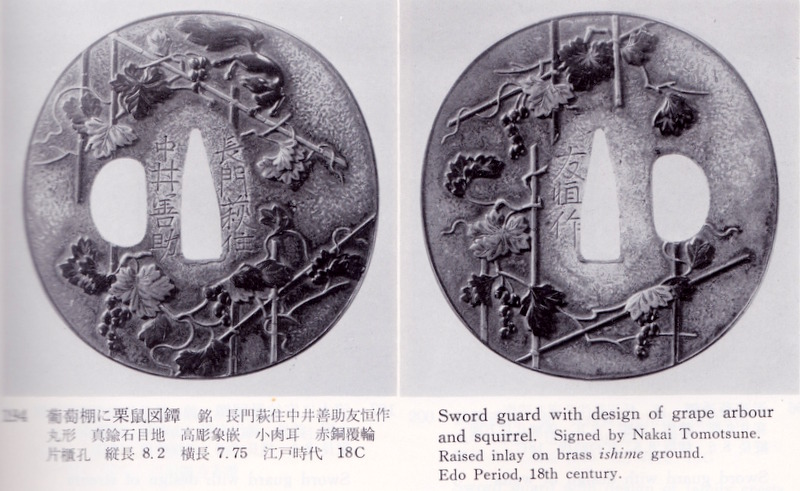
Joel, In my opinion your piece is not a cast work but hand made. It doesn't have any real age though, being a the work of a modern hobbyist. The material does seem, to my eyes, to be shakudo ( it's commercially available in Japan ) and it appears to be properly patinated. The workmanship is a little inept but the maker has attempted to use the traditional techniques of chiselling and punch work. The design/composition is clearly a classical one so this may be an utsushi study of an older piece. In fact I have a feeling I've seen the original in my books somewhere, it's ringing bells. It feels like a copy of Momoyama period Ko-kinko work.... The shakudo alone is probably worth about £100. Merry Christmas to you all and a Happy New Year :-) edit to add: I knew I'd seen it somewhere :-) Tokyo National Museum Collection. p55. Nakai Tomotsune, 18th cent.

-
Had To Share This Beautiful (To My Eyes) Tsuba
Ford Hallam replied to general_piffle's topic in Tosogu
Why do you think that? Pete. I agree that the apparent difference is merely the lighting though. -
Garry I can only echo Jean's comments and say that nothing I wrote was was intended to be a personal critisism. I am, however, humbled by your willingness to accept the points being made. After more than 30 years as a professional craftsman I still second guess myself and question the integrity of what I'm doing every day. Perhaps I'm a bit extreme but if by that example I can help you grasp a little of the "real deal" then I reckon we'll both be just a little happier for it Cheers, and good luck. p.s. Just in case you, or anyone else thinks I'm going soft let me ask this; How do you know it was the right consistancy? have you used it before? do you know exactly what it must do, now, and for the next 10 years? This is part of what I mean by real craft knowledge and understanding.
-
Jean, this is exactly how the real core values of crafts are lost. My mantra when teaching is, "no questions!" "If you could understand the answer you wouldn't need to ask", "Just do the work as instructed and maybe in 10 years you'll have something insightful to say....maybe." Every small alteration to try and make things easier or cheaper, of what has been passed down over countless generations, by people who have very little real understanding or investment in the tradition simply contributes to the eventual eradiction of real craft knowledge and skill.
-
As George wrote the mask is indeed that known as Hannya, the female demon. The story alluded to by the maple leaves is, I believe, that of Momijigari (Autumn Foliage Viewing), a brief description of the plot here on wikipedia.
-
The tadpoles are great, Stephen
-
Stephen it doesn't give an indication of date. Only school and materials/techniques. In my opinion the Hamano attribution is pretty tenuous (looks more like it was influenced by various aspects of the Nara school) and later than 1800s would be 20th century so I think it's safe to assume 1800s :-) I would sugest that this is one of those instances where the papers actually add nothing to the piece other than to artificially inflate the price. The set is what it is, late Edo machibori, mediocre. They say Hamano, I don't think that claim is very certain. Personally speaking I am now of the view that, rare exceptions aside, unless it's signed most school attributions are bogus. If an artist was a ligitimate member of a school this would have been a matter of record, and it seems from what I've read a matter of public knowledge, 'back in the day' and a significant selling point. If you actually bought a piece from a 'licenced' Hamano student you'd want his name on it as a mark of authenticity. Especially as in this case where the work isn't very distinctive. And don't get me started on unsigned Hirata Hikozo tsuba...the poor man's reputation is saddled with so much dull copper I'm sure he's be appalled were he able to look down from tsuba heaven. The absence of a mei on work of this sort of quality (average) indicates to me that while it may be emulating a fashionable style it can claim no direct connection to any recognised school. But that's just my present understanding of matters, others may hold differing opinions. regards Ford
-
Buy a copy of this.
-
I missed the end of this thread in July but with reference to David's estimating that it would take about a month to make his tadpole menuki I'd have to correct that. Including the making of the shakudo alloy I'd estimate more like 4 or 5 days at the most.
-
Nice Tsuba With Varous Religious Figures (Any Ideas Who, When Made?)
Ford Hallam replied to ggil's topic in Tosogu
Grant this piece is a very good, relatively early (for the school, perhaps mid 18th cent.) Soten style work, imo. Sadly the original patina has been stripped off at some point relatively recently. By the looks of the various metal surfaces it looks to me as though a mild acid or pickle of some sort was the culprit. The biggest 'give away' for me are the bright pink copper patches on Hotei's robe. What this really needs is a proper restoration and then it can safely be stored in a kiri-bako and treated just like any other tsuba in good condition. Hope that helps. ford p.s. the iron is almost certainly a very finely worked wrought iron, which would be usual for Soten work. -
Then I can only imagine they used magic. There is a joint there, it's simply hidden. The outer edge will have had a ring (flat strip) of shakudo fitted first. This may have been soldered in place or fused without solder. This is actually not a difficult thing to do with copper and shakudo. Then the front and back plates would have been similarly applied. If there was a visible solder join on the edge it could have been lightly chiselled out and the gap then simply hammered over to close up, thus creating an 'invisible' join. This sort of hidden join is most commonly to be (not ) seen on shakudo fuchi.