paulb
-
Posts
3,046 -
Joined
-
Last visited
-
Days Won
73
Content Type
Profiles
Forums
Events
Store
Downloads
Gallery
Everything posted by paulb
-
Ray, is it possible to see some images of the sword? I am green with envy just reading about it!!
-
Hi, I will try and help a little. Firstly the fittings will not help you define who made the sword. On an older sword they will have been changed several times. If they are good quality it suggests either a) the owner valued the blade highly enough to put good fittings on it or b) a dealer put better quality mounts on a mediocre blade to make it appear better than it was. Not much help I know. Regarding the blade. Key indicators are 1. Shape your blade is obviously suriage (shortenned) so try and imagine what the original shape may have been. Look at lots of references to help with this. The original shape will give you a starting point for the age. 2. Hada, there is little visible on the images but this is a key indicator to tradition and school 3. Hamon again will point you towards time and school through its shape and make up. What you are trying to achieve is very challenging, especially if the blade is in less than perfect polish. It takes many years of study to attempt to identify the work of specific periods schools and smiths and even those with a great deal of experience can oftern get it wrong. Having said that the research can be great fun and a great aid to learning if you are preapred to buy books and spwend a lot of time with them good luck
-
Veli, you are right and I didnt explain myself very well. put it down to it being early in the morning. The ken hi is sitting where the normal plain wider groove would be on a more conventional naginata hi. just behind where the blade narrows on the mune. as you rightly say if this was done originally it is perfectly reasonable that it would run back in to the nakago when it was shortened. regardless this is a very fine looking blade and my little green envy devil is working overtime!! Sorry for the confusion Best Regards Paul
-
Ray, Although not originally planned I have also become very keen on Naginata-Naoshi, particularly those from the late Kamakura and Nambokucho periods. What is very interesting about your blade (apart fom the fact that it is a very good looking sword) is the carving of the ken horimono behind the naginata hi. I cant remember seeing this before, do you think this is original to the piece or might it have been cut after it was modified? (from the images this seems unlikelty as the carving appears to run back into the nakago) Have you any thoughts on this? Regards Paul
-
Hi Steve, I think our mails crossed over. Yes the link you posted is interesting stuff. I think its worth differetiating beween the stamps seen. The Showa and Seki stamps are most commonly seen and the ones typically quoted when refering to non-traditionally made. The Star stamps have been the subject of much debate as to whether this indicated traditionally made or superior partially traditional. Somewhere within the JSSUS journals there is a detailed article on this. Likewise the Naval shrine emblem does, I believe, mean traditionally made as this was the Naval equivalent of the Yasakuni Shrine for the army. However as a committed student of Koto I am geting well out of my comfort zone here and I am sure there are many Showa and Gendai-To collectors who can throw more light on the subject
-
Steve, Just a quick clarification. I dont beleive Koto blades were made using imported steel, certainly none of the reference books I have read have ever suggested this. If I remember correctly most of the iron imported into Japan came from the Dutch rather than the Portugese and therefore after 1600. Regarding Shinto blades its true that some smiths did incorporate imported steel in their manufacture. However this was combined with rather than in place of Tamahagane. Showa-To were made using 9 or 10 diffrent methods ranging from Traditionally made with Tamahagane as in the Yasukuni shrine pieces to blades being formed out of single pieces of bar stock. There has been much debate over the years regarding Arsenal stamps on Gendai-To. I think the majority view remains that swords with an Arsenal stamp are not traditionally made using Tamahagane therefore not true Nihon-To. I think this debate is likely to go on and on because as you say it is extremely difficult to tell (assuming it is possible) whether a blade was made using Tamahagane or imported iron.
-
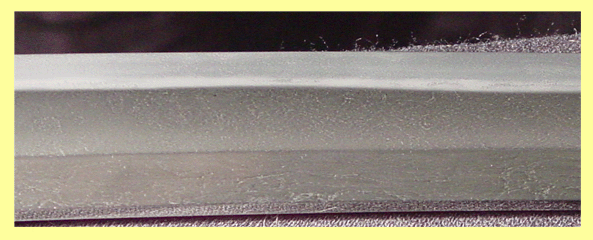
just for comparison below is an example of Aoe hada from a Chu-Aoe blade dated to the end of the Kamakura period
-
Dear Florian, In the absense of other responses I hope I can help a little. With Tanto it is not unusual for the blade to be made from one piece of steel, i.e. without a soft core. This can be seen on many welll polished early examples where the thickness is hugely reduced and there is no evidence of core steel showing. I remember one example shown here some years ago where the nakago looked "off-set" becauses so much steel had been removed fom one side of the blade. Still it showed attractive jigane. So I think (If I understand your point correctly) this is made from one piece. Witrh regard to the sword itself I have never seen hada looking like this and have little idea how it could end up looking this way. I agree that it looks as though two different quality steels were used but I haveny seen an example like this before. I wonder if the appearance has been exagerated by the polish? I am interested that you doubt the NBTHK attribution. I admit that mino would not spring o my mind either but then again nor would much else when trying to guess what it is. If the NBTHK see it as mino and I cant see what else it might be I think I would trust to their expertise. What makes you think they are wrong?
-
Guido, I think the board owes you a great vote of thanks for your efforts and willingness to share your knowledge which was gained through many years of study. In addition your forthright and often humorous approach has helped to cut through and head off some of the less productive discussions that have developed on occassion. Thank you very much for your efforts and contribution. Best Regrds paul
-
AUCTION RESULTS
paulb replied to Chishiki's topic in Sword Shows, Events, Community News and Legislation Issues
Thanks for the info Dale. Looking at Chrisities results I confess I have no idea what is going on. For some time in the UK I have beleived that Bonhams were taking the lead in sales of swords and armour. These two sales in New York totally contradict that trend. Also wondering why the armour did so well in Bonhams but the swords failed. A couple of other interesting points coming out of the Chrisities sales. The most successful sale, The Ichimonji Tachi sold for $146K but only had Hozon papers as did a blade by Ryokai which achieved a reasonable price. I think over recent years buyers have increasingly focussed on papers, mainly because they are buying unseen and gain a sense of security fom that attribution. This sword demonstrates the alternative attitude of obtaining a basic paper to confirm what it is but letting the swords quality do the rest. Dale, I was intersted in your point regarding the Tanto sold at Bonhams. Obviously the buyer was comfortable enough with the Horikowa attribution to spend $30K+ on this piece but you had your doubts to its authenticity can you share what it was about it that made you think the NTHK attribution was wrong? Regards Paul -
Just to add an additional point to Ians comprehensive summary. the ease or otherwise with which swords come in is very much dependant on the shipper. Based on personal experience the best (although usually the most expensive) are Fedex. The worst by a very long way are parcelforce. This may have improved since the dreaded Coventry International hub subcontracted their customs clearing, I think to UPS, but I have not had any direct recent experieince. Although frustrating and time consuming generally you get your piece and end up paying the right tariff. The path can sometimes be rather frustrating. Regards Paul ps Thank you Peter for the recommendation I didnt see it until after I posted the original response Paul
-
I can understand your comparison. I think the difference in thinking relates to appreciating technical efficiency, and at what point if any that technical ability moves from competent craftsmanship to art. A comparison in painting might be the superb technical victorian painters of the 19th century who while competent never transended the barrier to become true artists. I think there are similar parallels in swords. However I am beginning to sound like the left wing aging hippy vegetarian dope addled thinkers I keep criticsing for hijacking threads!!
-
Dear Jacques, As an old tortured soul I have to say I 180 degree totally disagree with you. I am a great lover of music, and especially painting. I am not ashamed to say that I have been moved to tears on occassion when hearing or viewing works I regard as particularly meaningful or powerful I have experienced similar feeling when looking at some, certainly not all, swords. The craftmanship, the landscape created by the foriging and tempering can and do have a profound effect as can some abstract paintings and sculpture. I can name examples 1. katana blade by Shinkai where the steel created a 3 dimensional quality where you felt you were looking through ice on a pool 2. A shikkake blade that created an incredibly serene landscape as the activity ran almost organically through the hamon 3. A Chu-Aoe blade that was just beautiful 4. An Awataguchi Tachi that was as near to perfection as I am ever likely to see. So I absolutely understand the comparison with art and music, particularly painting it is one I have and will continue to use without any concern or doubt. There of course other swords that simply move one to tears for totally other reasons! but that is another story. Regards paul
-
I appreciate you are as you say new to this forum and will not have seen that this has been discussed many times before however Please refrain from making global statements such as This is inaccurate and untrue and suggesting all papers produced before 2004 are fake is absolute nonsense and not supported by any organisation. Regrads paul
-
Gary, for the point of clarity reagrding your last post. Of course you are right and it is doubful that an old sword has its original habaki and if it did it probably would no longer fit. The point is that when habaki require replacement they should be and were custom made, not found amongst someones stock of old fittings. regards Paul
-
I fear I am about to start another controversy but am very surpirsed and more than a little concerned at the suggestion one should look for old habaki, saya and Tsuka to fit a blade. habaki are made to fit a specific blade, as are the tsuka and saya. The chances of finding a random habaki that fits the blade acceptably and then holds it correctly in a saya also not made for the blade must be extremely small. More importantly the combination of ill fitting habaki and old saya offer huge opportunity to damage the blade. I agree with Gary that finding fittings for a blade, i.e. Tsuba, menuki and fuchi kashira (and Kodzuka if you want) can be and is great fun and very rewarding but blade specific pieces such as tsuka, saya and habaki are better made new to fit the blade and by a qualified artisan. Regards Paul
-
Ted, Based on the view expressed by most that this is gimei do you believe the accompanying papers are fake, doctored or an example of the questionable papers I refered to in my earlier post?
-
The NBTHK Cetficiate is one of their older "blue papers" which between the 1950s and 80s was, I think, the level just below Juyo. I dont think these papers are particularly common. The NBTHKs reputation suffered during the 70s and up to the early 80s with accussaions of fraud and papering swords for special "clients" As a result there was a major clean up and the current papering system introduced. Because of this and because research has also moved on in the following years older papers are regarded as unreliable when compared to modern ones. I am not convinced this is altogether fair as I would suspect that the vast majority of the older papers, particularly those dealing with such well known and documented smiths as Hankei are more likely to be accurrate. There is also a fairly vocal school of thought that believe it was harder to achieve Juyo papers in the 50s and 60s than it is today. I have no view either way on that as I have insufficient experience in seeing such blades. With regard to you second point. If the NBTHK paper a signed blade they are saying they believe it is a genuine work and signature of the smith concerned. They will not paper gimei blades. hope this helps Paul
-
Hi Jacob, the important question is do you like it? its your money and effort that has bought it. Has it lived up to your expectation? What can you tell us about it? first sight it looks like a smallish Shinto blade in reasonable polish there are obviously some openings in the hada which will detract somewhat from its commercial value. However the general polish looks ok and there is some activity in the hamon. I am guessing you can see a lot more detail of both hamon and hada in hand than you can from the images. Over the years I have seen many first swords that are of much poorer quality than this so well done. I am sure those more knowledgible than me can comment on the fittings. Please tell us what you know about it from the seller. Welcome to the slippery slope that leads to Nihon-To addiction! Best Regards Paul
-
Newly interested in Nihonto, but quite unsure about it all!
paulb replied to aiki_Fritter's topic in Nihonto
David, first advice is to look at the various websites in the links aove. These are all dealers who have been around for some time and are known to members here second is avoid ebay unless you are very conident of what you are doing. There ae some good dealers on there but many many more less good to down right bad ones. third if it looks to be to good to be true it almost always is. once you have found something you like post some images here, while it may not be appropriate to discuss price (thats between buyer and seller) you will undoubtedly get help and advice regading quality and autheticity. regards Paul -
Are Gimei blades worth collecting?
paulb replied to Gabriel L's topic in General Nihonto Related Discussion
Guido, Sorry if I wasnt clear, but I agree absolutely that the concept that "gimei is ok" is wrong and not something we should encourage or endorse. Also many (probably the majority) of swords I have seen have been gimei. The only point I was trying to make was that one should not automatically dismiss a blade as being bad because it is gimei (again yes the vast majority are, and even those that arent are not of an equivalent quality to the original work of the copied artist). It may have some merit in its own right (without the mei). It is the same as dismissing all blades in gunto mounts because the vast majority are machine made. yes they are but occassionally something good appears. regrettably not to me! Best Regards Paul -
Are Gimei blades worth collecting?
paulb replied to Gabriel L's topic in General Nihonto Related Discussion
Dear Reinhard, WHile I agree with your comments in principal there are a couple of other points to consider: 1.Were Gimei always aimed at the uneducated? in some instances a school work or at least one that closely follows the originals style and quality might be used. If this is the case it would be true as you say that the blade does not live up to the mei but it could still be a good quality sword. 2. A good example of this was the most valuable blade in the A.Z. Freeman collection which when he bought it had the mei "Rai Kunitoshi" on it. The Mei was removed and it attained Juyo papers as a Ko-Senjuin piece and was/is a very fine blade. 3. More rcently a story( unconfirmed) of a Hizen Masahiro being rejected as gimei by the NBTHK and when the attribution was questioned the owner was told it was in fact an early work of the nidai Tadahiro. So the quality would have been at least comparable. I agree with you that if a blade is determended to be gimei there is little or no value in keeping the mei there and that the quality rarely lives up to the mei (if it did there would be no point in putting a false signature on it) But there are some good quality blades which have had gimei applied at some point in their history. These should not be discounted just because they are gimei, at least not in the first instance. I also like to think there is an increasingly large group of people in the west that are attempting to make a difference in the level of understanding and knowledge on the subject and I think this is being recognised increasingly in Japan -
Help to remove the blade from the koshirae
paulb replied to Dave0258's topic in Military Swords of Japan
Dave, thanks for your efforts and additional images. Having seen the nakago I agree with Peter that this would appear to be an older blade, (i.e not gendaito) based on pure statistics it is more likely to be shinto than shin-shinto because there are lot more of them in existence. I cant see anything in the images so far that would lead me to believe it is earlier than that, but there is not too much detail to see. Finally I agree with Stephen "get it oiled!!" good luck Paul -
In Praise of Fedex
paulb replied to paulb's topic in Sword Shows, Events, Community News and Legislation Issues
Hi Brian, label said "Antique Japanese Sword". I have received swords twice form the USA using Fedex and sent blades out from here to other parts of Europe and each time used the same description. So far without problems. I am assuming the Vendors of the blades I bought had them insured. The ones I sent the recipient did not require them to be insured. ( he is a braver man than me) I have also used a speciality antique shipping company in the UK when all else fails. they are good and arrange insurance but they are not cheap. Uk Parcelforce everyone knows about DHL refused to carry swords whether antique, legal or not UPS will not insure antiques. so the choice is fairly limited. hope this helps Regards Paul -
Help to remove the blade from the koshirae
paulb replied to Dave0258's topic in Military Swords of Japan
Dave, it is very difficult to recommend a course of action at distance in these situations as if you do it wrong based on suggestions you could damage the blade or worse still yourself. General things that may help but you must be extremely cautious and careful: 1. I have found that holding the tsuka near the end helps when using the traditional approach. It seems to improve the chances of loosening the blade. 2. If that doesn't work the Japanese use a small shaped piece of wood which is held against the tsuka surface near the habaki and gently tap it downwards with a wooden mallet. In the absence of the right tools for many years I used a small soft wood block to tap against the tsuka and that worked ok. 3. Normally I don't think the Sarute rivets go all the way through the nakago (except on machine made NCO blades). but if after gentle attempts to move the tsuka it is still jammed solid it might be worth seeing if they come free. As in all things of this nature take care and patience I have known people spend hours gently loosening a tsuka. Better to take time at this stage than do irreparable damage to the sword, fittings or you. not sure if this helps much but see how you go and others might have better suggestions regards Paul