paulb
-
Posts
3,046 -
Joined
-
Last visited
-
Days Won
73
Content Type
Profiles
Forums
Events
Store
Downloads
Gallery
Everything posted by paulb
-
For the sake of balance can I take the opposite view David. Who one chooses to send swords to for authentication is a matter of personal choice and I have blades papered by both the NBTHK and the NTHK (I have yet to have one from the NTHK NPO but should they come as planned to the UK I dont doubt that will change). Of these organisations I have much greater faith in the NBTHK. I think this is born out of the response I receive to enquiries and requests for help. In addition they seem to deal with a far greater number of appraisals than other bodies. I cannot comment on Chirs's statement about Japanese lacking respect for the NBTHK, I do not know what experience causes you to share that view, nor do I need to know. However if you look at swords for sale from most dealers in Japan and most international auctions the number of blades authenticated by the NBTHK outnumber all other groups substantially. I therefore think it reasonable to assume that the NBHK continues to command the respect of the majority of the sword world. Whether this will change in the future, who knows, but probably. Until then I will continue to put faith in their papers above others. regards Paul (member of the NBTHK and NTHK)
-
Eric, I totally agree with you. the key point here is who wrote the Sayagaki. I have been fortunate to have several swords over the years with sayagaki by Tanobe-san and also Honami Kozon. Both of these add value, not just commercially, but as reference material. Sayagaki by recognised authorities are valuable additions to the complete piece. Those by unknown bodies are not because they offer no context to validate the opinion. Regards Paul
-
Thank you Micha, From Darcy's description of hada and Nakago I can understand why he and you would consider this a daimai. sounds like a beautiful sword. enjoy it. Best regards Paul
-
Dear Micha, These are good looking examples. what leads you to the conclusion that the katana is daimei? is it the workmanship in the blade, the yasurimei or differences in the signature, or is it a combination of all of these? Thanks paul
-
David, not agreeing or disagreeing with your opinion but could you state your reasons for believing this is an aged shin-shinto blade? regards Paul
-
Chris, Immediate first reaction is that it is modern Chinese fake. Look at the nakago-ana (is that the right term?) it is rounded and typical of Chinese work and not at all similar to what you see on autherntic tsuba. also the work is very much in the style of what the Chinese think tsuba should look like. Having said all that this is not my fiels and others may have a better view regarding it authenticity. Regards Paul
-
Ian, I wish there were some around today I could keep them in work for a while
-
Hi Brian First immediate impression is a little earlier than that agree with possible Mino but would suggest Sue-Seki. Best regards Paul
-
Hi Eric, I think that may be a reasonable view. Certainly it has been suggested for some time in the past that a smith would make two or three blades for a customer to choose from and would only sign the blade selected. the others were then sold unsigned. I think this is one theory that appears to go in and out of fashion and I am not sure its current status, but again it would help explain some undigned ubu pieces.
-
Hi Eric, I think any discussion on this will be largely theoretical as I would doubt such detailed information was ever recorded anywhere. I think one needs to consider the wide range of manufacture, the market and what information is availalbe today. Taking the last first. nearly all of the information availale to us today on old work focuses on the top end. This is not unique to Japanese Swords but in any sphere of craft/art scholars nearly always study what is best. This means that our perception and view of swords is based on the top tier of production. Swords being produced for this top strata of soceity had to be of high quality and I would think any smith wishing to enhance or retain their reputation would not risk putting their name to or supplying anything that exhibited a recognised fault. Even if selling to a lesser user there would be the danger of an inferior work surfacing and damaging their reputation. This may account to some degree to the number of apparent mumei ubu blades attributed to well known smiths or schools which appear today (there are also many other theories for this as well). Beneath this top layer there must have been countless smiths/ schools/ production lines turning out basic weapons for the lesser mortals. Examples of this are the famous "bundle swords" produced in the late koto period in Bizen and Mino. As long as these blades functioned did not have faults which inhibited that function I would doubt that minor faults would have been the cause of concern. However as said above I dont think much is written about this group as they were regarded as having little artistic merit. Rgerads paul
-
Dear Mariusz, I don't want to answer for Jacques but I think it is possible for hagire to be a result of manufacture as well as a battle injury. I choose the word carefully because it is not a forging problem but could occur when the sword is quenched. As you know when the blade is plunged in to water the edge cools much more quickly than the body of the blade. As a result the blade curves towards the mune and this introduces incredible stresses in to the hard edge. As a result (modern smiths quote a failure rate of at least 10%) the blade may crack at the edge. So hagire can occur without a blade ever getting close to a battle/fight. However if this was to happen at this time it is unlikely the sword would ever be completed and enter the supply chain. Best Regards Paul ps Sorry Jacques mails crossed in the post!
-
Eric, you are absolutely right and the weakness is mine not the swords. I agree that the sword has much to appreciate and should be valued for those features. There is a certain contradiction in what I am saying as it is as I said previously if you (me) are unable to accept faults you should collect new swords and yet most of my focus over recent years has been on late Kamakura period work. attribute it to the early onset of contrary aging
-
Eric, I have to confess that if I had the Norishige it would break my heart every time I looked at it. What I should do is admire the way it has stood up to such punishment but in reality I would reach the point whete all I saw was the crack. As a result I would miss out on all that is beautiful around it. Thnaks for posting these they are good examples. Interestingly in this months NBTHK journal there is an oshigata of a Juyo Bijutsu Tomonari which appears to have lost most if not all of its boshi.
-
Hi Keith, the honest answer is I dont know. If I had to bet I would suggest it is something that has appeared from polishing over the years. It is possilbe that at some point a small amount of rust got in to the fold in the steel and subsequent removal has left that hairline opening. My simplistic view is that most stress damage is likely to form in line with the impact. I imagine the edge as being under stress logitudinally so if the edge hits someting sufficiently hard to start a crack those stresses will automatically pull away along the length. Hence hagiri are usualy perpendicular to the edge. I dont doubt there are exceptions but I dont think this is an example of one.
-
Hi Mariusz, Yes if it were a tempering crack I agree it would be a serious fault and I also would expect to see evidence of it on both sides. Also if it was a crack I would seriously doubt it would have achieved any papers from the NBTHK. Based on their defintions for awarding papers as listed on Danny Massey's site where it states that . The line is only visible on one side and is a narrow opening which runs part way along a line of sunagashi. I am therefore confident that it relates to a slight opening of a weld line. At what point in its history this became visible we will never know. Again a guess from my side is that it has appeared relatively late in its life after numerous polishes. As said previously I would much prefer this not to be there. However the fact that it is shouldnt stop us from appreciating the remaining 27 inches that are without fault and exhibit some beautiful workmanship.
-
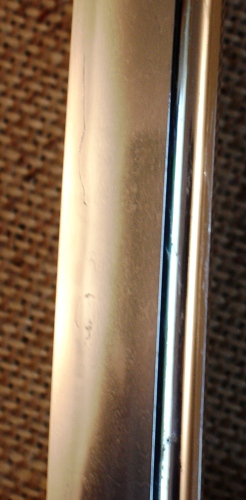
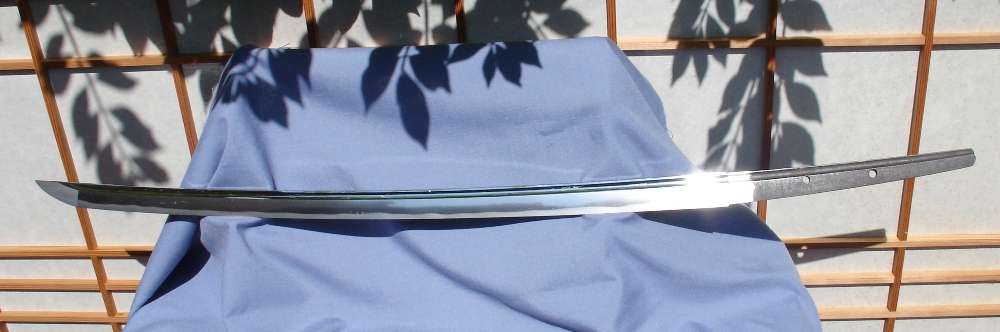
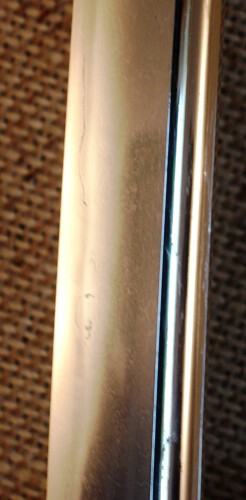
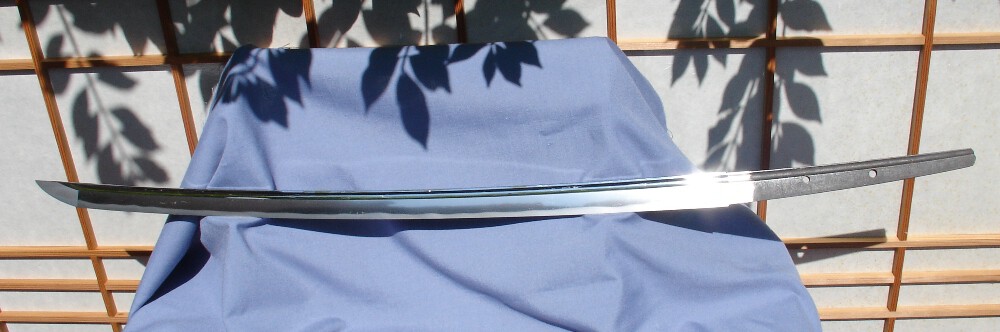
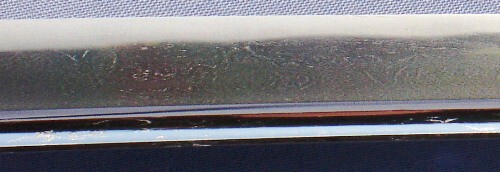
Hi Keith, I confess I would prefer always to have swords without fault. I am weak enough to allow such faults to take all my focus to the point where it is all I see and can often not see all the good things around it. This is a great shame and something I am trying to overcome. As has been said above and in previous posts the level and type of fault that is acceptable depends on the age and school of the sword. What is accepted in a Kamaukura blade would be unacceptable in a shin-shinto work. Equally some schools methodology lends itself to certain types of fault appearing. The most obvius and most often talked about is the appearance of core steel in Hizen blades. But equally relevent are the type of longitudinal faults you describe which usually follow a weld line close to or within the hamon. In Yamato and Mino works where there is a prevelance of masame hada I would guess that this type of fault is much more likely to appear. Because of this I think it tends to be (at least in Japan) more tolerated than if the same linear fault appeared in Bizen work. I have spent a lot of time with a blade that received Tokubetsu Hozon papers to Yamato Shizu. There is a weld line which has opened slightly (just to the point of visibility) within the hamon. While I would much prefer this not to be there I think it was accepted as being a likely occurance on this type of blade of this age. It would not achieve any higher level papers but is hugely enjoyable still and has many interesting features. take a look at the attached and see what you think
-
Over the years we have often debated and discussed different faults and flaws in blades. Two recent posts about swords for sale have raised a number of questions again and I wondered if it was worth revisiting this subject to gain peoples views/understanding about them I would like to consider the following: 1. What is a fatal flaw 2. What is a fault? when is it acceptable? and at what point does it convert in to a fatal flaw? To start discussion I would offer the following opinions: 1. A fatal flaw is one that threatens the integrity of the blade and results in its inability to fulfil or potentially fulfil its purpose. A fatal flaw cannot be repaired. By this definition hagire, the loss of boshi the reduction of the hamon to a point where it touches the edge of the blade might all be considered fatal. Equally if a blade is polished down to the point where large areas of core steel are visible one could argue that the blade has been fatally weakened through loss of jigane. 2. I would describe a fault as something which detracts from the aesthetic beauty of a blade but does not necessarilly effect it performance. This would then include, kizu, blisters etc. Another thing to consider is that some faults may be correctd or repaired (plugging holes left by openning blisters). How much such faults may be tolerated is an individual choice. In the recent posts its apparent that to some no faults are acceptable and their presence totally destroys the value of a blade to that individual. To others a total lack of faults in something proffessing to be 600+ years old creates suspicion in the opposite direction. If one wants to collect perfect blades in a condition as the maker intended they should collect shinsaku-To. Anything older which has had more than 1 polish is immediately compromised. The shape, thickness and structure of the blade will have changed. All Koto blades will have been polished many times and will therefore exhibit faults, tiredness etc to some degree. As said above the level of fault one can accept is a matter of individual taste and is influenced by other factors, rarity of the maker, the condition of the rest of the sword and of course price. The bottom line is that while we should aim to include perfect examples of swords within a collection if you want to collect koto or shinto blades you have to accept that there are likely to be some faults in them. If this is unacceptable and you find you focus totally on the faults to the exclusion of the rest of blade go for something else. I would be interested in others opinions as to what they find acceptable and unacceptable when looking at potential purchases. regards Paul
-
Hi Franco, Yes You are more than likely correct and I have seen the same on oshigata. I think I just struggle with the idea of someone weilding an original blade of 80-90cm, which of course some did. Are there not examples of blades from this period with hi that either run through an ubu nakago or at least well into it? If there were then it would be possible to achieve what you are seeing here by partial removal of the original nakago rather than complete removal. Just speculation as I dont know if such examples exist regards Paul
-
Hi Jean, I would say suriage rather than O-suriage. If it were O-suriage it would have to have been an enormous blade even by the standards of the time. If it were suriage then it is perfectly possible for Kozon-san to make an appraisal on it as a mumei blade. I have read the article by Darcy which I am sure is based on the conventional view of when different types of attribution were used. However as with all things in this subject thee does seem some contradiction bwetween sources as to what was used when and what it means. regards Paul
-
1st NBSK SWORD CRAFTSMEN COMPETITION RESULTS
paulb replied to Bazza's topic in General Nihonto Related Discussion
I would second Tony's comments. I have seen the dvd several times before but am still staggered every time I see it. Also the dragonfly tsuba is incredibly impressive "in the flesh" Congratulations Ford (and my jealousy of your talent has increased to an even higher level ) Well done Paul -
Bruno, I think it depends on the amount of oil you use. I think there is unanimous agreement that newly polished blades should be kept oiled. The amount is key, it shouldnt be dripping in the stuff, just a light film. You are right that if you apply too much it will soak in to the saya and dust, grime etc will stick. However the effect of a light film over a few months is vastly different to the accumulated grot that can find its way in to a saya over decades, especially if the sword has not been well cared for and allowed to rust. Of the swords I have had over the years the only one I had a problem with was one I returned to its original saya after polishing. It did exactly what Chuck's did and gave me the same reaction. Living in a less humid environment and with swords being stored in stable conditions I have moved away from keeping mine in oil and store them dry. I took this decision as I was concerned that the applicaion of uchiko every time I wanted to look at a blade posed a greater risk than keeping them dry. The only exception to this is when I get a newly polished sword which I always keep in oil for the first 3 to 6 months. As Franco said I think the best advise should come from the polisher.
-
Chuck, I am sorry you have had such a painful experience but it does highlight a point which may be worth re-mentioning. I hope you wont mind me using it as an example. In the past and I think still in the majority of cases it is recommended that when having a blade polished it is always a good idea to have a new shirasaya made for it. This is for exactly the reason your polisher has mentioned to you. While polishing may remove active rust from the blade returning it to the old saya exposes the newly polished surface to whatever has accumulated in the saya over the years. It is more than likely that dust, grit and active rust will be embedded in the saya. This is why all top quality blades you see rest in shirasaya and the koshirae is mounted on a tsunagi. If you are going to the expense and trouble of having a blade polished it is well worth finding the extra dollars to have a shirasaya made at the same time. As Franco says obtain the maintenance recommendations from your polisher. Normally it is recommended to keep your newly polished blade in oil for 6 months after polisher changing it initially every couple of weeks and later monthly. This is because polishing pushes water in to the metal surface and needs time to be drawn out. After this initial period how you best store your sword will depend on your location, the conditions you intend to store the sword in etc. I wish you success. Best Regards Paul
-
Hi Ford, I also have no specific research to support my opinion. It is interesting how people can read similar sources but their perception can be totally opposed. I guess thats how a lot of conflicts start. My understanding from reading what is available in English was that Myoju was first and foremost a metal worker producing fittings. This to some extent is supported by the relatively few swords extant compared to the number of tsuba and other work attributed to him. On the other side of the debate is that the swords he made were of very high quality and he had major influence on the sword making world counting Kunihiro and Tadayoshi amongst those he taught/influenced. He must therefore be regarded as an important maker (or a least teacher) and hence the designation of "Father of Shinto" that appers to be linked to him. Either way if one of his swords became available at an even vaguely affordable figure I think I would be one of the first in line. Regards Paul
-
Steve, for the record you are attributing someone elses (Ford's) comments to me. The style and information is much too learned for me!
-
Ford, I can feel the inquisitors reaching for the stake and the fuel to ensure they save your soul! My understanding was that he was first and foremost a fittings maker. Certainly the number of his swords in existence would suggest he was either very slow or did other things to earn a living. I have always had a problem with his designation as the father of Shinto, there just dont seem to be enough of his works around. Kunihiro has a longer pedigree and more pieces to evaluate. What cant be disputed is Myoju's influence on one of the best Shinto smiths (IMO) Hizen Tadayoshi. Again it is probably one of those theories that must be impossible to prove or disprove but can make or break reputations on the way. It is a little like the "Masamune never existed" idea hich gained fame in the 1950's and has rumbled around ever since. Regards Paul