Shugyosha
-
Posts
2,954 -
Joined
-
Last visited
-
Days Won
12
Content Type
Profiles
Forums
Events
Store
Downloads
Gallery
Everything posted by Shugyosha
-
Hi Dave, it’s signed “Kanesaki”. Maybe one of the Inaba ones? Anyhow, doesn’t use the abbreviated form of this “Kane” character so that should help to pin it down.
-
It requires the use of one of those odd stances where the knees are braced inwards rather than outwards. If I remember correctly it gets its name from the crescent movement of the front foot required when moving in stance.
-
As Christian says, probably early Edo, it’s probably had a suriage which is out of keeping with a gendaito - no reason to shorten a modern sword. If you imagine some added to the blade you might end up with a Kanbun sugata and the tang patina is definitely in that ballpark colour-wise.Nothing like the clean steel on a modern blade. I’d suggest measuring the space between the mekugi ana will give an indication of the original nagasa. .
-
Wakizashi Identification!
Shugyosha replied to Tokugawa Gord's topic in General Nihonto Related Discussion
You’re seeing more than me. To me the shape looks completely normal (shobu zukuri) except maybe in one photo where the Kissaki looks off but I thought camera angle. The Nakago jiri.seems a little odd but nothing off the scale. It looks like it has a hamon and It has a kitae ware suggesting a folded blade. I’m hoping Ray will expand on his post as this is a bit scary. -
Wakizashi Identification!
Shugyosha replied to Tokugawa Gord's topic in General Nihonto Related Discussion
Yep - I thought it was genuine too. Didn’t look at the fittings. -
Had one of these on the front of my soccer shirt when I was a kid:

-
Help with Stamp Kanji, Please!
Shugyosha replied to Bruce Pennington's topic in Translation Assistance
Sorry Bruce I only know a couple of stamps. Looks the “Nishi” kanji, meaning “west”, enclosed in a circle. Does that make any sense? -
There’s certainly some quality there. Hope the shinsa pans out.
-
Hi Paul, Sounds like it might be an interesting blade. Do you have any more photos please?
-
Hi Paul, You are indeed correct. I think my eye was grabbed by the hada which corresponded to the image in my mind of my own blade. I'll own up to having had my beer goggles on having had a pre-lockdown drink with some friends so that didn't help. 🙂 The zanguri/ hadatachi feature of the hada also points back to Mino, so there's probably enough elements pointing in that direction to make the call. Thanks for your insight Paul and to Dan for posting the blade.
-
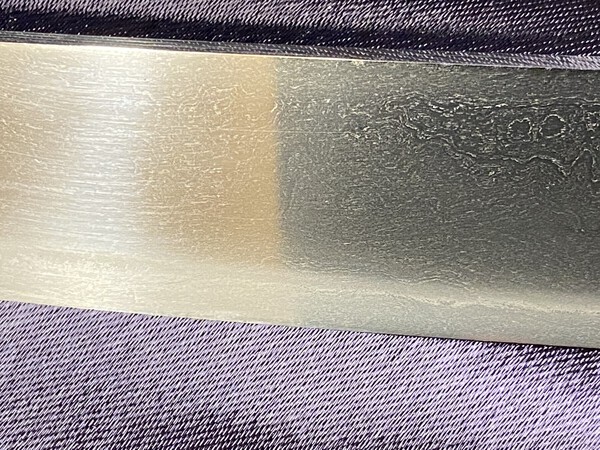
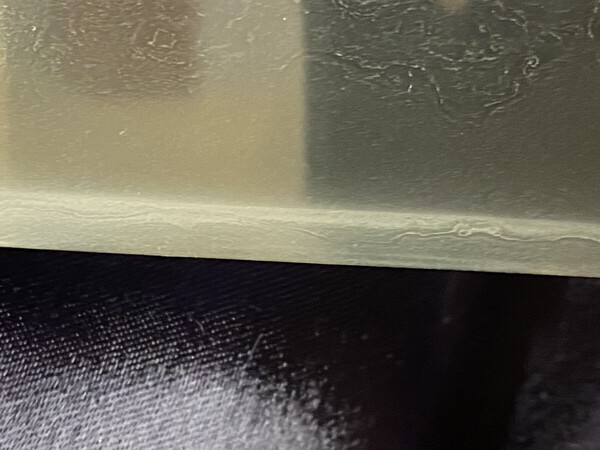
Hi Ken, I think it has just had a rough suriage without heating the blade to remove the hamon through the tang. I'm not as convinced as I was last night of the Mihara attribution though there are some similarities between my blade in terms of the boshi with the pointed look and long turn back. I think the jigane is different in terms of colour and Dan's blade has more of a "zanguri", standing up look to it. Here are the pictures:


-
Hi Paul, I can't get all of it: 三 ???住義国 It begins with Mi, Mitsu or San for the first kanji of a place name (I think) then there are three kanji that I can't get, though the last one may be "kawa" 川. The last two are the smith's name, Yoshikuni.
-
Hi Steve, For me, not toranba, but if you Google “Tsuda Sukehiro toranba” and you’ll find some examples of his blades that illustrate that form of hamon. With a lot of swords the hamon will consist of a variety of shapes and elements so it isn’t easy to say simply “Suguha” or “Notare”. In this sword I’m seeing irregular large, squarish choji and large round Choji elements (with I think some nioi kuzure) and there may be other elements that sharper eyes will see, but that ought to suggest a possible school to you. Hope that helps a little.
-
Hi Dan, This is what I can see on my phone: for a Mino blade I’d expect to see some masame (straightish) grain which I can’t. Also Boshi isn’t quite jizo but more pointed which might lead away from Mino. Jigane is quite dark which might point to Mino but the look of the burl grain with chikei suggests Mihara to me. It’s late in the UK right now but I’ll post some pictures of my Mihara tanto in the morning for a comparison. Anyhow, for me a Koto blade based on jigane and tang patina. Ultimately the best opinions will be got from a shinsa panel so short of those take everything else (including my view) with a pinch of salt.
-
Hi Roger, A ko Goto (I believe) kogai naoshi kozuka. It's essentially part of a kogai that has been re-purposed as a kozuka with the original inro motif and surrounding shakudo nanako set in smooth shakudo frame:

-
My guess is that it has been sharpened with some kind of grinding wheel by someone who didn't know what they were doing. Due to the speed of the wheel and/ or the angle of the blade the wheel has grabbed at the blade and left those marks. The hatchings going the other way are an attempt to remove the grinder marks with something less abrasive. Or to put it less kindly, someone d!cked with it and wrecked it.
-
In the cartouche, Tenzan then kao. I’m struggling for a clear view of the next bit but it looks like Bushi Kawagoe, Higo Motoyasu. No doubt Piers will be on in a while and give the definitive view.
-
That’s what it says. Still don’t know if it’s shoshin...
-
I’m not completely certain as I can’t rotate the picture but the signature may read Goto Hokyo Ichijo plus Kao. A big name if correct and genuine...
-
Hi Adam, I’ve had a look through my Mino books and haven’t turned anything up. I think I’d stick with late koto or as an outside maybe early Shinto Mino. The patina on the tang says koto to me. The yasurimei are In line with Mino, the hamon with the togariba; gunome/ crab claw elements don’t necessarily rule out Mino as Bizen influences crept into some smiths’ work. I can’t make out much of the Hada: it looks like itame but I might be seeing some oil as well. I’d expect to see some mokume with masame above the shinogi for classic Mino. My guess would be that it’s not necessarily gimei but not one of the big name Kanemoto. Sorry, doesn’t tell you much more than you already know but thanks for posting an interesting blade.
-
Hi Adam, I think you did well with this one at that price. Nothing not to like there for what you paid and the blade looks like it has something about it - well worth further research and maybe a polish and shinsa. Any chance of some close-ups of Boshi, hamon and Hada?
-
Paragraph translate help on Funada Ikkin tsuba?
Shugyosha replied to terminus's topic in Translation Assistance
...also, if you haven’t seen it, Darcy has a papered example on his web site. -
Paragraph translate help on Funada Ikkin tsuba?
Shugyosha replied to terminus's topic in Translation Assistance
I’ve seen that tsuba recently but can’t remember where...was there a description on the web page? -
What JP said. Also it might just be from a tight saya scuffing that area as the sword is drawn out and put back in the scabbard. It might get more of that if it's used as an iato.
-
Paragraph translate help on Funada Ikkin tsuba?
Shugyosha replied to terminus's topic in Translation Assistance
I think it's the first generation. A translation of the whole piece is a bit beyond me, but in the first line it has 船田一琴 (義長) 筆頭 Funada Ikkin (Yoshinaga) fudegashira, referring to Yoshinaga as head of the family/ first in line, and I can't see any reference in the piece to Yoshimori his son, the nidai, but no doubt you'll get some better information soon.