FlorianB
-
Posts
467 -
Joined
-
Last visited
-
Days Won
2
Content Type
Profiles
Forums
Events
Store
Downloads
Gallery
Everything posted by FlorianB
-
Interesting reference material! And it’s a fantastic collection overall! Coincidentally, I recently acquired a third piece depicted in this catalogue.
- 1 reply
-
- 2
-

-

-
Congrats to Tokubetsu Hozon! At least it is the old problem with the NBTHK: you receive a paper but no explanation, leaving you often at a loss. However, the NBTHK has, alas, neither the staff nor the time to provide further explanations for every piece.
-
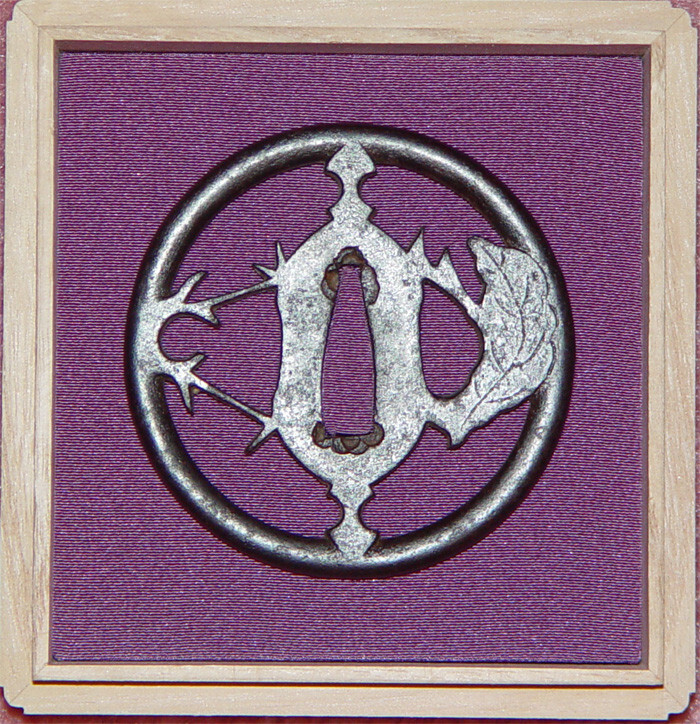
You do, I'm sorry for this. On one hand I spoke of the "full rounded rim" which is the same as the ""O" shaped cross-section (kan-mimi)" You mentioned. If You research Akasaka You'll come across those rims easily. Her's one I shot at a meeting, (alas I don't know to whom it belongs so I hope I get not in trouble by posting it!) The picture I've posted before has nothing to do with this but was chosen because of the tagane.

-
I would suggest starting a new thread and looking at the depiction of stars in general, so as to break free from this "Is it or isn't it?" straitjacket. As I mentioned earlier, you can see a constellation if you want to – or not. To conclude, I would like to share a brief anecdote regarding the credibility of Japanese experts: In the first edition of his „Handbook on Technical Terms for Sword Fittings“, Markus Sesko drew a connection between the famous namako-tsuba by Miyamoto Musashi and the hilts of the European "Katzbalger" swords used by "Landsknecht"-mercenaries. I expressed skepticism that a figure-eight-shaped crossguard of this Katzbalger could have served as the model for this famous Tsuba. On one hand, the timelines do not align (there is a gap of approximately 200 years), and the bladed weapons Europeans carried in Japan were of a completely different type; on the other hand, it is certainly not inconceivable that the concept of arranging two ellipses side by side could have been developed independently in different locations. Markus told me that this was merely the presentation of a theory by a Japanese researcher one he himself had doubts about and would omit in future editions. In Japan, too, there are people with strange ideas.
-
Thomas, this is what I call research! I think that’s the problem here from the beginning: an idea was too hastily presented to the public and not researched properly which takes certainly a longer time (not that AI instant research). Instead assumptions and speculations have been backing up the hypothesis.
-
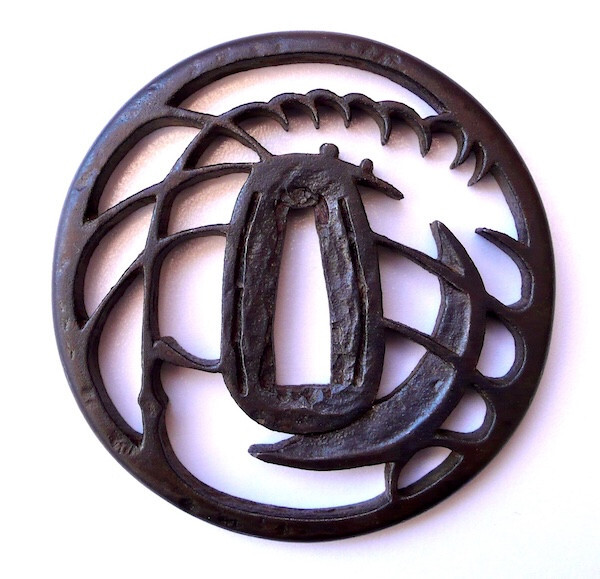
Well, the full-rounded rim is frequently seen on Akasaka pieces, the myoga motif, too. Here's coincidentally an other Akasaka from a fellow collector, note the tagane have been punched more or less to the outer side of the seppa-dai.
-
The myoga design was highly popular among the warrior class and symbolizes the desire for protection by Shinto and Buddhist deities, as the word myoga – when written with the kanji 冥加 – signifies "divine protection." The meaning of fundo is "wealth" and "good fortune." School may be Akasaka. Any signs of layers on the rim or the inner sides?
-
Though very abstract I think it should be kukurizaru or hanging monkeys, a a small fabric talisman tied to one's hands and feet. They symbolize self-restraint and control over one's own desires.

-
You’re so proud about the number of readers of Your „Cast Iron“ thread. Do You really think folks read it, because they are amazed by Your profound insights? No. They read it for entertainment, I’m afraid. They have been entertained by the quarrel between You and all those who won’t acclaim Your theories. At least those insults and vilifications put off not only new but also long-time members. „Onward“ like this? I hope not.
-
I just pointed out, that in Japanese culture stars have not the same significance as sun or moon. What is the sense of misinterpreting me? Why conflating this with my comments from other threads? I’m somewhat surprised by the direction this discussion is taking. At least not really surprised remembering a certain thread about cast iron tsuba. Obviously it is the intention is to silence critics.
-
Both. There are a lot of Edo pieces which were adapted to changing taste, but also embellished pieces for foreigners. Difficult to distinguish, but at least the quality counts. And Yours is nicely done – enjoy it!
-
I still can’t see any evidence, just speculation. The star constellation You show us on the Chinese chart consists out of eight stars while Your tsuba pattern show nine. Thus the connection of the stars is not identical. And is the constellation You highlighted on the chart the Great Dipper at all which You want to see on Your tsuba? That’s the problem: if the number doesn’t concur, superfluous stars have to be ignored or You talk about mysterious „ ‘dark’ stars, the existence of which astrologers and thus everyone believed in“. Where do You get this from? What actually are these „dark stars“ obviously mixing up astrology with astronomy? As far as I know, the Japanese — unlike the Chinese — were never particularly interested in astronomy and concerned themselves with the celestial bodies solely for aesthetic reasons. Thus they adopted the Chinese interpretation and that was enough for them to know. While the sun and especially the moon are ubiquitous in Japanese art, poetry etc. the stars are as far as possible ignored.
-
Two holes in the lower part of the plate are often named as udenuki-ana, used for pulling a ribbon through to secure the sword in the sheath. In Your case the motif is stars, so I think we have a kamon constisting out of a stellar group and three other stars on the right side. Sometimes a group of three stars are interpreted sun, moon and star. Here's an similar one:

-
Dan, If You want to see constellations in this rudimentary pattern, You have every right to do so. You made Your position clear but repeating Your speculation again and again doesn’t turn it into facts. At least there are no proofs, just a certain similarity to constellations and it works only if parts of the pattern are omitted. Not very convincing. I have hinted to old star maps, the way people interpreted the stars at this time without modern astronomy or telescopes. We have seen examples of how constellations are depicted in Japanese art: big dots connected with thin lines. But here are small dots connected with konvex openings, a result of overlapping circles – the real base of this particular pattern. With all due respect – I can see no sense in harping on Your theory without solid evidence.
-
What's this? Milky Way? https://www.metmuseum.org/art/collection/search/25699

-
Looks like some kind of worm with a thick belly. Maybe a marine creature as this manta ray? Or something completely different like an idea from "The Little Prince" I wonder if it is a standard kozuka-ana and the filling was continued on the plate as an overlay in this particular shape.


-
I never doubted that the stars in the sky are the same seen in Europe, America or Japan. But the way stargazers have connected the stars since ancient times to interpret images within them varies across different cultures as Sam pointed out. With a little research (without AI) there’s another example of traditional Chinese star map in higher resolution: https://upload.wikimedia.org/wikipedia/commons/9/91/Suzhou_star_cartography.jpg Concerning the Big Dipper which seems important to some members – in a wikipedia listing of traditional Chinese star maps ( https://en.wikipedia.org/wiki/Chinese_star_maps ) there are several entries that mention the Big Dipper. So it must have been known in old Japan, too. At last.
-
Please note that the european constellations are not the same as those in far east! Here's an old constellation map - alas I don't know where it comes from because the picture was hidden in the depth of my data. But please refer to these constellations when talking about star motifes on Tsuba.

-
Although there are similarities to star constellations these seem only coincidental. At least the mentioned constellations have different intervals between the stars. The idea of this scattered (chirashi) shippo-pattern (like many other patterns) is imperfection to symbolize transience and decay.
-
The both holes are called hitsu-ana, openings for kogai and kozuka when the Tsuba is mouted. There are many Tsuba on which one ore both hitsu-ana are plugged with soft metal, sometimes even with gold. Shutting the inner hole of the crest is not necessary, I think it would look nicer without the copper plug. BTW: If the kamon (heraldic sign) should be the kuyo-mon of the Hososkawa clan (see below) there should be nine stars (including the inner circle), but here we have ten! That's suspicious in my eyes.

-
 Pounding rice with kine (mallet) in a usu (trough) for mochi production
-
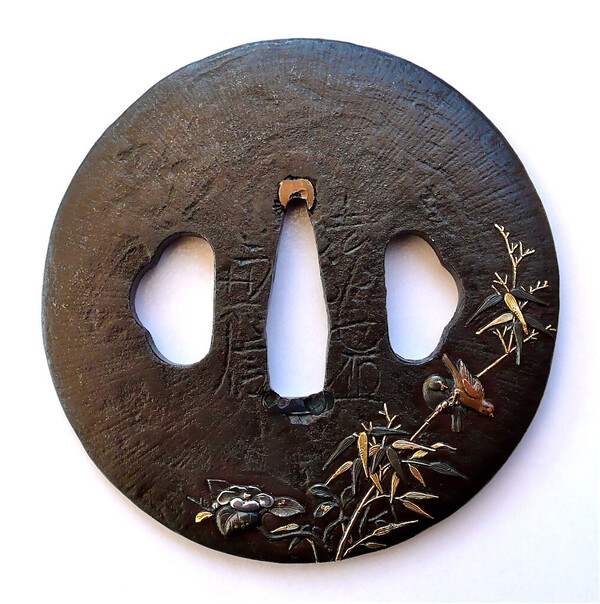
Absolutley. Many iron plates with a more or less simple design have been pimped up with soft metals. Very attractive combination, though purists will shudder. Here's another piece of a fellow collector:
-
Here's another cucoo https://nihontofrance.com/tosogu-2/tsuba-akao-2/?lang=en

-
Is it Hayashi at all? Hayashi would have made a more precise symmetry. Here I see discrepancies in the axes and askew hanabishi. I would suppose it’s Shoami. They made such kidney-shaped openings, too.
-
Brute force?? I can't see it in this way – on the contrary its an elegant piece with subtle variations in the lattice. Maybe strong and self confident describes it better. Not really. There are a lot of Tsuba with either rounded or suhama-shaped ana on both sides, maybe to emphasize the balance.